
Female sexual dysfunction is an umbrella term covering three different problems with three different treatment paths, which is why generic advice so often misses. This guide separates them, explains what a real workup looks like, and is honest about where genetic testing helps and where it does not.
On this page
Low desire and pain during sex. Trouble reaching orgasm, no matter how it used to feel. These complaints are common, not rare, and not something to quietly accept. An estimated 4 in 10 women experience some form of sexual difficulty at some point in their lives. Most wait years before mentioning it to a doctor.
Female sexual dysfunction (FSD) is a recognized medical condition, not a personal failing. Some cases trace back to hormones. Others link to a medication a woman is already taking, especially antidepressants. This guide breaks down what FSD actually is, why it happens, and where genetics fits into treatment decisions.
What Is Female Sexual Dysfunction?
Female sexual dysfunction is a group of conditions that disrupt desire, arousal, orgasm, or comfort during sex and cause real distress. The DSM-5 classifies it as a legitimate medical diagnosis, not a mood or a phase.
A woman doesn’t need every symptom on a checklist to qualify. She needs a persistent problem in one area of sexual response, plus distress about it, lasting six months or more. Distress is the deciding factor. Low desire that doesn’t bother someone isn’t a disorder. Low desire that does, and has stuck around, might be.
What Are the Main Types of Female Sexual Dysfunction?
The DSM-5 groups FSD into three categories:
- Interest/arousal problems.
- Orgasm problems.
- Pain during penetration.
In practice, they frequently overlap.
| Type | What It Involves | Older Term You May Still See |
| Female Sexual Interest/Arousal Disorder (FSIAD) | Little or no desire, or trouble getting physically aroused | HSDD, FSAD |
| Female Orgasmic Disorder (FOD) | Delayed, infrequent, or absent orgasms, or reduced sensation | Anorgasmia |
| Genito-Pelvic Pain/Penetration Disorder (GPPPD) | Pain, tightness, or fear around vaginal penetration | Dyspareunia, vaginismus |
You’ll still hear “HSDD” (hypoactive sexual desire disorder) from a prescriber or on a drug label. The DSM-5 folded it into FSIAD, but the older term stuck around in research and in FDA labeling.
What Causes Low Desire or Arousal Problems?
Low desire and arousal problems rarely trace back to one clean cause. Hormonal shifts, stress, a health condition, and medication side effects often overlap.
- Hormonal: Declining estrogen or testosterone, thyroid disorders, postpartum changes.
- Psychological: Stress, body image, past trauma, or depression itself, separate from its treatment.
- Relational: Conflict, mismatched desire between partners, lack of novelty.
- Medical: Diabetes, pelvic floor disorders, chronic pain, certain autoimmune conditions.
Depression itself causes sexual difficulty for many people, before medication ever enters the picture, which is worth separating from a drug side effect.
Can Medications Cause Sexual Side Effects?
Yes. Antidepressants, SSRIs specifically, are the most common prescription cause of sexual side effects in women. Certain birth control methods and blood pressure medications play a role too.
Reported rates of sexual side effects on SSRIs vary widely between studies, depending on the specific drug and how researchers measured it. Paroxetine and citalopram tend to rank higher; bupropion and mirtazapine tend to rank lower.
Genetics play a measurable role here. Enzymes such as CYP2D6 and CYP2C19 control how fast the body clears many SSRIs. A slow metabolizer ends up with higher-than-expected drug levels, raising the odds of side effects, sexual ones included. A fast metabolizer may get too little from a standard dose. The Clinical Pharmacogenetics Implementation Consortium (CPIC) already publishes dosing guidance for several SSRIs based on exactly this metabolizer status; it’s the gap RPh Labs’ PGx test is built to check.
How Does Menopause Change Sexual Desire?
Falling estrogen during perimenopause and menopause thins vaginal tissue, reduces natural lubrication, and often makes sex physically uncomfortable, which lowers desire as a result. Clinicians call this pattern genitourinary syndrome of menopause (GSM).
GSM is common after menopause and often goes untreated. Many women with GSM report both lower desire and pain during sex, and both are treatable.
Common treatment paths include:
- Low-dose vaginal estrogen.
- Non-hormonal moisturizers and lubricants.
- Ospemifene and vaginal DHEA.
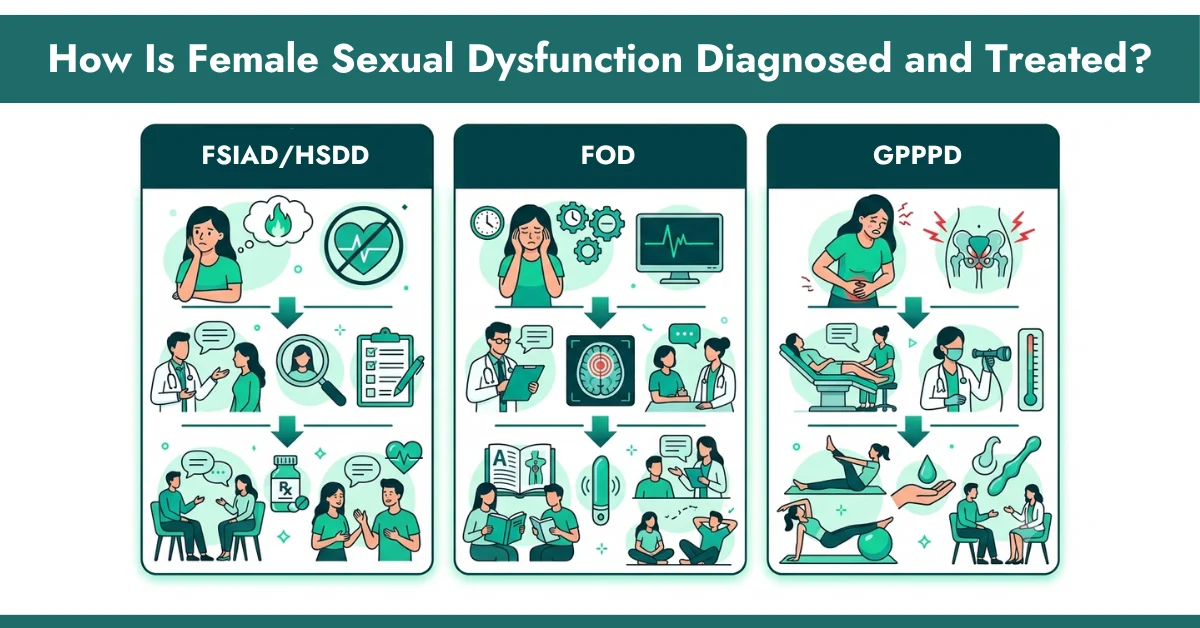
How Is Female Sexual Dysfunction Diagnosed and Treated?
Diagnosis starts with a conversation, not a lab test. A doctor rules out physical causes, reviews current medications, and asks how long the problem has lasted and how distressing it is.
Treatment depends on the type and the cause:
- FSIAD/HSDD: Flibanserin (Addyi) and bremelanotide (Vyleesi) are FDA-approved specifically for this diagnosis. Flibanserin’s approval expanded to postmenopausal women under 65 in December 2025, after a decade of covering only premenopausal women. Its own FDA label already flags CYP2C19, CYP2D6, and CYP2C9 as genes that change how much of the drug reaches the bloodstream, with slow metabolizers facing a real fainting risk.
- FOD: Sex therapy, adjusting the type of stimulation, or addressing a medication cause.
- GPPPD: Pelvic floor physical therapy, vaginal estrogen where menopause is the driver, counseling where fear or past trauma plays a role.
One thing worth knowing before assuming something’s wrong: many women do not reliably orgasm from vaginal penetration alone and rely on clitoral stimulation too. That’s anatomy, not dysfunction.
How Does Genetic Testing Fit Into Treatment?
If a current medication, an antidepressant especially, is the likely cause, pharmacogenomic (PGx) testing shows how your specific body processes that drug. It doesn’t diagnose FSD on its own, but it gives a prescriber data instead of a guess.
RPh Labs’ at-home PGx kit checks how your genes interact with 240+ medications, common SSRIs included, from a single cheek swab. Results arrive through a secure online portal in 7-10 business days, alongside support from a clinical pharmacist to walk through what it means. Genotype-guided prescribing is an active research area, and results are one input a prescriber weighs rather than a promised outcome. The kit is HSA/FSA eligible, and it doesn’t replace a prescriber’s judgment. Coverage and state availability vary, so check current details before ordering.
Why female sexual dysfunction goes unmentioned for years
The most common reason a problem goes untreated is that nobody asks about it. Many clinicians do not raise sexual function in a routine visit, and many patients assume a symptom is either normal or unfixable. Years pass, and by then the problem has usually collected a second layer: avoidance, anxiety about the next attempt, or strain in a relationship.
It also gets mislabeled. Low desire caused by a medication is treated as a relationship issue. Pain is treated as a desire problem. The label matters because each of the three categories of female sexual dysfunction leads somewhere different.
- A desire and arousal problem sends you toward a medication review, hormones and mood.
- An orgasm problem sends you toward stimulation, medication review and sometimes therapy.
- A pain problem sends you toward an exam, tissue treatment and often physical therapy.
If more than one applies, say so. Overlap is the rule rather than the exception, and an honest description of all of it saves you from being treated for the least important piece. You can raise this with a gynecologist, a primary care clinician, or a urogynecologist, and none of them will find the topic unusual.
Female orgasmic disorder: what actually changes
Female orgasmic disorder describes a marked delay, a marked reduction in frequency or intensity, or an absence of orgasm that has persisted and causes distress. As with the rest of female sexual dysfunction, the distress requirement is what separates a diagnosis from a variation.
Two things are worth knowing before you assume something is broken. First, needing direct clitoral stimulation is anatomy, not dysfunction, and a large share of women do. Second, a change in orgasm that started within weeks of a new prescription is more likely to be the prescription than anything else.
Where the evaluation usually goes
- A medication review first, since antidepressants are the most common prescription contributor.
- A look at pelvic floor tone, because both very tight and very weak muscles can blunt sensation.
- Attention to arousal itself, since a body that is not fully aroused rarely reaches orgasm.
- Therapy where anxiety about performance has become its own obstacle.
Treatment for female orgasmic disorder is rarely a pill. Sex therapy, changes to stimulation, and addressing a drug cause carry the most evidence, and progress is usually measured over months rather than weeks.
Painful sex after menopause, and the other causes of pelvic pain
Falling estrogen thins and dries vaginal tissue, and painful sex after menopause is the predictable result. Clinicians group this with related urinary symptoms under genitourinary syndrome of menopause. It is common, under-treated, and one of the more responsive problems in this whole field.
Low-dose vaginal estrogen works locally on the tissue. Non-hormonal moisturizers used regularly, and a good lubricant used during sex, help many people on their own. Ospemifene and vaginal DHEA are alternatives your clinician may raise. All of these are prescriber decisions, particularly if you have a history of hormone-sensitive cancer.
Pain that is not about menopause
- Pain at the entrance, especially with a tight, guarding response, points at the pelvic floor.
- Deep pain with thrusting can point at endometriosis, fibroids or adhesions.
- Pain with burning and urinary symptoms can point at bladder or vulvar conditions.
- New pain that began with a medication, including some breast cancer treatments, points at the drug.
Do not push through it. Repeated painful sex trains the pelvic floor to brace, which makes the next attempt worse and builds a cycle that takes longer to unwind than the original cause. Painful sex after menopause treated early is far easier to settle than the same problem two years on.
Pelvic floor physical therapy: what a course of care involves
Pelvic floor physical therapy is the main treatment for pain and penetration problems, and it is more concrete than most people expect. A specially trained physical therapist assesses muscle tone, strength and coordination, then works through a plan over several weeks.
The work usually mixes manual techniques to release overly tight muscle, breathing and relaxation training, graded use of dilators where appropriate, and exercises you do at home between visits. The goal is a pelvic floor that can relax on demand, not simply a stronger one.
- Expect an internal assessment at the first or second visit, with your consent, and ask questions before it.
- Expect homework, since between-visit practice drives most of the progress.
- Expect several weeks before a clear change, and raise it with the therapist if nothing shifts.
- Ask your insurer how many visits are covered, since plans differ widely.
Pelvic floor physical therapy also helps where fear rather than tissue is driving the guarding, and it pairs well with counseling in that situation. Ask your clinician for a referral to someone with specific pelvic health training rather than general orthopedic physical therapy.
SSRI sexual side effects and the enzymes that set drug levels
SSRI sexual side effects are a recognized class effect: lower desire, delayed or absent orgasm, and reduced genital sensation. They are printed in the labeling, and they are the single most common prescription contributor to female sexual dysfunction.
How much drug ends up in your bloodstream is partly genetic. CYP2D6 and CYP2C19 clear many antidepressants, and a poor metabolizer can sit at higher levels on a standard dose while an ultrarapid metabolizer may sit below a useful level. The FDA’s table of pharmacogenomic biomarkers in drug labeling lists the drugs where this information appears on the label itself.
What that means in practice
Knowing your metabolizer status does not tell you whether you will get SSRI sexual side effects. It tells your prescriber whether a standard dose is likely to run high or low in your body, which is useful information when a side effect appears and the question is dose versus drug. Our guide to genetic testing for antidepressants covers how that plays out in a visit.
Never stop an antidepressant on your own because of a sexual side effect. Abrupt discontinuation can cause dizziness, flu-like symptoms and a relapse of depression. A dose change, a switch, or a planned taper is a decision to make with your prescriber.
What to bring to an appointment about female sexual dysfunction
A short written summary changes the quality of a fifteen-minute visit. It also spares you from having to find the words twice.
- Name which of the three areas is affected: desire and arousal, orgasm, or pain.
- Say how long it has lasted, since six months is the usual threshold for a diagnosis.
- Say plainly whether it distresses you, because that word decides whether a diagnosis applies at all.
- List every medication and supplement with the month each started, including contraception.
- Note surgeries, deliveries, and any cancer treatment, since all three change the picture.
- Write down the one outcome that would matter most to you, so treatment aims at that.
If the answer is that this is normal for your age, it is reasonable to ask for a referral instead. Female sexual dysfunction is treated across gynecology, urogynecology, pelvic floor physical therapy, psychiatry and sex therapy, and the right door depends on which of the three problems you have.
What genetic testing covers here, and what it does not
Be clear about the limits. A pharmacogenomic panel does not diagnose female sexual dysfunction, does not measure hormones, and does not predict whether any treatment will restore desire, orgasm or comfort. There is also no pharmacogenomic guideline for estrogen, progestins, testosterone or hormonal contraception, so no genetic test picks those.
What a panel does is report how you are likely to process specific drugs, which is genuinely useful when an antidepressant or another medicine is in the frame. It is one input alongside your age, kidney and liver function, other prescriptions and your history.
How the RPh Labs panel works
The RPh Labs kit is a cheek swab you collect at home and mail back in a prepaid envelope, with free shipping both ways. It reads 20 genes and reports them against more than 240 medicines. A PharmD pharmacist reviews every report, results arrive 7 to 10 business days after the sample reaches the Dallas lab, and a pharmacist consultation is included. See how it works, check the medication list, or order the at-home PGx kit.
The kit is self-pay at $299 and HSA or FSA eligible, with insurance accepted for many plans. Ask your prescriber whether the result would actually change a decision in your case before you order anything.
Conclusion:
Female sexual dysfunction is common and often linked to hormones, medications, menopause, mental health, or underlying medical conditions. Identifying the cause is the first step toward the right treatment.
If symptoms began after starting a medication, PGx testing may help your healthcare provider make more informed prescribing decisions. Persistent symptoms deserve medical attention; they aren’t something you have to live with.
Disclaimer:
This content is for educational purposes only and is not medical advice. Always consult a qualified healthcare professional before making changes to your treatment or medications. PGx testing supports medication decisions but does not diagnose female sexual dysfunction.
Female sexual dysfunction: more questions answered
Is female sexual dysfunction common?
Yes. Roughly 4 in 10 women report some form of sexual difficulty at some point in their life, though a smaller share meet the full criteria for a diagnosable disorder, since ongoing distress is required.
What’s the difference between HSDD and FSIAD?
HSDD (hypoactive sexual desire disorder) described low desire alone under the older DSM-IV system. The DSM-5 merged it with arousal problems into one diagnosis, FSIAD, though “HSDD” remains the term used on FDA drug labels like Addyi and Vyleesi.
Do sexual side effects from antidepressants go away?
Sometimes, though not always, and they can persist even after stopping the drug in some cases. A dose change, a different medication, or pharmacogenomic testing to find a better-matched option are all worth raising with a prescriber before stopping anything alone.
Is PGx testing covered by insurance?
Coverage varies by plan. RPh Labs works with several major insurers and has a four-payment option with no added interest. Contact RPh Labs’ support team to confirm your specific coverage.
When should I see a doctor about this?
See a doctor if a symptom has lasted six months or longer, causes distress, or started shortly after a new prescription. A gynecologist, primary care provider, or urogynecologist can each evaluate FSD.
Do SSRI sexual side effects ever improve without changing the drug?
Sometimes. A share of people find SSRI sexual side effects ease over the first couple of months as the body adjusts. Others find they persist for as long as the drug is taken. Raise it at the two-month mark rather than waiting, because a dose change or a switch is a reasonable option to discuss.
Can a genetic test tell me which hormone therapy will help?
No. There is no pharmacogenomic dosing guidance for estrogen, progestins or testosterone, so no panel selects a hormone or a dose. Treatment for painful sex after menopause is chosen from your symptoms, exam findings and personal history, including any hormone-sensitive cancer, and discussed with your clinician.
How do I find a pelvic floor therapist?
Ask your gynecologist or primary care clinician for a referral to a physical therapist with specific pelvic health training, rather than general orthopedic care. Professional associations list credentialed clinicians by area. Check with your insurer about visit limits, since pelvic floor physical therapy is usually delivered over several weeks.
Is female orgasmic disorder permanent?
Usually not. Where a medication is the driver, a change often restores function. Where stimulation, arousal or pelvic floor tone is the issue, targeted work helps many people. Female orgasmic disorder that has lasted years may take months to shift, but a persistent lack of progress is a reason to change the plan, not to stop.
Should my partner come to the appointment?
It can help, particularly where the problem is pain or a mismatch in desire, and many clinicians welcome it. It is your call. If bringing a partner would make you less honest about symptoms or history, go alone for the first visit and include them later once a plan exists.
Does insurance cover this kind of evaluation?
Medical evaluation of sexual function is generally covered like any other visit, though coverage for specific treatments and for pharmacogenomic testing varies by plan. Check your own benefits before booking, and ask the office to confirm coverage for physical therapy visits and any prescribed medication.



Leave a Reply