Support & forms · Insurances
Insurances we accept for genetic testing
Genetic testing insurance coverage should not be a guessing game. RPh Labs works with a wide range of insurance providers to make pharmacogenomic testing accessible and affordable. Below are the plans and networks we are currently enrolled with, how coverage decisions are made, and what to do before you order.
If you do not see your insurance listed, contact our support team. We are happy to verify coverage or walk you through the other ways to pay.
Accepted insurance plans
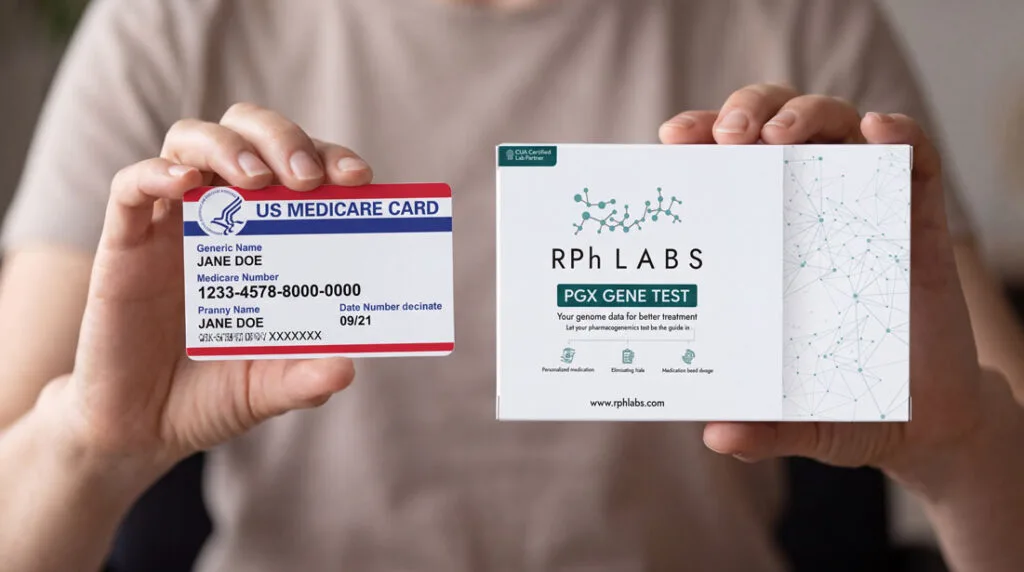
Six networks, in and out of Texas, including Medicare, Texas Medicaid and Blue Cross Blue Shield of Texas. Select a plan to visit the carrier’s own site.

USA Managed Care Organization
National PPO network access.
Visit plan site for USA Managed Care Organization (opens in a new tab) →

NOVA NET
Multi-state PPO network.

Baylor Scott & White Health Plan
Texas commercial and employer plans.
Visit plan site for Baylor Scott & White Health Plan (opens in a new tab) →

Medicare
Part B coverage for eligible beneficiaries.

Medicaid of Texas
Administered through TMHP.
Visit plan site for Medicaid of Texas (opens in a new tab) →

Blue Cross & Blue Shield of Texas
Statewide commercial plans.
Visit plan site for Blue Cross & Blue Shield of Texas (opens in a new tab) →
Being enrolled with a plan means we can submit the claim to it directly. It is the first step to genetic testing insurance coverage, but it does not guarantee that a specific test will be paid for, because every plan applies its own medical policy. That is why we check your benefits first.
When is genetic testing covered by insurance?
Genetic testing covered by insurance usually comes down to one question: will the result change your treatment? Most plans pay for a pharmacogenomic (PGx) test when it is medically necessary, and they judge that from your prescriptions and your diagnosis codes.
Coverage is far more likely when you are already taking, or about to start, a medication with recognized gene–drug guidance from the FDA or the Clinical Pharmacogenetics Implementation Consortium (CPIC). Common examples include antidepressants, antipsychotics, ADHD medications, clopidogrel, warfarin, some statins and several pain medications.
Things your plan will usually look at:
- A prescriber’s order: billing to insurance needs an order from your doctor, nurse practitioner or other licensed prescriber, with their NPI.
- Diagnosis (ICD-10) codes: the condition being treated, linked to the medications on the order.
- Medical necessity criteria: the plan’s written policy on when a PGx test is appropriate.
- Prior authorization: some plans want approval before the sample is collected.
- Your benefits: deductible, copay and coinsurance still apply, just as they do for any lab test.
Self-ordered tests paid out of pocket do not need any of this, which is why some people choose to self-pay and skip the paperwork. If you want to use your plan, it is worth the extra step: when a claim is approved, your share of the cost can be much lower.
Because each plan decides differently, we treat genetic testing insurance coverage as something to confirm before you order, not after. Ask us to check your benefits and we will tell you what to expect.
Medications that make genetic testing covered by insurance more likely
Plans look for a clear link between a medication and a gene. These are some of the best-established pairs, all with published CPIC dosing guidance, and the kind of prescription that makes genetic testing covered by insurance more likely:
- Clopidogrel (Plavix) and CYP2C19, after a stent or heart attack.
- Warfarin and CYP2C9 plus VKORC1, for blood-thinner dosing.
- Codeine and tramadol and CYP2D6, for pain relief and safety.
- SSRIs such as citalopram, escitalopram and sertraline and CYP2C19, and paroxetine and fluvoxamine and CYP2D6.
- Simvastatin and other statins and SLCO1B1, for the risk of muscle side effects.
- Azathioprine and mercaptopurine and TPMT plus NUDT15, before immune-suppressing or cancer treatment.
- Abacavir and HLA-B*57:01, and carbamazepine and HLA-B*15:02, to avoid severe allergic reactions.
Your prescriber lists the relevant medications and diagnosis codes on the order. If you take several of these drugs, or have had side effects or poor results on them, tell us when we verify your benefits.
Genetic testing insurance coverage by plan type
Genetic testing insurance coverage works a little differently for each kind of plan. This is how it usually works for the plans we accept:
| Plan type | How coverage usually works | What helps the claim |
|---|---|---|
| Medicare Part B | Covered in defined circumstances under NCD 90.1 (warfarin) or local MolDX policies | A qualifying medication, diagnosis codes, and an ABN if coverage is uncertain |
| Medicare Advantage | Follows the plan’s own policy, often with prior authorization | Benefits check and prior authorization before collection |
| Texas Medicaid (TMHP) | Covered when medically necessary, subject to program rules | Prescriber order and medical necessity documentation |
| Blue Cross and Blue Shield of Texas | Set by the plan’s medical policy for pharmacogenomic testing | Diagnosis codes and a medication with gene–drug guidance |
| PPO networks (USA MCO, NOVA NET) | Depends on the employer or health plan that uses the network | A benefits check with your plan details |
| Baylor Scott & White Health Plan | Commercial and employer plan policies apply | Prescriber order and diagnosis codes |
| Plan not listed | We may not be able to bill it directly | Call us, or pay with HSA/FSA or installments |
Medicare genetic testing coverage
Medicare covers pharmacogenomic testing in defined circumstances, not as a blanket benefit. Medicare genetic testing coverage for PGx generally applies when the beneficiary is taking, or about to begin, a medication with FDA labeling or CPIC guidance tied to a tested gene.
There are two layers of policy. A national coverage determination (NCD 90.1) covers testing of CYP2C9 and VKORC1 for warfarin dosing. Most other PGx testing is decided by the regional Medicare Administrative Contractors through local coverage determinations, including the MolDX program that covers much of the country.
When Medicare Part B does cover a clinical lab test, you usually pay nothing for the test itself: there is generally no deductible or coinsurance for covered clinical diagnostic laboratory tests. That is one reason Medicare genetic testing coverage is worth checking before you pay out of pocket.
Coverage is decided case by case against the applicable policy. If Medicare may not pay for a test, you will be asked to sign an Advance Beneficiary Notice of Noncoverage (ABN) before the sample is collected. The ABN tells you the test might not be covered and lets you decide whether to go ahead. You can complete our Medicare ABN form online.
Medicare Advantage plans follow their own rules and may need prior authorization. For a fuller explanation, read our guide: Does Medicare cover pharmacogenomic testing?
Does Medicaid cover genetic testing?
Does Medicaid cover genetic testing? It depends on your state, because every state runs its own Medicaid program and writes its own coverage rules. Many states cover pharmacogenomic testing when it is medically necessary, often with prior authorization.
RPh Labs is enrolled with Texas Medicaid, which is administered through the Texas Medicaid & Healthcare Partnership (TMHP). If you have Texas Medicaid, your prescriber can order the test and we will bill TMHP directly, subject to your eligibility and the program’s requirements.
Asking does Medicaid cover genetic testing for a child? Medicaid’s Early and Periodic Screening, Diagnostic and Treatment (EPSDT) benefit requires states to cover medically necessary services for members under 21, which can include a pharmacogenomic test when a child’s medication plan depends on it.
If you have Medicaid in another state, or a Medicaid managed care plan, contact us before you order. We will tell you honestly whether we can bill your plan, and point you to the other ways to pay if we cannot.
Blue Cross Blue Shield genetic testing coverage
We are enrolled with Blue Cross and Blue Shield of Texas for statewide commercial plans. Blue Cross Blue Shield genetic testing coverage is set by each plan’s medical policy, so two members with the same card can have different benefits depending on their employer or plan type.
For a Blue Cross Blue Shield genetic testing claim, the plan will usually look for a prescriber’s order, the diagnosis codes, and a medication with known gene–drug guidance. Some plans require prior authorization. If your Blue Cross Blue Shield plan is based outside Texas, contact us and we will check whether we can bill it for you.
The same approach applies to our other commercial networks: USA Managed Care Organization and NOVA NET PPO networks, and Baylor Scott & White Health Plan for Texas commercial and employer members.
Out-of-network and out-of-state plans
If your plan is not on our list, the test may still be partly covered. Some PPO plans pay a share of out-of-network lab costs, and some employer plans reimburse members directly when they submit an itemized receipt. Your plan documents, or a quick call to the member services number on your card, will tell you whether genetic testing covered by insurance applies out of network.
The same is true of Blue plans from other states. Blue Cross Blue Shield genetic testing benefits are set by the local Blue company that issued your card, so contact us with your plan details and we will check what we can do.
When direct billing is not possible, many patients choose to self-pay with HSA or FSA funds, which often works out simpler than waiting for a coverage decision.
Important notes
Benefits and necessity
Coverage is subject to plan-specific benefits and medical necessity requirements.
Prior authorization
Some tests require prior authorization before the specimen is collected.
Final eligibility
Coverage status can change. Your insurer determines final eligibility at the time of service.
Diagnosis codes
Claims need ICD-10 codes from your prescriber that support the medications on the order.
How to use your insurance for a PGx test
Here is the process from start to finish when you want to bill the test to your insurance:
- Check the list above. If your plan is not on it, call us before you order.
- Ask us to verify your benefits. Call (888) 383-2181 or contact support. We will tell you what your plan is likely to require and what you may owe.
- Your prescriber completes the order. They fill in the insurance billing form with their NPI, the medications and the ICD-10 codes, and sign it.
- Attach your insurance card. A copy of the front and back, with the policy and group numbers.
- Medicare patients sign an ABN if needed. Use the ABN form when Medicare may not cover the test.
- Collect your sample and send it back. We submit the claim, and your plan sends you an explanation of benefits.
Understanding your explanation of benefits
After the claim is processed, your plan sends you an explanation of benefits (EOB). It is not a bill. It shows what the lab charged, what the plan allowed, what it paid, and what, if anything, you may owe.
If a claim is denied, the EOB gives a reason code. The most common reasons are a missing prior authorization, diagnosis codes that do not match the plan’s policy, or a plan that excludes pharmacogenomic testing. Call us and we will go through the EOB with you and explain what the plan needs.
Most plans let your prescriber request a review or file an appeal with a letter of medical necessity that explains why the result will change your treatment. Keep a copy of your EOB and any letters from your plan until the matter is closed.
What to have ready before you call
Having these details to hand makes the benefits check quick:
- Your insurance carrier, policy number and group number.
- The name, date of birth and relationship of the insured person, if that is not you.
- A photo or scan of the front and back of your insurance card.
- Your prescriber’s name, practice and NPI number.
- The medications you take or are about to start, and the diagnosis they treat.
Calling for a patient from a prescriber’s office? Have the patient’s demographics, insurance details and the planned order ready, and we can usually tell you on the same call whether prior authorization is needed. Clinicians who order regularly can use our provider requisition for self-pay orders.
We keep your insurance details private and use them only to check benefits and bill your claim. Read how we protect your information in our privacy policy.
If your plan does not cover the test
If your plan will not pay, or you would rather not wait for a coverage decision, you can order the at-home PGx test kit directly. It is a one-time price of $299 with no subscription and no fee to share your results.
- Pay in four interest-free installments.
- Use HSA or FSA funds. The test is eligible, and we issue an itemized receipt for your plan administrator.
- No doctor’s order is needed to self-pay: a licensed clinician reviews every self-ordered requisition.
Your genes do not change, so one test covers you for life, and we update your report at no cost when prescribing guidelines change.
Genetic testing insurance coverage FAQ
Is genetic testing covered by insurance?
Often, when it is medically necessary. Most plans cover a pharmacogenomic test when you are taking or about to start a medication with known gene–drug guidance, and your prescriber supplies the order and diagnosis codes. Deductibles and coinsurance still apply, so ask us to verify your benefits first.
Does Medicare cover genetic testing for medications?
In defined circumstances. Medicare covers PGx testing for warfarin dosing nationally, and most other PGx testing through regional local coverage determinations such as MolDX. Decisions are made case by case, and you may be asked to sign an ABN before the sample is collected.
Does Medicaid cover genetic testing?
It depends on your state. We are enrolled with Texas Medicaid through TMHP. If you have Medicaid in another state, contact us before you order and we will tell you whether we can bill your plan.
Does Blue Cross Blue Shield cover genetic testing?
Many Blue Cross Blue Shield plans cover pharmacogenomic testing when their medical policy criteria are met. We are enrolled with Blue Cross and Blue Shield of Texas. For a Blue plan from another state, contact us to check.
What if my insurance is not listed?
Call us on (888) 383-2181 or send a message. We can verify your coverage, explain any out-of-network options, or help you pay another way, including HSA or FSA funds and four interest-free installments.
How much will I pay with insurance?
That depends on your deductible, copay and coinsurance. We will give you an estimate when we check your benefits, before anything is billed.
Need help with insurance verification?
Our team can verify your benefits and answer questions about coverage, billing, and out-of-pocket cost. Contact us to confirm your insurance details before placing an order.
(888) 383-2181 · hello@rphlabs.com · 9am–5pm CT, Monday to Friday