

What Is PGx Testing & Why Does It Matter for Medicare Patients?
Pharmacogenomic (PGx) testing analyzes your DNA to predict how your body metabolizes specific medications. It examines genes like CYP2D6, CYP2C19, VKORC1, and CYP2C9, enzymes that control how quickly your body breaks down drugs, from antidepressants to blood thinners. Why it matters for Medicare patients: For Medicare patients, most of whom are managing multiple chronic conditions and taking several medications at once, this matters enormously. According to the FDA, genetic variation accounts for approximately 20-95 % of individual differences in drug response. Getting this wrong doesn’t just waste money; it causes real harm. One of the most overlooked benefits of PGx testing in Medicare patients is its ability to evaluate “polypharmacy risk” not just single-drug response, but how multiple prescriptions interact genetically in the same patient. This increases the risk of:- Drug interactions.
- Side effects.
- Ineffective treatments.
- Hospitalizations due to adverse drug reactions.
Does Medicare Cover Pharmacogenomic Testing in 2026?
Yes, Medicare covers pharmacogenomic (PGx) testing, but it is a limited coverage policy, not a blanket approval. Two coverage mechanisms:- National Coverage Determination (NCD 90.1): The only national-level NCD covers PGx testing specifically for warfarin dosing guidance, looking at the CYP2C9 and VKORC1 genes. This has been in effect since 2009.
- Local Coverage Determinations (LCDs): Because no broad national policy exists beyond warfarin, most PGx coverage is handled at the regional level by Medicare Administrative Contractors (MACs) through LCDs, including the widely used MolDX program, which covers most of the country.
What Are Medicare’s Medical Necessity Requirements for PGx Testing?
Medicare will not cover a PGx test ordered “just in case.” The test must meet specific criteria:- A provider is currently considering or prescribing a medication.
- The drug has a known gene-drug interaction (CPIC or FDA-supported).
- The result will influence treatment decisions.
- Documentation must be retained.
- The test must demonstrate analytical validity, clinical validity, and clinical utility.
Why Medicare PGx Claims Get Denied
Even when PGx testing is technically “covered,” denials are common due to billing and documentation issues. Most common denial reasons include:- Missing or incorrect diagnosis code linkage.
- No documented drug being considered.
- Ordering a broad panel without justification.
- Non-MolDX participating laboratory.
- Lack of Advance Beneficiary Notice (ABN) when coverage is uncertain.
Which Genes and Drug Classes Are Typically Covered?
Under MolDX and similar LCD frameworks, Medicare generally covers testing for drug-gene pairs supported by CPIC guidelines or FDA labeling. Commonly covered combinations include:| Gene | Drug Class |
| CYP2C19 | Antidepressants, antiplatelet drugs (e.g., clopidogrel) |
| CYP2D6 | Antidepressants, opioids, antipsychotics |
| CYP2C9 + VKORC1 | Warfarin (blood thinner) |
| TPMT | Thiopurines (immunosuppressants, chemotherapy) |
| HLA-B | Carbamazepine, abacavir, allopurinol |
| SLCO1B1 | Statins (e.g., simvastatin) |
How Does Medicare Pay for PGx Testing? What Are the Costs?
Medicare Part B covers outpatient diagnostic laboratory tests, which includes PGx testing when medically necessary. Here’s what to expect in 2026:- If covered under Part B: You typically pay nothing for the lab test itself if the provider accepts Medicare assignment. However, the standard Part B deductible ($283 in 2026) and 20% coinsurance for the associated physician visit may still apply.
- If not covered: Medicare will deny the claim, and you will be responsible for the full cost out of pocket.
- Prior authorization may be required depending on your specific plan and test ordered. Always verify before proceeding.
Is PGx Testing a One-Time Test Under Medicare?
Generally, yes. Because your DNA doesn’t change, pharmacogenomic results are lifelong. Medicare’s policies under MolDX include restrictions on repeat testing for the same gene set unless:- A new clinical indication arises.
- A different drug category is being evaluated.
- Additional genes are required for a new treatment decision.
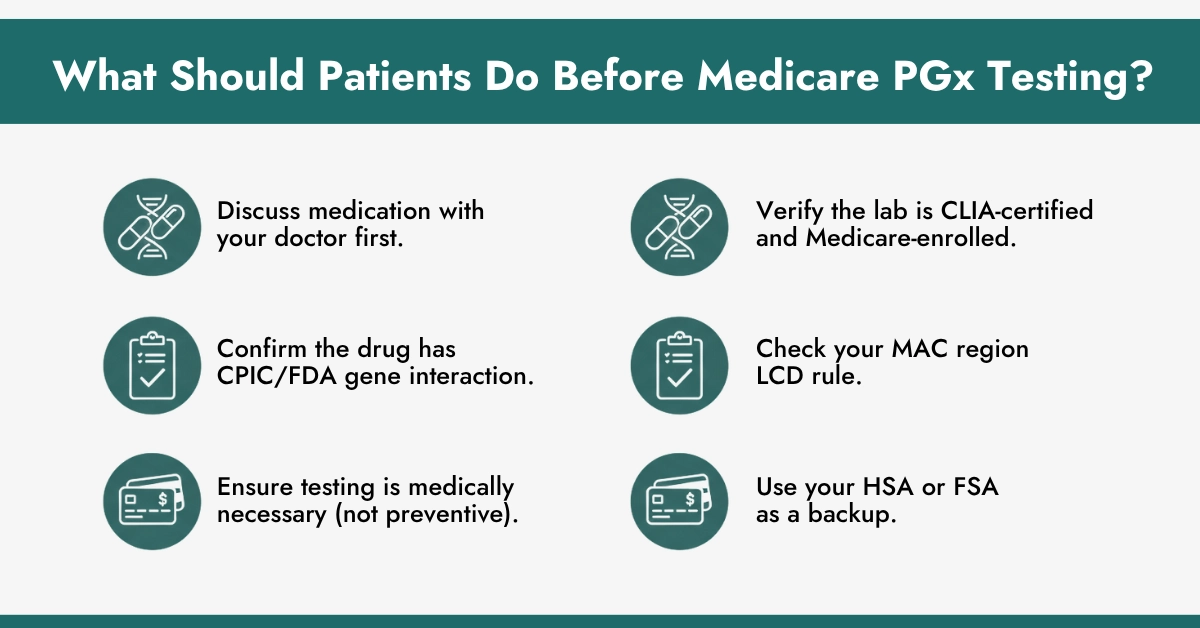
What Should Patients Do Before Medicare PGx Testing?
Follow these steps to maximize your chances of coverage:- Discuss medication with your doctor first.
- Confirm the drug has CPIC/FDA gene interaction.
- Ensure testing is medically necessary (not preventive).
- Verify the lab is CLIA-certified and Medicare-enrolled.
- Check your MAC region LCD rule.
- Use your HSA or FSA as a backup.
Conclusion:
Medicare does cover pharmacogenomic testing, but only when the right conditions are in place: a medically necessary indication, a documented drug-gene pair recognized by CPIC or the FDA, and testing performed by an eligible, accredited laboratory. The policy framework is actively maintained and expanding, reflecting growing confidence in the clinical value of PGx testing. If you’re navigating Medicare coverage and want to understand how your genetic profile could affect your medications, RPh Labs’ CLIA-accredited PGx test offers a clear, affordable starting point, with easy-to-read reports, HSA/FSA eligibility, and results that can inform your treatment for life.Disclaimer:
Coverage for Medicare pharmacogenomic (PGx) testing can vary based on CMS guidelines, MAC region rules, and individual clinical documentation. Because every patient situation is different, it’s always best to confirm details with your healthcare provider or billing team before making any decisions. Some images used in this content may be AI-generated for illustration purposes only and may not reflect real-world visuals.Frequently Asked Questions
Does Medicare Advantage cover PGx testing differently than Original Medicare?
Medicare Advantage plans must cover at minimum what Original Medicare covers, but they may have additional prior authorization requirements or use narrower lab networks. Always confirm coverage directly with your plan before ordering.
Can PGx testing be used as preventive care?
No. Medicare does not cover PGx testing as a general screening or preventive measure. Coverage requires medical necessity tied to a specific drug under current consideration.
What happens if Medicare denies my PGx claim?
You have the right to appeal. Ask your provider or the lab for an Advance Beneficiary Notice (ABN) before testing if there is uncertainty about coverage; this protects you from unexpected bills.
Does Medicare cover PGx testing for mental health medications?
Yes, in many cases. Drug-gene pairs involving antidepressants (SSRIs, SNRIs) and antipsychotics are commonly covered under MolDX LCDs when the prescribing provider documents clinical necessity.
Is a CLIA-accredited lab required for Medicare to cover PGx testing?
Yes. Medicare requires laboratory services to meet CLIA certification standards. Always confirm the lab’s accreditation status before submitting for reimbursement.



Leave a Reply