
How it works
At-home pharmacogenomic test: how it works
A pharmacogenomic test reads the genes that shape how your body handles medication. Order online, swab your cheek at home in about two minutes, mail it back prepaid, and get pharmacist-reviewed results in 7 to 10 business days.
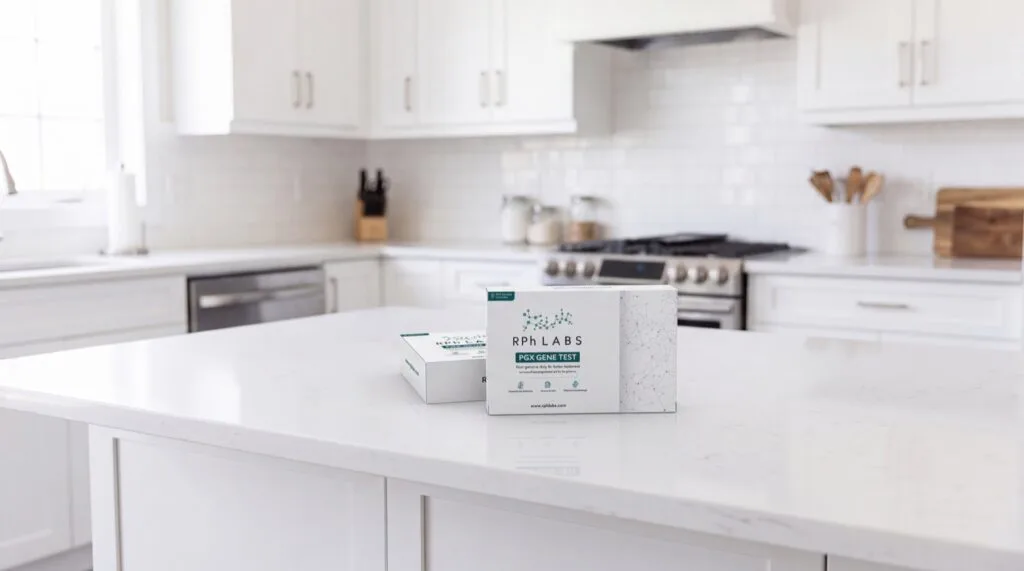
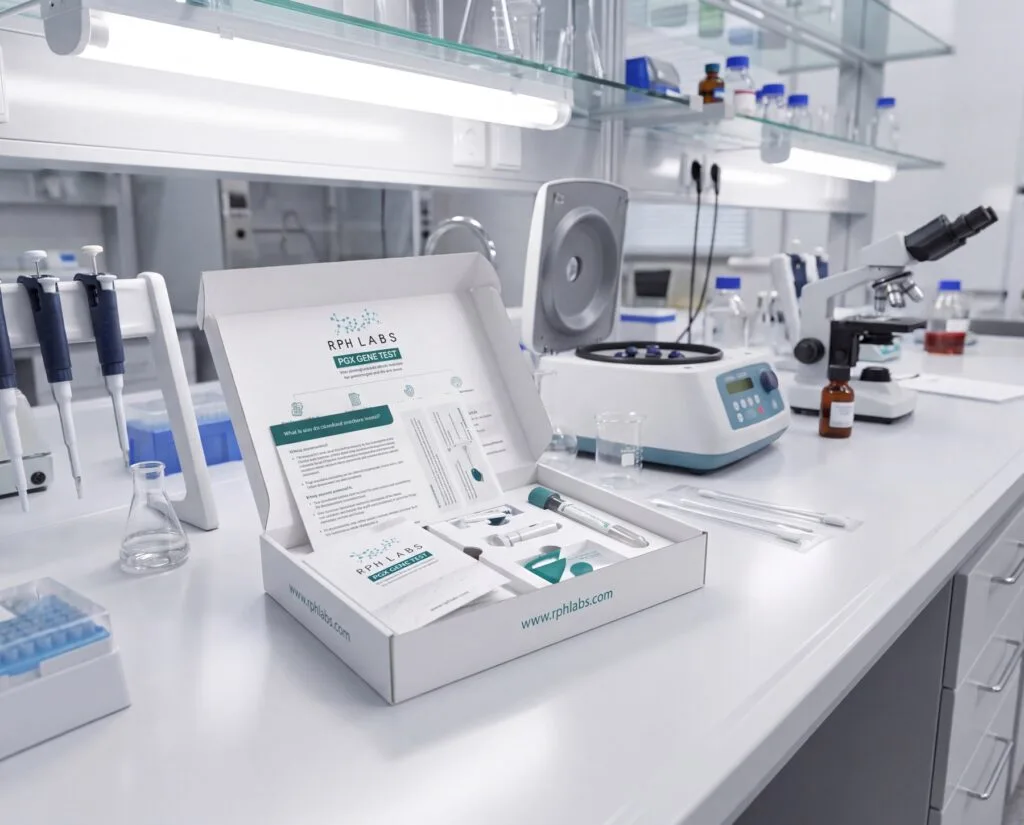
What is a pharmacogenomic test?
PGx testing is a paradigm for personalized medication. A pharmacogenomic test is a DNA-based drug metabolism test that helps your doctor choose the prescription options most likely to work for you.
Your DNA identifies the genes that are specific to you, so a PGx test can show how your body is likely to react to different drugs. It acts like a shield against treatments that are not suited to you.
The same tablet at the same dose can be too strong for one person and do almost nothing for the next. Much of that difference comes from inherited variation in liver enzymes and drug transporters, and that variation is exactly what a pharmacogenomic test measures.
How PGx testing works in 4 simple steps
Our all-in-one Genie portal lets you order, track and review results in one place. Less hassle, more control.
Step 1
Order online
And receive a PGx test kit at your doorstep.
Step 2
Perform & activate
Activate your kit online, then fill the swab with saliva.
Step 3
Return your sample
Using the provided prepaid envelope.
Step 4
Results
Within 7 to 10 business days on the RPh Labs portal.
Step by step: from order to pharmacogenomic test results
Here is exactly what happens at each stage, how long it takes, and what you need to do. Most people have a finished report two to three weeks after ordering.
Step 1
Order your kit online
Order the kit on our website in a few minutes. There is no clinic visit and no referral needed to self-pay: a licensed clinician reviews every self-ordered requisition before the lab runs it.
Kits ship within one business day and usually arrive in two to four business days. Everything you need is in the box, including prepaid return postage.
Step 2
Activate the kit and swab your cheek
Activate the kit on the RPh Labs portal first, so the sample is linked to you. Then rub the swab along the inside of each cheek for about thirty seconds per side and seal it in the transport tube.
Do not eat, drink, smoke or brush your teeth for thirty minutes before swabbing, so the sample is not diluted. Keep taking your medications as prescribed.

Step 3
Mail the sample back
Put the sealed tube in the prepaid envelope and post it the same day. Postage is already paid both ways, and you can track the sample in the portal once it reaches the laboratory.
If a sample fails quality control, the lab re-extracts and re-runs it at no charge. If a second sample is needed, we ship a replacement kit free.
Step 4
Get your results and talk to a pharmacist
Results are ready 7 to 10 business days after the lab receives your sample. A licensed PharmD pharmacist reviews every report before it is released to your account.
You get a plain-language summary for you and a clinical report for your prescriber. A free one-to-one consultation with a pharmacist is included, by phone or video.
What a DNA test for medication measures
A DNA test for medication does not read your whole genome. It reads a clinical panel of pharmacogenes, the genes that control how your body absorbs, activates and clears drugs, and reports only the results that can change prescribing.
CYP2D6, CYP2C19, CYP3A4
Liver enzymes that process many antidepressants, antipsychotics, pain medications and heart drugs.
CYP2C9 and VKORC1
Together they affect warfarin dosing, and CYP2C9 also processes NSAIDs and some anti-seizure drugs.
SLCO1B1
A liver transporter linked to the risk of muscle side effects on some statins.
TPMT and HLA genes
TPMT guides thiopurine dosing, and HLA variants flag the risk of severe reactions before the first dose.
For each gene, the report translates your genotype into a metabolizer status. That status is what your prescriber actually uses:
- Poor metabolizer: the drug is cleared slowly and can build up, raising the risk of side effects.
- Intermediate metabolizer: reduced activity, so a standard dose may be slightly too strong.
- Normal metabolizer: the drug is processed as the label expects.
- Rapid or ultrarapid metabolizer: the drug is cleared quickly and may not work at a standard dose, or a prodrug may be activated too fast.
Most people carry at least one gene variant that affects a commonly prescribed drug, so an actionable result is common, not rare. The point of the test is to find those differences before a prescription is written, rather than after weeks of trial and error.
CYP2D6 is the hardest gene to read correctly, because people can carry extra or missing copies of it. Our lab runs the copy-number and hybrid-gene analysis it needs, not just a simple variant check.
Why a saliva test for medication is enough
The cells in a cheek swab carry the same DNA as the cells in your blood, so a saliva test for medication gives the same genotype as a blood draw. There is no needle, no fasting and no lab appointment.
A few simple habits give the lab the best possible sample:
- Swab first thing in the morning or at least thirty minutes after eating, drinking, smoking or chewing gum.
- Rub firmly on the inside of both cheeks, not the gums or tongue, for the full thirty seconds per side.
- Do not touch the swab tip with your fingers, and let it air-dry briefly if the instructions say so.
- Post the sample the same day, and avoid leaving it in a hot car or mailbox for long.
Your sample is processed in a CLIA-certified, CAP-accredited laboratory that takes part in external proficiency testing for pharmacogenomic markers. The DNA is used only for the test you ordered. Read how we protect it in our privacy policy.
Because your genes do not change, you only need one pharmacogenomic test in your life. The same results can be reused every time a new prescription is written.
What happens to your sample in the lab
Once your envelope arrives, the laboratory checks the tube, matches it to your activated kit and logs it in the portal, so you can see that it has been received.
- DNA extraction: DNA is isolated from the cells on the swab and checked for quantity and quality.
- Genotyping: the lab reads the specific variants in each pharmacogene that are known to change how drugs work.
- Star-allele calling: those variants are combined into named versions of each gene, such as CYP2C19*2 or CYP2D6*4, including extra or missing copies of CYP2D6.
- Interpretation: each result is matched to published guidelines and turned into medication-by-medication guidance.
- Pharmacist review: a licensed PharmD checks the finished report before it is released to you.
Every run includes controls, and the lab takes part in external proficiency testing, so your pharmacogenomic test is held to the same standard as any other clinical lab result.
Genetic information can improve your overall treatment
According to PubMed, genetic variation accounts for roughly 20 to 95 percent of the variability in individual responses to medications. 113 FDA-approved drug labels already include information on differences in patient response caused by genetics.
Pharmacogenomic testing produced a 38% increase in the number of patients with a current medication-change opportunity, and gave prescribers genetic information they can reference for future prescribing decisions.
Our reports follow the dosing guidelines published by the Clinical Pharmacogenetics Implementation Consortium (CPIC) and the FDA Table of Pharmacogenomic Biomarkers in Drug Labeling.
Download the table of pharmacogenomic biomarkers in drug labeling (PDF) →
Pharmacogenomics can play an important role in identifying responders and non-responders to medications, avoiding adverse events, and optimizing drug dose.
Food and Drug Administration
How to read your pharmacogenomic test report
Every medication in your report is sorted into one of three bands, so you and your prescriber can see at a glance where attention is needed:
- Standard precautions: your genes do not change how this drug is expected to work. Use it as labeled.
- Use with caution: a dose change or closer monitoring may be needed.
- Consider alternatives: a different drug in the same class may work better or cause fewer side effects.
The report is written to be read twice: once by you in plain language, and once by your prescriber with the genotypes and guideline citations attached. You can download it, print a one-page summary, or send it to any clinician from the portal.
Never stop or change a medication on your own because of a result. Bring the report to your prescriber or book a call with one of our pharmacists, who will walk through it line by line and can speak to your doctor directly.
A result in the consider alternatives band does not mean a drug is dangerous for everyone with your genes. It means the evidence suggests another option, or a different dose, is more likely to work well for you, and your prescriber weighs that alongside your history, other medications and symptoms.
When prescribing guidelines change, we reissue your report at no cost, so your results stay current for life.
Sharing your results with your prescriber
Your results are most useful in the hands of the people who prescribe for you: your primary care doctor, psychiatrist, cardiologist or pharmacist. From the portal you can download the full report, print the one-page summary, or send it straight to a clinician by email.
Two well-known examples show why this matters. People who are CYP2C19 poor metabolizers activate clopidogrel poorly, so the drug may not protect them as intended. CYP2D6 ultrarapid metabolizers turn codeine into morphine too quickly, which raises the risk of serious side effects.
Many patients bring the one-page summary to their appointment, because it fits the few minutes a visit actually allows, and leave the full clinical report for the chart. Clinicians who want to order for their own patients can use our provider requisition.
We make effective testing easier
Accurate results, read by pharmacists, on an easy four-payment installment plan with zero interest. Your report covers 240+ medications across these areas:
Psychiatry
Antidepressants, antipsychotics, ADHD and anxiety medications.
Multiple sclerosis
Disease-modifying therapies and symptom management.
Pain
Opioids, NSAIDs and adjuvant pain medications.
Antihistamines
Allergy and related over-the-counter medications.
Each category is broken down by drug class, with standard precautions, use with caution, and consider alternatives sections. See every drug in the full medication list.
Clinical pharmacogenetic test vs. ancestry DNA kits
Consumer ancestry kits read DNA too, but they are built for heritage and traits, not for medical decisions. A clinical pharmacogenetic test is different in a few ways that matter to your prescriber:
| RPh Labs pharmacogenetic test | Ancestry or trait DNA kit | |
|---|---|---|
| Laboratory | CLIA-certified, CAP-accredited clinical lab | Usually not run for clinical use |
| Genes read | Pharmacogenes that change prescribing, with CYP2D6 copy-number analysis | General markers for ancestry and traits |
| Who reviews it | A licensed PharmD pharmacist, before release | No clinical review |
| Report | Medication-by-medication guidance your prescriber can act on | Not intended to guide medical care |
| Support | Free pharmacist consultation and free report updates | Customer service only |
Cost, insurance and HSA/FSA
The at-home kit is a one-time price with no subscription, no per-report charge and no fee to share your results. You can pay in four interest-free installments, and the test is HSA and FSA eligible, with an itemized receipt for your plan administrator.
Insurance coverage depends on your plan, your diagnosis codes and the plan’s medical policy, and billing to insurance usually needs an order from your prescriber. Medicare covers pharmacogenomic testing in defined circumstances. Check the insurances we accept or send us the insurance billing form and we will tell you what to expect before you order.
Many patients see the kit as a one-time cost set against a lifetime of prescriptions. A single failed trial of a medication can mean weeks of side effects, another appointment and another prescription, and the same pharmacogenomic test result can guide every one of those decisions for years.
Who should consider PGx testing?
PGx testing is most useful before or early in treatment, but it can help at any point. It is worth talking to your prescriber about a test if you:
- Have tried two or more antidepressants, antipsychotics or ADHD medications without relief.
- Have had strong side effects at normal doses, or needed unusually high doses for any effect.
- Take several medications at once, which is common after 65.
- Are about to start a drug with a known gene interaction, such as clopidogrel, codeine, warfarin or some statins.
- Want results on file for yourself or your family before the next prescription is written.
Not sure it fits your situation? Our pharmacists offer a free twenty-minute consultation before you buy. Book a call and bring your medication list.
Latest reviews
Just received my test reports. Happy for the clear insights it has. Would recommend.
Emily Johnson
Review from Google
My sister has been suffering from mental health problems. Our doctor recently recommended a gene test to start personalized medication. Let us see how it goes.
Sarah Davis
Review from Facebook
My son has been diagnosed with ADHD and someone recommended this PGx gene test. Hoping it helps us get to the right medication.
Jessica Miller
Review from Facebook
Loved the detailed and clear report. Took around 9 days, but the report looks pretty helpful.
Matthew Moore
Review from X
I have bipolar disorder. My doctor has recently suggested this test for effective medication. My friends directed me toward RPH LABS.
Amanda Thomas
Review from Google
I am living with bipolar disorder and have tried different medications with close to no results. I just heard this DNA-based drug metabolism test may be covered by my insurance.
Alex Jr.
Review from Facebook
How PGx testing works: common questions
How long does a pharmacogenomic test take?
Kits ship within one business day and usually arrive in two to four business days. Swabbing takes about two minutes. Results are ready 7 to 10 business days after the lab receives your sample, so most people have their report two to three weeks after ordering.
Do I need a doctor’s order to take the test?
Not if you pay for the test yourself. A licensed clinician reviews every self-ordered requisition. If you want to bill the test to insurance, your plan will usually need an order from your prescriber.
Is a saliva test for medication as accurate as a blood test?
Yes, for genotyping. A cheek swab carries the same DNA as a blood sample. Samples are run in a CLIA-certified, CAP-accredited laboratory, and a sample that fails quality control is re-run or replaced at no charge.
Do I need to stop my medications before the test?
No. Keep taking your medications as prescribed, because they do not change your DNA. Just avoid eating, drinking, smoking or brushing your teeth for thirty minutes before you swab.
Will I ever need to repeat a pharmacogenetic test?
No. Your genes do not change, so one pharmacogenetic test stands for life. When prescribing guidelines change, we update and reissue your report at no cost.
Can a DNA test for medication tell me which drug will work?
It cannot guarantee a result, and it does not diagnose disease. It shows how your genes are likely to affect each medication, so your prescriber can choose a drug and dose with better odds from the start.
Who can see my results?
You, and any clinician you choose to share them with. We never sell your DNA or genetic data. The federal Genetic Information Nondiscrimination Act (GINA) also stops health insurers and most employers from using genetic information against you.
Ready to see how your body handles your medications?
Order the kit today, or talk to a pharmacist first. The consultation is free and takes about twenty minutes.