
Support & Forms
Pharmacogenomic testing support and forms
Every page in the Support & Forms menu, summarised in one place. Use it to find the pharmacogenomic testing support you need in a few seconds: the forms directory and the documents inside it, the insurances we accept, the 45 states we serve, and the quickest way to reach a pharmacist at our Dallas laboratory.
Nothing here replaces those pages. Each summary says what the page is for, what you will find on it and when you need it, then links straight to it. If you would rather just ask, RPh Labs customer support is one call away: (888) 383-2181 between 9am and 5pm CT, Monday to Friday, or [email protected] and a pharmacist replies.

Pharmacogenomic testing resources at a glance
Four pages sit under Support & Forms. Between them they cover paperwork, payment, geography and people. These are the pharmacogenomic testing resources most people need before or just after they order a kit, and together they answer most of the questions our pharmacogenomic testing support line hears in a week.
Forms
The forms directory: the Medicare ABN, the insurance billing order form and the provider requisition, each as a printable PDF and an online version you can complete on a phone. It also explains which forms you actually need, and what to have ready before you start.
Insurances We Accept
The six networks we bill directly, including Medicare, Texas Medicaid and Blue Cross and Blue Shield of Texas, how a plan decides whether a PGx test is medically necessary, and what to do if your plan is not on the list.
Where We Serve
The 45 states we ship kits to today, the five we cannot serve yet, a coverage map, and how long the kit takes to reach you, come back and turn into a report.
Contact Us
Phone, fax, email, opening hours and the laboratory address in Dallas, plus a free consultation form that puts a licensed pharmacist on the other end. This is RPh Labs customer support in one page.
The rest of this page expands each one, adds the sub-pages that live inside the forms directory, and ends with a glossary and a pharmacogenomic testing support FAQ.
Genetic testing help: which page answers your question
Most questions have one obvious home. Find yours in the left column and go straight there — this table is the fastest genetic testing help we can give you, and the quickest route to the right pharmacogenomic testing support.
| What you need | Where to go |
|---|---|
| A form to fill in or print | Forms |
| To know whether we can bill your plan | Insurances We Accept |
| To check we ship to your state | Where We Serve |
| To speak to a pharmacist | Contact Us |
| Medicare may not cover your test | Medicare ABN form |
| The test is being billed to insurance | Insurance billing form |
| You are a prescriber ordering for a patient | PGx requisition form or the provider portal |
| A question about the science or the report | Frequently Asked Questions, or ask for pharmacogenomic testing support on the phone |
| To see whether your medication is on the panel | Medication List |
| To order a kit | At-home PGx test kit |
Forms: every document you may need
The forms page is the directory. It holds two categories — Medicare ABN and insurance forms, and pharmacogenomic test forms — and each entry gives you both a PDF to download and an online version to complete in the browser. Nothing on it is required for a self-paid kit.
That is the single most common misunderstanding we hear on the support line, so it is worth repeating: if you are buying the at-home kit yourself, with your own money, an HSA card or an FSA card, there is no form to fill in. Your details are collected at checkout and again when you activate the kit. Forms only come into it when somebody else is paying, or when a clinician is ordering on your behalf.
| Your situation | Forms to complete |
|---|---|
| Buying the at-home kit yourself (self-pay, HSA or FSA) | None. Details are collected at checkout and at kit activation. |
| The test is billed to your insurance | The insurance billing form, completed with your prescriber. |
| You have Medicare and coverage is uncertain | The Medicare ABN form, plus the insurance billing form. |
| A clinician is ordering for a patient | The PGx requisition form, or an order through the provider portal. |
Before you start any of them, have your photo ID, your insurance card, the prescriber’s name and NPI, a current medication list with doses, and any diagnosis codes your prescriber has given you. Gathering those first turns a twenty-minute job into a five-minute one. If a field does not make sense, stop and ask for pharmacogenomic testing support rather than guessing: a wrong NPI or a missing diagnosis code is the most common reason a claim comes back.
Medicare ABN form
An Advance Beneficiary Notice of Noncoverage is the notice Medicare requires before a laboratory performs a test that Medicare may not pay for. Ours follows the CMS form CMS-R-131 (OMB number 0938-0566) and runs from part A to part J: who is giving the notice, what the service is, why we expect Medicare may not pay, the estimated cost, the option you choose in part G, and your signature and date.
Signing it does not mean Medicare will refuse the claim, and it does not commit you to going ahead. It means you were told in advance and made your own decision. The online ABN form walks you through the parts in order and produces a completed copy for your records; if you would rather print it, the ABN form PDF is the same document. Read the CMS guidance on the ABN if you want the rule in the government’s own words.
Insurance billing form
This is the order form used whenever a pharmacogenomic test is billed to a health plan instead of paid for directly. It has seven sections: the patient, the insurance, the ordering prescriber, the medications under review, the diagnosis codes that support medical necessity, the specimen details and the signatures. Your prescriber completes the clinical sections; you complete the rest.
Complete it online and the medication and ICD-10 lists are searchable, which removes most of the transcription errors that hold claims up. The printable version exists for offices that prefer paper or need a wet signature.
PGx requisition form for prescribers
The new order requisition is the clinician-facing form: patient demographics, medical history, the test requested and the prescriber’s details, including the NPI, which the form looks up for you as you type. Practices ordering regularly should use the provider portal instead, where orders, sample tracking and results all sit in one account.
Every submitted form arrives at the laboratory as a stamped PDF on the laboratory’s own letterhead, so what you sign and what our staff read are the same document. More detail on all of this, including a glossary and a nine-question FAQ, is on the forms page; for anything it does not cover, PGx testing support will fill in the gap.
Insurances we accept, in brief
We are enrolled with six networks and can submit a claim to any of them directly:
- Medicare — Part B, in the circumstances its national and local policies allow.
- Medicaid of Texas — administered through the Texas Medicaid & Healthcare Partnership.
- Blue Cross and Blue Shield of Texas — statewide commercial plans.
- Baylor Scott & White Health Plan — Texas commercial and employer plans.
- USA Managed Care Organization — national PPO network access.
- NOVA NET — a multi-state PPO network.
Being enrolled means we can bill the plan. It does not mean the plan will pay: every insurer applies its own medical policy, and for a PGx test that policy turns on one question — will the result change your treatment? Plans look for a prescriber’s order with an NPI, diagnosis codes that match the medications under review, and a drug with recognised gene–drug guidance from the FDA or the Clinical Pharmacogenetics Implementation Consortium. Some plans want prior authorisation before the sample is collected.
Because that varies so much, we verify benefits before you order rather than after. Call us with your plan details and we will tell you what to expect, including an estimate of your share. Benefits verification is part of pharmacogenomic testing support, and it costs you nothing. If your plan is not on the list, you can still pay directly, use HSA or FSA funds, or spread the cost over four interest-free instalments.
The full version — coverage by plan type, the medications that make approval more likely, Medicare and Medicaid rules, and what to do with an explanation of benefits — is on Insurances We Accept.
Where we serve: 45 states, with kits by post
RPh Labs ships at-home pharmacogenomic test kits to 45 states. The five we cannot serve yet are New York, Maryland, Pennsylvania, Rhode Island and California, where state laboratory rules differ; Where We Serve has a coverage map and a notification form that emails you if that changes.
- Kits ship within one business day of the order and usually arrive in two to four business days.
- Return postage is prepaid and already in the box, so the swab goes back the day you collect it.
- Results are ready seven to ten business days after the sample reaches the laboratory.
- Most people have a report two to three weeks after ordering, and are emailed as soon as it is posted to their account.
- If a sample fails quality control the laboratory re-runs it at no charge, and ships a replacement kit free if a second sample is needed.
Every sample, whichever state it came from, is processed in one CLIA-certified, CAP-accredited laboratory that takes part in external proficiency testing for pharmacogenomic markers, and every report is reviewed by a licensed PharmD pharmacist. No clinic visit is needed anywhere: the cheek swab is collected at home in about two minutes.
Wherever you live in those 45 states, the same team answers the phone, so PGx testing support does not change from one state to the next.
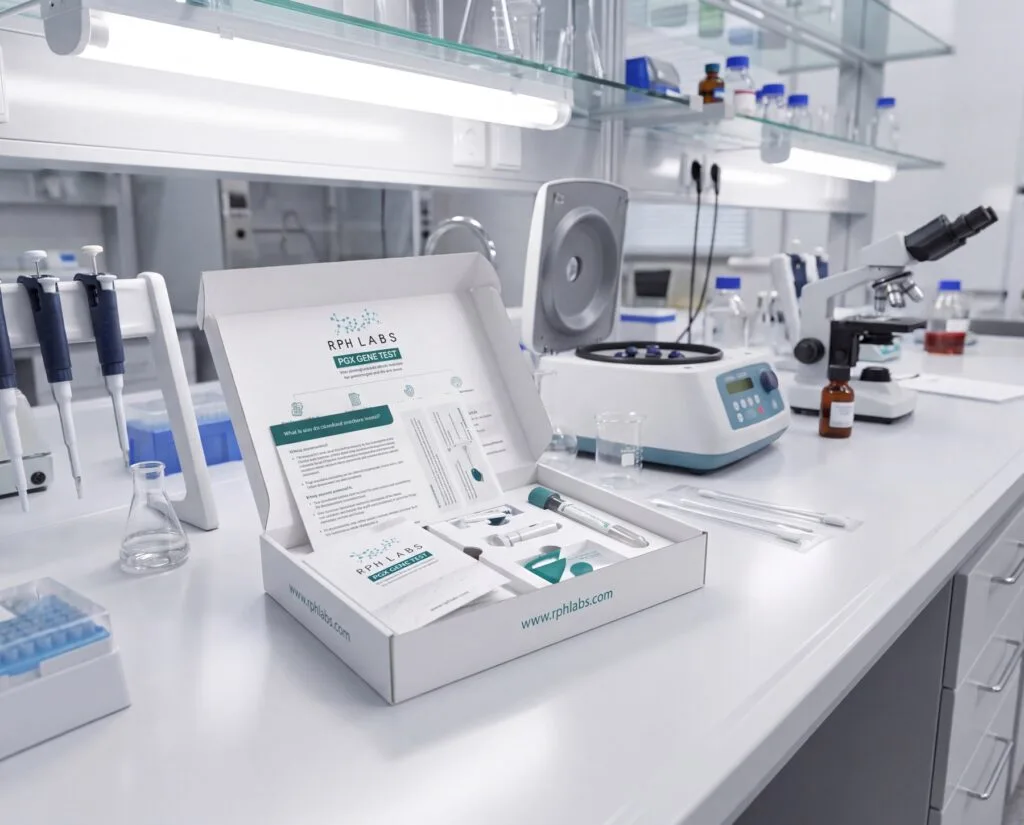
RPh Labs customer support: hours, phone and email
One team in Dallas handles orders, billing questions and clinical questions, so you do not need to work out who to ask. RPh Labs customer support is open 9am to 5pm Central, Monday to Friday.
| Channel | Detail |
|---|---|
| Phone | (888) 383-2181 |
| Fax | (888) 383-2181 |
| [email protected] | |
| Hours | Monday to Friday, 9am–5pm CT |
| Laboratory | 8230 Elmbrook Drive, Suite 200, Dallas, Texas 75247 |
| Prescribers | Provider portal for orders, sample tracking and results |
The contact page also carries a free consultation form: send a note and a pharmacist calls you back. Use it for anything you would rather not explain twice — a confusing explanation of benefits, a medication you are worried about, or a report you want walked through. There is no charge for it, and no obligation to order anything.
One thing the address does not mean: walk-in collection is not offered. The kit is posted to you and returned by prepaid post, so there is no reason to travel to the laboratory. RPh Labs customer support handles everything else by phone, email or the form.
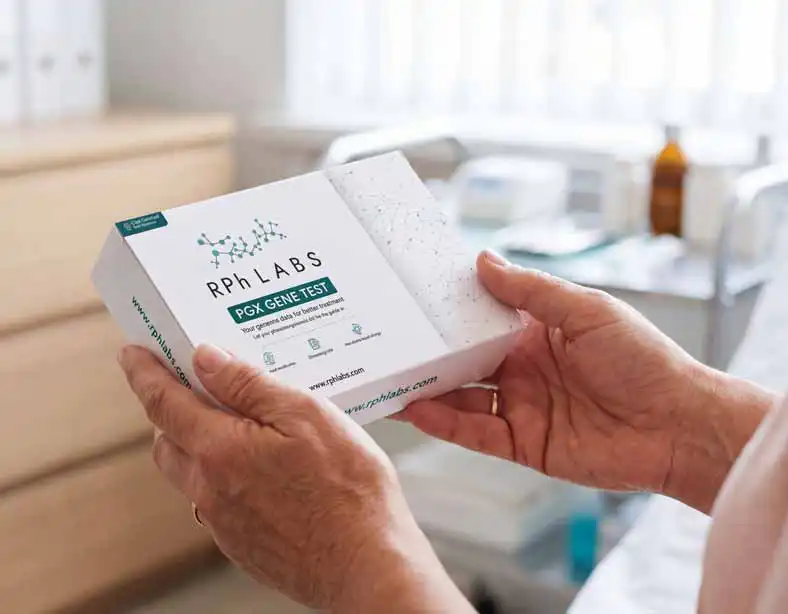
What PGx testing support covers
PGx testing support is not only about paperwork. These are the things people most often ask us for, grouped by when they ask. All of it is included: pharmacogenomic testing support is part of the test, not an add-on.
Before you order: PGx testing support while you decide
- Checking that we serve your state.
- Verifying your insurance benefits and estimating your share of the cost.
- Telling you which forms, if any, apply to your situation.
- Confirming whether a specific medication is on the panel.
- Explaining what the test can and cannot tell you, so nobody buys the wrong thing.
While your sample is with us
- Tracking a kit that has not arrived, or a return that has not been scanned.
- Replacing a kit free of charge when a sample fails quality control.
- Correcting a detail on a submitted form before the sample is processed.
After your report: genetic testing help that does not stop at delivery
- Walking through the report with a licensed pharmacist.
- Sending a copy to your prescriber, or explaining how to share it yourself.
- Helping with a denied claim, an explanation of benefits or an itemised receipt for an HSA or FSA administrator.
- Re-issuing the report at no cost when prescribing guidelines change, because your genes do not.
From first question to final report
This is the whole journey, where each Support & Forms page fits into it, and where pharmacogenomic testing support steps in at each stage.
- Ask. Call, email or use the consultation form. We check your state and your benefits, and tell you which forms apply.
- Paperwork, if any. Self-pay needs none. Insurance needs the billing form; Medicare may also need an ABN; a clinician-ordered test needs the requisition.
- Order. The kit ships within one business day and arrives in two to four.
- Swab. A two-minute cheek swab at home, then straight back in the prepaid envelope.
- Analysis. Seven to ten business days in the CLIA-certified, CAP-accredited laboratory, with a pharmacist review.
- Report. You are emailed when it is posted to your account, and support will walk you through it or send it to your prescriber.
Support for prescribers, clinics and pharmacies
Clinical teams get the same phone number and a few extra tools. For Providers covers when to order, how to read the gene and phenotype tables, medical necessity documentation and how we compare with other laboratories. The provider portal holds orders, sample tracking and results, and requisition and consent forms are issued with every account.
Offices that order occasionally can skip the portal and use the PGx requisition form directly. If your practice wants printed kits, co-branded patient handouts or a standing supply, say so when you call and we will set it up. Clinical PGx testing support — interpreting a phenotype, checking an interaction, or talking a patient through a result — comes from the same pharmacists, at the same number.
How your information is protected
Everything on our forms is protected health information. Submissions travel over an encrypted connection, are stored on access-controlled systems and are shared only with the people involved in your test — the laboratory, the reviewing pharmacist and, where you have asked for it, your prescriber and your insurer.
We do not sell genetic information, and we do not use it for advertising. Our privacy policy sets out what we collect and how long we keep it; our HIPAA policy and notice of privacy practices sets out your rights over that information and how to exercise them. To use one of those rights — a copy, a correction, a restriction — ask pharmacogenomic testing support and we will start it for you.
More pharmacogenomic testing resources
Outside the Support & Forms menu, these pharmacogenomic testing resources answer the questions support hears most often:
- Frequently Asked Questions — fifty questions on the science, the sample, the results, privacy and cost.
- How It Works — the four steps from ordering to report, with the evidence behind them.
- Medication List — searchable by gene and by drug, so you can check your own prescriptions.
- Videos — short explainers, including how to collect a good cheek swab.
- Blog — longer articles on specific medications and conditions.
- At-home PGx test kit — what is in the box, what it costs and what the report looks like.
Bookmark this page if you would rather keep all the pharmacogenomic testing resources behind one link, and use the table of contents above to jump straight to the part you need.
Terms you will see on our forms and pages
Most requests for genetic testing help start with a word on a form. These are the ones that come up most, in plain English.
| Term | What it means |
|---|---|
| ABN | Advance Beneficiary Notice of Noncoverage — the Medicare notice given before a test Medicare may not pay for. |
| CLIA | The federal standard every clinical laboratory in the United States must be certified against. |
| CPIC | The consortium that publishes the gene–drug dosing guidelines our reports follow. |
| EOB | Explanation of benefits — your insurer’s statement of what was billed, allowed and paid. It is not a bill. |
| ICD-10 code | The diagnosis code that tells a plan why a test was ordered. |
| Medical necessity | A plan’s test for whether a service is needed, and therefore covered. |
| NPI | National Provider Identifier — the ten-digit number identifying your prescriber. |
| PGx | Pharmacogenomics: how your genes affect the way you process medication. |
| Phenotype | The plain-language result for a gene, such as poor, intermediate, normal, rapid or ultrarapid metaboliser. |
| Prior authorisation | Approval some plans require before a test is carried out. |
Pharmacogenomic testing support FAQ
How do I get pharmacogenomic testing support?
Call (888) 383-2181 between 9am and 5pm CT, Monday to Friday, email [email protected], or use the free consultation form on the contact page and a licensed pharmacist calls you back. One team in Dallas handles orders, billing and clinical questions, so pharmacogenomic testing support is never more than one call away.
Does pharmacogenomic testing support cost anything?
No. Benefits verification, help with lab forms, sample tracking and a pharmacist walking you through your report are all included in the price of the test. The consultation form on the contact page is free to use even if you never order a kit.
Which forms do I actually need?
None if you are buying the kit yourself with your own money, an HSA card or an FSA card. The insurance billing form if the test is billed to a health plan. A Medicare ABN as well if you have Medicare and coverage is uncertain. The requisition form if a clinician is ordering for you.
Where do I find the forms?
The forms page at /forms/ is the directory. Each entry has a printable PDF and an online version you can complete on a phone, and the page explains what to have ready before you start. If a field is unclear, ask for pharmacogenomic testing support rather than guessing.
Do you accept my insurance?
We bill six networks directly: Medicare, Medicaid of Texas, Blue Cross and Blue Shield of Texas, Baylor Scott and White Health Plan, USA Managed Care Organization and NOVA NET. We verify benefits before you order, and if your plan is not listed you can self-pay, use HSA or FSA funds, or pay in four interest-free instalments.
Do you ship to my state?
We serve 45 states. The five we cannot serve yet are New York, Maryland, Pennsylvania, Rhode Island and California. The Where We Serve page has a coverage map and a form that emails you when that changes.
How long does the whole process take?
The kit ships within one business day and arrives in two to four. Results are ready seven to ten business days after your sample reaches the laboratory, so most people have a report two to three weeks after ordering.
Can someone help me read my report?
Yes. A licensed PharmD pharmacist reviews every report and will walk you through it on the phone, and we can send a copy to your prescriber if you ask. That is the genetic testing help most people use us for once results arrive.
Can I visit the laboratory to give a sample?
No. Walk-in collection is not offered. The kit is posted to you and returned by prepaid post, and the cheek swab takes about two minutes at home.
What happens to the information on my forms?
It is treated as protected health information: encrypted in transit, stored on access-controlled systems and shared only with the people involved in your test. We do not sell genetic information. The privacy policy and the HIPAA notice of privacy practices set out your rights in full.
Still need pharmacogenomic testing support?
If the page you want is not in the list above, ask us. We would rather answer a quick question than have you order the wrong thing or fill in a form you never needed. Pharmacogenomic testing support is free, and you do not have to be a customer to use it.
(888) 383-2181 · [email protected] · 9am–5pm CT, Monday to Friday