
Online form · self-pay
Standard New Order PGx Requisition Form
This PGx requisition form is our online pharmacogenomic test order form for self-pay patients. Complete all four sections below: patient and prescriber details are required before the laboratory can process a sample.
"*" indicates required fields
What the PGx requisition form is for
The standard new order PGx requisition form is how a licensed prescriber orders a pharmacogenomic (PGx) test from RPh Labs for a patient who is paying for the test themselves. It carries everything the laboratory needs to accept the sample, run the requested genes and send an interpreted report back to the right clinician: who the patient is, why the test is being ordered, which genes to report and who ordered it.
Use this form for self-pay orders. If the test will be billed to a health plan, use the insurance billing form instead, because it also collects the policy and subscriber details a claim needs. For patients with Original Medicare whose coverage is uncertain, the patient also signs the ABN form before the specimen is collected.
The online PGx requisition form and the printed version ask for the same information in the same order, so a practice can use whichever fits its workflow. Online orders reach the laboratory the moment you submit them, with nothing to fax or post.
How to order PGx testing in five steps
If you are new to the lab, this is how to order PGx testing from start to finish.
- Confirm the test is right for the patient. PGx testing is most useful before starting a medication with a known gene-drug interaction, or after a failed trial or unexpected side effects.
- Complete the PGx requisition form above. Fill in patient information, medical history, the requested PGx test and prescriber information, then accept the disclaimer.
- Collect the specimen. Take a buccal (cheek) swab in the office, or we ship an at-home kit to the patient within one business day.
- Send the sample to the laboratory. The prepaid return envelope comes with every kit; label the tube so it matches the requisition exactly.
- Receive the report. A PharmD pharmacist reviews every result before release, and the report is posted to the provider portal in 7 to 10 business days from receipt.
That is the whole process for how to order PGx testing with RPh Labs. You do not need an account to submit the requisition, although the provider portal makes it easier to track orders and download results.
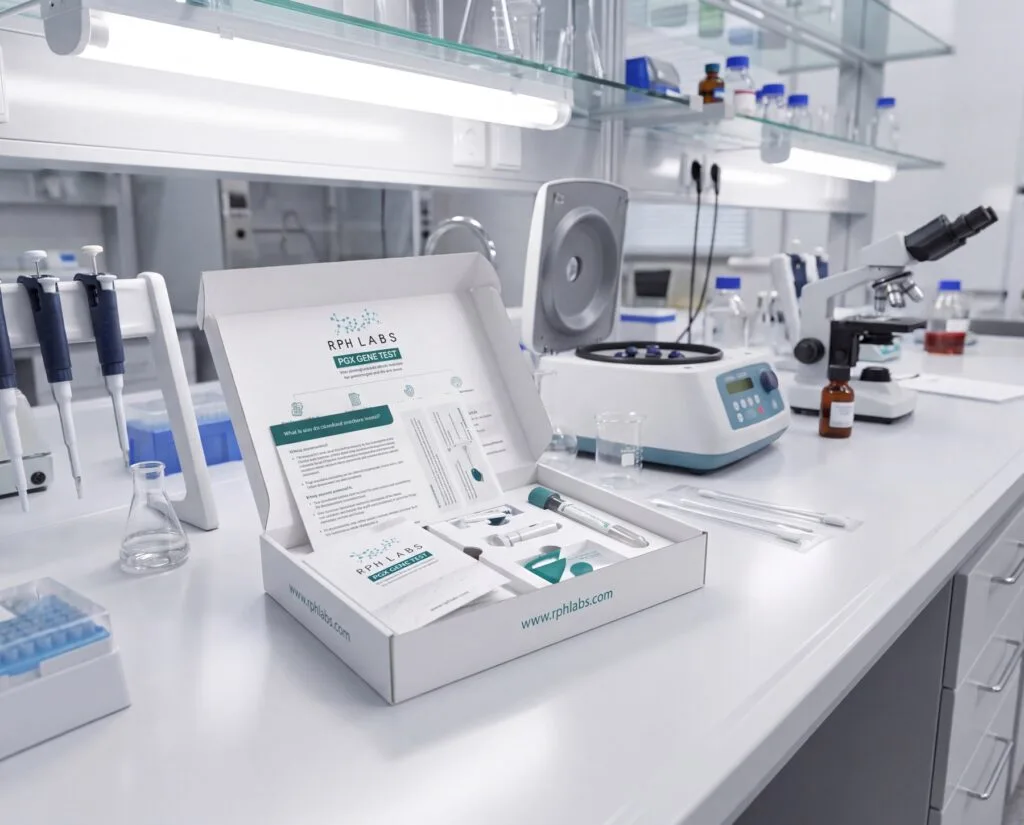
Pharmacogenomic test order form, section by section
The pharmacogenomic test order form has four numbered sections and a short disclaimer. Required fields are marked with an asterisk; the form will not submit until they are complete.
Section 1: Patient information
- First and last name exactly as they appear on the patient’s identification. The name is matched to the specimen label, so spelling matters.
- Street address, city, state and ZIP. Used to ship an at-home kit and to confirm we can serve the patient’s state.
- Email and phone. Used to confirm the order and arrange collection.
- Date of birth. The second identifier, printed on the report and matched to the specimen.
- Preferred language (optional) and gender.
- Ancestry (optional, select all that apply). Some variants are much more common in certain populations, so ancestry helps the laboratory interpret results in context.
Section 2: Medical history
- Diagnosis code(s) (required): the ICD-10 codes for the conditions behind the order. See the examples below.
- Current medication(s): list every prescription, including dose, plus relevant over-the-counter drugs and supplements.
- Considering medication(s): drugs you are thinking of starting. The report highlights these first.
Section 3: Requested PGx test
Tick Test for all genes listed below to run the full panel, or choose individual genes. With all genes ticked there is no need to choose individual genes. Many prescribers order the full panel, because germline results do not change and a single test then informs every future prescription.
Section 4: Prescriber information
- Prescriber’s name, practice address, city, state and ZIP.
- NPI number and physician license number. The NPI field looks the prescriber up in the NPPES registry and fills in the practice details for you.
- Phone (required), fax and an office contact name (optional), so we can reach the right person with questions.
- Prescriber signature (type the full name) and date. Typing the name is the electronic signature for this order.
Disclaimer and consent
By accepting the disclaimer, the patient and/or prescriber confirms the information is accurate and authorizes RPh Labs to perform the requested testing. Results are for use by a licensed healthcare provider, and the responsible party accepts financial responsibility for the charges.
Choosing genes on the pharmacogenetic testing requisition
The pharmacogenetic testing requisition lists twenty genes. Each one is linked to medications with published guidance from the Clinical Pharmacogenetics Implementation Consortium (CPIC) or pharmacogenomic information in FDA drug labeling. These are the genes on the form and examples of the medications each one affects:
| Gene | Example medications |
|---|---|
| ABCG2 | Rosuvastatin |
| APOE | Amyloid-targeting Alzheimer’s therapies such as lecanemab (risk of ARIA) |
| BCHE | Succinylcholine and mivacurium (prolonged paralysis) |
| CYP2B6 | Efavirenz, methadone, sertraline |
| CYP2C19 | Clopidogrel, citalopram, escitalopram, sertraline, proton pump inhibitors, voriconazole |
| CYP2C9 | Warfarin, phenytoin, celecoxib and other NSAIDs, siponimod |
| CYP2C (rs12777823) | Warfarin dosing, particularly in patients of African ancestry |
| CYP3A4 | Tacrolimus and other CYP3A substrates |
| CYP3A5 | Tacrolimus |
| CYP2D6 | Codeine, tramadol, ondansetron, atomoxetine, tricyclic antidepressants, paroxetine, aripiprazole, tamoxifen |
| CYP4F2 | Warfarin |
| DPYD | Fluorouracil and capecitabine |
| G6PD | Rasburicase, primaquine, tafenoquine, dapsone |
| MT-RNR1 | Aminoglycoside antibiotics (hearing loss risk) |
| NAT2 | Isoniazid, hydralazine |
| NUDT15 | Azathioprine, mercaptopurine, thioguanine |
| SLCO1B1 | Simvastatin and other statins |
| TPMT | Azathioprine, mercaptopurine, thioguanine |
| UGT1A1 | Irinotecan, atazanavir |
| VKORC1 | Warfarin |
If you order individual genes, make sure the selection covers every drug listed under current and considering medications. For example, warfarin needs CYP2C9, VKORC1, CYP4F2 and CYP2C together, and thiopurines need both TPMT and NUDT15. When in doubt, order the full panel. The complete medication list shows every drug the report covers.
Diagnosis codes and medication lists
Every PGx requisition form needs at least one ICD-10 diagnosis code. For a self-pay order the code does not decide payment, but it tells the reviewing pharmacist why the test was ordered, which shapes how the report is prioritized. Use the codes documented in the patient’s record. Common examples on pharmacogenomic orders include:
| ICD-10 code | Description |
|---|---|
| F33.1 | Major depressive disorder, recurrent, moderate |
| F41.1 | Generalized anxiety disorder |
| F90.2 | Attention-deficit hyperactivity disorder, combined type |
| I48.91 | Unspecified atrial fibrillation |
| I25.10 | Atherosclerotic heart disease of native coronary artery without angina pectoris |
| G43.909 | Migraine, unspecified, not intractable, without status migrainosus |
| Z79.01 | Long term (current) use of anticoagulants |
| Z79.899 | Other long term (current) drug therapy |
These are examples, not recommendations; code to the patient’s documented conditions. In the medication fields, one drug per line with its dose is easiest to read. Include drugs the patient stopped because of side effects or poor response, because those are often the medications the report explains.
Why the medication list on the requisition matters
A genotype describes what a patient’s enzymes can do; the medication list shows what they are actually doing. Strong inhibitors can change the picture. Fluoxetine, paroxetine and bupropion, for example, strongly inhibit CYP2D6, so a patient who is genetically a normal metabolizer can behave like a poor metabolizer while taking them. This effect is called phenoconversion.
Listing every current medication on the pharmacogenetic testing requisition lets the reviewing pharmacist point out interactions like these alongside the genetic result. It is one of the main reasons a PGx requisition form asks for more detail than a routine lab order.
What a pharmacogenetic testing requisition must include
Clinical laboratories certified under CLIA must receive a written or electronic test request with specific information before testing. The rule, 42 CFR 493.1241, requires a pharmacogenetic testing requisition, like any test request, to include:
- The name and address, or other suitable identifier, of the authorized person ordering the test.
- The patient’s name or a unique patient identifier.
- The patient’s sex and age or date of birth.
- The test or tests to be performed.
- The source of the specimen, where appropriate, and the date of collection.
- Any additional information needed for accurate testing and interpretation, such as the patient’s medications.
Our PGx requisition form is built around those requirements, which is why several fields are mandatory. A requisition that is missing any of them has to be completed before the laboratory can report results.
Genetic testing requisition form vs a standard lab order
A routine lab order can be a single line: the test name, a code and a signature. A genetic testing requisition form asks for more, for good reasons:
- Medication lists. A PGx result is only as useful as its link to the drugs the patient takes or may take, so the genetic testing requisition form asks for them up front.
- Gene selection. A panel can be ordered whole or gene by gene, so the form lists each gene.
- Ancestry. Optional, but it helps interpret results in context, since some variants are far more common in certain populations.
- Consent. Genetic testing carries its own authorization, captured by the disclaimer at the end of the form.
The extra fields take a few minutes, and they are what turn a genotype into a medication-by-medication report you can act on.
Workflow tips for practices
Practices that order regularly tend to build the PGx requisition form into their normal visit flow rather than treating it as a separate task. A few habits make it quicker:
- Let staff prepare the order. An office team member can enter patient details, medications and diagnosis codes; the prescriber then reviews the order and types their name as the signature.
- Use the reconciled medication list. Copy the list from the visit’s medication reconciliation so the pharmacogenomic test order form matches the chart.
- Name an office contact. The optional contact field routes our questions to the person who can answer them.
- Decide how the patient will collect. Swab in the office when the patient is in front of you, or send an at-home kit if they are seen by telehealth.
- Track orders in one place. The provider portal shows each order’s status and stores every report for later prescribing decisions.
Ordering for children and older adults
The same PGx requisition form is used at every age. For a child, a parent or legal guardian provides consent and contact details, and the patient’s date of birth tells the laboratory to interpret results with pediatric use in mind. Pharmacogenomic guidance applies to many medications prescribed to children, including ADHD medications such as atomoxetine, SSRIs and ondansetron.
For older adults, the value is usually in polypharmacy. A patient on five or more medications may have several with gene-drug interactions, and one test can inform all of them. List every medication, and consider the full panel so future prescriptions are covered too.
Common requisition errors that delay results
- A name or date of birth that does not match the specimen label. The lab cannot run a sample it cannot match to its requisition.
- No diagnosis code. The field is required, and a missing code holds the order.
- An incomplete medication list. The report can only highlight drugs it knows about.
- Genes that do not cover the medications listed. Order the full panel if you are unsure.
- Missing NPI or license number. Results are released only to an identified, licensed prescriber.
- No signature or date. Type the prescriber’s full name and today’s date before submitting.
If something is missing, our team contacts the practice before testing goes ahead. Questions before you submit? Call (888) 383-2181, 9am to 5pm CT, Monday to Friday.
Matching the specimen to the requisition
The laboratory needs only a buccal swab. The patient should not eat, drink, smoke or brush their teeth for thirty minutes before collection. Rub the swab firmly on the inside of each cheek for about thirty seconds, seal it in the transport tube, and label the tube with the patient’s full name and date of birth exactly as written on the PGx requisition form.
Patients testing at home receive a kit with step-by-step instructions and a prepaid return envelope. Samples that fail quality control are re-extracted and re-run at no charge, and a replacement kit is sent free if a second sample is needed. See how it works for the patient’s side of the process.
After you submit the PGx requisition form
- The laboratory team confirms the order by email within one business day.
- If the patient is testing at home, the kit ships within one business day.
- The sample is genotyped in our CLIA-certified, COLA-accredited Dallas laboratory.
- A PharmD pharmacist reviews every report before release.
- Results are posted to the provider portal 7 to 10 business days after the sample arrives, and our pharmacists will talk the report through with you.
Because the report is reissued when guidelines change, the same result keeps informing prescriptions for years after the first order.
What comes back: reading the report
For each gene, the report turns the genotype into a phenotype: poor, intermediate, normal, rapid or ultrarapid metabolizer for the enzymes, and function or risk categories for transporters and other genes. It then applies the matching guideline to every medication listed on the PGx requisition form, with a clear action for each one, such as standard dosing, a dose change or an alternative drug.
Medications you did not list are covered too, because the report includes every drug on the panel, and a pharmacist is available to talk any of it through with you or your patient.
Printable PGx requisition form (PDF)
Prefer paper? Download the printable PGx requisition form (PDF), complete every section, sign it and send it with the specimen, or use the Download PDF button beside the submit button above. The paper and online versions of the pharmacogenomic test order form collect exactly the same information.
All of our forms, including the ABN and insurance billing forms, are on the forms page.
Insurance, Medicare and self-pay orders
This requisition is for self-pay orders, where the patient pays the laboratory directly. Current self-pay pricing, including HSA and FSA eligibility and interest-free installments, is on the PGx test kit page.
To bill a health plan, use the insurance billing form and check the insurances we accept. For Medicare patients, read does Medicare cover pharmacogenomic testing? and have the patient sign the ABN form when coverage is uncertain. Prescribers new to the lab can read more on the for providers page.
Privacy and security
The information on this pharmacogenetic testing requisition is protected health information. It travels over an encrypted connection, is stored securely, and is used only to perform the test and report results to the ordering prescriber, in line with HIPAA. Read our HIPAA policy and privacy policy for details.
PGx requisition form FAQ
Who can submit the PGx requisition form?
A licensed prescriber, or practice staff on the prescriber’s behalf. The prescriber’s name, NPI, license number and typed signature are required.
Is this form for self-pay or insurance?
This standard new order form is for self-pay testing. To bill insurance, use the insurance billing form; for Medicare patients whose coverage is uncertain, the patient also signs the ABN form.
What should I have ready?
The patient’s contact details and date of birth, their diagnosis codes and medication list, and the prescriber’s NPI and license number.
Should I order the full panel or individual genes?
The full panel is usually the better choice. Germline results do not change, so a full panel informs future prescriptions as well as the current one.
Can I use a paper genetic testing requisition form instead?
Yes. Download the PDF, complete and sign it, and send it with the specimen. It asks for the same information as the online form.
How will I know the order was received?
You see a confirmation on screen as soon as you submit, and the laboratory team confirms by email within one business day.
Which genes does the PGx requisition form cover?
Twenty genes: ABCG2, APOE, BCHE, CYP2B6, CYP2C19, CYP2C9, CYP2C, CYP3A4, CYP3A5, CYP2D6, CYP4F2, DPYD, G6PD, MT-RNR1, NAT2, NUDT15, SLCO1B1, TPMT, UGT1A1 and VKORC1. Order all of them or choose individual genes.
Does the patient need to prepare for the swab?
No fasting is needed. The patient should not eat, drink, smoke or brush their teeth for thirty minutes before the cheek swab.
Is the same order form used by every specialty?
Yes. Psychiatry, cardiology, primary care and pain practices all use the same pharmacogenomic test order form; the report puts the medications you list first.
When will results be ready?
Results are posted to the provider portal 7 to 10 business days after the sample reaches the laboratory, after review by a PharmD pharmacist.