
Videos
Watch how pharmacogenomic testing actually works
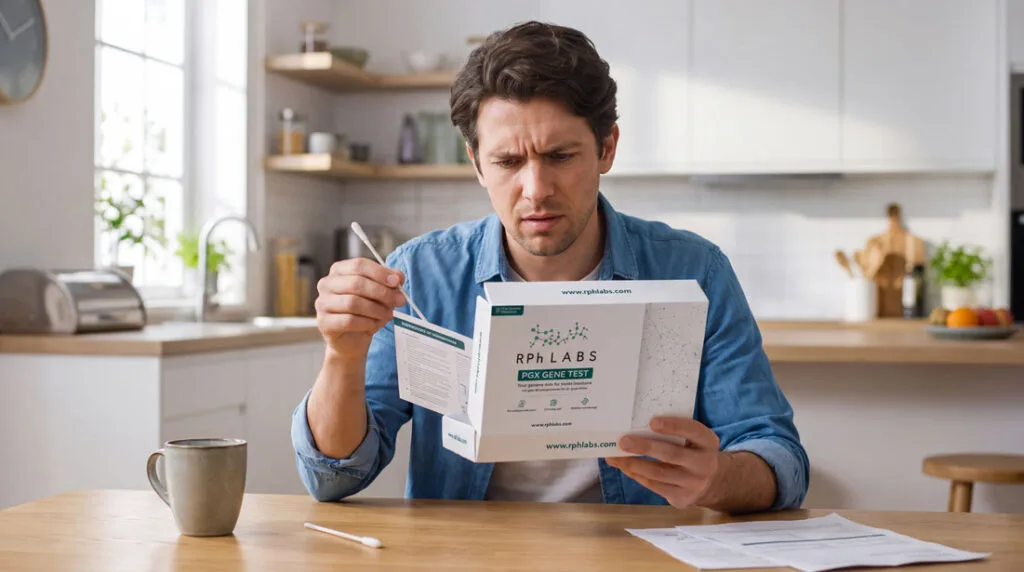
Every pharmacogenomic testing video here is a short explainer on how the test works, start to finish. Start with the 1:17 overview, then dig into collection, your report, or what a metaboliser status really means.
On this page
Start here
If you watch one thing before ordering, watch this. Just over a minute on what the test reads, what it cannot tell you, and what arrives at the end.
What a pharmacogenomic test actually is
Why the six-week trial-and-error cycle exists, how your genes change the way you handle a medication, and what comes back from a single cheek swab: 20 genes, around 240 medications, in a report your prescriber can use.
How to collect your sample
Unboxing the kit, the thirty-minute clean-mouth window, how firmly and how long to rub each cheek, the two identifiers the lab needs on the tube, and how to seal it and send it back.
What the overview video covers
The overview pharmacogenomic testing video, in writing, for anyone who prefers to read.
Pharmacogenomic testing reads the genes that control how your body absorbs, activates and clears medications. Most of them code for liver enzymes in the CYP450 family, such as CYP2D6, CYP2C19 and CYP2C9, plus transporters and immune genes such as SLCO1B1 and HLA-B. Small inherited differences in those genes explain why the same dose of the same drug can be too much for one person and too little for the next.
The test itself is a cheek swab you collect at home. The laboratory reads a clinical panel of these genes and turns each result into a metabolizer status, then applies published guidance from the Clinical Pharmacogenetics Implementation Consortium (CPIC) and FDA drug labeling to 240+ medications.
Every medication in your report lands in one of three bands: standard precautions, use with caution, or consider alternatives. A licensed PharmD pharmacist reviews the report before it is released, and a free consultation is included so someone walks you through it.
What the test cannot do matters just as much. It does not diagnose disease, it cannot guarantee that a drug will work, and it never replaces your prescriber’s judgment. It narrows the options and informs the dose, so the first prescription is more likely to be the right one.
Why pharmacists lead these explainers
Pharmacogenomics sits between genetics and pharmacy. The question a result answers is a prescribing one, which drug and what dose, so the people best placed to explain it are pharmacists who spend their day on exactly that. Every report is reviewed by a licensed PharmD before release, and the same team records these films and takes the consultation calls.
That also means the explainers stay practical. They skip the lab chemistry and focus on what you will actually see: what to do with the swab, what the bands in the report mean, and what to bring to your prescriber.
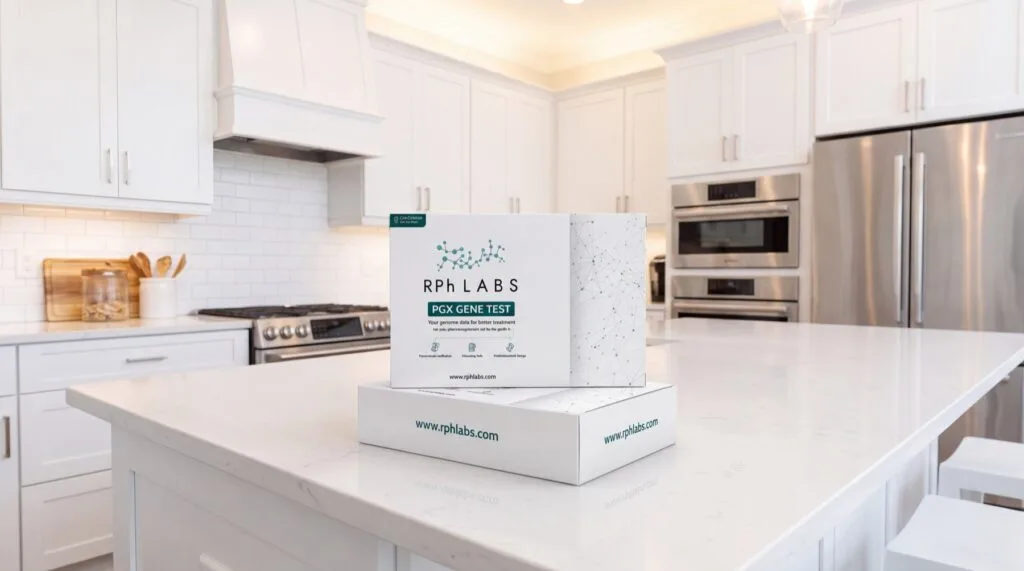
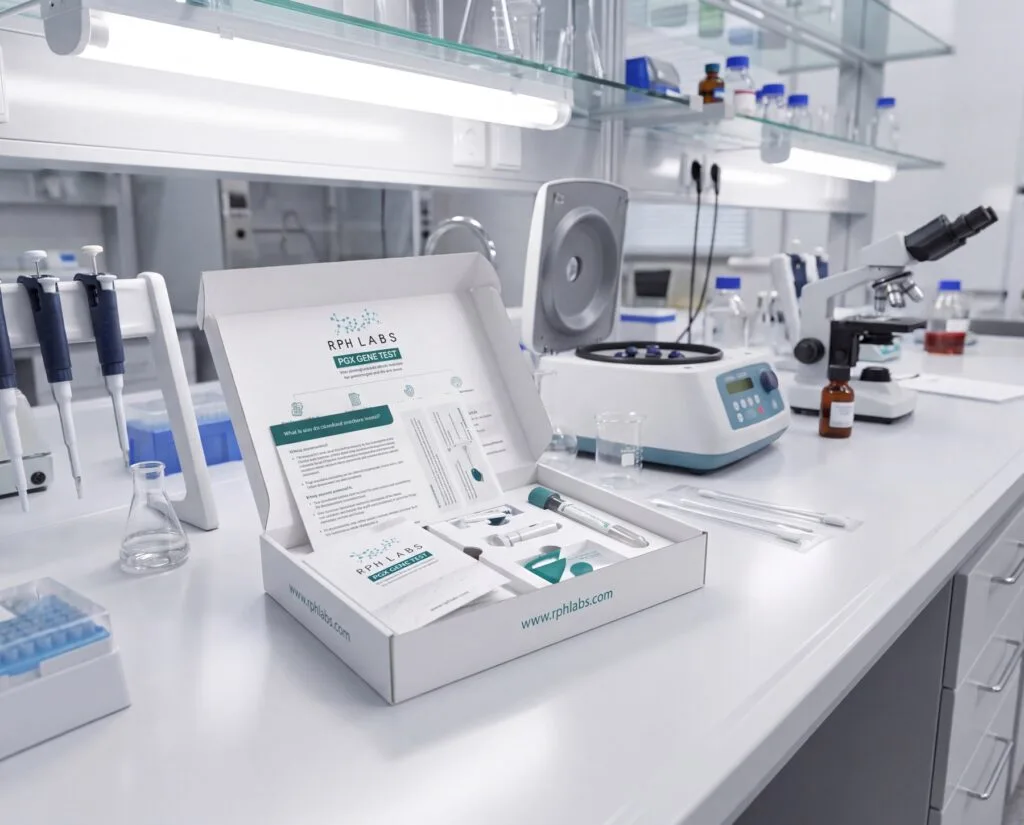
What arrives in the box
- Two sterile cheek swabs: enough for the full panel, with a spare in case a collection needs repeating.
- A registration card: activate the kit online in a minute so the sample is tied to your account.
- A prepaid return mailer: postage is covered both ways; seal it and drop it in any mailbox.
- Step-by-step instructions: a plain-language collection guide, plus a pharmacist line if you get stuck.
Kits ship within one business day and usually arrive in two to four business days. Ordering for several people? Each kit is registered to one individual, so order one per person.
Everything in the box is labeled, and the instructions match the collection video step for step, so you can follow along on your phone while you swab. Keep the box until your sample has been received, in case you need the spare swab.
Cheek swab DNA test, step by step
The collection video, written out. A cheek swab DNA test takes about two minutes and needs no needle or appointment.
A cheek swab DNA test collects cells from the inside of your mouth. The DNA in those cells is the same as the DNA in your blood, so for genotyping a swab works just as well as a blood draw. Here is how to collect a sample that passes the laboratory’s quality checks the first time:
- Wait thirty minutes. Do not eat, drink, smoke, chew gum or brush your teeth for thirty minutes before you swab, so the sample is not diluted or contaminated.
- Activate the kit. Register the kit ID online first, so the sample is linked to your account.
- Swab both cheeks. Rub the swab firmly on the inside of one cheek for about thirty seconds, then the other. Keep to the cheek, not the gums or tongue, and do not touch the tip.
- Seal it. Place the swab in the transport tube and close it as the instructions show.
- Post it the same day. Put the tube in the prepaid return mailer and drop it in any mailbox.
The kit includes two sterile swabs, so there is a spare if a collection goes wrong. If a sample still fails quality control at the laboratory, it is re-run at no charge, and a replacement kit is sent free if a second sample is needed.
Common collection mistakes
Most failed samples come down to one of these, and all of them are easy to avoid.
- Eating or drinking too soon. Food, coffee or mouthwash in the thirty minutes before swabbing can dilute or contaminate the sample.
- Swabbing too lightly. The swab should press firmly enough to collect cells from the cheek lining, not just saliva.
- Touching the tip. Handle the swab by the stem only, and do not let the tip touch a counter or your fingers.
- Skipping activation. A sample that is not registered to an account cannot be matched to a person, which delays results.
- Waiting to post it. Send the sample the same day, and avoid leaving it in a hot car or mailbox for long.
If something does go wrong, call us before you post the sample. The spare swab in the box usually means you can simply collect again.
Poor, intermediate and ultra rapid metabolizer types
What a metabolizer status really means, from the report video.
For each enzyme gene, your report gives a metabolizer status. It describes how much working enzyme your genes make, and it decides how a medication on the panel is likely to behave in your body.
Poor metabolizer
A poor metabolizer has little or no working enzyme. Drugs that the enzyme clears can build up to higher levels, with more side effects at a standard dose. Prodrugs, which the enzyme has to activate, may barely work: a CYP2C19 poor metabolizer activates clopidogrel poorly, and a CYP2D6 poor metabolizer gets little pain relief from codeine.
Intermediate metabolizer
An intermediate metabolizer has reduced enzyme activity, between poor and normal. Often a standard dose is fine, but for some drugs guidelines suggest a lower starting dose or closer monitoring, and for some prodrugs an alternative is preferred.
Normal metabolizer
A normal metabolizer processes the drug the way its label expects, and standard dosing applies.
Rapid and ultra rapid metabolizer
A rapid or ultra rapid metabolizer has more enzyme activity than usual, sometimes because they carry extra copies of the gene. Active drugs can be cleared before they reach an effective level, so an antidepressant may seem not to work. Prodrugs can be converted too quickly: an ultra rapid metabolizer for CYP2D6 can turn codeine into dangerous amounts of morphine, which is why guidelines advise avoiding it.
Your status can differ from gene to gene: the same person can be a poor metabolizer for CYP2C19 and an ultra rapid metabolizer for CYP2D6. Other medications can also change how you behave in practice, so your prescriber reads the result alongside your full medication list. See every drug linked to each gene in the medication list.
Examples by gene
How the same idea plays out across the most common genes on the panel.
- CYP2D6: processes many antidepressants, antipsychotics and beta-blockers, and activates codeine, tramadol and tamoxifen. It is also the gene where people most often carry extra or missing copies.
- CYP2C19: activates clopidogrel and clears several SSRIs, benzodiazepines and proton pump inhibitors.
- CYP2C9 and VKORC1: together set the right starting dose of warfarin; CYP2C9 also clears many NSAIDs.
- SLCO1B1: a liver transporter; reduced function raises the risk of muscle side effects on some statins.
- TPMT and NUDT15: clear thiopurine drugs such as azathioprine; low activity means a much lower dose.
- HLA-B: certain variants flag a risk of severe allergic reactions to abacavir, carbamazepine or allopurinol before the first dose.
Reading your report
The report walkthrough, in writing.
The report is written to be read twice: once by you in plain language, and once by your prescriber with the genotypes, phenotypes and guideline citations attached. The first pages summarize the medications where your genes matter most; the rest lists every drug on the panel in its band.
- Start with the summary. It lists any medications in the use with caution or consider alternatives bands.
- Check your current medications. Find each one and note its band and the gene behind it.
- Look up your metabolizer statuses. Whether you are a poor metabolizer, an intermediate metabolizer or an ultra rapid metabolizer for a gene explains why a drug is flagged.
- Bring it to your prescriber. The one-page summary fits a normal appointment; the full report goes in your chart.
Never stop or change a medication on your own because of a result. Book your free consultation and a pharmacist will go through the report line by line, and can speak to your prescriber directly.
An illustrative example
A made-up example, simplified, of how one result changes a plan.
Imagine someone taking sertraline for anxiety, who has had side effects at a standard dose, and whose doctor is considering codeine after a minor operation. Their report shows they are a CYP2C19 poor metabolizer and a CYP2D6 normal metabolizer.
For sertraline, the CYP2C19 result places it in the use with caution band: a poor metabolizer clears it more slowly, which can explain the side effects, and guidelines suggest a lower dose or a different SSRI. For codeine, the normal CYP2D6 result places it in standard precautions. The prescriber now has a reason for the side effects and a clear plan for the pain relief, before anything is changed.
Real reports cover every medication on the panel, and your pharmacist will walk you through your own results, gene by gene, during the consultation.
Questions to ask your prescriber
Take these to the appointment where you share your report.
- Which of my current medications are affected by my results?
- Should any dose change, or is there a better option in the same class?
- Do any of my other medications change how these genes behave?
- How will we use the report the next time a new medication is proposed?
- Would it help for you to speak with the RPh Labs pharmacist who reviewed my report?
Our pharmacists will speak with your prescriber directly at your request, and follow-up consultations when a new medication is proposed are included.
Testing children and older adults
A cheek swab needs no needle, so collection is easy for children, with a parent or guardian helping and signing. Results are relevant at any age for the drugs on the panel, and because genes do not change, a result taken in childhood stays useful for life.
For older adults the value is often cumulative. Someone taking several medications may have more than one with a gene-drug interaction, and a single report lets a prescriber or pharmacist review all of them at once during a medication review.
Words you will hear in the videos
- Genotype: the specific versions of a gene you carry, written as star alleles such as CYP2C19*1/*2.
- Phenotype: what the genotype means in practice, such as normal, intermediate or poor metabolizer.
- Star allele: a named version of a pharmacogene, each linked to a known level of enzyme activity.
- Prodrug: a medication that has to be activated by an enzyme before it works, such as codeine or clopidogrel.
- CPIC: the Clinical Pharmacogenetics Implementation Consortium, which publishes the dosing guidelines the report follows.
- Phenoconversion: when another drug makes you behave like a different metabolizer type than your genes predict.
- The three bands: standard precautions, use with caution, and consider alternatives, the categories every medication in your report falls into.
Before you order
The test is a one-time $299, with free shipping both ways, a pharmacist consultation and lifetime report updates included. You can pay in four interest-free installments, use HSA or FSA funds, or check whether your plan covers it on the insurances page.
We currently serve 45 states; see where we serve. For the full written walkthrough, read how the at-home test works, or browse the pharmacogenomic testing FAQ for fifty more answers.
After you watch
- Check your current medications in the medication list.
- Order the at-home test kit when you are ready.
- Book a free consultation if you would rather talk it through first.
- Clinicians: see ordering for your patients.
Pharmacogenomic testing video FAQ
How long is each pharmacogenomic testing video?
The overview runs 1:17, the collection film under three minutes, and the report walkthrough about six. Each has a written companion on this page.
Is a cheek swab DNA test as accurate as a blood test?
Yes, for genotyping. A cheek swab carries the same DNA as a blood sample, and samples are processed in a CLIA-certified laboratory.
What is a poor metabolizer?
Someone whose genes make little or no working enzyme for a given drug pathway. Active drugs can build up and cause side effects, while prodrugs such as codeine or clopidogrel may not be activated enough to work.
What is an ultra rapid metabolizer?
Someone with more enzyme activity than usual, sometimes from extra copies of a gene. Active drugs may be cleared before they work, and prodrugs such as codeine can be converted too quickly.
What is an intermediate metabolizer?
Someone with reduced enzyme activity, between poor and normal. Some drugs need a lower starting dose or closer monitoring.
Can I talk to a pharmacist instead of watching?
Yes. The consultation is free, takes about twenty minutes, and there is nothing to sign.
Questions the videos did not answer?
Talk to a pharmacist before you buy. The consultation is free, takes about twenty minutes, and there is nothing to sign.