
Frequently asked questions
Everything people ask about pharmacogenomic testing
Forty-nine answers on the science, the sample, the report and the money. If yours is not here, call (888) 383-2181 from 9am to 5pm CT, or write to [email protected].
The basics
Pharmacogenomics sits between genetics and pharmacy, so most questions start here: what the test reads, who it is for, and why one sample stands for the rest of your life.
What is pharmacogenomic (PGx) testing?
Pharmacogenomic testing is a genetic test that reads the genes controlling how your body absorbs, activates and clears medications. Those genes code for liver enzymes and drug transporters: the CYP450 family, SLCO1B1, VKORC1 and others, and small inherited differences in them explain why the same 20mg tablet can be too much for one person and too little for the next. A PGx test does not tell you what conditions you have; it tells your prescriber how you are likely to respond to the drugs they are already considering, before the trial-and-error starts.
Is this the same as an ancestry or wellness DNA test?
No. Consumer ancestry kits genotype a broad, shallow set of markers chosen for traits and heritage, and they are not built to guide medical care. RPh Labs runs a clinical pharmacogenomic panel in a CLIA-certified, CAP-accredited laboratory, reporting only the pharmacogenes that change prescribing, at the depth required for star-allele calling, including the copy-number and hybrid-gene analysis that CYP2D6 demands. Every result is reviewed and interpreted by a licensed PharmD pharmacist before it reaches you.
Is it a diagnostic test?
No. Pharmacogenomic results inform prescribing; they do not diagnose disease and they do not replace clinical judgement, therapeutic monitoring or your own symptom history. Think of the report as one more input on the prescribing decision alongside your kidney and liver function, your other medications and your response so far. Never start, stop or change a medication on the basis of the report without your clinician.
Who benefits most from pharmacogenomic testing?
Anyone taking more than one long-term medication, anyone who has had a poor response or an unusual reaction to a drug, and anyone about to start a medication with a narrow therapeutic window. In practice the highest-yield groups are people managing depression and anxiety, chronic pain, cardiac and clotting conditions, reflux, autoimmune disease and cancer therapy, areas where gene–drug guidance is best established. Polypharmacy patients over 60 often see the most immediate change, because the report surfaces interactions as well as metaboliser status.
Is there an age limit for testing?
We test adults 18 and over by self-order. Minors can be tested on a prescriber’s order with a parent or guardian giving written consent, which is common in paediatric psychiatry and oncology where dosing decisions carry real weight. Because genotype is fixed at birth, a test taken at any age remains valid for the rest of the patient’s life.
Do I need a doctor to order the test?
No. You can order the kit yourself, collect the sample at home and share the report with whichever clinicians you choose: primary care, psychiatry, cardiology, your pharmacist. A licensed clinician reviews every self-ordered requisition, and a pharmacist reviews the report before it is released to your account. Prescribers ordering for their patients use the provider portal and receive results directly.
Do I need to be tested more than once?
No. Your genome does not change, so one pharmacogenomic test stands for life and can be reused every time a new prescription is written. What does change is the science built on top of it: when a covered drug’s FDA labelling or a CPIC guideline is updated in a way that affects your genotype, we reissue your report and email you the new version at no extra cost.
The science
Every recommendation in your report traces back to a named gene, a published guideline and an FDA label. These answers cover the panel itself and how far the evidence reaches.
Which genes does the panel test?
The core pharmacogenes that drive the majority of clinically actionable gene–drug pairs: CYP2D6, CYP2C19, CYP2C9, CYP3A4 and CYP3A5, CYP1A2, CYP2B6, VKORC1, SLCO1B1, DPYD, TPMT, NUDT15, UGT1A1, plus the hypersensitivity markers HLA-B*15:02 and HLA-B*57:01. MTHFR, COMT and factor V Leiden are reported where they inform therapy. Together these cover the enzymes responsible for metabolising the large majority of commonly prescribed small-molecule drugs.
What does metaboliser status mean?
Metaboliser status summarises how fast a given enzyme processes a drug, and it is the single most useful line in your report. Poor metabolisers clear a drug slowly and can accumulate it at a standard dose; ultrarapid metabolisers clear it so quickly that a standard dose may never reach therapeutic effect; intermediate and normal metabolisers sit between. For prodrugs such as codeine or clopidogrel the logic inverts, because a poor metaboliser cannot activate the drug at all, and that reversal is exactly the kind of reversal the report spells out rather than leaving to inference.
Which medications are covered?
More than 240 commonly prescribed medications, weighted towards the classes where gene–drug evidence is strongest: antidepressants and antipsychotics, antiplatelets and anticoagulants, statins, opioids and NSAIDs, proton-pump inhibitors, immunosuppressants, antifungals, anticonvulsants and several oncology agents. The medication list names the gene behind each drug so you can check a specific prescription before you order.
Where does your dosing guidance come from?
Published CPIC and DPWG guidelines, FDA drug labelling and the peer-reviewed pharmacogenomic literature, not proprietary scoring. Every recommendation in the report cites the guideline that supports it, with the evidence level attached, so your prescriber can read the source rather than take our word for it. Where guidelines disagree or evidence is thin, the report says so instead of manufacturing a confident answer.
How accurate is the genotyping?
Analytical accuracy for the reported variants exceeds 99%, and every batch runs with positive, negative and no-template controls. Samples that fail quality control are re-extracted and re-run at no charge; if a second sample is needed we ship a replacement kit free. The laboratory is CLIA-certified and CAP-accredited, and participates in external proficiency testing for pharmacogenomic markers.
Can the test predict whether a drug will work?
It predicts drug exposure reliably; it predicts the whole clinical response only in part. Genetics explains a meaningful share of how much active drug reaches your system, but kidney and liver function, diet, smoking, alcohol, other medications, age, weight and adherence explain the rest. The honest framing is that pharmacogenomics narrows the field and shortens the trial-and-error, rather than guaranteeing the outcome of any single prescription.
Does ancestry affect pharmacogenomic results?
Variant frequencies differ substantially between populations, and panels built only on European cohorts systematically miss alleles that matter elsewhere. Ours deliberately includes variants common in African, East Asian, South Asian, Middle Eastern and Indigenous American ancestries, among them CYP2D6*17 and *29, CYP2C19*3, CYP2C9*5, *6, *8 and *11, and NUDT15*3, so that the call is as reliable for one patient as the next.
Does the panel cover HLA hypersensitivity risk?
Yes. HLA-B*57:01, which predicts abacavir hypersensitivity, and HLA-B*15:02, which predicts carbamazepine-induced Stevens–Johnson syndrome in at-risk ancestries, are both reported. Both carry boxed-warning relevance in FDA labelling, and both are examples of a single genotype preventing a severe, sometimes fatal reaction before the first dose is taken.
Sample and kit
Collection is a two-minute cheek swab at your own table, with prepaid postage both ways. Here is what arrives, how to swab it correctly, and what happens if something goes wrong.
What kind of sample do you need?
A simple buccal (cheek) swab. There is no blood draw, no needle, no fasting and no clinic visit. You rub the swab along the inside of your cheek for about thirty seconds per side, seal it in the transport tube and post it back. Collection takes roughly two minutes at your kitchen table, and the DNA in a cheek swab is identical to the DNA in a blood sample for genotyping purposes.
Do I have to fast or stop my medications first?
No, and you should not stop any medication to take this test. Nothing you eat, drink or take changes your DNA, so results are unaffected by your current prescriptions. The only instruction is practical: avoid food, drink, chewing gum and tobacco for thirty minutes before swabbing so the sample is not diluted or contaminated.
How long does the kit take to arrive?
Kits ship within one business day of your order and typically arrive in two to four business days by standard post. Return postage is prepaid and already in the box, so the sample goes back the same day you collect it. Total turnaround from order to report is usually two to three weeks, most of which is laboratory analysis rather than shipping.
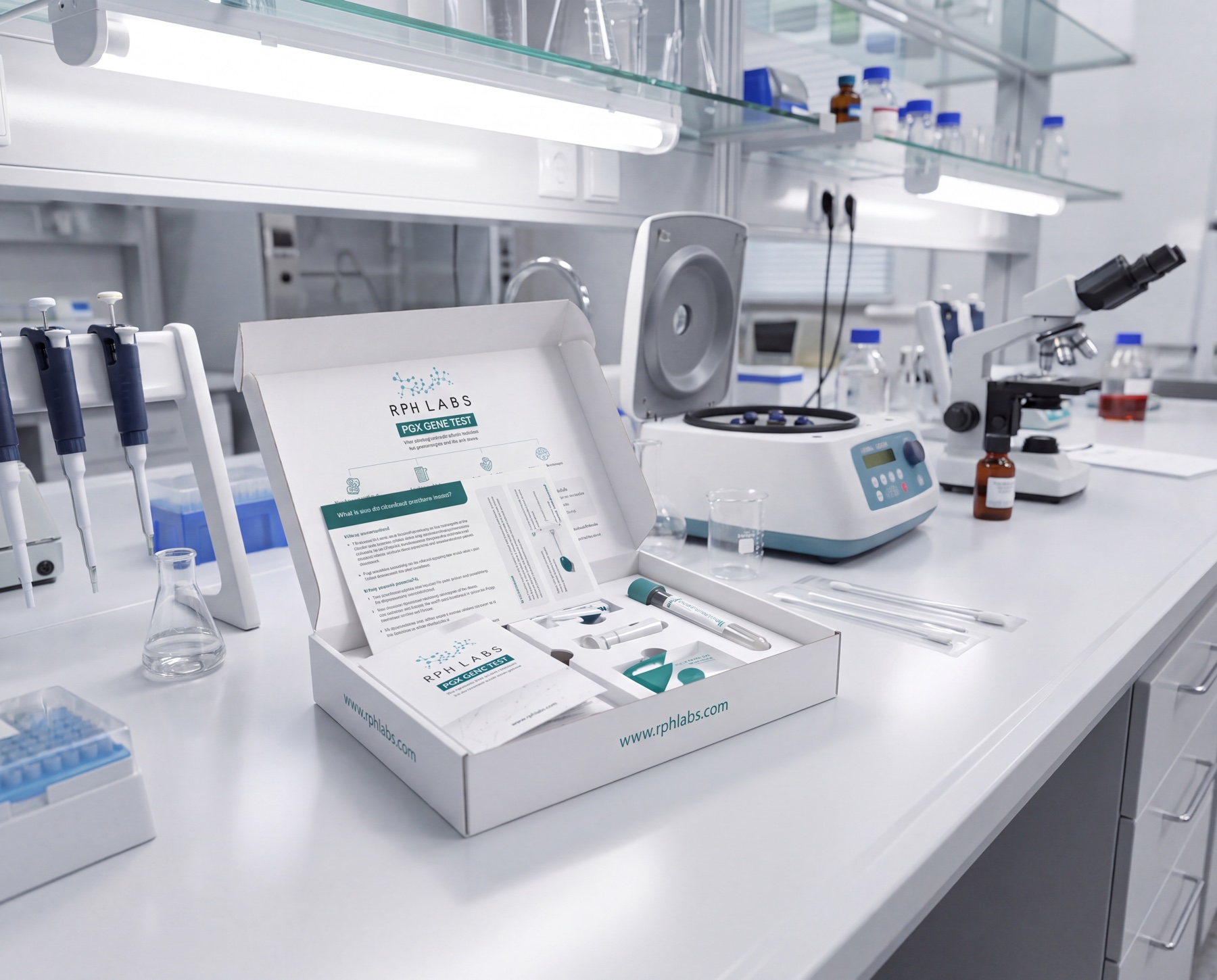
What is in the box?
Two sterile collection swabs, a labelled transport tube with stabilising solution, the requisition and consent form, illustrated step-by-step instructions, a registration card with your kit ID, and a prepaid return mailer. Register the kit ID in your account before you swab, because that is what links the sample to you and lets you track it through the laboratory.
What happens if I collect the sample incorrectly?
Quality control catches an insufficient or degraded sample before analysis begins, so a bad swab never becomes a bad result. If that happens we mail you a replacement kit free of charge and re-run the test at no cost. It affects a small share of orders, usually where the swab was returned damp or the thirty-minute clean-mouth window was missed.
Can I track my sample through the laboratory?
Yes. Your account shows four states (kit shipped, sample received, analysis in progress, report ready) and you are emailed at each transition. If a sample has not been scanned in within ten days of you posting it, contact us and we will trace it or reissue the kit.
Can more than one person use the same kit?
No. Each kit is registered to one person and one requisition, because the genotype has to be tied unambiguously to a named patient and their medication list. Order a kit per person; household and family orders can be placed together at checkout and shipped in one parcel.
How long do you keep my sample?
The physical sample is destroyed after analysis unless you ask us in writing to retain it for possible future testing. Retention is opt-in and never the default, and you can revoke it at any time. Destroying the sample does not affect your report, which stays in your account indefinitely.
Your report
The report is written to be read twice: once by you in plain language, once by your prescriber with the genotypes and citations attached. These answers cover timing, format and updates.
How long do results take?
Seven to ten business days from the moment your sample reaches the laboratory, plus shipping each way, so most people have a report two to three weeks after ordering. You are emailed as soon as it is posted to your account. Complex genotypes that need confirmatory work, particularly CYP2D6 copy-number calls, occasionally add a few days, and we tell you if that applies to you.
What does the report actually say?
Every covered medication is sorted into one of three bands (use as directed, use with caution, or consider an alternative) with the gene and variant behind the call, the predicted metaboliser phenotype, the specific dosing note from the guideline, and a named substitute where one exists. Drug–drug, drug–food and organ-function interactions are flagged alongside the genetic findings, because in real prescribing those rarely arrive separately.
Will someone explain the results to me?
Yes, and it is included in the price, not an upsell. Licensed PharmD pharmacists and genetic counsellors take one-to-one consultations by phone or video, will walk through the report line by line, and will speak directly with your prescriber at your request. Follow-up consultations when a new medication is proposed are also included.
What format does the report come in?
A clinical PDF in your account with genotypes, phenotypes and guideline citations for your prescriber, plus a plain-language summary written for you rather than for a clinician. Both can be downloaded and printed as often as you like, and a one-page wallet card lists your key metaboliser statuses for pharmacy visits and emergencies.
Do you update the report over time?
Yes, at no cost. When a covered drug’s FDA labelling or a CPIC guideline changes in a way that affects your genotype, or when a newly approved medication joins the panel, we regenerate your report and email you the new version. This is what makes a one-time test durable: the genotype is fixed, but the interpretation keeps improving.
What if a medication I take is not on the panel?
The report lists it as untested rather than implying it is safe. Absence of a call means we have no genetic evidence for that drug, not that there is no interaction, which is an important distinction your pharmacist will make too. If a drug matters to you, check the medication list before ordering and we will confirm coverage.
Will the results tell me about disease risk?
No. The panel is deliberately confined to pharmacogenes, and we do not report carrier status, disease predisposition, ancestry or any trait finding. If you want that information, it is a different kind of test with different counselling requirements. Keeping the scope narrow is also what keeps the report usable in a short clinical appointment.
Working with your prescriber
A report only helps if it reaches the person writing the prescription. Our pharmacists will join that conversation, and these answers cover how the handoff usually goes.
What if my doctor has never used PGx testing before?
That is common, and it is exactly why the pharmacist consultation is included. Our PharmD team will join a call with your prescriber, walk through the genotype, and cite the CPIC guideline or FDA label behind each recommendation so the conversation happens in the evidence rather than in opinion. Most clinicians engage quickly once they see the drug they are actually prescribing named in the guideline.
Should I stop a medication because of my result?
Never on your own. A flagged medication may still be the right medication at a different dose or with closer monitoring, and abrupt discontinuation carries its own risks. Changes to psychiatric, cardiac, anticoagulant and anticonvulsant therapy in particular must be planned and supervised by your prescriber.
Can the report explain a medication that already failed me?
Often, yes, and this is one of the most common reasons people test. A drug that did nothing at a standard dose, or caused side effects at a low one, is precisely the pattern an ultrarapid or poor metaboliser status can explain. Knowing that also stops the same mistake being repeated with a chemically related drug cleared by the same enzyme.
Does it help with dose, or only with drug choice?
Both. Where a guideline gives a numeric adjustment such as a 50% starting-dose reduction, a slower titration schedule, an alternative loading strategy, or a recommendation to avoid the drug entirely, the report states it explicitly rather than leaving your prescriber to look it up.
Can my pharmacist use the report?
Yes. Community and clinical pharmacists routinely use pharmacogenomic reports to flag interactions at the point of dispensing and to suggest alternatives to the prescriber. Share the PDF and ask them to file it against your record so it is checked every time a new prescription is filled.
Is pharmacogenomic testing accepted in clinical practice?
Yes, within a defined scope. FDA labelling for well over a hundred medications references pharmacogenomic information, CPIC guidelines are implemented across major health systems, and several academic centres now test pre-emptively before prescribing. It is an established prescribing aid with a published evidence base, not a replacement for monitoring and not a fringe test.
Privacy
Genetic data is protected health information and we treat it that way. Nothing is sold, nothing is shared with insurers or employers, and research use is strictly opt-in.
Who can see my results?
You, and anyone you explicitly choose to share the report with. Results are protected health information handled under HIPAA and held in an access-controlled account with audit logging. Laboratory staff see only what is needed to run and review the test, and no clinician outside your care receives the report unless you send it to them.
Do you sell genetic data?
No. We do not sell, license or trade genetic data, and we do not share it with insurers, employers, marketers or data brokers. There is no commercial partnership behind the price, which is why the test costs what it costs.
Can my insurer use this against me?
The Genetic Information Nondiscrimination Act (GINA) prohibits health insurers and employers from using genetic information in coverage, underwriting or employment decisions, and many states add further protection. GINA does not extend to life, disability or long-term care insurance, so if you are planning to apply for those policies, read their terms before testing.
Is my data used for research?
Only if you opt in, and only in de-identified form under a separate consent you can withdraw at any time. Declining changes nothing about your test, your report, your consultation or your price. The opt-in is genuinely optional, not a condition of service.
Can I have my data deleted?
Yes. Write to us and we will delete your genetic data and destroy any retained sample, subject only to the record-retention period that clinical laboratories are legally required to observe under CLIA. We will confirm in writing when the deletion is complete.
Cost and coverage
One price covers the kit, the analysis, the report and the pharmacist consultation, with no fees added later. These answers cover payment routes, coverage and the states we can serve.
How much does pharmacogenomic testing cost?
$299 covers the kit, laboratory analysis of the full panel, the written report and the pharmacist consultation, with shipping paid in both directions. Four interest-free instalments are available at checkout. Compared with the cost of a single failed medication trial, meaning weeks of symptoms, a wasted prescription and another appointment, most patients treat it as a one-time cost against a lifetime of prescribing.
Can I pay with HSA or FSA funds?
Yes. The test is HSA and FSA eligible, and an itemised receipt with the relevant documentation is issued with your order so you can submit it to your plan administrator without chasing us for paperwork.
Is pharmacogenomic testing covered by insurance?
We work with a range of providers and accept claims, but coverage depends on your plan, your diagnosis codes and the plan’s medical-necessity criteria. Coverage is far more likely when you are already taking, or about to start, a drug with recognised gene–drug guidance. Ask us to check your benefits before you order and we will tell you what to expect rather than surprise you afterwards.
Does Medicare cover it?
Medicare covers pharmacogenomic testing in defined circumstances, generally when the beneficiary is taking or about to begin a medication with FDA labelling or CPIC guidance tied to a tested gene. Coverage is decided case by case against the applicable local coverage determination, and we can review your situation before you order.
Which states do you ship to?
Forty-five states. State law currently prevents us from shipping kits to New York, Maryland, Pennsylvania, Rhode Island or California. If you live in one of those states, a prescriber-ordered test through a local laboratory may still be available to you, so ask us and we will point you in the right direction.
Can I get a refund?
Yes, in full, at any time before your sample reaches the laboratory. Just contact us and return or discard the kit. Once analysis has begun the test cannot be refunded, because the laboratory work has already been performed. If a sample fails quality control, we re-test rather than refund, at no cost to you.
Still deciding?
Talk to a pharmacist before you buy. The consultation is free, takes about twenty minutes, and there is nothing to sign.