
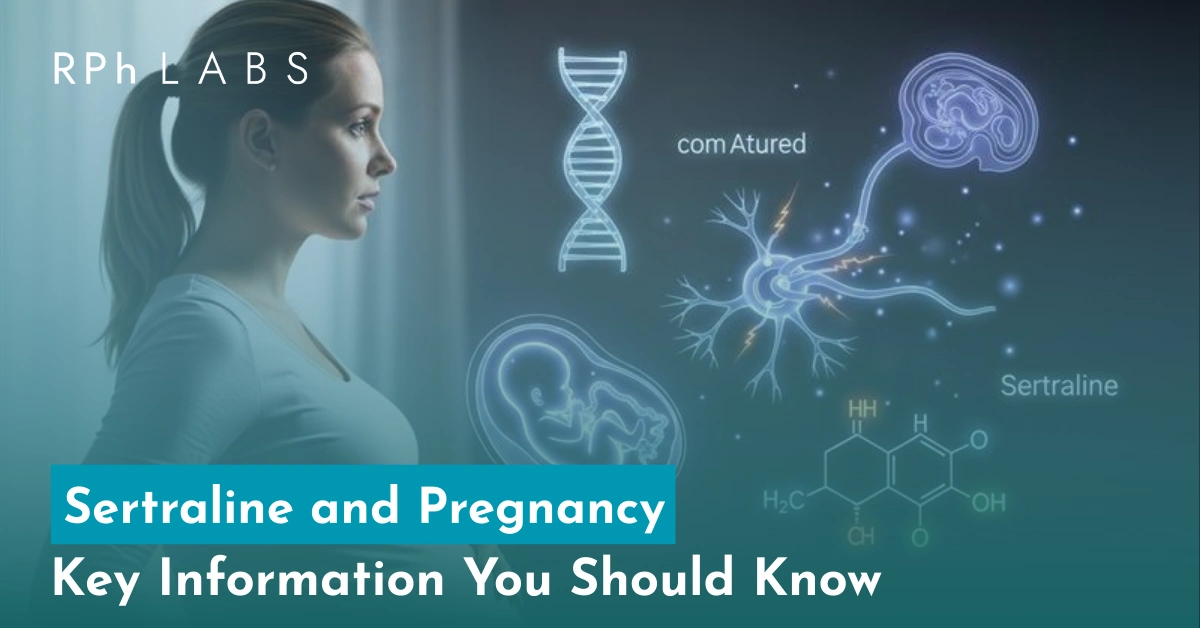
Decisions about sertraline and pregnancy are rarely about the drug alone. They weigh the risks of a medicine against the risks of leaving depression or anxiety untreated, and both sides are real. Here is how clinicians approach that balance, and what to ask your obstetric and mental health team.
On this page
Sertraline is a popular medication in the category of selective serotonin reuptake inhibitors (SSRIs) that is mainly prescribed for depression, anxiety, obsessive-compulsive disorder (OCD), and post-traumatic stress disorder (PTSD). However, in pregnancy, the administration of any medication during pregnancy brings into question the risk to the mother and the developing child. If you are pregnant or trying to become pregnant and are taking sertraline or if you intend to take it as a form of treatment, then you must know the benefits and also the risks.
What is Sertraline?
Sertraline, sold as Zoloft, is an SSRI antidepressant. It works by raising the level of serotonin, a chemical messenger that contributes to mood, anxiety, and other brain functions. Sertraline prevents the reuptake of serotonin, keeping it in the brain longer to produce improved mood and symptom relief of mental illness.
Sertraline and Pregnancy: What Research Shows
The connection between sertraline use during pregnancy and risk is currently under investigation. Whether SSRIs, such as sertraline, influence pregnancy, fetal development, and long-term child health has been studied. Here is a summary of the overall findings:
First Trimester Risks
In the first trimester, when the organs of the baby are developing, there are fears that drugs such as sertraline may cause birth defects. Most studies, however, conclude that the risk of significant birth defects with sertraline use during early pregnancy is low. An extensive survey of the National Birth Defects Prevention Study did not find an increased risk of substantial birth defects in women who used sertraline during the first trimester.
Chances of Miscarriage
There have been some study hints of a slight risk increase of miscarriage with the administration of SSRIs, including sertraline, during early pregnancy. However, the risk is low overall, and further evidence is required to draw firm conclusions. It must be noted that depression or anxiety that goes untreated in pregnancy also has the potential to cause complications, and, therefore, the decision to withdraw or continue drugs must be weighed suitably.
Preterm Delivery and Low Birth Weight
Some research indicates that SSRIs like sertraline could lead to low birth weight or preterm delivery by a small proportion. However, the evidence is not conclusive, and most of these dangers could be due to the condition being treated and not the drug.
Neonatal Adaptation Syndrome
The most discussed effect of sertraline exposure late in pregnancy is Neonatal Adaptation Syndrome, also called poor neonatal adaptation. It is a short period of adjustment in some newborns whose mothers took an SSRI in late pregnancy, not an injury to the baby. Reported signs include jitteriness or irritability, mild breathing changes, feeding difficulty, and trouble holding body temperature.
They are usually mild, need only observation and support, and settle within a few days, though they are unsettling for parents. It is a different thing from neonatal abstinence syndrome, which follows opioid exposure, even though both are sometimes shortened to the same initials.
Persistent Pulmonary Hypertension of the Newborn (PPHN)
A potential connection has been challenged between SSRIs, such as sertraline, and Newborn Persistent Pulmonary Hypertension (PPHN), a severe and unusual condition in which a newborn’s circulatory system fails to adapt following birth, leading to breathing trouble. Several studies indicate that late pregnancy exposure to SSRIs may pose a risk for PPHN, but this is not yet established.
Long-Term Impact on Child Development
Evidence on the long-term developmental impact of sertraline exposure in pregnancy is still limited. There have been some reports, however, that children exposed to SSRIs in pregnancy might be at a small, but perhaps slightly increased, risk of delayed development, e.g., of language or motor skills. This risk appears to be very small but is an area where research is needed.
Balancing the Risks: What Do You Do?
If you are pregnant or could become pregnant, be sure to consider the benefits and risks of using sertraline. Some things you should know are listed below:
Consult Your Healthcare Provider
Do not alter your medication schedule in any way unless your obstetrician and psychiatrist instruct you. They can discuss with you the advantages and disadvantages of staying on sertraline during pregnancy and whether treatment is necessary in addition. If you are treated with sertraline for depression or anxiety, the benefits of staying on treatment for these illnesses during pregnancy far outweigh the disadvantages if the disease is severe.
Consider Non-Medication Therapies
For some women, therapy and lifestyle change are good alternatives to medications like sertraline. Cognitive-behavioural therapy (CBT), mindfulness exercises, or support groups may be beneficial tools for handling mental health during pregnancy. Speak with your medical professional to learn what would suit your mental well-being.
Be Vigilant of Side Effects
If you persist in taking sertraline while pregnant, your doctor will need to closely follow up and monitor you. Make sure to report any new or worsening symptoms, both emotional and physical, to your doctor. If caught early, complications can be avoided, and you and your baby can remain healthy.
Postpartum Considerations
Following birth, the question of whether or not sertraline can affect breastfeeding should be addressed. Sertraline does pass into breast milk, but is not usually harmful to women who are lactating. Every circumstance is unique, however, and your physician can provide guidance regarding substitutes or monitoring techniques if complications arise.
Pharmacogenetic Role in the Control of Sertraline
Pharmacogenetic (PGx) testing is a resource that can help make the administration of sertraline in pregnancy more personalized based on one’s genetic makeup and response to the drug. For sertraline, CYP2C19 is the gene with published dosing guidance, and CYP2B6 also plays a part. Results can show whether you are likely to clear sertraline faster or slower than average, which helps explain side effects at a standard dose or a weak response to one.
What results cannot do is say anything about risk to the baby. No gene on the panel predicts birth defects, neonatal adaptation, or PPHN, and pregnancy itself changes how the body handles medicines. Treat PGx as one input your obstetrician and prescriber weigh alongside your history and how you are actually doing.
Sertraline and pregnancy: 7 important facts to bring to your appointment
These points summarize how the conversation usually goes. Each one is expanded below, and none of them is a reason to change your dose before you speak to your prescriber.
- Stopping an antidepressant abruptly is its own risk, both for withdrawal symptoms and for relapse, so any change is planned rather than sudden.
- Sertraline is one of the more studied SSRIs in pregnancy, which is why it is often part of the discussion.
- The illness being treated also affects pregnancy outcomes, so untreated depression in pregnancy belongs on the risk side of the ledger.
- Absolute risks reported for SSRIs are generally small, and studies struggle to separate the drug from the condition.
- Newborns exposed late in pregnancy are watched for a short adjustment period after birth.
- Sertraline is among the antidepressants most often discussed for use while breastfeeding, because very little reaches milk.
- Your obstetrician, your mental health prescriber and your pharmacist should all be working from the same medication list.
The one message that matters more than any statistic is that sertraline and pregnancy is a shared decision. Two people with the same prescription can reasonably reach different conclusions with their teams.
Why untreated depression in pregnancy belongs in the calculation
It is tempting to treat stopping a medicine as the cautious option. It is not automatically safer, because untreated depression in pregnancy carries its own consequences for a parent and a baby.
- Poor sleep, low appetite and reduced ability to attend prenatal care can follow a relapse, and untreated depression in pregnancy makes each of those harder to correct.
- Severe depression and anxiety raise the risk of self-harm, and that risk is highest when symptoms go unmanaged.
- Relapse risk is real. Many people who stop an antidepressant abruptly during pregnancy become unwell again within months.
- Postpartum depression is more likely in people with a history of depression, so continuity of care through delivery matters.
This is why guidance frames the question as which risk you are choosing rather than whether risk can be avoided. Weighing untreated depression in pregnancy against medication exposure is a clinical judgment made with you, based on how severe your illness has been and how you have responded to treatment before.
If you are having thoughts of suicide or self-harm at any point in pregnancy or after birth, treat it as urgent. In the United States you can call or text the 988 Suicide and Crisis Lifeline at any hour, and call 911 if anyone is in immediate danger.
For general background on depression that is not written by a drug maker, the NIMH page on depression is a reliable place to read.
How the body handles zoloft during pregnancy
Pregnancy changes pharmacology, which is one reason a dose that felt right before conception may feel different later. Blood volume rises, kidney clearance increases and the activity of several liver enzymes shifts across the trimesters.
Sertraline is broken down by several liver enzymes working together, with CYP2C19 carrying a meaningful share and CYP2B6, CYP2C9, CYP3A4 and CYP2D6 contributing. Because the load is shared, no single gene decides your levels.
The practical point about zoloft during pregnancy is that your symptoms may drift in either direction as the pregnancy progresses. Some people need closer monitoring in the third trimester, and any adjustment is made by the prescriber, not at home.
Other medicines can matter more than any of this. Acid reducers such as omeprazole and some antidepressants inhibit CYP2C19, so let your pharmacist screen your full list, including anything bought over the counter.
A single missed dose of zoloft during pregnancy is not an emergency, but repeated gaps can trigger withdrawal symptoms and destabilize treatment. Tell your team if doses are being missed because of nausea or vomiting, since that is a solvable problem.
Neonatal adaptation syndrome, in plain terms
The phrase sounds frightening and the reality is usually mild. Neonatal adaptation syndrome describes a short, self-limited period after birth when a baby exposed to an antidepressant late in pregnancy takes a little longer to settle.
Reported features include jitteriness or increased muscle tone, irritability, mild feeding or sleeping difficulty, faster breathing and temperature instability. Most cases are mild and resolve within days with routine newborn care.
It is not the same as neonatal abstinence syndrome from opioid exposure, and it is not evidence of harm to the brain. Neonatal adaptation syndrome is a monitoring issue, and the main practical step is making sure the delivery team knows what you are taking so the nursery is prepared.
Stopping medication late in pregnancy to try to avoid it is not a decision to make alone. It trades a short newborn adjustment period for a higher chance of relapse at the exact moment a new parent needs to be well, and your prescriber will want to weigh that with you.
Ask before delivery who will be watching the baby, for how long, and what would be considered outside the expected range. Hospitals see neonatal adaptation syndrome often enough that the answer should be ready.
Sertraline while breastfeeding
Breastfeeding questions often arrive late, and they deserve an answer before the birth. Sertraline while breastfeeding is one of the better documented situations in this area, and only very small amounts pass into milk.
That is why it is frequently among the options discussed for someone who needs treatment after delivery. It is not a guarantee, and the decision still belongs to you, your prescriber and your baby’s clinician together.
- Tell your baby’s pediatric clinician which medicines you take, so any feeding or sleeping concern is interpreted with that in mind.
- Premature or medically fragile infants warrant extra caution and closer follow-up.
- Do not switch drugs simply because you are breastfeeding, since changing to a less studied medicine may not be an improvement.
- Sleep deprivation makes depression worse, so a feeding plan that protects some sleep is part of treatment, not a luxury.
If you are already stable on the medicine, continuity is usually valuable, and that logic applies to sertraline while breastfeeding as much as to pregnancy itself. Raising sertraline while breastfeeding at a prenatal visit gives everyone time to plan rather than deciding in the first exhausted week.
Where a PGx report helps, and where it does not
Pharmacogenomic testing does not answer safety questions about pregnancy. No genetic report can tell you whether a medicine is right to continue while you are expecting, and it is honest to say that plainly.
What it can inform is dose and drug selection. CYP2C19 carries published guidance for several SSRIs, including sertraline, and CYP2D6 matters for many other antidepressants your prescriber might consider. The CPIC guidelines set out those recommendations, and our article on genetic testing for antidepressants explains what they look like in practice.
There is a second limit worth naming. Pregnancy itself alters enzyme activity, so a genotype result is a baseline rather than a live measurement. That is one more reason it never outranks clinical monitoring.
If that information would be useful for your chart, the RPh Labs at-home PGx kit is a cheek swab covering 20 genes reported against more than 240 medications, with every report reviewed by a PharmD pharmacist and a free consultation included. Results follow 7 to 10 business days after your sample reaches the Dallas lab, and because inherited genes do not change, you only test once. You can look up a specific drug on our medication list.
Building a plan across pregnancy and after
The people who do best usually have a plan written down before anything goes wrong. It does not need to be complicated.
- Name one clinician who owns the mental health prescription, so advice does not come from three directions.
- Agree what early warning signs look like for you, and who to call when they appear.
- Plan the postpartum period at a prenatal visit, including sleep, feeding support and follow-up timing.
- Ask that your obstetric and delivery teams have the medication list well before the due date.
- Keep a single pharmacy so interactions are screened in one place.
Write questions down between visits. Appointments are short, and the question you remember in the car park is usually the important one. Sertraline and pregnancy covers a lot of ground, and no single visit will settle all of it.
Partners and close family can help by knowing the plan too. A second person who recognizes early signs is one of the most useful safeguards there is.
Questions to ask your obstetrician and prescriber
Take this list in with you. Every item is fair game, and a good clinician will welcome questions about sertraline and pregnancy rather than brushing them aside.
- Given my history, what is the chance I become unwell again if we change or stop treatment?
- If we continue, how will we monitor me through each trimester?
- What will the delivery team and the nursery need to know?
- What are the options if symptoms worsen later in pregnancy?
- How does the plan change if I intend to breastfeed?
- Would non-medication treatment such as therapy add to the plan in my case?
One request applies to every visit. Do not start, stop or adjust a dose based on an article, including this one. Bring what you read to the person who knows your history, and make the decision together.
Conclusion
While sertraline is safe during pregnancy under medical guidance, it is far from riskless. The risk of the following complications will need to be balanced against the value of treating mental illness with pregnancy: neonatal adaptation syndrome, preterm birth, and PPHN. Each pregnancy is unique, and therefore, the choice of continuing or stopping sertraline would be made together with your doctor, considering your mental status, the degree of your illness, and other individual considerations.
If you are pregnant, it is advisable to have an open and continuous conversation with your healthcare provider to ensure the optimal outcome for you and the baby. Also, learn how long zoloft stays in your system.
Sertraline and pregnancy FAQ
Is sertraline safe to take in pregnancy?
Sertraline is one of the better studied SSRIs in pregnancy and is often continued, but no medicine is risk free. Your obstetrician and prescriber weigh the risks of treatment against the risks of untreated depression or anxiety, which are real. Never start or stop it on your own.
Can sertraline lead to birth defects?
Studies indicate that the possibility of birth defects from sertraline is slight, particularly in the first trimester, but always first ask your doctor.
Does sertraline increase miscarriage risk more?
Some research indicates a higher risk of miscarriage, while overall, the risk is minimal. Consider also taking into account the risks associated with untreated depression.
What are the side effects on the baby?
Neonatal Adaptation Syndrome in the baby has been reported when sertraline is exposed in utero, with mild irritability and difficulty with feeding in infancy, both usually resolving spontaneously.
Can I still breastfeed if I’m taking sertraline?
Sertraline passes into milk in minute quantities and is ordinarily safe in lactating women. However, always discuss this with your doctor for individual advice.
Should I stop my antidepressant as soon as I find out I am pregnant?
Not on your own. Stopping abruptly can cause withdrawal symptoms and raises the chance of relapse, and untreated depression in pregnancy carries its own risks. Call your prescriber and your obstetrician, keep taking the medicine until you have spoken to them, and make the decision together.
How long is a newborn watched for neonatal adaptation syndrome?
Most babies are observed for a short period after birth, often a day or two, because symptoms are usually mild and resolve on their own. The exact plan depends on your hospital and your baby. Tell the delivery team what you take so the nursery knows to watch and can explain what to expect.
Is sertraline while breastfeeding considered compatible with nursing?
It is one of the better studied options and only small amounts reach milk, which is why it is often discussed for people who need treatment after delivery. Sertraline while breastfeeding still needs a conversation with your prescriber and your baby’s clinician, particularly for a premature or medically fragile infant.
Does the dose need to change during pregnancy?
It might, and only your prescriber can decide. Blood volume, kidney clearance and liver enzyme activity all shift across the trimesters, so symptoms can drift in either direction. That is why monitoring matters more than a fixed number, and why any adjustment is made at a visit rather than at home.
Can a genetic test tell me whether zoloft during pregnancy is safe for my baby?
No. Pharmacogenomic testing speaks to how you process a medicine, which informs dose and drug choice. It cannot answer safety questions about zoloft during pregnancy, and pregnancy itself changes enzyme activity. Treat a report as one input for your prescriber, never as a substitute for obstetric advice.
What if nausea makes me vomit my dose?
Tell your prescriber and pharmacist rather than guessing whether to repeat it. Repeated missed doses can trigger withdrawal symptoms and destabilize treatment, and there are usually practical fixes such as changing the timing. Do not double up on your own to make up for a lost dose.
Leave a Reply