

If you have ever wondered why are period cramps so painful for you when a friend barely notices hers, the answer usually sits in three places at once: how much prostaglandin your uterus makes, whether something else is driving the pain, and how your body handles the pain reliever you reach for.
On this page
Cramps that double you over. A wave of nausea. An ache spreading into your back and thighs before you’ve even started bleeding. A painful period touches nearly every part of your body, not just your uterus, and that’s not in your head.
The chemical driving your cramps, prostaglandin, is also behind a lot of the back pain, diarrhea, and exhaustion people describe alongside their period. Doctors call this dysmenorrhea, and it affects up to 90% of people who menstruate, according to the American College of Obstetricians and Gynecologists (ACOG).
This guide covers why period pain spreads the way it does, what actually helps, why one person’s go-to pain reliever can do nothing for someone else, and the signs that mean it’s time to call a doctor.
What Causes Period Cramps (Dysmenorrhea)?
Period cramps happen when your uterus contracts to shed its lining, triggered by hormone-like chemicals called prostaglandins; the more your body releases, the harder the contraction and the more it hurts.
Prostaglandin levels peak on day one of your period and drop as bleeding continues, which is why cramps usually ease by day 2-3. Pain with no underlying condition behind it is called primary dysmenorrhea, and it typically starts within a year of your first period.
Secondary dysmenorrhea is different: Pain caused by an underlying issue, most often endometriosis, along with adenomyosis or fibroids. It tends to worsen as your period goes on, can show up other times of the month too, and is worth raising with a doctor rather than managing alone.
Why Do Cramps Spread to Your Back, Hips, or Legs?
Prostaglandins don’t stay in your uterus. They trigger contractions in nearby muscle and travel along nerve pathways your pelvis shares with your lower spine, which is why cramping so often radiates into your lower back, hips, and thighs.
This is one of the most common dysmenorrhea symptoms, reported right alongside the cramps themselves, usually a dull, deep ache that peaks on day one and fades with the rest of the cramps.
Heat works well here because it targets the actual mechanism: warmth relaxes contracted muscle and increases local blood flow, easing the referred pain along with the cramp. Back pain paired with nausea or vomiting, or pain that ibuprofen doesn’t touch, is worth mentioning to a doctor.
Why Does Your Period Cause Nausea, Diarrhea, or “Period Flu”?
The same prostaglandins that contract your uterus act on your gut too, which is why nausea, loose stools, headaches, and even a low-grade fever can show up right alongside your cramps.
Some people call this cluster “period flu.” It isn’t an actual virus; it’s prostaglandins circulating beyond your uterus, plus the drop in estrogen and progesterone that happens right before your period, according to Cleveland Clinic. Both can leave you feeling achy and drained days before you even start bleeding.
For most people, these symptoms track the same timeline as the cramps: worst on day one, better within a couple of days. Severe vomiting, won’t let you keep fluids down, or lasts beyond your first day or two is different; that’s a reason to call your doctor rather than wait it out.
Why Doesn’t the Same Pain Reliever Work for Everyone?
NSAIDs like ibuprofen and naproxen are the first-line treatment for period pain because they block prostaglandin production directly. They do not give enough relief for everyone, though, and part of that gap can come down to genetics rather than effort or dosing.
Ibuprofen and several other common NSAIDs (naproxen, celecoxib, meloxicam) are broken down largely by a liver enzyme called CYP2C9. Depending on which version of that gene you carry, your body can clear these medications faster or slower than a standard dose assumes: slower metabolism means the drug stays active longer and side-effect risk climbs at a “normal” dose, while faster metabolism can mean the relief wears off before your cramps do. The Clinical Pharmacogenetics Implementation Consortium (CPIC) publishes prescribing guidance built around exactly this variation.
One tip that helps regardless of genetics, straight from ACOG: NSAIDs tend to work best when you start them a day or two before your period, not after the pain has already peaked.
This is where pharmacogenomic (PGx) testing earns its place in the conversation. A PGx panel like the one RPh Labs runs from a simple cheek swab checks CYP2C9 and dozens of other genes against your actual medication list, so you and your provider aren’t left guessing which reliever, or which dose, fits your biology. You can check whether your usual pain reliever is on RPh Labs’ tested medication list.
What Actually Helps Relieve Period Cramps?
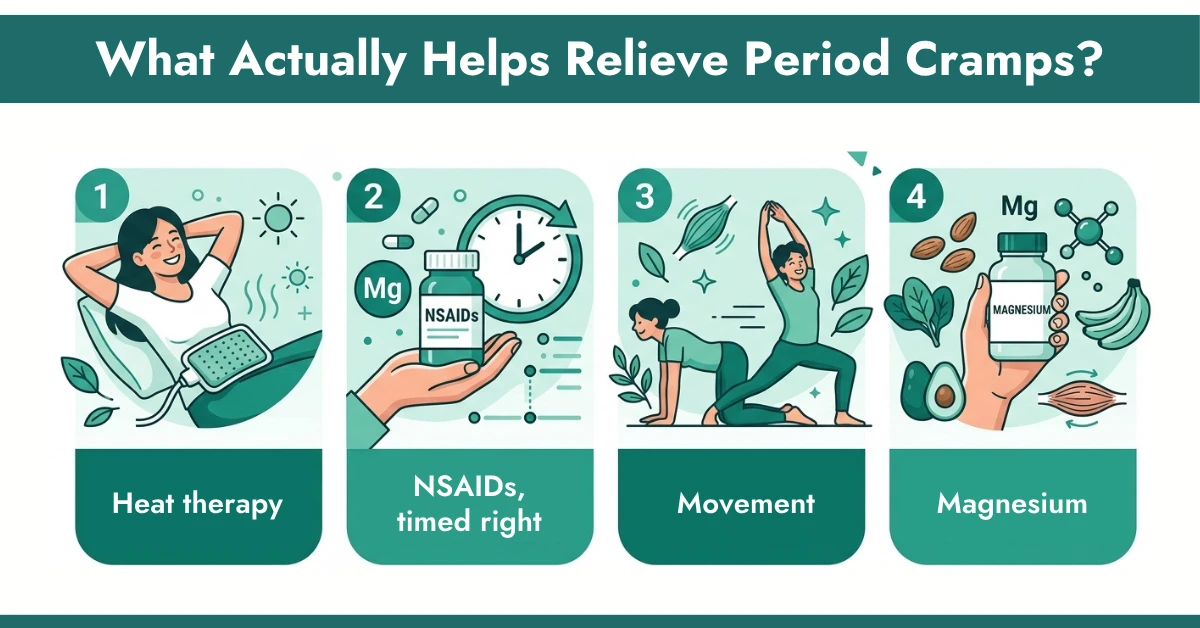
Heat, correctly timed NSAIDs, and steady movement have the most research behind them, and heat performs better than most people expect.
- Heat therapy: In randomized trials, a heating pad on the lower abdomen worked as well as ibuprofen for period pain, with one study finding relief arrived faster. 20 minutes a couple of times a day is the typical dose researchers test.
- NSAIDs, timed right: Starting a day or two before your period, rather than after cramps peak, tends to work better; prostaglandins are easier to block before levels spike than after.
- Movement: Light activity like walking or stretching eases cramp intensity for most people, even when it’s the last thing you feel like doing.
- Magnesium: Several clinical reviews link regular magnesium intake to milder cramps over time, likely from its effect on muscle relaxation.
Magnesium isn’t instant relief; ask your pharmacist whether it fits alongside anything else you take.
If your entire routine leans on one pain reliever and it’s still not enough, that’s worth digging into rather than pushing through it every month.
When Are Period Cramps a Sign of Something More?
Most period pain is uncomfortable, not dangerous. But pain that’s sudden, severe, or clearly different from your usual pattern is your body telling you to get checked instead of waiting it out.
| Usually just period pain | Talk to a doctor promptly |
| Cramping that starts a day or two before your period, eases by day 2-3. | Pain that’s sudden, severe, or unlike your usual cramps. |
| Mild-to-moderate back, hip, or thigh ache. | Fever, fainting, or feeling like you might pass out. |
| Some nausea, loose stools, or bloating. | Heavy bleeding (soaking a pad or tampon within an hour), or large clots. |
| Pain that eases at least partly with heat or NSAIDs. | Pain that keeps getting worse cycle after cycle, or stops responding to treatment. |
| Symptoms that resolve within a few days of your period starting. | New pelvic cramping after menopause, or severe pain with any chance of pregnancy. |
Sudden, one-sided pain, especially with fever or vomiting, needs prompt evaluation to rule out causes like appendicitis or an ovarian cyst, not a home guess. Pain that sits higher up, closer to your ribs or kidneys than your pelvis, is also worth mentioning, since it may not be period-related at all. Chest pain or shortness of breath are never typical period symptoms, on your cycle or off it; treat those as reasons to get checked right away.
How Is Dysmenorrhea Diagnosed & Can Genetic Testing Help?
Most doctors diagnose dysmenorrhea from your symptom history and a physical exam. If pain doesn’t improve with NSAIDs or hormonal treatment after a few months, your doctor may order a pelvic ultrasound to check for endometriosis, fibroids, or adenomyosis before looking further.
A PGx test doesn’t replace that workup; it adds to it. RPh Labs’ at-home PGx kit checks how your body processes 240+ medications from one cheek swab, with results delivered through your secure portal in 7-10 business days. Here’s exactly how the process works, along with the insurance and payment options available if you’d rather not pay the full cost out of pocket.
A PGx result is one input your provider weighs alongside your history, not a stand-alone diagnosis, and not a guarantee of pain relief.
Why are period cramps so painful for some people and not others
Two people with the same cycle can have completely different months. If you are asking why are period cramps so painful in your case and mild in hers, the difference is rarely willpower, and it is usually a stack of factors rather than one.
- Prostaglandin output varies. More prostaglandin means harder uterine contractions and more pain.
- A second condition may be present. Endometriosis symptoms, adenomyosis and fibroids all amplify cramping.
- Pain processing differs. Months of severe pain can make the nervous system more responsive to it.
- Heavy flow adds work. A uterus shedding more lining contracts harder and for longer.
- NSAIDs for period pain do not perform equally in every body, which is where metabolism enters the picture.
- Sleep, stress and other pain conditions raise the baseline that period pain is added to.
Asking why are period cramps so painful is really asking which of these apply to you, and the list is worth working through in order. The first two are questions for a clinician, the third and fourth change what treatment aims at, and the fifth is the one almost nobody checks.
None of this means severe pain has to be accepted. Pain that keeps you home from work or school is a reason to be evaluated, not a normal cost of menstruating, and it is the clearest reason to keep asking why are period cramps so painful until someone answers it.
NSAIDs for period pain: using them the way guidelines describe
NSAIDs for period pain work by blocking prostaglandin production rather than masking pain afterwards. Timing is part of the answer to why are period cramps so painful even on a normal dose, because starting before prostaglandin levels spike gives the drug something to prevent instead of something to chase.
Dose and schedule belong to your prescriber or pharmacist, and the label sets an upper limit for a reason. What you can do is use the timing and the practical details well.
- Start at the point in your cycle your clinician advises, typically before pain peaks rather than after.
- Take them with food to reduce stomach irritation.
- Keep NSAIDs for period pain at regular intervals through the worst day or two instead of waiting for pain to return.
- Tell your pharmacist about every other medicine, since NSAIDs interact with blood thinners, some blood pressure drugs and lithium.
- Raise a history of stomach ulcers, kidney disease, asthma or heart disease before starting any NSAID routine.
If NSAIDs for period pain are not touching it after two or three properly timed cycles, that is information rather than failure. It points either at a second cause worth investigating or at how your body handles the drug, and both change what dysmenorrhea treatment should look like next.
Endometriosis symptoms that get dismissed as bad periods
Endometriosis is the most common cause of secondary dysmenorrhea, and diagnosis is often delayed for years because the pain is written off as ordinary. The pattern is what distinguishes it, not the intensity alone.
Endometriosis symptoms worth raising with a clinician include:
- Pain that starts earlier than the usual day before bleeding, or that keeps going past day three.
- Pain that gets worse year over year instead of staying steady.
- Deep pain during sex, rather than pain at the entrance.
- Pain with bowel movements or urination during your period.
- Bowel symptoms that follow the cycle, including diarrhea or constipation at predictable points.
- Trouble conceiving alongside painful periods.
Adenomyosis and fibroids overlap heavily with endometriosis symptoms, often with heavier bleeding. A pelvic exam and ultrasound are the usual first steps, and normal imaging does not rule endometriosis out, since much of it is not visible that way.
Bring a written symptom log. Endometriosis symptoms described as a pattern across several cycles carry more weight in a short appointment than a general report of bad cramps.
Hormonal dysmenorrhea treatment beyond pain relievers
When pain relief alone is not enough, the next line of dysmenorrhea treatment usually works on the lining itself. Less lining means less prostaglandin and lighter, less painful periods.
- Combined hormonal contraception, sometimes taken continuously to skip withdrawal bleeds.
- Progestin-only options, including the hormonal IUD, which thins the lining over several months.
- Treatment aimed at a specific diagnosis, where endometriosis symptoms have been confirmed on examination or surgery.
- Referral to a gynecologist when two or three rounds of dysmenorrhea treatment have not worked.
Each dysmenorrhea treatment has its own trade-offs, and migraine with aura, blood clot history, smoking and blood pressure all affect which ones are safe for you. That is a prescriber conversation, and it is worth going in with your migraine and clot history written down.
Non-drug measures still earn their place alongside any dysmenorrhea treatment. Heat has real trial evidence behind it and works well alongside NSAIDs for period pain, light movement helps most people, and consistent sleep lowers the baseline you are adding pain to. None of them replaces investigating a cause that is still unexplained after several cycles.
CYP2C9 and ibuprofen: what a variant actually changes
Ibuprofen, naproxen, celecoxib and meloxicam are broken down largely by a liver enzyme called CYP2C9, and the gene that codes for it comes in versions that work at different speeds. That is the link between CYP2C9 and ibuprofen that prescribing guidance is built on.
A decreased-function result means the drug is cleared more slowly, so it lingers at higher levels on an ordinary dose. For CYP2C9 and ibuprofen the concern is not weaker pain relief but a higher chance of stomach and kidney side effects, which is why guidance for poor metabolizers leans toward the lower end of the dose range and shorter courses. MedlinePlus explains the CYP2C9 gene in plain language, and CPIC publishes the prescribing guideline clinicians use.
What it does not tell you
Knowing your CYP2C9 and ibuprofen status does not predict how much your period will hurt, does not diagnose endometriosis symptoms, and does not guarantee that any pain reliever will work. It tells your prescriber whether the standard dose is likely to sit high in your body. That is one input among several, and CYP2C9 also carries guidance for warfarin and phenytoin, which matters if you take either.
Only a prescriber changes a dose. A CYP2C9 and ibuprofen result on paper is not permission to take more or less of anything.
A cycle-by-cycle plan to take to your doctor
Three tracked cycles turn the question of why are period cramps so painful into something a clinician can act on. Track on paper or in any period app, and keep it simple enough that you will actually do it.
- Rate pain daily from zero to ten, and mark which days you could not do your usual activities.
- Note what you took, when you took it, and whether it helped.
- Mark bleeding heaviness and any clots.
- Note bowel, bladder and nausea symptoms with the day they happened.
- Flag pain outside your period, since that is what separates primary cramps from endometriosis symptoms and other secondary causes.
- Bring the log, your full medication list, and one sentence on what you most want to change.
If you have already cycled through more than one pain reliever without relief, a pharmacogenomic panel is one thing you can ask about. The RPh Labs at-home PGx kit is a cheek swab reporting 20 genes against more than 240 medicines, including the CYP2C9 and ibuprofen pairing described above. See how it works, check the medication list first, and review insurance and payment options before ordering.
Getting through work and school on your worst days
Severe dysmenorrhea is a health condition, and once you know why are period cramps so painful in your own pattern, planning around it is reasonable rather than dramatic. A little preparation turns an unmanageable day into a difficult one.
- Know your worst two days from your log and avoid scheduling anything unmovable on them where you can.
- Keep a heat patch, water and your usual pain reliever where you will actually have them.
- Eat something before taking NSAIDs for period pain, even on a day you do not feel like eating.
- Ask about flexible hours or remote work if pain is predictable, and use a clinician’s note if your employer needs one.
- For students, a note from a clinician usually carries more weight than a general explanation.
Keep track of days missed. A count of missed days over six months is one of the more persuasive things you can put in front of a clinician, and it often moves dysmenorrhea treatment from pain relief to investigating a cause.
Get urgent care for pain with fainting, fever, vomiting you cannot keep fluids down through, or sudden one-sided pain, and do not wait for your next appointment.
Conclusion:
Period pain that derails your month deserves more than “take ibuprofen and wait it out.” For most people, correctly timed NSAIDs, heat, and movement cover it. For the people whose usual pain reliever barely makes a dent, genetics may be a piece nobody’s checked yet.
RPh Labs’ PGx test checks CYP2C9 and dozens of other genes against 240+ medications, from a cheek swab you can do at your kitchen table. See if your state is covered, or check which medications are on the list before you order.
Disclaimer:
This article is educational and isn’t a substitute for individualized medical advice. Talk with your doctor or pharmacist about any symptoms that worry you.
Painful period cramps: more questions answered
Is it normal to have diarrhea or nausea with period cramps?
Yes. Prostaglandins act on your digestive tract the same way they act on your uterus, which is why loose stools and nausea are common alongside cramps. Vomiting that’s severe or won’t let you keep fluids down is different, and worth a call to your doctor.
What is the ICD-10 code for menstrual cramps?
Dysmenorrhea is coded N94.6 when the cause isn’t specified. If a provider has documented a specific cause, you may instead see N94.4 (primary dysmenorrhea) or N94.5 (secondary dysmenorrhea) on your chart.
Can you have cramps without an actual period?
Yes, ovulation, early pregnancy, and other causes unrelated to your uterus can all produce period-like cramps. If pregnancy is possible and the pain is severe or one-sided, contact a doctor promptly rather than waiting to see if your period starts.
Does exercise help or worsen period cramps?
For most people it helps. Light activity such as walking, stretching or easy cycling tends to ease cramp intensity, probably by improving blood flow and releasing the body’s own pain-relieving chemicals. Hard training on your worst day can feel like too much, so match the effort to how you feel. Exercise does not make cramps worse, and stopping movement altogether usually does not help.
Why does my rectum or anus hurt during my period?
Rectal or anal pain during your period is usually caused by uterine contractions and prostaglandins irritating nearby nerves and pelvic muscles. Severe or recurring pain may be a sign of endometriosis.
Can a genetic test tell me which birth control will ease my cramps?
No. There is no pharmacogenomic dosing guidance for contraceptive hormones, so no panel selects a pill, patch or IUD. Hormonal dysmenorrhea treatment is instead chosen from your migraine and clot history, blood pressure, smoking status and preferences, discussed with a prescriber who has your full record.
Is it safe to take an NSAID every month for years?
Regular cyclical use is common and is usually fine for healthy people, but long-term use raises stomach, kidney and cardiovascular considerations. Tell your prescriber how many days a month you use NSAIDs for period pain so they can weigh it against your history and suggest a stomach-protecting option if needed.
Does a normal ultrasound rule out endometriosis?
No. Much endometriosis is not visible on ultrasound, so a normal scan does not close the question. Imaging is useful for finding fibroids, ovarian cysts and some deeper disease. Persistent endometriosis symptoms with normal imaging still deserve referral to a gynecologist rather than reassurance.
Why does acetaminophen work less well than ibuprofen for cramps?
Acetaminophen relieves pain but does not block prostaglandin production the way NSAIDs for period pain do, so it does not target the mechanism causing the contractions. It is still a reasonable option for people who cannot take NSAIDs. Ask your pharmacist which fits your other conditions and medicines.
Do I need a CYP2C9 result before taking ibuprofen?
No. Most people use NSAIDs without any genetic information, and testing is not a prerequisite. A CYP2C9 and ibuprofen result becomes useful when standard treatment keeps failing or causing side effects, or when you also take warfarin or phenytoin, where the same gene carries dosing guidance.
Can stress make period pain worse?
It can raise how much pain you feel without changing what is happening in your uterus, because poor sleep and sustained stress lower pain tolerance. That does not make the pain imaginary. It means sleep and stress are worth addressing alongside treatment rather than instead of it.
Leave a Reply