
Chronic pain syndrome is pain that has outlasted healing and started to reshape sleep, mood and daily function, which is why treating it takes more than a stronger prescription. This guide covers how it is managed, what physical therapy and pacing involve, and the one place genetics changes a prescribing decision.
On this page
You’ve tried pain medication after pain medication. One barely touches the pain. Another leaves you exhausted, nauseated, or dizzy. Your doctor changes prescriptions, yet the results never seem predictable.
That happens more often than many people realize. Genetics plays a role in how your body processes many medications, making one person’s “perfect” prescription another person’s disappointment.
Chronic pain syndrome isn’t simply pain that lasts. It affects movement, mood, sleep and daily life. This article explains what chronic pain syndrome is, what causes it, how doctors treat it, and why RPh Labs’ CLIA-certified, COLA-accredited PGx test may give your care team another piece of information when choosing certain medications.
What Is Chronic Pain Syndrome?
Chronic pain syndrome (CPS) is pain lasting more than three months, combined with real changes beyond the physical, shifts in mood, sleep, or behavior tied directly to that pain. It has its own diagnosis code (G89.4), separate from general chronic pain (G89.29). A diagnosis of chronic pain syndrome depends on documented physical and emotional effects, not only on how long the pain has been present.
- Chronic pain: any pain lasting longer than three months
- Chronic pain syndrome: chronic pain plus documented psychological or behavioral effects, such as anxiety, depression, drug dependence concerns, or complaints that seem out of proportion to physical findings
- Duration alone doesn’t make pain a “syndrome.” The added impact does.
One aspect that many articles overlook is how persistent pain can affect the nervous system. Over time, the brain and spinal cord may become more sensitive to pain signals, a phenomenon known as central sensitization. This means pain may continue even after the original injury has healed, making treatment more complex than simply addressing the initial cause.
What Causes Chronic Pain Syndrome?
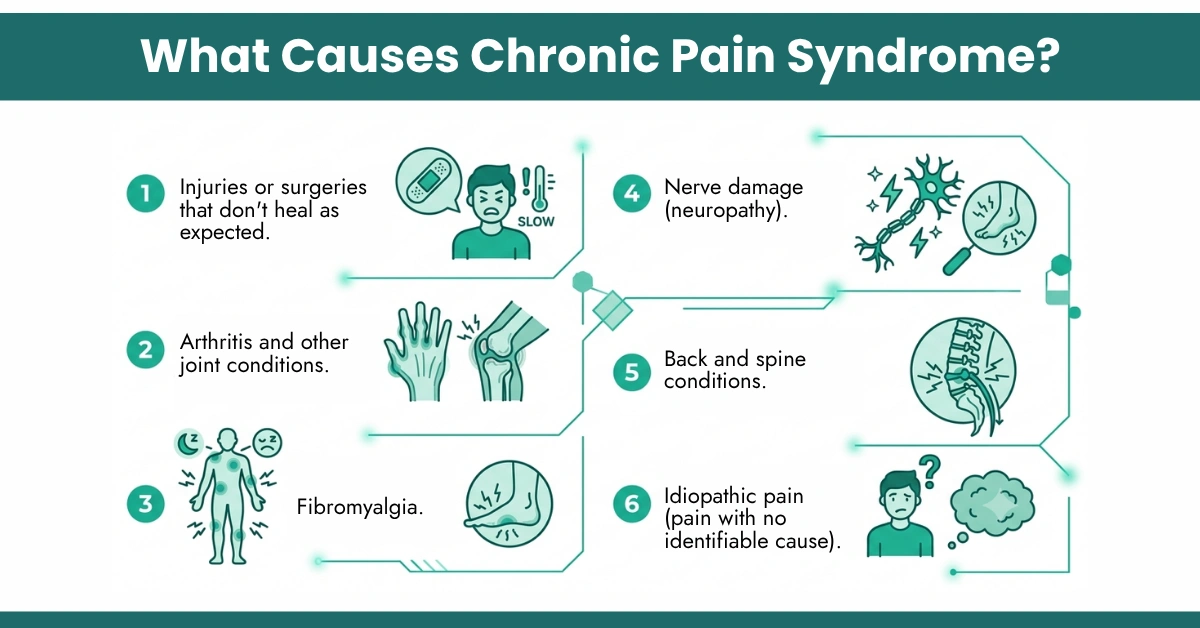
Chronic pain syndrome often starts with an injury, surgery, or illness that never fully resolves. Sometimes a clear medical condition drives it. Other times, no single cause turns up, even after testing.
Common contributors:
- Injuries or surgeries that don’t heal as expected.
- Arthritis and other joint conditions.
- Fibromyalgia.
- Nerve damage (neuropathy).
- Back and spine conditions.
- Idiopathic pain (pain with no identifiable cause).
Risk factors may include older age, diabetes, obesity, smoking, poor sleep, repetitive physical strain, anxiety, and depression. Having one or more risk factors doesn’t mean you’ll develop chronic pain syndrome, though they may increase the likelihood of persistent pain in some people.
What Are the Types and Symptoms of Chronic Pain?
Chronic pain shows up in different forms, and the pattern often hints at the cause. Some people experience pain in a single area of the body. Others feel it move around or spread across the body.
- Dull, aching pain is often muscle or joint-related.
- Sharp or stabbing pain often points to nerve involvement.
- Throbbing pain is often tied to inflammation.
- Diffuse pain spread widely, common with fibromyalgia.
- Intermittent pain comes and goes instead of staying constant.
- Pain that shifts locations shows up in different spots over weeks or months.
Common sites include the lower back, neck, joints, and muscles. Pain that touches several of these categories at once is typical with chronic pain syndrome, not a sign that anything unusual is happening.
How Does Chronic Pain Affect Your Body and Mental Health?
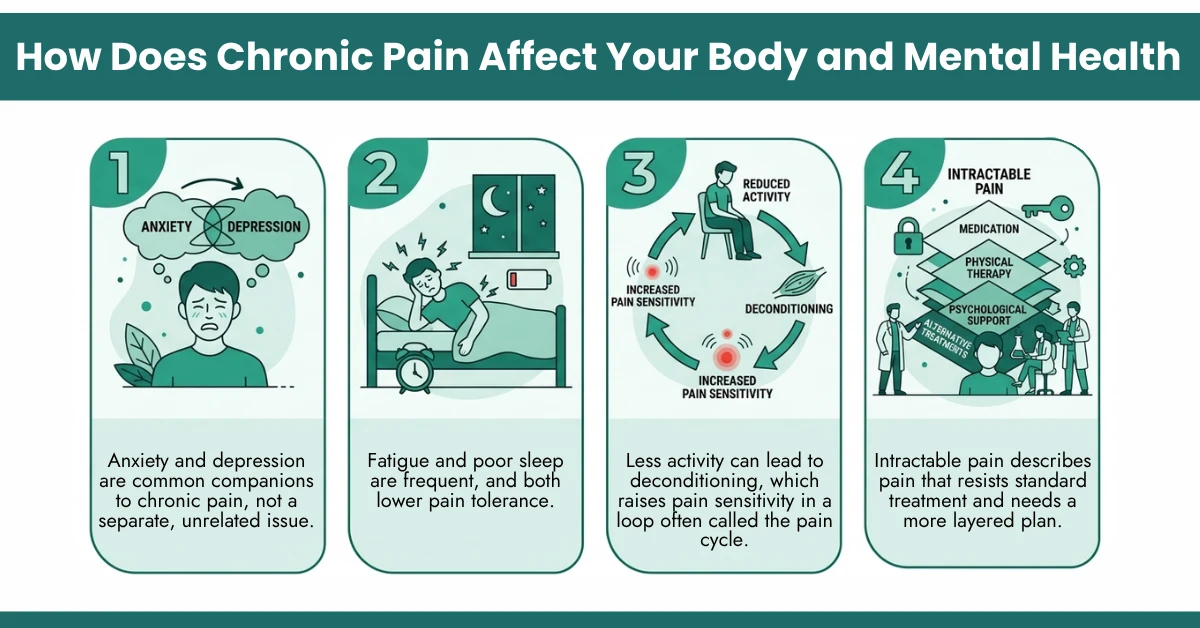
Chronic pain rarely stays confined to the body. Anxiety, depression, fatigue, and disrupted sleep show up often alongside it, and each one can make the pain itself feel worse.
- Anxiety and depression are common companions to chronic pain, not a separate, unrelated issue.
- Fatigue and poor sleep are frequent, and both lower pain tolerance.
- Less activity can lead to deconditioning, which raises pain sensitivity in a loop often called the pain cycle.
- Intractable pain describes pain that resists standard treatment and needs a more layered plan.
None of this means the pain is “in your head.” It means pain touches the whole system, not just the spot where you feel it.
How Is Chronic Pain Syndrome Treated?
Chronic pain syndrome usually responds best to a mix of approaches, not one fix. Medication, physical therapy, and psychological support each play a role, and the right combination looks different for every person.
- Medication: Several classes exist, and the right one depends on the type of pain. A doctor or pharmacist should always guide dosing.
- Physical therapy: Builds strength and function, which can lower pain over time.
- Psychological approaches: Cognitive behavioral therapy (CBT) and similar methods address the mental load pain creates.
- Lifestyle factors: Sleep, movement, and stress management all shape how much pain you feel day to day.
One reason treatment requires trial and error is that genetics affects how your body processes many pain medications.
Why Do Pain Medications Affect Everyone Differently?
Genetics plays a real role in how your body processes pain medications. That’s a big part of why a drug that works well for a friend or family member might do little for you, or bring side effects they never dealt with. The FDA provides pharmacogenomic information in the prescribing information for numerous medications, reflecting the role that genetic variation plays in drug response and clinical decision-making.
Two genes show this clearly:
- CYP2D6 affects codeine and tramadol. Your body converts these drugs into an active form to feel relief. Some people convert too little of it (weaker relief) or too much (higher side-effect risk).
- CYP2C9 affects many common NSAIDs. Some people clear these drugs more slowly, so the medication can stay active longer than a standard dose accounts for.
| Gene | Medications It Can Affect | What a Variant May Mean |
| CYP2D6 | Codeine, tramadol | Weaker pain relief, or a higher risk of side effects. |
| CYP2C9 | Common NSAIDs (ibuprofen, celecoxib, meloxicam, and similar) | Medication may stay active longer than expected at a standard dose. |
This is exactly what RPh Labs‘ at-home PGx test looks at. A cheek swab, mailed to our CLIA-certified, COLA-accredited lab, checks how your genes may affect your response to 240+ medications, including pain drugs. See how the testing process works, from kit to results.
A genetic test doesn’t replace your doctor’s judgment or set your dose on its own. Never change a medication or its dose without talking to your prescriber first.
Seven facts about chronic pain syndrome worth knowing early
A lot of frustration in the first year comes from expectations that were never accurate. These seven points reset most of them.
- Pain that persists past three months is treated differently from acute pain, because the mechanism has changed.
- Chronic pain syndrome is diagnosed on the effects as well as the duration, which is why mood and sleep questions appear in every assessment.
- Imaging often looks normal, and a normal scan does not mean the pain is not real.
- The goal is usually better function rather than a pain score of zero, and that shift is not a defeat.
- No single treatment carries the load. Combinations outperform any one intervention.
- Progress is measured in months, and flare-ups are part of the pattern rather than proof of failure.
- Medication is one part of a plan, and the first drug tried is often not the one you stay on.
It also helps to name what you want from treatment. Sleeping through the night, returning to a specific activity, or getting through a work shift are all measurable. General pain reduction is not, and it makes progress hard to see.
Bring that one goal to appointments. It changes which options a clinician suggests, and it gives both of you a way to tell whether the plan for your chronic pain syndrome is working.
Central sensitization: why pain persists after healing
Central sensitization describes a nervous system that has become more responsive to pain signals. The spinal cord and brain amplify what reaches them, so a smaller input produces a bigger experience of pain. It is a real, measurable change, not an imagined one.
That mechanism explains several things people find confusing about their own symptoms.
- Pain that continues after an injury has clearly healed.
- Pain spreading beyond the original site over months.
- Light touch, pressure or temperature becoming painful when it should not be.
- Poor sleep and stress making pain noticeably worse without any change in tissue.
- Anti-inflammatory drugs helping less than they did at the start.
Because central sensitization sits in the nervous system rather than at the injury, treatment aimed only at the original site often disappoints. That is the reasoning behind graded activity, sleep work, and medicines that act on nerve signaling rather than inflammation.
Understanding central sensitization also helps with the question people are usually too polite to ask: no, this does not mean the pain is psychological. It means the alarm system has become more sensitive, and the alarm system can be retrained.
Non opioid pain medication options and what each one does
Most long-term pain is managed with non opioid pain medication, and the choice depends on the type of pain rather than its intensity. Dosing belongs to your prescriber, and this is a map rather than a recommendation.
- Acetaminophen, often used as a base layer, with a strict daily ceiling because of liver risk.
- NSAIDs such as ibuprofen, naproxen and celecoxib, which target inflammation but carry stomach, kidney and cardiovascular cautions.
- Duloxetine, an antidepressant with recognized use in several chronic pain conditions.
- Amitriptyline and nortriptyline, tricyclics used at lower doses than for depression, often for nerve pain and sleep.
- Gabapentin and pregabalin, used for nerve pain and cleared mainly by the kidneys.
- Topical options, including NSAID gels and lidocaine patches, which limit whole-body exposure.
Each of these takes a different length of time to judge. A topical gel shows its hand within days, while duloxetine or a tricyclic may need several weeks at a settled dose before an honest verdict is possible.
Non opioid pain medication is also where the pharmacogenomic angle is strongest, because NSAIDs run through CYP2C9 and the antidepressant-type options run through CYP2D6 and CYP2C19. Gabapentin and pregabalin are the exceptions, since kidney clearance is not something a gene panel reports.
CYP2D6 and codeine: the clearest gene-drug link in pain care
Codeine and tramadol are prodrugs, which means they do very little until the body converts them into an active form. CYP2D6 does that conversion, and that is what makes CYP2D6 and codeine one of the best-established pharmacogenomic pairings in medicine.
The consequences run in both directions, which is unusual.
- A poor metabolizer converts too little, so pain relief is weak or absent while side effects still occur.
- An ultrarapid metabolizer converts too much and too quickly, raising the risk of dangerous sedation and slowed breathing.
- Certain other medicines, including fluoxetine, paroxetine and bupropion, block CYP2D6 and can turn a normal metabolizer into a functional poor one.
- Tramadol behaves similarly, with the added factor that it also acts on other pathways.
This is why regulators restrict codeine in children and in people who are breastfeeding, and why prescribing guidance recommends an alternative for both poor and ultrarapid metabolizers rather than a dose adjustment. CPIC publishes the guideline, and the FDA table of pharmacogenetic associations lists the recognized pairs.
None of this is a reason to change anything yourself. A CYP2D6 and codeine result is information for your prescriber, who weighs it against your kidney and liver function, your other medicines and your history.
Physical therapy for chronic pain, and pacing that works
Physical therapy for chronic pain is not the same as rehabilitation after an injury. The aim is to rebuild capacity in a nervous system that has become protective, which means starting lower and progressing more gradually than most people expect.
The pattern to avoid is the boom-and-bust cycle: a good day leads to doing everything, which leads to three bad days, which leads to doing nothing. Pacing breaks it.
- Find your reliable baseline, meaning the amount of an activity you can do on a bad day without a flare.
- Work at that level consistently, including on good days, for a week or two.
- Increase in small steps, changing one thing at a time.
- Split longer tasks into timed blocks with planned breaks, rather than stopping when pain forces it.
- Keep going through a mild flare at a reduced level instead of stopping altogether.
- Review the plan with your therapist every few weeks.
Physical therapy for chronic pain usually pairs with something psychological, and that combination is not an implication that the pain is invented. Cognitive behavioral therapy and acceptance-based approaches both have evidence for reducing disability, largely because they change how activity and flare-ups are handled.
Ask about cost and visit limits early, since plans differ widely and a course spread over months is a different budget from six visits.
Building a plan with your care team
Chronic pain syndrome is managed by several people, and it works better when someone is clearly coordinating rather than each clinician adjusting one piece.
- A primary care clinician usually holds the overall plan and the medication list.
- A pain specialist adds procedures and more complex medication decisions.
- A physical therapist handles capacity, movement and pacing.
- A psychologist or counselor addresses the load pain puts on mood and sleep.
- A pharmacist reviews interactions and duplication, which matters once the list passes five or six medicines.
If you have cycled through several medicines with poor results or bad side effects, a pharmacogenomic panel is worth raising. The RPh Labs panel reads 20 genes, CYP2D6, CYP2C9 and CYP2C19 among them, and reports them against more than 240 medicines from a cheek swab collected at home. A PharmD pharmacist reviews every report and a consultation is included. See how it works, check the medication list, or read which medications need a PGx test first.
A result does not diagnose anything, does not predict whether you will develop a condition, and does not set a dose. It is one input, and it is most useful before a new prescription rather than after a plan is already working. You can order the at-home PGx kit if your prescriber agrees it would change a decision.
Opioid safety, and what counts as an emergency
Opioids have a role in some plans, usually a limited one, and the decision belongs entirely to a prescriber. What matters on your side is knowing the risks and the emergency numbers before you need them.
For a suspected overdose, call 911 immediately. In the US, Poison Control can be reached at 1-800-222-1222. If you are having thoughts of harming yourself or ending your life, call or text 988 to reach the Suicide and Crisis Lifeline, which is available 24 hours a day. Persistent pain raises the risk of depression, and that risk is worth naming out loud rather than managing alone.
- Slow or shallow breathing, extreme drowsiness, confusion, or blue lips are overdose signs needing emergency help.
- Ask your prescriber about naloxone if you or anyone in your household takes an opioid.
- Never combine opioids with alcohol, benzodiazepines or other sedatives unless your prescriber has planned it.
- Store opioids securely and dispose of leftovers through a take-back program.
- Do not take medication prescribed for someone else, since the same dose affects two people very differently.
Stopping a long-term opioid abruptly causes withdrawal and is not safe to do alone. Any reduction is tapered on a schedule agreed with your prescriber, and the same principle applies to gabapentin and to the antidepressants used for pain.
Conclusion:
Chronic pain syndrome affects the body and daily life at the same time, and it deserves a treatment plan built around both. Medication is often part of that plan, and genetics explains why the first option isn’t always the right one.
RPh Labs’ CLIA-certified, COLA-accredited PGx Testing Kit gives you and your doctor another piece of information when reviewing medications that include pharmacogenomic guidance. The report evaluates genes associated with responses to 240+ medications, giving clinicians additional insight during medication selection.
Disclaimer:
This article is educational and isn’t a substitute for professional medical advice. Genetic testing gives your care team another data point; it doesn’t replace their judgment, guarantee a specific outcome, or set your dose. Always talk to your doctor or pharmacist before starting, stopping, or changing any medication.
Chronic pain syndrome: more questions answered
Does chronic pain syndrome ever go away completely?
Sometimes, especially if an underlying cause resolves. More often, the goal shifts from a full cure to real management: less pain, better function, fewer flare-ups. Many people see major gains even if the pain never fully disappears.
What’s the difference between chronic pain and chronic pain syndrome?
Chronic pain is any pain lasting more than three months. Chronic pain syndrome is chronic pain combined with documented mood, sleep, or behavior changes tied to it, a distinct diagnosis, not just a longer timeline.
Can a genetic test tell you which pain medication will work best?
A PGx test shows how your genes may affect specific medications, which can rule some options in or out. It’s one input for your doctor to weigh, not a guarantee of which drug will work for you.
Why do some people need a different dose of the same medication?
Genetics affects how quickly the body breaks down many drugs. Faster or slower metabolism can mean a standard dose does too little or too much for a given person. Always follow your prescriber’s dosing guidance.
Is chronic pain syndrome considered a disability?
Eligibility depends on the underlying condition, medical records, and how much the pain limits daily activities. A healthcare professional and, if needed, a disability benefits specialist can explain your specific situation.
Is chronic pain syndrome the same as fibromyalgia?
No. Fibromyalgia is a specific condition that causes widespread pain and fatigue. Chronic pain syndrome is a broader condition involving persistent pain that affects daily life, mood, or sleep. Fibromyalgia can be one cause of chronic pain syndrome, but they are not the same diagnosis.
Does PGx testing replace my doctor’s medical advice?
No. Pharmacogenomic (PGx) testing is one source of information that may assist medication decisions for certain drugs. Your doctor considers your genetic results alongside your symptoms, medical history, current medications, and overall health before making treatment recommendations.
Does a normal MRI mean my pain is not real?
No. Imaging shows structure, not pain processing, and central sensitization does not appear on a scan. Many people with disabling pain have unremarkable imaging, and many people with alarming imaging have no pain at all. A normal scan usually redirects treatment rather than closing the case.
Do I need a genetic test before taking ibuprofen or acetaminophen?
No. Most people use non opioid pain medication without any genetic information. Testing becomes worth discussing when several medicines have failed, when side effects keep stopping you at low doses, or when codeine or tramadol is being considered, where CYP2D6 results change the recommendation.
Why would a prescriber avoid codeine entirely for me?
Because for both poor and ultrarapid metabolizers, guidance recommends a different drug rather than a different dose. The CYP2D6 and codeine relationship is unusual in that the risk runs in both directions: too little conversion means no relief, and too much means dangerous sedation.
How long should I stay with a physical therapy program?
Give it several weeks at a consistent level before judging it, and expect progress in function before a change in pain. Physical therapy for chronic pain is measured over months. If nothing has shifted after a couple of months of real effort, raise it with the therapist rather than quietly stopping.
Can flare-ups be prevented entirely?
Not usually, and a plan built on never flaring tends to shrink your life. Pacing reduces how often and how badly they happen, and having a written flare plan, including what to reduce and for how long, shortens them. Flares are part of the pattern rather than evidence of failure.
Is it worth seeing a pain specialist?
It is worth asking for a referral if several medicines and a course of therapy have not helped, if the diagnosis is unclear, or if procedures are being considered. Bring a written medication history with what each drug did, since that record shapes the appointment more than anything else.

Leave a Reply