

Statins cause muscle pain for a mix of reasons, and the mix is different for every person. This section goes past the basics into what actually drives the ache, how prescribers test whether the statin is to blame, what relief options exist, and where a gene result genuinely helps.
On this page
Sore legs & heavy shoulders. Aching that started right around the time you filled a new cholesterol prescription. If this sounds familiar, you’re dealing with one of the most common complaints tied to statins: muscle pain.
Doctors call it statin-induced myopathy once it’s confirmed by bloodwork, and myalgia when it’s soreness alone. Either way, it’s a leading reason people ask their prescriber for a change. Some people never feel a thing on a given statin. Others notice it within a week. Dose, other medications, and genetics all play a part in that difference.
Here’s what’s behind the ache: why statins cause muscle pain, which ones carry more of that risk, the warning signs worth same-day attention, and where genetic testing fits in.
What Happens When a Statin Causes Muscle Pain?
Muscle pain from statins isn’t one condition; it’s a range. Myalgia means soreness with normal bloodwork. Myopathy means that same soreness plus a real rise in creatine kinase (CK), a protein muscle cells release under stress. Rhabdomyolysis sits at the far end: muscle tissue breaks down fast enough to threaten the kidneys.
Clinical trials put the rate of muscle symptoms around 1% to 5% of statin users. Real-world reporting, outside a trial’s tighter screening, runs closer to 10%, sometimes higher. Same drug class, different counting method, and a reminder that trial numbers and lived experience don’t always match.
Why Do Statins Cause Muscle Pain?
Statins block an enzyme called HMG-CoA reductase, which your liver uses to make cholesterol. That same pathway also makes CoQ10, a compound muscle cells burn for energy. Less CoQ10 may mean less fuel for muscle, one leading theory behind the ache.
Genes play a role too. A well-documented variant in the SLCO1B1 gene changes how much simvastatin builds up in muscle rather than clearing through the liver. In a large genome-wide study of high-dose (80mg) simvastatin users, carriers of this variant showed roughly four times the myopathy risk of non-carriers, according to genetics research published through the National Institutes of Health.
That finding is part of why regulators later restricted new prescriptions of the 80mg simvastatin dose. RPh Labs’ PGx panel checks SLCO1B1 and ABCG2, the two transporter genes CPIC uses for its statin guidance, along with CYP2C9.
Are Some Statins More Likely to Cause Muscle Pain?
Some, yes, though the old rule of thumb is less tidy than it sounds. Lipophilic (fat-soluble) statins atorvastatin, simvastatin, lovastatin, fluvastatin slip into muscle tissue more easily. Hydrophilic (water-soluble) statins, pravastatin, rosuvastatin, stay closer to the liver.
| Statin (Generic) | Brand Name | Solubility Type | Typical Intensity Range |
|---|---|---|---|
| Atorvastatin | Lipitor | Lipophilic | Moderate to high |
| Rosuvastatin | Crestor | Hydrophilic | Moderate to high |
| Simvastatin | Zocor | Lipophilic | Low to moderate |
| Pravastatin | Pravachol | Hydrophilic | Low to moderate |
| Lovastatin | Mevacor | Lipophilic | Low to moderate |
| Fluvastatin | Lescol | Lipophilic | Low to moderate |
Exact intensity depends on the prescribed dose, not the drug alone.
Real-world data has muddied that clean split. A large UK health-record cohort study found muscle-event rates were close between hydrophilic and lipophilic statins at matched doses, hydrophilic rosuvastatin even edged slightly above lipophilic atorvastatin, though the gap was too small to rule out chance. Dose and individual biology drive the outcome at least as much as chemistry does.
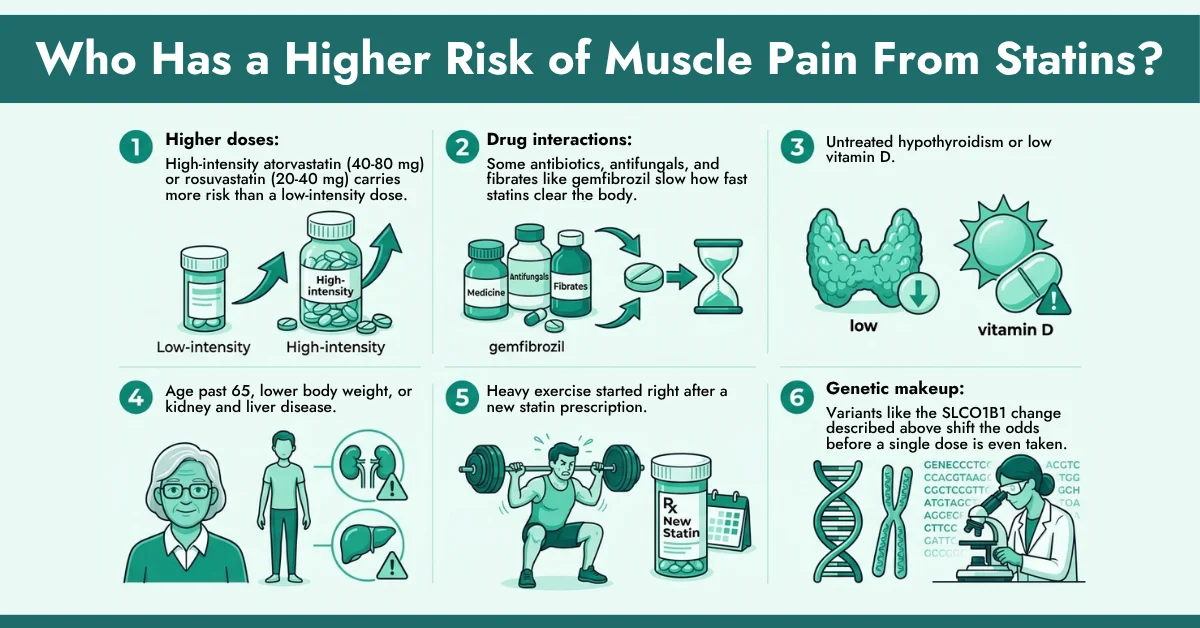
Who Has a Higher Risk of Muscle Pain From Statins?
Some factors make muscle pain with statin drugs more likely.
Risk factors include:
- Higher doses: High-intensity atorvastatin (40-80 mg) or rosuvastatin (20-40 mg) carries more risk than a low-intensity dose.
- Drug interactions: Some antibiotics, antifungals, and fibrates like gemfibrozil slow how fast statins clear the body.
- Untreated hypothyroidism or low vitamin D.
- Age past 65, lower body weight, or kidney and liver disease.
- Heavy exercise started right after a new statin prescription.
- Genetic makeup: Variants like the SLCO1B1 change described above shift the odds before a single dose is even taken.
When Is Statin Muscle Pain an Emergency?
Most statin-related muscle pain is mild and settles on its own or with a dose change. A small share of cases point toward rhabdomyolysis, which calls for same-day care.
Contact a doctor immediately, or head to an emergency room, for:
- Dark, tea-colored, or cola-colored urine.
- Serious muscle weakness or swelling.
- Muscle pain paired with fever, confusion, or very little urine output.
A CK blood test confirms it; waiting it out isn’t the move here.
Can Genetic Testing Explain Why Statin Causes Muscle Pain?
Genetics is one reason two people on the identical dose of the identical drug feel completely different things. RPh Labs’ at-home PGx testing kit looks at SLCO1B1, ABCG2, CYP2C9 and 17 other genes against 240+ medications, statins among them. A cheek swab, mailed back in a prepaid envelope, gets you a result through a secure portal in 7 to 10 business days after your sample reaches the lab, with a PharmD pharmacist to walk through what it means.
A PGx report doesn’t diagnose muscle pain on its own, and it’s not a swap-in for a CK test or a doctor’s exam. What it gives your prescriber is one more data point when choosing a statin, or a dose, matched to how your body handles it. See the full list of genes and medications the panel covers, or check how testing works before ordering.
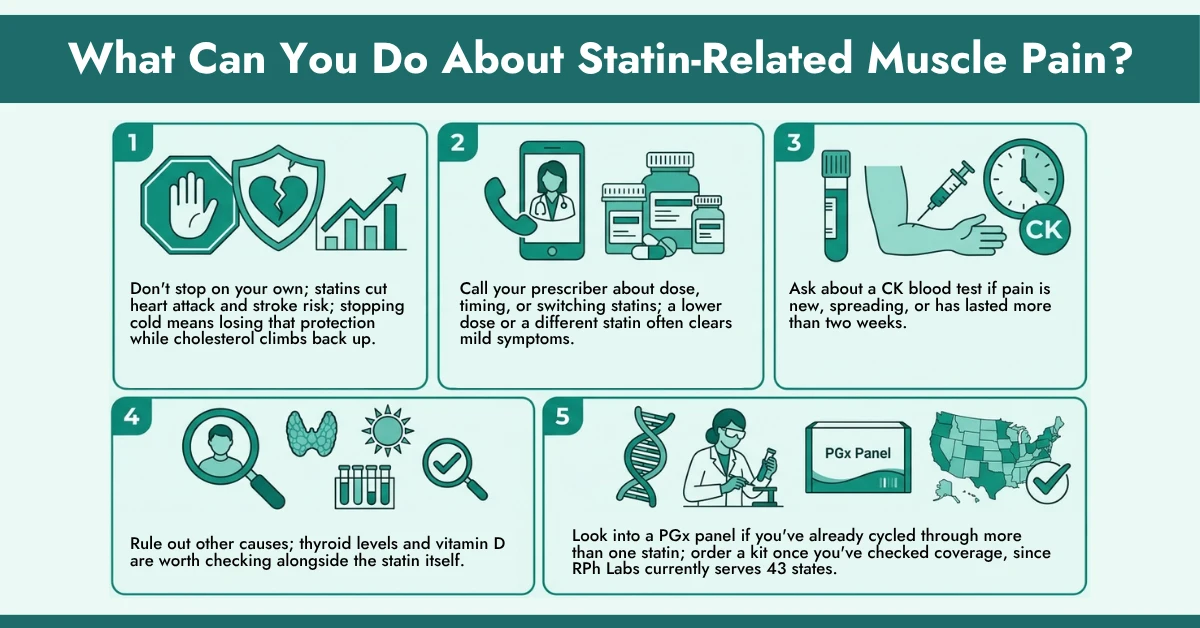
What Can You Do About Statin-Related Muscle Pain?
- Don’t stop on your own; statins cut heart attack and stroke risk; stopping cold means losing that protection while cholesterol climbs back up.
- Call your prescriber about dose, timing, or switching statins; a lower dose or a different statin often clears mild symptoms.
- Ask about a CK blood test if pain is new, spreading, or has lasted more than two weeks.
- Rule out other causes; thyroid levels and vitamin D are worth checking alongside the statin itself.
- Look into a PGx panel if you’ve already cycled through more than one statin; order a kit once you’ve checked coverage, since RPh Labs currently serves 45 states.
Statins cause muscle pain for 7 overlapping reasons
There is rarely a single cause. When statins cause muscle pain, it is usually several factors stacking up at once.
- Dose and intensity. Higher intensity regimens carry more muscle risk than low or moderate ones.
- Drug interactions. Medicines that slow statin clearance push blood levels higher than the dose intends.
- Transporter genetics. SLCO1B1 variants reduce uptake of statins into the liver, so more circulates.
- Muscle energy pathways. The same enzyme statins block also feeds CoQ10 production, a leading theory for the ache.
- Unrelated deficiencies. Untreated thyroid disease and low vitamin D cause myalgia on their own and make statin symptoms worse.
- Physical load and body factors. A new exercise program, older age, smaller body size and reduced kidney or liver function all shift the odds.
- Expectation. Blinded rechallenge research suggests that for some people symptoms appear whether or not the tablet contains a statin, which does not make the pain imaginary but does change what helps.
That last item is the one people find hardest to hear, so it is worth stating carefully. The pain is real either way. What the research suggests is that the cause is not always the drug, which is exactly why a structured rechallenge with your prescriber beats guessing.
Statin myopathy symptoms and ordinary soreness
Sorting one from the other is the first useful step when you suspect statins cause muscle pain. Statin myopathy symptoms tend to follow a pattern that gym soreness and arthritis do not.
- Symmetrical: both thighs, both shoulders or both calves rather than one side
- Proximal: large muscles close to the trunk, so stairs and reaching overhead feel hardest
- Timed to the drug: starting within weeks of a new statin or a dose increase
- Described as heaviness, weakness or cramping rather than sharp joint pain
- Sometimes accompanied by a rise in creatine kinase on a blood test
Statin myopathy symptoms rarely look like joint disease. Joint-centered pain, pain in one knee or shoulder, and pain that started months before the prescription point elsewhere. So does soreness that follows an unusually hard workout by a day or two.
Write down when the statin myopathy symptoms began, which muscles are involved, and what you were prescribed and when. That short record makes the appointment far more productive than trying to recall the sequence. Statin myopathy symptoms plus dark urine or severe weakness is a different situation, covered further down.
How long does statin muscle pain last?
The common question after a change is how long does statin muscle pain last, and the honest answer depends on what changed.
- After a supervised pause, many people notice improvement within days to a few weeks.
- If symptoms have not moved at all after several weeks off the drug, the statin probably was not the cause.
- After a dose reduction or a switch, symptoms may settle gradually rather than disappear overnight.
- If creatine kinase was elevated, your prescriber may want to see it fall before restarting anything.
Two cautions matter here. First, never run this experiment alone. A pause is a diagnostic step your prescriber plans, with a date to restart, because unmonitored time off a statin means unprotected time for your arteries. Second, how long does statin muscle pain last is not a fixed number you will find in a table, since thyroid status, vitamin D, exercise and other medicines all influence the timeline.
Statin muscle pain relief options a prescriber can use
There is more room to maneuver than most people realize when statins cause muscle pain. Statin muscle pain relief usually comes from adjusting the regimen rather than abandoning cholesterol treatment.
- Lower dose. Many people tolerate a reduced dose of the same drug, which still lowers LDL meaningfully.
- Different statin. Switching drugs within the class resolves symptoms for a large share of people.
- Less frequent dosing. Some prescribers use alternate-day dosing with a longer-acting statin, always as a supervised plan.
- Fix the background causes. Correcting low vitamin D or treating hypothyroidism can remove the aches entirely.
- Non-statin add-ons. Ezetimibe, bempedoic acid or a PCSK9 inhibitor can carry part of the LDL lowering.
- Review interacting drugs. Removing or replacing an interacting medicine sometimes fixes the problem at the source.
CoQ10 supplements come up constantly in statin muscle pain relief discussions. Trial evidence is mixed and does not support them as a reliable fix, though they are generally well tolerated. If you want to try one, tell your prescriber rather than adding it quietly.
Gentle, gradual activity is part of statin muscle pain relief for most people, more so than rest. What does not help is stopping the statin and waiting, which is the most common self-directed approach to statin muscle pain relief and the one with the clearest downside.
Is there a best statin for muscle pain?
There is no single best statin for muscle pain, and any article that names one is oversimplifying. What exists are patterns prescribers use when someone has already had symptoms.
- Hydrophilic options such as pravastatin and rosuvastatin enter muscle tissue less readily in theory, though real-world data shows the split is not clean.
- Low-dose high-potency strategies, for example a small rosuvastatin dose, can hold LDL down with less total drug exposure.
- Fewer interactions matters if you take several medicines, which counts against simvastatin and lovastatin in some regimens.
- Pitavastatin is sometimes chosen for people on complex medication lists because of its metabolic route.
Your kidney function, liver health, LDL target, other prescriptions and genotype all narrow the list. That is why the best statin for muscle pain is a personal answer worked out with your prescriber, often after trying more than one.
Dose still matters more than chemistry, so the best statin for muscle pain is often simply a smaller one. A moderate-intensity regimen you can take every day protects you more than a high-intensity one you abandon after a month.
Interactions that make statins cause muscle pain more often
One reason statins cause muscle pain in some months and not others is interactions. Muscle injury risk climbs when something slows the statin’s exit from your body. This is the most fixable item on the whole list.
- Fibrates, especially gemfibrozil, and high-dose niacin
- Certain antibiotics such as clarithromycin and erythromycin
- Azole antifungals including itraconazole and ketoconazole
- Some HIV and hepatitis C antivirals
- Cyclosporine and some other immunosuppressants
- Certain heart medicines, including verapamil, diltiazem and amiodarone, which cap the allowable simvastatin dose
- Grapefruit and pomelo, for the statins that depend on CYP3A4
The practical habit is simple: every time any prescriber or dentist adds a medicine, ask your pharmacist to check it against your statin. Red yeast rice deserves a mention too, since it contains a compound chemically identical to lovastatin and effectively doubles your statin dose.
Keep one current list of everything you take, supplements included. Most cases where statins cause muscle pain suddenly, after months of tolerating the drug, trace back to something new on that list.
The SLCO1B1 guideline your prescriber can act on
Genetics is part of why statins cause muscle pain in one person and not another, and it is one of the strongest examples of pharmacogenomics being genuinely actionable. CPIC has published recommendations covering SLCO1B1, ABCG2 and CYP2C9 with statins, and they are available in the CPIC guidelines.
SLCO1B1 codes for a liver transporter. Decreased function variants mean less statin is pulled into the liver and more stays in circulation, which is associated with a higher chance of muscle symptoms. The MedlinePlus SLCO1B1 page covers the biology, and our page on SLCO1B1 decreased function explains what a result means in practice.
- Recommendations are statin specific, so a variant may argue for a lower dose of one statin or a switch to another.
- ABCG2 is relevant to rosuvastatin, and CYP2C9 to fluvastatin.
- The RPh Labs 20-gene panel includes SLCO1B1, ABCG2, CYP2C9 and APOE, reported against 240 or more medications.
- Your genotype does not change, so one result informs every future statin decision.
An at-home cheek swab kit reports these genes in 7 to 10 business days after the lab receives the sample, and a PharmD pharmacist reviews every report. A result does not diagnose why statins cause muscle pain in your case, and it never replaces a creatine kinase test or an exam. You can confirm coverage on the medication list by gene.
How a structured rechallenge works
How long does statin muscle pain last is easiest to answer with a plan. When the cause is unclear, prescribers often use a planned sequence rather than a guess. It usually looks something like this.
- Baseline bloodwork, which may include creatine kinase, thyroid function and vitamin D.
- A supervised pause of two to four weeks to see whether symptoms actually lift.
- Correction of anything else found, such as low thyroid hormone or low vitamin D.
- Restarting a lower dose of the same statin, or starting a different one.
- A review appointment to compare symptoms against the baseline notes you kept.
- A different strategy, such as alternate-day dosing or a non-statin add-on, if symptoms return.
This is also the point where a genotype is most useful, because it can tip the choice of which statin to try next. Bring your symptom notes to each step, since the whole process depends on comparing how you feel across defined periods rather than on memory.
When muscle pain is an emergency, and what not to do
Rhabdomyolysis is the rare end of the range in which statins cause muscle pain, and it needs same-day care. Go to an emergency room for dark, tea-colored or cola-colored urine, severe muscle pain with weakness or swelling, or muscle pain with fever, confusion or very little urine output.
For a suspected overdose of any medicine, call 911 in the United States or your local emergency number. Poison Control is available at 1-800-222-1222 and can advise while help is on the way.
- Do not stop your statin without telling your prescriber, even if you are certain it is the cause.
- Do not raise, lower or skip doses on your own to test a theory.
- Do not add a fibrate, niacin or red yeast rice product on your own.
- Do not ignore weakness that is getting worse week over week.
Call rather than wait if new pain is spreading, if it has lasted more than two weeks, or if you are already planning to quit the drug. Mild statin myopathy symptoms handled early almost always end in an adjustment, not in giving up on cholesterol treatment.
Conclusion
Muscle pain on a statin is common enough to take seriously and, in most cases, mild enough not to panic over. Genetics is one piece of a larger picture that also includes dose, drug interactions, and thyroid or vitamin D levels.
RPh Labs’ at-home PGx testing kit gives your prescriber genetic information to work with: a cheek swab, a mailed lab, and results back in 7 to 10 business days after your sample reaches the lab, with a PharmD pharmacist reviewing them alongside you. Check whether RPh Labs currently serves your state before you order.
Statins cause muscle pain FAQ
Is atorvastatin a blood thinner?
No. Atorvastatin and other statins lower cholesterol by blocking a liver enzyme. Blood thinners, warfarin, DOACs, and aspirin work on clotting through a completely different mechanism.
Can I stop taking a statin if it’s causing muscle pain?
Not without calling your prescriber first. Stopping suddenly removes the cardiovascular protection statins give you. Muscle pain often clears up with a dose change or a different statin instead.
Why is a statin sometimes taken at night?
Short-acting statins like simvastatin and pravastatin clear the body within hours, and the liver makes the most cholesterol overnight; a bedtime dose lines up with that cycle. Atorvastatin and rosuvastatin last much longer, so timing matters less for those two.
Can genetic testing predict if a statin will cause muscle pain?
It can flag gene variants tied to how your body handles certain statins, one more data point for your prescriber alongside dose and labs. It’s not a guarantee, and it doesn’t replace a CK test or a medical exam.
How long does statin muscle pain last after stopping the drug?
How long does statin muscle pain last depends on the cause. When the statin is the cause, many people improve within days to a few weeks of a supervised pause. If nothing changes after several weeks off, the statin probably was not responsible and another cause deserves attention. Always plan the pause and the restart date with your prescriber rather than stopping alone.
What counts as statin myopathy symptoms rather than normal aches?
Symptoms that point toward the statin are usually symmetrical, affect large muscles near the trunk such as thighs and shoulders, start within weeks of a new statin or dose increase, and feel like heaviness or weakness. A creatine kinase blood test can confirm whether muscle is actually being damaged.
Is there a best statin for muscle pain if I have already reacted to one?
The best statin for muscle pain has no universal answer. Prescribers often try a different statin, a lower dose, or a low dose of a more potent one, and sometimes a hydrophilic option such as pravastatin or rosuvastatin. Your genotype, kidney function, LDL target and other medicines all shape which comes next.
Does CoQ10 give reliable statin muscle pain relief?
Statin muscle pain relief from CoQ10 is not well established. The evidence is mixed and does not support it as a dependable fix, although it is generally well tolerated. Adjusting the dose, switching statins and correcting low vitamin D or untreated thyroid disease have better track records. Tell your prescriber before adding any supplement to the plan.
Can a PGx test prove that statins cause muscle pain in my case?
No. A panel reports SLCO1B1, ABCG2 and CYP2C9 status, which tells your prescriber whether you carry variants linked to higher statin exposure. It is one input for choosing a statin and a dose, not a diagnosis, and it does not replace bloodwork or a physical exam.
Should I stop exercising while my muscles hurt?
Usually not. Gentle, gradual activity tends to help more than complete rest, though it is wise to hold off on starting an intense new program right after a statin change. Report worsening weakness, swelling or dark urine promptly instead of pushing through it.


Leave a Reply