

Migraine treatment is built as a sequence rather than a single prescription, and genetics shows up twice in it: once in whether you inherited the condition, and again in how quickly your body clears the drugs used to treat it. This guide separates those two questions, because they lead to different decisions.
On this page
You’ve tried three different migraine medications, and none worked the way your neurologist promised. Your sister takes the same triptan and gets relief within an hour. That gap between two people with the same diagnosis often traces back to DNA. Migraine itself runs in families, and the genes you inherit also change how your body processes the medications meant to treat it.
Below is what current research shows about migraine genetics and migraine treatment, from family risk to the specific genes tied to triptans, preventive drugs, and gepants.
Is Migraine Hereditary?
Yes. Twin and family studies put migraine’s heritability at roughly 35%-60%, and the American Migraine Foundation notes that a person with one migraine-affected parent has a 50%-75% chance of developing migraine too. That makes migraine one of the more strongly inherited neurological conditions, even without a single gene behind it.
- First-degree relatives of someone with migraine face 1.4-3 times the typical risk.
- Migraine affects an estimated 39 million people in the U.S., roughly 12%-15% of adults, and closer to 1 in 5 women.
- Genetics set the risk level; hormones, sleep, stress, and other triggers decide when an attack actually happens.
What Genes Are Linked to Migraine Risk?
No single “migraine gene” exists. Genome-wide studies have tied migraine risk to dozens of DNA regions, most involved in nerve signaling or blood vessel regulation, including TRESK and MTHFR. Those are research findings about risk, not prescribing genes. Neither is on the RPh Labs 20-gene panel, which reports how you may process medications and does not test disease risk.
A narrow exception is familial hemiplegic migraine (FHM), a rare, distinct subtype passed down in an autosomal dominant pattern, meaning one altered gene copy from a single parent is enough to cause it. FHM traces to mutations in three specific genes:
- CACNA1A (FHM type 1).
- ATP1A2 (FHM type 2).
- SCN1A (FHM type 3).
Researchers note these three genes explain FHM specifically. They play little to no role in the common migraine most people live with.
Why Do Migraine Medications Work Differently for Different People?
Two people with an identical migraine diagnosis can fill the same prescription and land on opposite outcomes. Genes that control liver enzymes are a major reason.
Those enzymes decide how fast a drug clears your system.
- A “poor metabolizer” breaks a drug down slowly, so it can build up and cause side effects at a standard dose.
- A “rapid” or “ultrarapid” metabolizer clears the same drug so fast it may never reach a working level. Neither pattern shows up on a routine blood panel; it’s written into DNA, which is where pharmacogenomic testing comes in.
Which Genes Affect How Migraine Medications Are Broken Down?
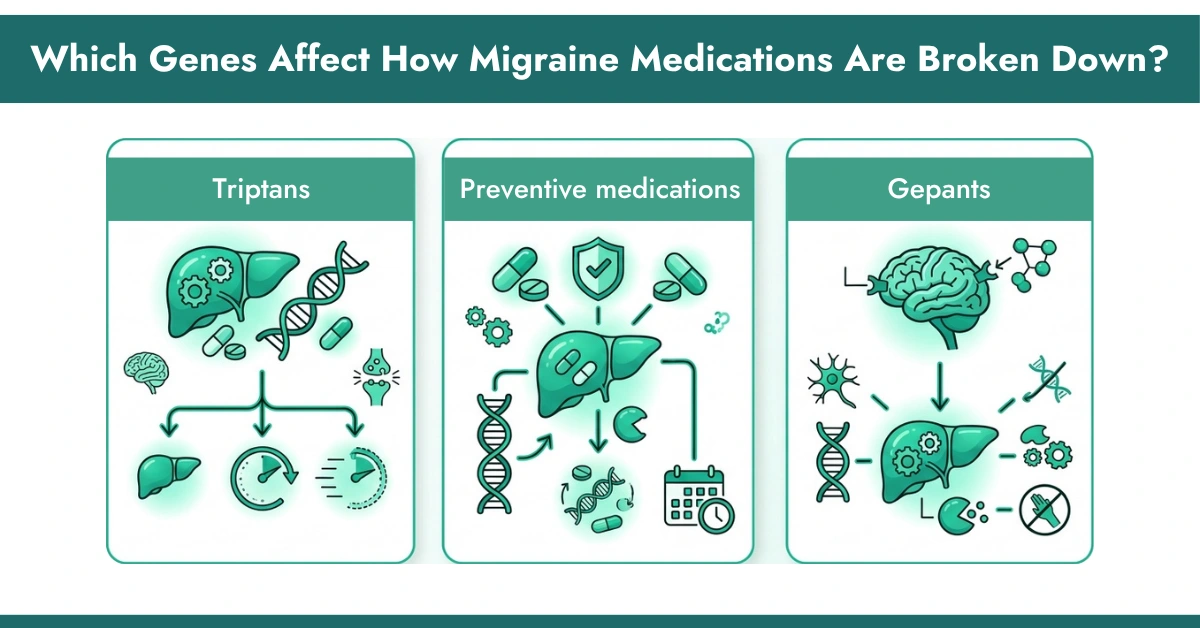
Several liver enzymes govern how the body clears migraine drugs, and the specific enzyme depends on the drug class:
- Triptans: Sumatriptan and rizatriptan rely mainly on the MAO-A enzyme; zolmitriptan runs through CYP1A2 and MAO-A; almotriptan uses CYP3A4 and MAO-A; eletriptan, frovatriptan, and naratriptan lean on the broader CYP450 pathway. That split is one reason a person may respond to one triptan and not another. No guideline sets a triptan dose from genotype, and CYP1A2 and MAO-A are not on the RPh Labs panel.
- Preventive medications: Amitriptyline, prescribed off-label for migraine prevention, is processed through CYP2D6 and CYP2C19. The Clinical Pharmacogenetics Implementation Consortium (CPIC) already publishes dosing guidance for people whose genes make them poor or ultrarapid metabolizers of this drug class, and the FDA’s Table of Pharmacogenomic Biomarkers in Drug Labeling lists dozens of comparable drug-gene pairs.
- Gepants: Newer options like rimegepant and atogepant are metabolized mainly through CYP3A4, the same enzyme affected by genetics and by certain other medications a person might already take.
Does the MTHFR Gene Cause Migraines?
Not on its own. MTHFR affects how the body handles folate and homocysteine, and several studies connect one MTHFR variant (C677T) to a higher rate of migraine with aura. Other studies find no connection; researchers describe the evidence as inconsistent rather than settled.
No medical guideline currently recommends MTHFR testing as a stand-alone way to diagnose or predict migraine. It’s one data point in a larger genetic picture, not a verdict by itself.
Can a DNA Test Help Find the Right Migraine Medication?
A pharmacogenomic (PGx) test reads how your specific genes process medications, giving your doctor a data point on which drug classes and doses fit your metabolism before you cycle through options by trial and error.
RPh Labs’ at-home PGx test is run in a CLIA-certified, COLA-accredited lab, and checks how your body may respond to 240+ medications from a single cheek swab:
- Order the PGx testing kit online.
- Swab your cheek and mail the sample back in the prepaid envelope; full steps are on the how it works page.
- Get results in 7-10 business days through the online Genie portal.
- Check the gene-drug list for the specific medications your report covers.
A PGx report is one input your prescriber weighs alongside your symptoms and history, not a stand-alone diagnosis or a guarantee any one drug will work.
What Should You Do If Migraine Runs in Your Family?
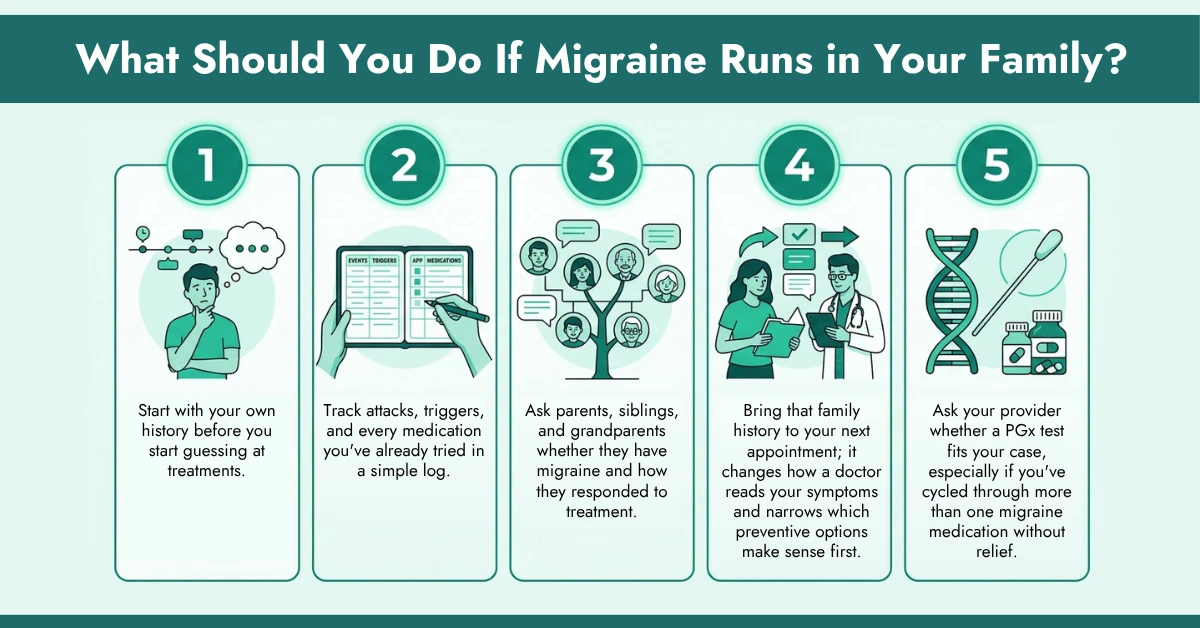
- Start with your own history before you start guessing at treatments.
- Track attacks, triggers, and every medication you’ve already tried in a simple log.
- Ask parents, siblings, and grandparents whether they have migraine and how they responded to treatment.
- Bring that family history to your next appointment; it changes how a doctor reads your symptoms and narrows which preventive options make sense first.
- Ask your provider whether a PGx test fits your case, especially if you’ve cycled through more than one migraine medication without relief.
How migraine treatment is chosen in the first place
Before any gene enters the conversation, migraine treatment splits into two jobs. Acute treatment stops an attack that has already started. Preventive treatment reduces how often attacks happen. Most people need the first, and a smaller group needs both.
The decision to add prevention usually turns on frequency and disability rather than pain intensity alone.
- Several headache days a month, or attacks that reliably cost you work or school days.
- Acute medication needed on more days than is safe over the long run.
- Attacks that do not respond well to acute treatment, whatever you try.
- Attacks with troubling features, such as prolonged aura or weakness, which need specialist input.
Non-drug measures belong in the plan rather than instead of it. Regular sleep and meal timing, hydration, limits on caffeine, and a written headache diary all reduce attack frequency for some people and cost nothing. A diary is also what makes any migraine treatment decision reviewable three months later.
Expect a step-up process. Guidelines describe trying a medication at an adequate dose for an adequate period before calling it a failure, which is usually weeks for acute options and two to three months for prevention.
Triptans for migraine: what to expect and what limits them
Triptans for migraine are the main prescription class for stopping an attack. They work on the trigeminovascular pathway rather than simply blunting pain, which is why they can end an attack rather than mask it.
Two practical points drive most of the difference between success and disappointment. Taking one early in the attack works better than waiting to see whether it will be a bad one. And failing one triptan does not predict failing another, because the drugs differ in how fast they act, how long they last and how they are cleared.
- Fast-acting options suit attacks that escalate quickly.
- Longer-acting options suit attacks that drag on or recur the next day.
- A nasal spray or injectable form helps when nausea and vomiting make tablets useless.
- Triptans for migraine are not suitable for everyone, including people with certain heart or stroke histories or uncontrolled blood pressure.
There is also a ceiling. Using acute medication on too many days a month can produce medication overuse headache, a pattern where treatment starts driving the attacks. Your prescriber sets that limit, and a diary is how you notice you are approaching it.
Be aware of what genetics does not offer here. Most triptans for migraine are cleared largely by monoamine oxidase A rather than by the cytochrome enzymes on a pharmacogenomic panel, and there is no published gene-based dosing guideline for this class.
Migraine prevention medication classes and how long each takes
Migraine prevention medication is taken every day, or on a set schedule, whether or not you have a headache. Several classes are used, and most of them were developed for something else before their preventive effect was recognized.
- Beta blockers such as propranolol and metoprolol, often a first choice where blood pressure is also a factor.
- Tricyclic antidepressants, most commonly amitriptyline, used at doses lower than those used for depression.
- Certain anti-seizure medicines, which carry specific cautions in pregnancy that must be discussed before starting.
- Candesartan and other blood pressure medicines, used off-label in some guidelines.
- Newer CGRP-targeted options, including monthly injections and oral gepants.
None of these works immediately. Most migraine prevention medication needs six to twelve weeks at a settled dose before you can judge it, which is why abandoning one after two weeks wastes the attempt. Your prescriber builds the dose up gradually to limit side effects.
Choice is driven as much by what else is going on as by the migraines themselves. Blood pressure, mood, sleep, weight, pregnancy plans and other medicines all narrow the list before genetics is considered at all. Bring your full medication list to that conversation, since interactions rule options out quickly.
Amitriptyline for migraine and the CYP2D6 link
This is the clearest place where a pharmacogenomic result touches migraine treatment. Amitriptyline for migraine is a tricyclic antidepressant used preventively, and it is cleared by CYP2D6 and CYP2C19, two genes with published prescribing guidance.
A poor metabolizer accumulates more drug on a standard dose, which raises the chance of dry mouth, constipation, drowsiness, dizziness and heart rhythm effects. An ultrarapid metabolizer may clear it too fast for a standard dose to do much. The CPIC guidelines set out how clinicians adjust the starting dose or choose a different drug in each case.
Other medicines can change the same result
Metabolizer status is not decided by genes alone. Fluoxetine, paroxetine and bupropion inhibit CYP2D6 strongly, so someone with a normal genotype can behave like a poor metabolizer while taking them. Our guide to CYP2D6 inhibitors explains how that plays out.
Propranolol is also partly cleared by CYP2D6, though the guidance there is weaker than for amitriptyline for migraine. Never adjust either drug on your own. Stopping a beta blocker abruptly can cause a rebound in heart rate and blood pressure, and tricyclics are tapered rather than stopped.
Is migraine hereditary in a way any test can measure?
Is migraine hereditary? Yes, clearly, and family studies have shown that for decades. Whether that heritability is testable is a separate question, and the honest answer for common migraine is no.
Common migraine involves many DNA regions each contributing a small amount, which is why no single gene test predicts it. The rare exception is familial hemiplegic migraine, tied to specific genes and inherited in a dominant pattern, and that diagnosis is made by a neurologist and a genetic counselor rather than by a consumer panel.
- No commercial panel tells you whether you will develop migraine.
- MTHFR testing is not recommended by any guideline as a way to diagnose or predict migraine.
- The genes tied to familial hemiplegic migraine are not on a pharmacogenomic panel and are not screened casually.
- A pharmacogenomic panel reports drug metabolism, not disease risk of any kind.
So when you ask is migraine hereditary and wonder whether to test, the useful version of that question is different: ask relatives which migraine treatment worked for them. That family history costs nothing, is not available from any laboratory, and genuinely informs which option a clinician tries first.
What a pharmacogenomic report changes in migraine treatment
Set expectations correctly and a panel is useful. Expect it to predict your migraines and it will disappoint you. A report describes how you are likely to process specific drugs, and for migraine treatment that mainly touches the preventive options and the other medicines you take alongside them.
- It can flag a likely problem with amitriptyline or another tricyclic before you start.
- It can explain why a past trial of one of those drugs went badly.
- It covers antidepressants prescribed for depression or anxiety that often travel with migraine.
- It does not cover triptans, and it does not cover the CGRP injections at all.
The RPh Labs panel reads 20 genes and reports them against more than 240 medicines from a cheek swab collected at home. Every report is reviewed by a PharmD pharmacist, a consultation is included, and results arrive 7 to 10 business days after the sample reaches the Dallas lab. See how it works, check your own prescriptions on the medication list, or order the at-home PGx kit.
A result is one input your prescriber weighs alongside your age, kidney and liver function, blood pressure, other drugs and your attack pattern. It is not a diagnosis and not a guarantee that any migraine treatment will work.
Headache warning signs that need urgent care
Most migraine is miserable rather than dangerous, and a long-standing pattern that behaves the way it always has is reassuring. New or changed features are what matter.
Get emergency help, by calling 911 in the US, for any of the following:
- A headache that reaches maximum intensity within seconds, sometimes described as thunderclap.
- The worst headache of your life, or one clearly unlike your usual attacks.
- Headache with fever and a stiff neck, or with a new rash.
- Headache with weakness, numbness, slurred speech, confusion or vision loss, especially if it does not resolve.
- Headache after a head injury, or one that started during exertion.
- A new headache pattern during pregnancy, or a first severe headache after age 50.
Short of an emergency, book an appointment rather than waiting if aura lasts longer than an hour, if attacks are becoming more frequent month on month, or if you are using acute medication on more days than your prescriber advised. Each of those changes what the next step in migraine treatment should be.
Conclusion:
Migraine genetics decide more than whether the condition runs in your family; they shape how your body responds to the medications meant to treat it. If you’ve cycled through migraine treatments without relief, that pattern may trace back to biology rather than bad luck.
See which migraine medications match your biology. Check if your medication is on our list or order your PGx testing kit.
Disclaimer:
This article is educational and isn’t a substitute for individualized medical or genetic counseling. Talk with your doctor or a genetic counselor before making treatment decisions based on genetic test results.
Migraine treatment and genetics: more questions
Can migraines show up with no family history at all?
Yes. Migraine comes from a mix of many small genetic effects plus environmental triggers, so a first case in a family is possible; heritability studies describe a strong pattern, not a guarantee.
How rare is hemiplegic migraine & is it different from typical hereditary migraine?
Familial hemiplegic migraine is a rare, specific subtype tied to three known genes (CACNA1A, ATP1A2, SCN1A). Researchers note these genes explain FHM but play little to no role in the common migraine most people experience.
Does RPh Labs’ PGx test cover migraine medications specifically?
The test screens 240+ medications across categories including pain and psychiatric drug classes, several of which overlap with migraine prevention. Check the gene-drug list for your specific prescriptions before ordering.
Is pharmacogenomic testing for migraine covered by insurance?
Coverage varies by plan. The $299 RPh Labs test is HSA/FSA-eligible and ships with an interest-free 4-installment payment option for anyone paying out of pocket. Check your insurance details before ordering.
Can a panel tell me which triptan to use?
No. Most triptans for migraine are cleared largely by monoamine oxidase A rather than the cytochrome enzymes a pharmacogenomic panel reports, and there is no published gene-based dosing guideline for the class. Choosing between them is done on speed of onset, duration, formulation and your cardiovascular history.
Why did my relative do well on a drug that did nothing for me?
Metabolism is one reason, and it is inherited, but attack pattern, other medicines, dose and how early the drug was taken all matter too. Asking relatives which migraine prevention medication helped them is still worth doing, since it gives your clinician a reasonable place to start.
Is amitriptyline addictive?
No, it is not a controlled substance and does not cause craving. It should still not be stopped abruptly, because a sudden stop can cause nausea, sleep disturbance and a return of headaches. Any change to amitriptyline for migraine is tapered on a schedule your prescriber sets.
Should I get genetic testing before trying prevention?
It is optional rather than required, and most people start without it. It is most worth discussing if a previous tricyclic or antidepressant trial went badly, if you take several medicines that interact, or if side effects have repeatedly stopped you at low doses.
Does knowing that migraine runs in my family change anything practical?
Yes, though not through a laboratory. Is migraine hereditary matters because a family history makes the diagnosis more confident, helps a clinician interpret unusual symptoms, and points toward options that worked in relatives. It does not justify testing children or screening healthy people.
Can I take a triptan while on an antidepressant?
Often yes, and many people do, but it is a question for your prescriber and pharmacist rather than something to decide alone. They will check the specific combination, your other medicines and your history before confirming, and will tell you what symptoms should prompt a call.



Leave a Reply