

A menstrual migraine is one of the few headache patterns you can see coming, which is exactly what makes it treatable. This guide covers how to prove the pattern, how timed prevention works, which contraception is safe if you get aura, and what changes as you approach perimenopause.
On this page
A headache builds behind one eye two days before your period, right on schedule. No amount of coffee or Tylenol touches it. If this happens most months, you’re dealing with a menstrual migraine. Doctors also call it a hormonal migraine, tied to the drop in estrogen right before your period starts. Roughly half of women with migraine notice this pattern.
Standard headache advice rarely accounts for the hormone piece. The same migraine medication that works well for a friend can do very little for you. Part of that comes down to how your body clears it. Here’s what causes menstrual migraines, how to spot the pattern, what actually eases them, and where genetics fits in.
What Is a Menstrual Migraine?
A menstrual migraine, also called a catamenial migraine, clusters around your period. It typically runs from two days before bleeding starts through day three of your period, a five-day window. Doctors split this into two patterns.
- Pure menstrual migraine: Attacks show up only around your period, never at other points in the cycle. This is the rarer pattern.
- Menstrually related migraine: Attacks show up around your period and at other times too. Most women with a cycle-linked pattern fall here.
Both patterns share the same core trigger. A sharp fall in estrogen right before your period sets the attack in motion.
Why Do Hormones Trigger Migraines Before Your Period?
Estrogen climbs through the month, then drops sharply in the two days before your period. That drop, not a flat low level, sets off the migraine for most women. Progesterone falls around the same time, though research points to the estrogen dip as the stronger trigger. Prostaglandins, hormone-like compounds released during your period, add to the pain. They’re a likely reason cramps often show up alongside the headache.
| Cycle Phase | Estrogen | Migraine Risk |
| Period (Days 1-5) | Low | High, especially days 1-2 |
| Follicular (Days 6-13) | Climbing | Low |
| Ovulation (~Day 14) | Peaks, then dips | Some women feel a mid-cycle headache |
| Luteal (Days 15-25) | Elevated | Low |
| Late luteal (Days 26-28) | Drops sharply | Highest, the classic trigger window |
This same estrogen-withdrawal pattern explains another common complaint: A headache during the placebo week on hormonal birth control, not just around a natural period.
What Does a Menstrual Migraine Feel Like?
A menstrual migraine usually brings throbbing, one-sided head pain. Nausea and sharp sensitivity to light and sound are common too. Those are the usual signs of migraine at any time of the month, just often worse here. Compared with migraines elsewhere in your cycle, the perimenstrual kind tends to run longer and hit harder. It also tends to skip the visual aura, even in women who get aura on other days.
Common symptoms include:
- Throbbing pain, usually on one side of the head.
- Nausea, sometimes with vomiting.
- Sensitivity to light and sound.
- Neck stiffness.
- Feeling lightheaded or foggy.
- Extra-heavy cramps on the same days.
Can Ovulation Cause Migraines or Headaches?
Yes. A second, usually milder headache can show up around ovulation, roughly two weeks before your period. This happens when estrogen peaks and then briefly dips. Some women feel this ovulation migraine as a dull ache. Others barely notice it. Luteal phase headaches in the days after ovulation are a separate but related pattern, tied to the progesterone rise and fall later in the cycle. Tracking headaches against your cycle for two to three months is the clearest way to tell these apart from your main premenstrual attack.
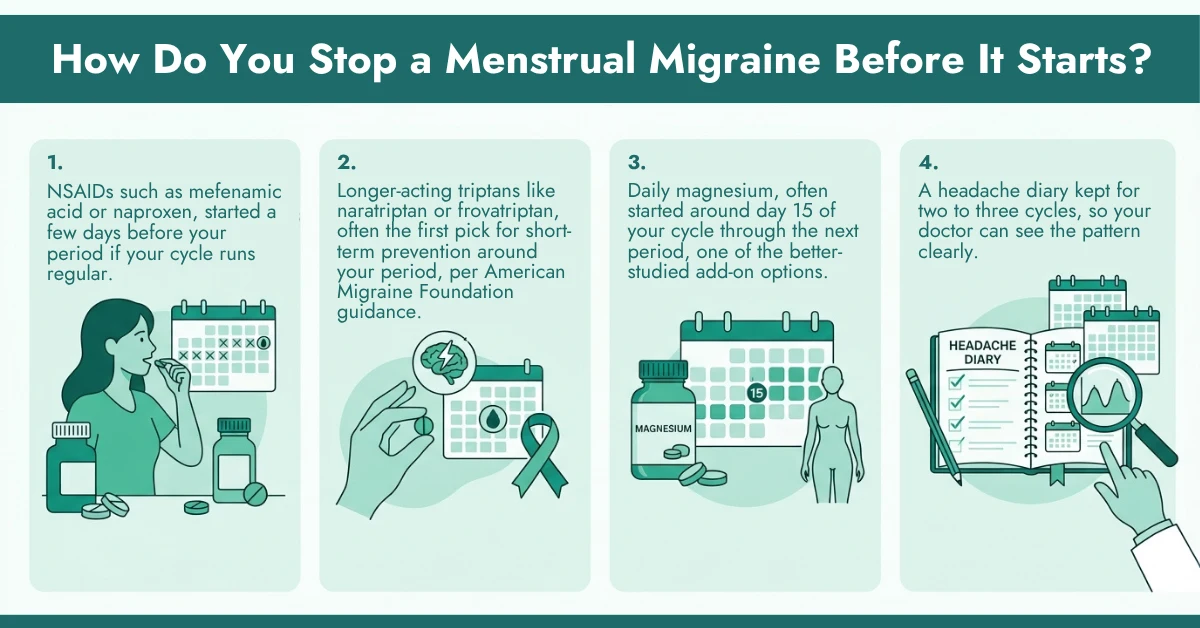
How Do You Stop a Menstrual Migraine Before It Starts?
Timing sets menstrual migraine prevention apart from typical migraine care. The trigger window is predictable. Many women start a medication a few days ahead of it, rather than waiting for the pain to begin. Headache specialists call this mini-prevention.
Options doctors commonly discuss:
- NSAIDs such as mefenamic acid or naproxen, started a few days before your period if your cycle runs regular.
- Longer-acting triptans like naratriptan or frovatriptan, often the first pick for short-term prevention around your period, per American Migraine Foundation guidance.
- Daily magnesium, often started around day 15 of your cycle through the next period, one of the better-studied add-on options.
- A headache diary kept for two to three cycles, so your doctor can see the pattern clearly.
Ask your doctor which combination fits your cycle and health history.
Can Birth Control Help Prevent Menstrual Migraines?
Some hormonal birth control smooths out the estrogen drop that triggers these migraines by keeping levels steadier across the month. Others don’t fit every migraine pattern. Your migraine history is what decides which is safe.
If you get migraine with aura, visual sparkles, zigzag lines, or numbness before the headache, combined estrogen-containing birth control is generally off the table. Clinical guidelines list it as a contraindication, tied to a higher stroke risk in that group. Progestin-only pills, an implant, a hormonal IUD, or an injection like Depo-Provera are the usual safer routes instead.
If you don’t get aura, continuous or extended-cycle combined birth control is one option. Skipping the placebo week can prevent the estrogen dip altogether. Women approaching perimenopause sometimes add a low-dose estrogen patch for the same reason. Bring your full migraine history, aura included, to this talk with your OB-GYN or neurologist.
Can Genetics Affect How Migraine Medications Work?
Sometimes the plan is right and the medication is still the problem. Liver enzymes control how fast you clear a drug, and those enzymes are set by your genes. That’s why the same migraine or mood medication can work well for one person and barely touch another.
Pharmacogenomic (PGx) testing looks at genes like CYP2D6 and CYP2C19. The FDA’s drug-labeling database links these genes to more than a hundred approved medications. Both shape how your body breaks down amitriptyline, sometimes prescribed off label to prevent migraine, and CPIC publishes dosing guidance for it. Propranolol, another off-label option, has no genotype-based dosing guideline. The same genes affect SSRIs like citalopram and fluoxetine, sometimes prescribed for PMDD symptoms on the same days as your headache.
RPh Labs’ at-home PGx testing kit checks how your body is likely to handle 240+ medications from one cheek swab, sent to a CLIA-certified, COLA-accredited lab, with results in 7-10 business days. The kit is $299, HSA/FSA eligible, and splits into four no-interest payments. See how it works.
Tracking a hormonal headache before period so the pattern is provable
Everything useful starts with a diary, because a clinician cannot time prevention around a pattern nobody has written down. Three cycles is the usual minimum, and paper works as well as any app.
Record these each day, not only on headache days:
- Cycle day, with day one being the first day of real bleeding.
- Whether you had a headache, how bad it was on a scale of one to ten, and how long it lasted.
- Aura, if any, and exactly what you saw or felt and for how long.
- What you took, when you took it, and whether it worked.
- Sleep hours, missed meals, alcohol and anything else you suspect.
- Days you could not work, study or care for others.
After three cycles, count how many attacks fall in the window from two days before bleeding through day three. If most of them do, you have a hormonal headache before period pattern rather than a coincidence, and that changes what treatment is offered.
A diary also catches the two patterns that get confused with this one: a mid-cycle attack around ovulation, and a headache during the hormone-free week on contraception. Those look similar on a bad month and quite different across three.
Estrogen withdrawal headache: why the drop matters more than the level
The trigger is the fall, not the floor. An estrogen withdrawal headache follows a sharp drop from a higher level, which is why attacks cluster in the two days before bleeding rather than sitting through the whole low-estrogen stretch of your cycle.
That single mechanism explains several patterns that otherwise look unrelated.
- The headache in the placebo or hormone-free week of a combined contraceptive.
- Headaches in the weeks after childbirth, when estrogen falls steeply.
- Headaches that appear after stopping a hormonal method abruptly.
- The unpredictable stretch of perimenopause, when levels swing rather than decline smoothly.
Prostaglandins released during your period add a second layer, which is why heavy cramps and headache so often arrive together. Treating the cramps sometimes takes the edge off the headache as well.
Understanding an estrogen withdrawal headache also explains why the goal of hormonal prevention is a flatter line rather than a higher one. Skipping the hormone-free week, or bridging it, removes the drop instead of raising estrogen overall.
Magnesium for migraine prevention and other add-ons
Magnesium for migraine prevention is one of the better-studied supplement options, and it is often suggested for a cycle-linked pattern because it can be started on a schedule. Many clinicians suggest beginning mid-cycle and continuing through the next period.
A few practical points matter more than the brand you choose.
- Loose stools are the most common problem, and different salts are tolerated differently.
- Magnesium interacts with some antibiotics and other medicines, so ask your pharmacist about timing.
- Kidney disease changes the picture entirely, and magnesium should not be started without advice in that case.
- Give it several cycles before judging, since it is a preventive rather than a rescue.
- Supplements are not reviewed before sale the way prescription drugs are, so bring the bottle to your pharmacist.
Riboflavin and coenzyme Q10 are the other two commonly discussed add-ons. Evidence for all three is modest rather than strong, and none of them is a reason to skip prescription prevention if your attacks are frequent or disabling.
Treat magnesium for migraine prevention as one layer alongside sleep regularity, meal timing, hydration and a caffeine ceiling. Those habits are unglamorous and they reduce attack frequency for a lot of people.
Migraine with aura and birth control: the safety rule to know
This is the single most important safety point in this article. The combination of migraine with aura and birth control containing estrogen carries a higher stroke risk, and major guidelines treat combined hormonal contraception as contraindicated for people who get aura.
Aura means reversible neurological symptoms before or during the headache: flickering or zigzag lines, blind spots, numbness or tingling spreading up an arm, or trouble finding words. It is not the same as sensitivity to light, which almost everyone with migraine has.
- If you get aura, tell any prescriber before they write a contraceptive prescription, every time.
- Progestin-only pills, the implant, the hormonal IUD and the injection are the usual alternatives.
- The copper IUD contains no hormones at all.
- Smoking, high blood pressure and a clot history compound the risk and change the advice further.
If you already take a combined method and have started getting aura, do not simply stop, because that leaves a pregnancy risk gap. Contact your prescriber promptly and ask for a same-week review so the switch is planned.
Where there is no aura, the rules are different, and continuous or extended-cycle combined contraception is one recognized approach. Migraine with aura and birth control decisions belong with a clinician who has your full history in front of them, aura included.
Perimenopause, and the years when the pattern changes
Many people find attacks get worse in their forties before they get better. The reason is mechanical rather than mysterious: estrogen in perimenopause swings up and down unpredictably, and swings are what trigger these attacks.
That instability is also why a pattern that was reliably premenstrual can scatter across the month. A diary becomes more useful here, not less, because the timing of prevention has to follow the pattern as it changes.
- Expect the pattern to shift, and expect your plan to need revisiting more than once.
- Ask about options that smooth hormone levels rather than raise them, if you do not get aura.
- Ask what happens to your prevention plan if you start hormone therapy for other menopause symptoms.
- Raise any new blood pressure reading, since that changes which options are available.
A word of caution about claims you may see online: no genetic test picks a hormone therapy, a dose or a delivery route. There is no pharmacogenomic dosing guidance for estrogen or progestins, so those decisions rest on your symptoms, your history and your clinician’s judgment.
For most people attacks ease once periods stop for good, though that can take several years and is not guaranteed.
Treating a menstrual migraine on your worst two days
Acute treatment for a menstrual migraine follows the same rules as any other attack, with one difference: you usually know it is coming, so you can have everything ready rather than hunting for it at 6 a.m.
- Keep your acute medication where you will actually reach it, not in a bag somewhere.
- Treat early in the attack rather than waiting to see how bad it will get.
- Use a formulation that survives nausea, which may mean a nasal spray or an injectable rather than a tablet.
- Keep a count of how many days a month you use acute medication, since exceeding your prescriber’s limit can create medication overuse headache.
- Note in your diary whether it worked, so the plan can be revised with evidence.
- Ask about a short course of timed prevention if these days are consistently unmanageable.
Attacks in this window often run longer and respond less well to a first dose, which is exactly why timed prevention exists for this pattern. Discuss both halves of the plan, rescue and prevention, at the same appointment.
Metabolism is a small part of this picture. Drugs like amitriptyline and propranolol, sometimes used preventively, are cleared partly by CYP2D6, which has published prescribing guidance from CPIC. Most triptans are not, so no panel picks a triptan for you. The RPh Labs at-home PGx kit reports 20 genes against more than 240 medicines from a cheek swab, reviewed by a PharmD pharmacist. Check the medication list and state availability first.
When to see a headache specialist, and when to go to the ER
A long-standing pattern that behaves the way it always has is reassuring. Change is what warrants attention, and some changes warrant it immediately.
Call 911 or go to an emergency department for a headache that peaks within seconds, the worst headache of your life, headache with fever and a stiff neck, or headache with weakness, slurred speech, confusion or vision loss that does not resolve. A first severe headache after 50, or a new severe headache in pregnancy, also needs same-day assessment.
- Book a specialist review if attacks are becoming more frequent month after month.
- Book one if aura lasts more than an hour or looks different from your usual aura.
- Book one if two properly trialled preventive options have not helped.
- Book one if you are using acute medication on more days than your prescriber advised.
Bring the diary. Three tracked cycles, a medication history with what each drug did, and a clear note of whether you get aura will do more for a first specialist appointment than anything else you can prepare.
Conclusion:
Menstrual migraines follow a pattern once you track them against your cycle. That pattern is what makes them treatable: timed medication, the right birth control choice for your aura history, and knowing how your own body clears what you’re prescribed.
If migraine medications have let you down more than once, an RPh Labs PGx testing kit shows how your genes handle 240+ common drugs, information you can bring straight into your next appointment. Check your state coverage (RPh Labs currently reaches 45 states) and order your kit online.
Disclaimer:
This article is educational. It’s not a stand-in for advice from your own doctor, neurologist, or genetic counselor. Talk with them before you start, stop, or switch any medication or birth control.
Menstrual migraine: more questions answered
Can low estrogen cause headaches?
A falling estrogen level, not a flat low level on its own, is the bigger trigger. The two-to-three-day drop before your period is when most menstrual migraines start. Timing matters more than the number on any given day.
Can endometriosis or PCOS make menstrual migraines worse?
Endometriosis has a well-documented, two-way link with migraine; each raises the odds of the other. The PCOS-migraine connection is far less settled; research so far hasn’t found a consistent link. Mention both conditions to your doctor if you have them.
Is nausea or feeling lightheaded normal with a period headache?
Yes. Nausea, lightheadedness, and extra light sensitivity are common with menstrual migraines. On their own, they don’t point to a separate problem. Symptoms that are severe, new, or don’t ease up are still worth a call to your doctor.
How long does a menstrual migraine usually last?
These attacks often run longer than migraines at other points in the month, sometimes a full day or more. They can also respond less to the first dose of medication. That’s part of why timed prevention matters for this pattern.
Should I see a doctor about menstrual migraines?
See a doctor if migraines show up most months, disrupt work or school, or don’t ease with over-the-counter pain relief. A neurologist or OB-GYN can map the pattern against your cycle and adjust your plan.
How do I know whether what I get is aura?
Aura is a reversible neurological symptom that usually builds over minutes and lasts under an hour: zigzag or flickering lines, a blind spot, numbness spreading up one arm, or trouble finding words. Light sensitivity alone is not aura. The distinction decides whether migraine with aura and birth control is a safe combination for you.
Can magnesium replace prescription prevention?
Not for frequent or disabling attacks. Magnesium for migraine prevention has modest evidence and is best treated as one layer alongside sleep, meal timing and, where needed, prescription prevention. Ask your pharmacist before starting it, especially if you have kidney disease or take antibiotics.
Why do I get a headache in the placebo week of my pill?
That is an estrogen withdrawal headache, driven by the drop in hormone level during the hormone-free days rather than by anything about your period itself. Skipping or shortening that week is one approach prescribers use, though it is only an option for people who do not get aura.
Does pregnancy make this better or worse?
Many people find attacks ease after the first trimester, when estrogen is high and stable, then return in the weeks after delivery as levels fall. Medication choices change significantly in pregnancy and while breastfeeding, so review your whole plan with your obstetric clinician rather than continuing as before.
Is a hormonal headache before period the same as PMS?
No, though they overlap in timing. A hormonal headache before period is a migraine attack triggered by the estrogen drop, with throbbing pain, nausea and light sensitivity. PMS describes a broader set of mood and physical symptoms in the same window. You can have both, and tracking separates them.
Should I stop birth control to see whether it helps?
Not without planning it, because stopping leaves a pregnancy risk gap and can trigger its own withdrawal headache. Bring your diary and discuss a switch instead. If you get aura and are on a combined method, contact your prescriber promptly rather than waiting for a routine appointment.
Leave a Reply