
If you take Imuran or your doctor has suggested it, understanding azathioprine metabolism helps explain why two people on the same dose can have very different results. This guide covers the enzymes and genes involved, the blood tests you can expect, and how a pharmacogenomic test fits in.
On this page
Azathioprine is an immunosuppressant which belongs to the drug class of thiopurines and works by suppressing blood cells that cause inflammation. Available in tablet form for oral administration, available in the US under the brand name Imuran. Azathioprine is approved to prevent kidney transplant rejection and to treat rheumatoid arthritis, and it is also widely used for inflammatory bowel disease. Available in tablet form (for oral administration) and injection form (for intravenous administration).
Tablets have been available in 25mg, 50mg, and 100mg Azathioprine, whereas the injection strength is 100mg/ml. However, as per the latest FDA data, Imuran injections (AZATHIOPRINE SODIUM) as well as the 25mg tablets have been discontinued. As there are risks of malignancy in humans, particularly of the skin, physicians administering Azathioprine should be well aware of its metabolism-associated risks.
According to the FDA label, “IMURAN should not be given during pregnancy without careful weighing of risk versus benefit.” Do not administer to pregnant women for treating arthritis.
Indications and Usage:
Kidney transplant rejection and Rheumatoid Arthritis have been indicated in the FDA label, whereas Crohn’s disease, Lupus nephritis, and Ulcerative Colitis are off-label indications.
Renal Homotransplantation: IMURAN serves as an adjunct to prevent rejection in renal homotransplantation. Data from over 16,000 transplants indicate a 5-year patient survival rate between 35% and 55%. However, survival outcomes depend on factors such as donor compatibility, HLA antigen match, presence of anti-donor or anti-B-cell alloantigen antibodies, and other variables. The impact of IMURAN on these factors has not been evaluated in controlled trials.
Rheumatoid Arthritis: IMURAN is indicated for active RA to help reduce signs and symptoms. During IMURAN treatment, patients may continue using aspirin, non-steroidal anti-inflammatory drugs (NSAIDs), and/or low-dose glucocorticoids. However, the combined use of IMURAN with disease-modifying anti-rheumatic drugs (DMARDs) has not been studied for potential added benefits or unforeseen adverse effects. Talk to your prescriber before combining the two.
CONTRAINDICATIONS:
IMURAN should not be administered to patients with known hypersensitivity to the drug. It is contraindicated for treating rheumatoid arthritis in pregnant women. Additionally, patients with RA who have previously received alkylating agents (such as cyclophosphamide, chlorambucil, or melphalan) may face a significantly increased risk of malignancy if treated with IMURAN.
Azathioprine Metabolism
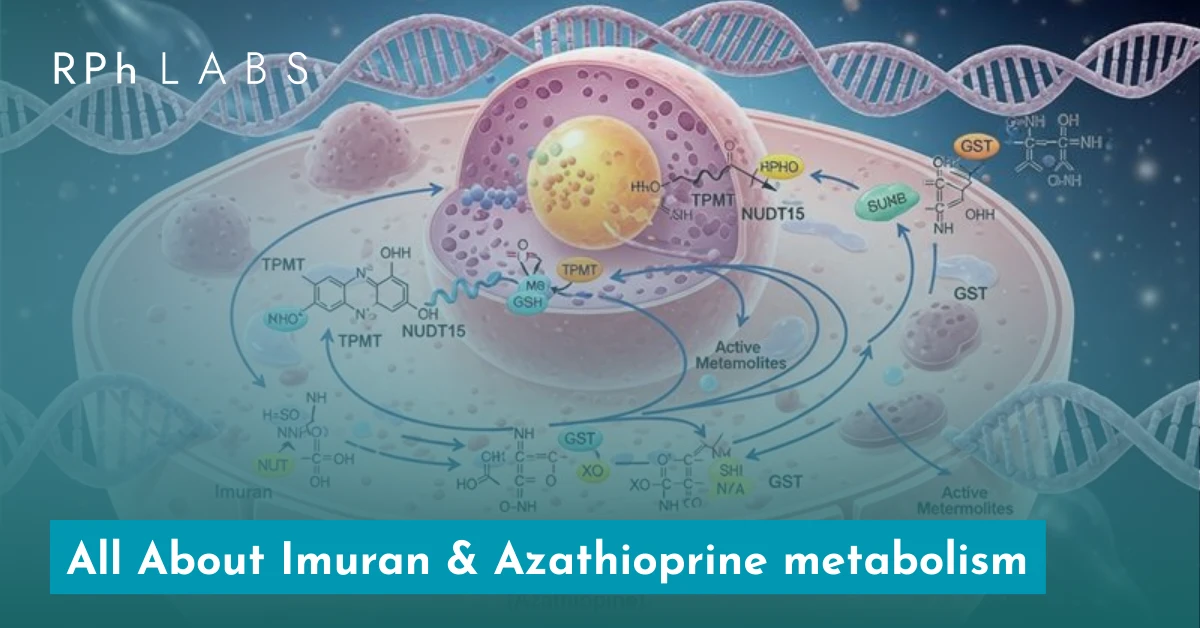
Azathioprine is an immunosuppressive medication that is metabolised into 6-mercaptopurine (6-MP) in the liver through a glutathione-dependent process facilitated by glutathione-S-transferase. 6-MP is subsequently converted into active metabolites, including 6-thioguanine nucleotides (6-TGNs), which are incorporated into DNA, contributing to the drug’s cytotoxic effects. The metabolism of 6-MP involves several enzymes, notably thiopurine S-methyltransferase (TPMT) and xanthine oxidase (XO), which play roles in its inactivation pathways. According to the FDA label, “Maximum serum radioactivity occurs at 1 to 2 hours after oral 35Sazathioprine and decays with a half-life of 5 hours.
Imuran (Azathioprine) Ingredients
Each scored tablet of Imuran contains 50 mg of the active ingredient azathioprine. The inactive ingredients include lactose, magnesium stearate, potato starch, povidone, and stearic acid.
Genes or Enzymes Involved in Azathioprine’s Metabolism
The primary enzymes involved in azathioprine metabolism are:
- Thiopurine S-methyltransferase (TPMT): Catalyses the methylation of 6-MP to inactive metabolites. Genetic polymorphisms in the TPMT gene can lead to variations in enzyme activity, affecting drug toxicity and efficacy.
- Xanthine Oxidase (XO): Involved in the oxidation of 6-MP to inactive metabolites.
- Hypoxanthine-guanine phosphoribosyltransferase (HGPRT): Facilitates the conversion of 6-MP to active metabolites, including 6-TGNs.
Additionally, genetic polymorphisms in the NUDT15 gene have been associated with variations in azathioprine metabolism, particularly in certain populations. Variants in NUDT15 can lead to increased sensitivity to the drug and a higher risk of myelosuppression.
Effects of Azathioprine on Normal Metabolizers
Individuals with normal TPMT activity (homozygous for functional alleles) typically metabolise azathioprine efficiently, maintaining a balance between active and inactive metabolites. This balance generally allows for effective immunosuppression with a standard dosing regimen and a lower risk of adverse effects.
Effects of Azathioprine on Intermediate Metabolizers
Intermediate metabolizers possess one functional and one non-functional TPMT allele, resulting in reduced enzyme activity. These individuals may have higher levels of active metabolites (6-TGNs), increasing the risk of myelotoxicity, such as leukopenia. Dose adjustments and careful monitoring are recommended to mitigate potential toxicities in these patients.
Imuran Drug Interactions:
1. Use with Xanthine Oxidase (XO) Inhibitors
Azathioprine is broken down in the body through a process that can be blocked by XO inhibitors like allopurinol and febuxostat.
Allopurinol: If taken together with IMURAN, the dose of IMURAN should be reduced to 1/3 or 1/4 of the usual amount.
Febuxostat: Should not be used with IMURAN.
Patients with low or no TPMT enzyme activity: Since both TPMT and XO pathways help break down IMURAN, extra dose reductions or alternative treatments should be considered.
2. Use with Aminosalicylates
Certain anti-inflammatory drugs used for bowel diseases, such as sulphasalazine, mesalazine, or olsalazine, may reduce TPMT enzyme activity. If used with IMURAN, extra caution is needed.
3. Use with Drugs Affecting White Blood Cell Production
Some medications, such as co-trimoxazole, may significantly lower white blood cell levels, especially in kidney transplant patients.
4. Use with Angiotensin-Converting Enzyme (ACE) Inhibitors
ACE inhibitors, commonly used for high blood pressure, may cause anaemia and severe white blood cell reduction (leukopenia) when taken with IMURAN.
5. Use with Warfarin
IMURAN may reduce the blood-thinning effects of warfarin, possibly making it less effective.
6. Use with Ribavirin
Ribavirin, a drug for hepatitis C, may cause severe blood cell reduction (pancytopenia) when taken with IMURAN.
- Ribavirin blocks an enzyme (IMPDH) needed for one of IMURAN’s breakdown pathways. This can lead to a toxic buildup of 6-MTITP, a substance linked to low white blood cells (neutropenia), low platelets (thrombocytopenia), and anaemia.
- Patients using both drugs should have frequent blood tests: 1. Weekly for the first month 2. Twice a month for the second and third months 3. Monthly or more often if the dose or treatment plan changes.
Did you know?
Adverse drug reactions are preventable.
Thioguanine Nucleotides Activation & PGx
According to PubMed, “Azathioprine is a prodrug that must first be activated to form thioguanine nucleotides (TGNs), the major active metabolites.” The enzyme nudix hydrolase 15 (NUDT15) and thiopurine methyltransferase (TPMT) activate and inactivate the active metabolites of this medicine. Thus, people who are intermediate metabolizers of either of these enzymes are at higher risk of adverse effects.
The FDA label for azathioprine recommends TPMT testing (genotype or phenotype) before starting treatment. It is important to note that the most common non-functional alleles associated with reduced levels of TPMT activity are TPMT*2, TPMT*3A and TPMT*3C, while for NUDT15 the most common no-function allele is NUDT15*3.
An at-home PGx test by RPh LABS gives insights into your genome (set of all DNA) and shows how your body may respond to 240+ medications. Thus, allowing your doctor to prescribe drugs and dosages as per your genetic makeup.
Azathioprine metabolism in plain language
Azathioprine is a prodrug. That means the tablet you swallow is not the form that does the work. Your body first turns it into 6-mercaptopurine (6-MP), and then splits 6-MP down three roads at once.
- The activation road: the enzyme HGPRT starts converting 6-MP into thioguanine nucleotides, the active compounds that calm an overactive immune system.
- The TPMT road: the enzyme TPMT adds a methyl group to 6-MP, which diverts it away from the active pathway.
- The xanthine oxidase road: xanthine oxidase breaks 6-MP down into an inactive waste product.
Think of it like water flowing into three channels. If the TPMT channel is narrow because of a gene variant, more of the drug flows into the activation channel. The same dose then produces more thioguanine nucleotides than expected.
NUDT15 works further down the line. It helps break down the most active form of the drug before it is built into DNA. When NUDT15 function is reduced, active drug builds up in a similar way. This is why azathioprine metabolism is so closely tied to your genes.
Why thioguanine nucleotides matter for you
Thioguanine nucleotides are the part of the drug that actually suppresses the immune cells driving your condition. You need enough of them for the treatment to work. The problem is that the same compounds also slow down fast-dividing cells in your bone marrow.
Your bone marrow makes white blood cells, red blood cells and platelets. When thioguanine nucleotides build up too high, marrow output can drop. Doctors call this myelosuppression. It can show up as a low white cell count, which makes infections more likely, or as anemia or low platelets.
Some specialist clinics measure metabolite levels in the blood during treatment. That test looks at thioguanine nucleotides and a second group of methylated metabolites. It can help your care team see whether a lack of response is due to low drug levels, or whether levels are high enough to raise safety concerns. It is an ordered lab test, not something you do at home.
Genetic testing and metabolite testing answer different questions. Your genes predict how you are likely to handle the drug before you start. Metabolite levels show what is actually happening once you are on it.
Common azathioprine side effects and warning signs
Most people who take azathioprine do not have serious problems, but it helps to know what to watch for. The official label lists nausea and vomiting as common, especially early in treatment. Taking the dose after food may help, but ask your prescriber before changing how you take it.
The more serious azathioprine side effects are the ones linked to blood counts and the liver. Call your care team promptly if you notice any of these:
- Fever, chills, sore throat or other signs of infection
- Unusual bruising or bleeding, such as nosebleeds or bleeding gums
- Severe tiredness, pale skin or shortness of breath
- Yellow skin or eyes, dark urine or pain on the right side of your belly
- Severe stomach pain, which can be a sign of pancreatitis
The label also carries a warning about a higher long-term risk of certain cancers, including skin cancer and lymphoma. Using sunscreen, covering up outdoors and keeping up with skin checks are simple habits worth building while you take it.
Never stop azathioprine on your own because of a side effect. Stopping suddenly can let your condition flare or put a transplant at risk. Your prescriber can decide whether to pause, lower the dose or switch.
Azathioprine blood tests: what to expect
Regular azathioprine blood tests are a standard part of treatment for everyone, whatever their genes. The label calls for a complete blood count (CBC) weekly during the first month, twice a month for the second and third months, then monthly or more often if the dose changes.
Your care team will usually check liver tests as well. Many clinics also check TPMT status, and increasingly NUDT15, before the first dose.
Tests you may have before starting
- TPMT genotype or phenotype. A genotype test reads your DNA. A phenotype test measures enzyme activity in red blood cells. A recent blood transfusion can make the phenotype result unreliable, but it does not affect a genotype test.
- NUDT15 genotype. Important for everyone, and especially relevant for people of East Asian or Hispanic ancestry, where reduced-function variants are more common.
- Baseline CBC and liver tests to compare against later results.
Tests during treatment
The CBC keeps going for as long as you take the medicine. A normal gene result does not replace it. Low counts can still happen from other causes, such as infections, other drugs or a flare of the underlying disease. You can read more about the enzyme itself in our guide to TPMT testing.
Azathioprine and allopurinol: a critical interaction
The combination of azathioprine and allopurinol deserves special attention. Allopurinol, used for gout, blocks xanthine oxidase, one of the three roads described above. When that road is closed, more 6-MP is pushed toward the active pathway and toxic levels can build up quickly.
For that reason, the Imuran label says the azathioprine dose should be cut to one third or one quarter of the usual amount when allopurinol is added. Febuxostat, another gout drug that blocks the same enzyme, is not recommended with azathioprine.
In some specialist settings, doctors deliberately use a low dose of azathioprine and allopurinol together to shift metabolism in people who make too much of the methylated metabolite. That is a planned strategy with close blood monitoring, never something to try on your own.
The practical takeaway is simple. Make sure every prescriber and pharmacist who looks after you knows you take azathioprine, including dentists and urgent care clinics. If someone suggests a new medicine for gout or high uric acid, ask them to check it against your azathioprine first.
How TPMT and NUDT15 results change azathioprine metabolism
The Clinical Pharmacogenetics Implementation Consortium publishes dosing guidance for thiopurines based on both TPMT and NUDT15. You can read the full document on the CPIC guidelines page. In simple terms, results fall into three groups:
- Normal metabolizer: usually start at the normal dose for your condition.
- Intermediate metabolizer: guidelines suggest starting at a reduced dose and adjusting based on blood counts.
- Poor metabolizer: for non-cancer conditions, guidelines suggest considering a different drug. If a thiopurine is still needed, a greatly reduced dose with very close monitoring is used.
If you have reduced function in both TPMT and NUDT15, the effect on azathioprine metabolism adds up and a larger dose reduction is usually needed.
Your genes do not change over your lifetime, so these results stay useful. If you ever need 6-mercaptopurine or thioguanine in the future, the same TPMT and NUDT15 results apply. MedlinePlus has a clear overview of the TPMT gene if you want more background.
Talking to your prescriber about azathioprine metabolism
Your genes are one piece of the picture. Your prescriber will also weigh your condition, other medicines, kidney and liver function, and how your blood counts respond. These questions can help you get the most from the conversation:
- Has my TPMT or NUDT15 status been checked, and what was the result?
- What starting dose are you planning, and how will we adjust it?
- How often will I need azathioprine blood tests, and who will call me with results?
- Do any of my current medicines or supplements interact with azathioprine?
- Which symptoms should make me call you the same day?
If you do not already have gene results, the RPh Labs at-home PGx kit uses a cheek swab and includes TPMT and NUDT15 among its 20 genes. Every report is reviewed by a PharmD pharmacist, and you can share it with your prescriber. You can see how the process works before deciding whether it makes sense for you.
Conclusion:
Azathioprine metabolism depends on TPMT, NUDT15, XO, and HGPRT enzymes, which regulate its activation (6-TGNs) and inactivation pathways. TPMT and NUDT15 intermediate metabolizers are at higher risk due to increased accumulation of toxic 6-TGNs. Thus, the FDA label clearly states for TPMT testing as “consideration should be given to either genotype or phenotype patients for TPMT.” However, it should be kept in mind that a TPMT test CANNOT substitute for a complete blood count (CBC) test in patients who are being administered Azathioprine.
Azathioprine metabolism FAQ
Where does azathioprine metabolism happen in the body?
Azathioprine is converted to 6-mercaptopurine mainly in the liver and red blood cells through a glutathione-dependent step. After that, enzymes such as HGPRT, TPMT, xanthine oxidase and NUDT15 act inside many tissues, including the bone marrow, to form or break down the active thioguanine nucleotides that suppress the immune system.
How long does azathioprine take to start working?
Azathioprine is slow acting. For conditions such as rheumatoid arthritis or inflammatory bowel disease, it often takes several weeks to a few months before you notice a clear benefit. Your prescriber may use other medicines to control symptoms in the meantime. Keep taking it as prescribed and keep up with your scheduled blood tests.
Can I take azathioprine and allopurinol together?
Only if your prescriber has planned for it. Allopurinol blocks one of the pathways that breaks azathioprine down, so levels of active drug can rise sharply. The label advises cutting the azathioprine dose to one third or one quarter of normal when the two are combined, with close blood count monitoring.
Do I still need azathioprine blood tests if my TPMT result is normal?
Yes. A normal TPMT or NUDT15 result lowers the chance of early severe toxicity, but it does not rule out low blood counts from other causes. The label still calls for regular complete blood counts during treatment, and liver tests are commonly checked too. A gene test adds to monitoring; it never replaces it.
Which azathioprine side effects need urgent attention?
Contact your care team promptly for fever, sore throat or other signs of infection, unusual bruising or bleeding, yellowing of the skin or eyes, severe stomach pain, or extreme tiredness. These can signal low blood counts, liver problems or pancreatitis. Do not stop the medicine on your own; let your prescriber decide the next step.
Does a cheek swab test show TPMT and NUDT15 status?
Yes. A genotype test can be done from a cheek swab because your DNA is the same in every cell. The RPh Labs panel includes both TPMT and NUDT15. Results come back 7 to 10 business days after the sample reaches the lab and are reviewed by a Pharm D before release.


Leave a Reply