
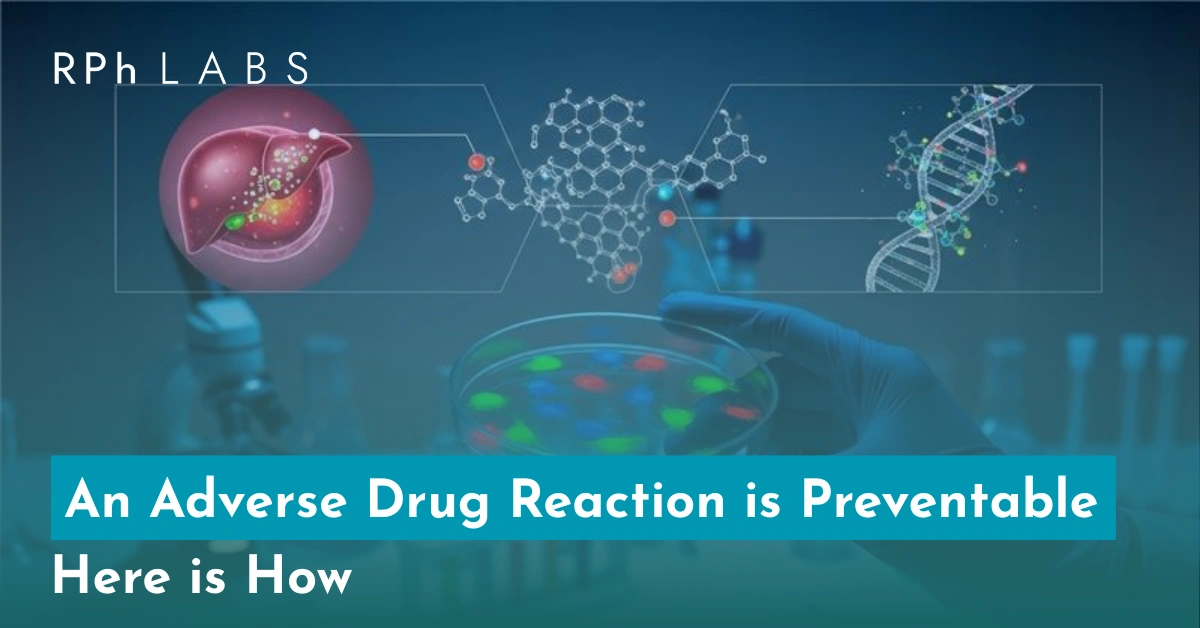
An adverse drug reaction is any unwanted effect a medicine causes, and a meaningful share of them can be headed off with better information rather than better luck. The sections below cover the types, the drugs that cause the most harm, the warning signs that need help today, and where genetics genuinely helps.
On this page
Adverse drug reactions (ADRs) occur when medications produce unintended, harmful effects. These reactions range from mild discomfort to severe complications like organ damage or life-threatening conditions. Many ADRs result from improper dosing, drug interactions, or individual variations in drug metabolism. An adverse drug reaction is preventable (significant number of reactions) through personalized medicine, pharmacogenomic testing, and careful monitoring.
Drugs Metabolism
Drugs undergo metabolism primarily in the liver, where enzymes break them down for elimination. Although various enzymes contribute to drug metabolism, the cytochrome P450 (CYP) enzyme family plays a crucial role in metabolizing numerous drugs. Variants in these enzymes affect how quickly or slowly a person processes medications, influencing drug efficacy and safety.
Genetic variations in metabolism create four patient types:
- Poor metabolizers (PMs) – Process drugs slowly, so an active drug can build up. For prodrugs such as codeine and clopidogrel, which the body has to switch on, poor metabolizers get less effect instead.
- Intermediate metabolizers (IMs) – Have a reduced ability to metabolize drugs, increasing side effect risks.
- Normal metabolizers (NMs) – Process drugs as expected.
- Rapid/ultrarapid metabolizers (RMs/UMs) – Break down active drugs quickly, which can reduce the effect. With a prodrug such as codeine, the opposite happens and too much active drug is formed.
Pharmacogenomic (PGx) testing helps predict these responses, allowing for tailored drug selection and dosing to minimize ADRs. An easy-to-read PGx test by RPh labs does not only show how you may respond to certain medications, but also provides alternatives to some drugs.
Drug Classes with High ADR Risks
Certain drug classes are more prone to causing ADRs because of how they work and how much their handling varies from person to person. Commonly reported examples include:
1. Antipsychotics
Clozapine, Olanzapine, Haloperidol, Risperidone, Aripiprazole, Amisulpride, Quetiapine, Lurasidone, Chlorpromazine, Levosulpiride, Ziprasidone, and Fluphenazine fall under the class of anti-psychotic drugs. CYP1A2 enzyme is primarily involved in metabolising Clozapine and Olanzapine. CYP3A4 is the main isoform responsible for metabolizing Haloperidol. Risperidone is primarily metabolised by P450 2D6 (CYP2D6) in humans. Metabolism and elimination of Aripiprazole are primarily facilitated by CYP2D6 and CYP3A4.
Quetiapine and Lurasidone are primarily metabolised by CYP3A4. Similarly, there are specific enzymes and isoforms in our body which are responsible for metabolising and clearing out the drugs from our body.
2. Antidepressants
Antidepressants are primarily metabolised by cytochrome P450 (CYP) enzymes, with specific isoforms responsible for different drugs:
- Tricyclic Antidepressants (TCAs): These are extensively metabolised by CYP2D6 and CYP2C19. Genetic polymorphisms in these enzymes can significantly impact TCA metabolism, leading to varied drug responses and potential interactions.
- Selective Serotonin Reuptake Inhibitors (SSRIs): Many SSRIs are substrates of CYP2D6 and CYP2C19. For instance, escitalopram is metabolised by CYP2C19, and genetic variations in this enzyme can affect drug response and tolerability.
- Serotonin-Norepinephrine Reuptake Inhibitors (SNRIs): Drugs like venlafaxine are primarily metabolised by CYP2D6. Variations in this enzyme’s activity can influence the drug’s efficacy and risk of adverse effects.
- Atypical Antidepressants: Mirtazapine is metabolised by multiple CYP enzymes, including CYP1A2, CYP2D6, and CYP3A4. Genetic differences in these enzymes may alter mirtazapine’s pharmacokinetics.
3. Anti-Addiction Medications
Medications used to treat substance use disorders are metabolized by various CYP enzymes:
- Methadone: This opioid replacement therapy is primarily metabolized by CYP3A4, with contributions from CYP2B6 and CYP2D6. Genetic polymorphisms, especially in CYP2B6, can affect methadone plasma levels and treatment outcomes.
- Naltrexone: Used for opioid and alcohol dependence, naltrexone is metabolized by the liver, but the specific CYP enzymes involved are not well-defined.
- Disulfiram: Employed in alcohol dependence treatment, disulfiram inhibits aldehyde dehydrogenase rather than CYP enzymes, leading to unpleasant effects when alcohol is consumed.
4. Miscellaneous Psychotropic Medications
Other psychotropic drugs and their metabolic pathways include:
- Benzodiazepines: Many, such as diazepam and alprazolam, are metabolized by CYP3A4. Variations in this enzyme can influence drug clearance and patient response.
- Mood Stabilizers: Carbamazepine is primarily metabolized by CYP3A4 and can induce its own metabolism, leading to variable blood levels.
- Stimulants: Amphetamine is partly handled by CYP2D6, but a large share leaves the body unchanged in urine, and there is no guideline that sets a stimulant dose from a gene result. Methylphenidate is cleared by CES1, which is not on the RPh Labs panel.
Understanding the metabolism of these medications is crucial for predicting drug interactions, individualising dosages, and minimising adverse effects.
How an Adverse Drug Reaction is Preventable?
A pharmacogenetic test, commonly known as a PGx test, gives insights into how your body may respond to certain medications. Humans can be divided into 4 types of metabolizers, i.e., poor, intermediate, normal, and rapid metabolizers. You may be a rapid metabolizer of one drug, while poor at another, etc. If we have 4 patients of the same age, sex and other health conditions, but having different genetic makeups, here is how a doctor may tailor their medications:
One FDA-labelled drug that affects individuals differently based on genetic makeup and requires careful dosing is Warfarin. Warfarin is primarily metabolised by the CYP2C9 enzyme, and its effect is influenced by variations in CYP2C9 and VKORC1 genes.
Here’s a hypothetical case of four patients with the same age, sex, and health conditions but differing in their CYP2C9 and VKORC1 genotypes. CYP2C9 has no recognized rapid metabolizer phenotype, so the fourth patient differs in VKORC1 instead:
| Patient Type | Genotype (CYP2C9 Variant) | Metabolism Type | Expected Warfarin Response | Dosing Considerations |
| Patient A | CYP2C9 *3/*3 | Poor Metabolizer (PM) | Warfarin is metabolised very slowly, increasing bleeding risk. | Requires significantly lower dose; close INR monitoring. |
| Patient B | CYP2C9 *1/*3 | Intermediate Metabolizer (IM) | Reduced warfarin clearance, higher sensitivity. | Lower-than-standard dose; more frequent INR checks. |
| Patient C | CYP2C9 *1/*1 | Normal Metabolizer (NM) | Warfarin clearance is as expected; standard response. | Standard dosing with routine INR monitoring. |
| Patient D | CYP2C9 *1/*1 with VKORC1 -1639 G/G | Normal CYP2C9 metabolizer, less warfarin sensitive | Warfarin clearance is normal, and the VKORC1 genotype makes the target enzyme less sensitive to it. | Often needs a higher dose than average; dosing is still set by INR results. |
Key Takeaways:
- Poor metabolizers (PMs) have a significantly higher bleeding risk due to slow drug clearance.
- Intermediate metabolizers (IMs) also have increased sensitivity, but to a lesser extent.
- Normal metabolizers (NMs) generally respond as per standard guidelines.
- VKORC1 -1639 G/G patients are usually less sensitive to warfarin and often need a higher dose, while the A/A genotype points the other way.
If administered the same dosage of Warfarin (an anticoagulant) to all 4 different metabolizers in the above case, the chances of adverse drug reaction could have increased. An adverse drug reaction is preventable with the help of Vigilant dosing or tailored dosing, which involves a careful assessment of all such factors. Still have ambiguities? Here you can see how it works.
References:
Adverse drug reaction or medication side effects: telling them apart
The words get used interchangeably, but the difference changes what happens next. Getting the label right on your chart is one of the cheapest safety wins available.
- Dose related reactions come from the drug doing too much of what it normally does. Bleeding on a blood thinner, low blood sugar on insulin, drowsiness on a sedative. These are predictable, and they are the ones dosing and genetics can influence.
- Immune reactions are true allergies. Hives, swelling of the lips or tongue, wheezing and anaphylaxis belong here, and so do the rare severe skin reactions. They are not dose related and they can happen on a small amount.
- Intolerance means the drug bothers you without an immune mechanism, such as nausea from an antibiotic. It is uncomfortable rather than dangerous.
- Interaction effects happen because of a second drug, a supplement or even grapefruit, not because either drug is wrong on its own.
- Withdrawal effects follow stopping too quickly rather than taking the drug.
Mislabeling matters. When nausea gets written down as a penicillin allergy, that patient may spend decades receiving broader, less suitable antibiotics for infections that penicillin would have handled. Ask your prescriber or pharmacist to record what actually happened, in plain words, alongside the drug name and the date.
So not every unwanted effect is an adverse drug reaction in the reporting sense, and not all medication side effects are avoidable. Sorting them honestly is what makes the avoidable ones visible.
High risk medications that cause the most harm
Harm is not spread evenly across the pharmacy, and a handful of high risk medications account for most of it. A short list of drug classes accounts for a large share of emergency visits and hospital admissions, mostly because small differences in blood level produce big differences in effect.
- Anticoagulants and antiplatelets: warfarin, the direct oral anticoagulants, clopidogrel. Too much means bleeding, too little means clots.
- Insulin and sulfonylureas: glipizide, glyburide and insulin of any kind, where a dosing error shows up as hypoglycemia within hours.
- Opioids and sedatives: especially combined, because breathing depression is additive.
- Methotrexate: a weekly drug that is dangerous if taken daily by mistake.
- Digoxin, lithium and phenytoin: narrow margins between a helpful level and a toxic one.
- Chemotherapy and immunosuppressants: fluorouracil, capecitabine, thiopurines such as azathioprine and mercaptopurine.
- NSAIDs: ordinary over the counter drugs that cause bleeding and kidney injury, particularly in older adults.
Several of these high risk medications have a genetic component, which is the reason pharmacogenomics exists at all. Thiopurine toxicity tracks with TPMT and NUDT15 variants. Fluorouracil and capecitabine toxicity tracks with DPYD. Warfarin dose relates to CYP2C9, VKORC1 and CYP4F2.
Preventing an adverse drug reaction from these high risk medications is otherwise a matter of process rather than genes: one pharmacy, an accurate list, and a human who checks the new prescription against the old ones. Our guide to which medications need a PGx test first sorts the drugs where testing changes something from the ones where it does not.
Polypharmacy in older adults: how risk multiplies
Risk does not rise in a straight line as medicines are added. Each new drug can interact with every existing one, so the number of possible pairs grows quickly, and polypharmacy in older adults is the setting where that arithmetic bites hardest.
Three things change with age and drive much of the risk in polypharmacy in older adults. Kidney function declines gradually even when it looks normal on paper, body composition shifts so some drugs linger, and the brain becomes more sensitive to sedating and anticholinergic effects.
- Prescribing cascades: a side effect from drug one gets treated with drug two, whose side effect gets treated with drug three.
- Anticholinergic load: antihistamines, bladder drugs, some antidepressants and muscle relaxants add up to confusion, constipation and falls.
- Duplicate therapy: two drugs from the same class arriving from two prescribers.
- Drugs with no current purpose: a proton pump inhibitor or sleep aid started years ago for a reason that has passed.
The fix is a scheduled review rather than a crisis. Bring every bottle, including over the counter products, eye drops and supplements, to one appointment each year and ask which medicines could come off. Deprescribing is a planned, supervised process, and it is done with a prescriber, never by stopping things at home.
Polypharmacy in older adults also makes each adverse drug reaction harder to attribute, which is why a written timeline of what started when is worth more than any single lab result.
CYP2C19 poor metabolizer and other phenotypes that change outcomes
Phenotypes such as CYP2C19 poor metabolizer are only useful when they attach to a real prescribing decision. These are the examples with published guidance behind them, not speculation.
Clopidogrel
Clopidogrel is a prodrug: it has to be activated by CYP2C19 before it can thin the blood. A CYP2C19 poor metabolizer activates less of it, so the antiplatelet effect is diminished. The FDA label carries a boxed warning about exactly this, and guidelines suggest an alternative antiplatelet for affected patients after stent placement.
Codeine and tramadol
Both need CYP2D6 to become their active forms. A poor metabolizer may get little pain relief, while an ultrarapid metabolizer can reach unexpectedly high active drug levels. That is a genuine safety issue rather than a comfort issue.
Thiopurines and fluoropyrimidines
TPMT and NUDT15 variants raise the risk of severe blood count suppression from azathioprine and mercaptopurine. DPYD variants raise the risk of severe toxicity from fluorouracil and capecitabine. In both cases testing before the first dose is the point, not after. See TPMT testing for the detail.
Antidepressants and voriconazole
CYP2C19 and CYP2D6 shape the levels of many antidepressants. Voriconazole levels run high in a CYP2C19 poor metabolizer and low in an ultrarapid metabolizer, which affects both toxicity and treatment failure. Our page on CYP2C19 rapid metabolizer status covers the other end of that range.
You can check any of this independently. The CPIC guidelines set out the actionable gene and drug pairs, and the FDA table of pharmacogenetic associations lists the associations the agency considers supported.
Warning signs that need help the same day
Most medication side effects are a nuisance and settle on their own. A short list is not, and knowing them in advance saves hours.
- Swelling of the face, lips or tongue, wheezing or trouble breathing: possible anaphylaxis. Call 911.
- A spreading rash with blisters, peeling skin, mouth or eye sores, or fever: possible severe skin reaction. This needs emergency assessment, not a wait and see.
- Bleeding that will not stop, black or tarry stools, vomiting blood, or a sudden severe headache while on a blood thinner.
- Agitation, fever, sweating, muscle twitching and a racing heart after a serotonergic drug change, which can indicate serotonin syndrome.
- Yellowing of the eyes or skin, dark urine, or right upper abdominal pain: possible liver injury.
- Fever with a sore throat or mouth ulcers on a drug that can suppress blood counts.
For a suspected overdose or poisoning in the United States, call 911 for anything severe, and Poison Control at 1-800-222-1222 for guidance. If a medicine change brings new or worsening thoughts of self harm, the 988 Suicide and Crisis Lifeline is available around the clock.
One more thing: do not stop a medicine abruptly to see if it was the cause. Benzodiazepines, some antidepressants, antiseizure drugs, beta blockers and steroids can all cause harm when stopped suddenly. Call first, and let your prescriber plan the change.
How to report and record an adverse drug reaction
A reaction that nobody writes down will happen again, often years later, to the same person. Reporting takes minutes and it protects you first.
- Tell the prescriber who wrote the drug, and tell your pharmacy so it lands in the record they check at every fill.
- Ask that the entry says what happened, how soon after the dose, and how it was treated, rather than just the word allergy.
- Keep your own copy: drug name, strength, date started, date of the reaction, what you did.
- Ask whether the reaction should be reported to the FDA’s MedWatch program, which collects safety signals from patients and clinicians.
- Ask whether anything you already take should be reviewed at the same time, since interactions are a common hidden cause.
If you use more than one pharmacy, consolidating to one is the single most effective change most people can make. Interaction checks only work on the list the system can actually see.
Write it down even for a mild reaction. An adverse drug reaction that seemed minor at a low dose can matter a great deal at a higher one, or when a second drug joins in.
A short checklist before a new prescription starts
Most prevention happens in the two minutes before a prescription is filled. These questions fit in that window.
- What is this for, and how will we know it is working?
- What are the most common medication side effects, and which ones mean I should call?
- Does this interact with anything on my list, including supplements and over the counter products?
- Does my kidney or liver function change the dose?
- Is there a gene result that applies to this drug?
- When is the follow up, and what gets checked then?
Ask your pharmacist the same questions about medication side effects and interactions. Pharmacists catch interactions and duplicate therapy for a living, and the conversation is free.
Keep one current list on your phone, updated the day anything changes. In an emergency it is the most useful document you own.
Where a PGx test helps, and where it does not
Pharmacogenomic testing explains one slice of variability: how fast you activate or clear certain drugs. That is a real slice, and for the gene and drug pairs above it can prevent a predictable adverse drug reaction before the first dose.
It is not a complete safety net, and we would rather say so plainly.
- It does not predict most true allergies. Immune reactions to antibiotics generally are not read from a pharmacogenomic panel, and severe skin reaction risk with carbamazepine depends on HLA testing, which is ordered separately.
- It does not replace monitoring. INR for warfarin, blood counts on thiopurines, kidney function checks and glucose logs all still apply.
- It says little about drugs cleared by other routes, such as lithium and gabapentin through the kidneys, methylphenidate through CES1, or olanzapine and clozapine mainly through CYP1A2 and UGT1A4.
- It cannot see your other medicines, so a strong CYP2D6 inhibitor like fluoxetine, paroxetine or bupropion can make a normal metabolizer behave like a poor one. That is called phenoconversion, and only a human review catches it.
The RPh Labs at-home pharmacogenetic testing kit is a cheek swab covering 20 genes, reported against more than 240 medications. Every report is reviewed by a PharmD pharmacist and includes a free consultation, which is where phenoconversion and your actual list get sorted out. Our how it works page covers the process and the medication list shows the coverage.
Used that way, testing is one layer among several. The others are an accurate list, one pharmacy, planned reviews for polypharmacy in older adults, and a prescriber who knows what you reacted to last time.
Adverse drug reaction FAQ
What is the difference between an allergy and medication side effects?
An allergy is an immune response: hives, swelling, wheezing or anaphylaxis, and it can happen on a very small amount. Medication side effects are usually dose related and predictable, like drowsiness from a sedative or nausea from an antibiotic. The distinction decides whether a drug class is off limits for life or simply needs a different dose or timing.
Which high risk medications should be reviewed most often?
Blood thinners, insulin and sulfonylureas, opioids and sedatives, methotrexate, digoxin, lithium, phenytoin, thiopurines and fluoropyrimidines. They share narrow margins between a helpful level and a harmful one. If you take any of them, ask how often levels, blood counts or kidney function are checked, and keep the results with your own records.
Can a genetic test prevent every adverse drug reaction?
No. It addresses the dose related reactions tied to specific enzymes and transporters, which is a useful share but not all of them. It does not predict most allergies, it does not replace monitoring such as INR or blood counts, and it cannot see the rest of your medicine list. Treat it as one layer of safety, reviewed with a pharmacist.
How do I know if I am a CYP2C19 poor metabolizer?
Only a laboratory test can tell you. A cheek swab or blood sample is genotyped, and the report translates your alleles into a phenotype. It matters most before clopidogrel, voriconazole and several antidepressants. Because inherited results do not change, one test stays valid for life, although the interpretation is updated as guidelines change.
What should I do about polypharmacy in older adults at home?
Gather every bottle, including over the counter products and supplements, and book one annual review. Ask which medicines could be stopped, which could be simplified, and whether any dose needs adjusting for kidney function. Do not stop anything on your own, because several common drugs cause harm when discontinued abruptly. Deprescribing is planned with a prescriber.
Who should I call first if I think a medicine is causing harm?
For breathing trouble, facial swelling, a blistering rash, uncontrolled bleeding or collapse, call 911. For anything less urgent, call the prescriber and your pharmacy the same day. Poison Control at 1-800-222-1222 handles suspected overdose questions. Do not stop the medicine on your own before you have spoken with someone.


Leave a Reply