
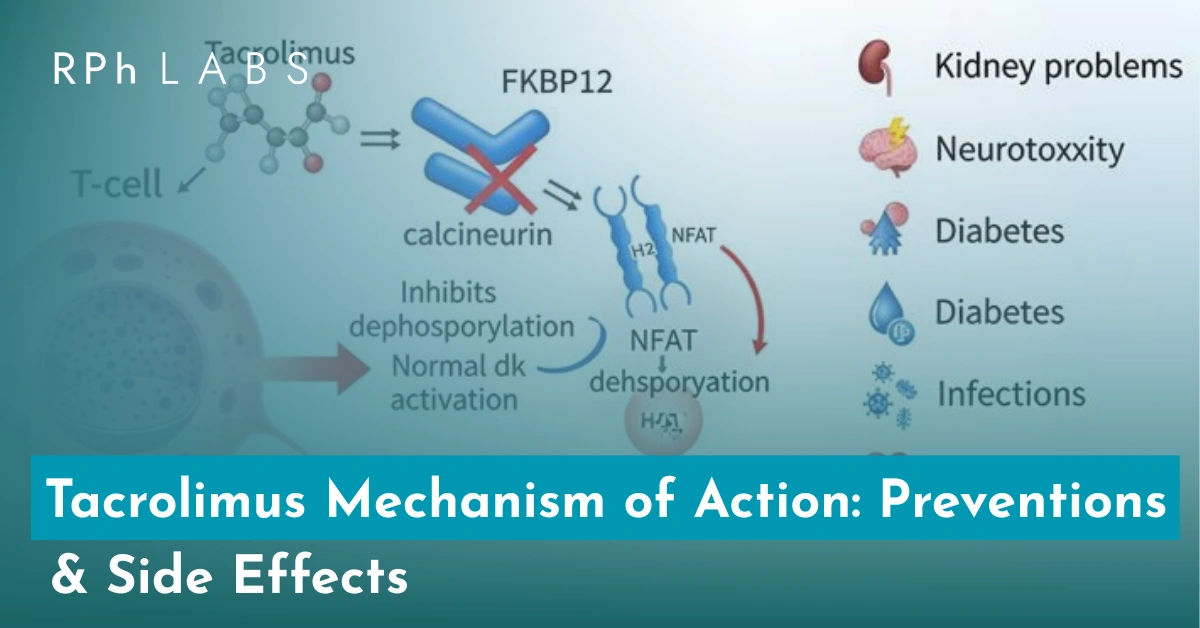
The tacrolimus mechanism of action is easier to follow than most drug pathways once you see the order of events: the drug grabs a carrier protein, that pair switches off one enzyme, and a single immune signal never gets sent. Here is how that works, and why trough levels, interactions and CYP3A5 genetics decide your dose.
On this page
Our immune system maintains self-tolerance. Tacrolimus, commonly available under the brand name Prograf, is an immunosuppressant medication primarily used to prevent organ rejection after transplantation (kidney, liver, heart, lung). It works by suppressing the immune system, which helps prevent the body from attacking the transplanted organ. Let’s have a look at Tacrolimus mechanism of action, some common Tacrolimus side effects and possible solutions to manage them.
Tacrolimus Mechanism of Action, Potencies, Administration Route, Warnings and Cessation
- Mechanism of Action: Tacrolimus’s mechanism of action mainly involves inhibiting calcineurin/calcineurin phosphatase (calcium-activated serine/threonine protein phosphatase), a protein involved in the activation of T-cells, a crucial component of the immune system. By suppressing T-cell activity, tacrolimus prevents the body from recognising the transplanted organ as foreign and attacking it.
- Administration & Potencies: Tacrolimus can be administered through the intravenous route (IV, injected into veins), oral (usually in tablet form), topical (applied as an ointment), and sublingual (placed under the tongue).
Available in 0.5mg, 1mg, and 5mg. Tacrolimus dosing is highly individualized and requires careful monitoring by a healthcare professional. According to the dosing instruction shared by the NIH, oral and intravenous dosing varies in the case of a Heart, Liver, or Kidney transplant. The following are the adult dosing guidelines:
Heart Transplant: (Used with an antimetabolite)
Oral:
- IR: Start with 0.075 mg/kg/day, split into two doses every 12 hours.
- IV: Start with 0.01 mg/kg/day as a continuous infusion.
Liver Transplant:
Oral:
- IR (Immediate Release): Start with 0.1 to 0.15 mg/kg/day, split into two doses, combined with other medications.
- ER (Extended Release): Take 0.1 to 0.2 mg/kg once daily with a corticosteroid. (Note: The XL version is not approved in the US for liver transplants due to higher death rates in female patients.)
- IV (Intravenous): Start with 0.03 to 0.05 mg/kg/day as a continuous infusion.
Kidney Transplant: (Used with an antimetabolite)
Oral:
- IR: Start with 0.2 mg/kg/day if combined with azathioprine, or 0.1 mg/kg/day if combined with mycophenolate mofetil.
ER:
- XL: 0.15 to 0.2 mg/kg/day with basiliximab, or 0.2 mg/kg/day without it.
- XR: Start with 0.14 mg/kg/day.
- IV: 0.03 to 0.05 mg/kg/day as a continuous infusion.
Warnings:
-Serious Side Effects: Tacrolimus can cause serious side effects, including kidney problems, high blood pressure, diabetes, and an increased risk of infection.
-Cancer Risk: Some studies have suggested a possible increased risk of certain cancers in individuals taking tacrolimus long-term.
-Drug Interactions: Tacrolimus interacts with numerous medications, including many commonly used drugs.
Both CYP3A4 and CYP3A5 metabolise Tacrolimus, and CYP3A5 is the one with published pharmacogenomic dosing guidance. A non-invasive PGx test by RPh LABS, by showing whether you are a CYP3A5 expresser or a non-expresser (for example, the *3/*3 genotype is a non-expresser), gives you and your transplant team one more input alongside blood level monitoring. This test requires just a cheek (buccal) swab and gives you insights into how your body may respond to 240+ medications.
- Cessation Rules: Abruptly stopping tacrolimus can lead to severe consequences, including organ rejection. Therefore, it should always be tapered off gradually under the close supervision of a healthcare professional.
- Dose Adjustments: Tacrolimus dosing requires careful monitoring and frequent blood tests to ensure therapeutic levels and minimise side effects. Dose adjustments are often necessary based on blood levels, kidney function, and other factors.
- Active Ingredient: Prograf is one of the most widely used tacrolimus brands, and the active ingredient in Prograf is tacrolimus.
- Metabolism: Tacrolimus is metabolised in the liver by the enzymes CYP3A4 and CYP3A5.
Can Tacrolimus (Prograf) Be Abused?
Tacrolimus is a prescription medication, and its use should be strictly as directed by a healthcare professional. Due to its potent immunosuppressive effects and potential for serious side effects, tacrolimus has a low potential for abuse. However, it can be misused if taken in higher doses than prescribed or used without medical supervision.
How Your CYP3A5 Genotype Affects Tacrolimus Levels
- CYP3A5 non-expressers: People who carry two non-functional copies, such as the *3/*3 genotype, make little CYP3A5 and tend to reach higher tacrolimus blood levels on a standard dose.
- CYP3A5 expressers: People who carry at least one functional copy clear tacrolimus faster and often need a higher starting dose, which the transplant team sets and then confirms with blood levels.
How Should Tacrolimus Doses Be Personalised?
Tacrolimus dosing is highly individualised and requires careful monitoring. Factors that influence dosing include:
- Transplant type: The type of organ transplanted (e.g., kidney, liver) significantly impacts dosing requirements.
- Patient factors: Age, weight, kidney function, and liver function all play a role in determining the appropriate dose.
- Drug interactions: Concurrent medications can significantly impact tacrolimus levels.
- CYP3A5 genotype: The individual’s CYP3A5 genotype can influence tacrolimus metabolism and therefore dosing. Pharmacogenetics testing, commonly known as PGx testing, can help doctors administer dosages according to your genome (set of all DNA).
Tacrolimus mechanism of action, step by step
Inside the cell, tacrolimus first binds a small carrier protein called FKBP12. On its own, neither the drug nor the protein does much. Together they form a complex that latches onto calcineurin and stops it working.
Calcineurin is a phosphatase, an enzyme that removes phosphate groups. Its job in a T cell is to strip phosphate from a transcription factor called NFAT so that NFAT can move into the nucleus and switch on genes. Block calcineurin and NFAT stays stuck outside the nucleus.
The gene that matters most is the one for interleukin-2, the growth signal T cells use to multiply. Without it, the T cells that would recognise a transplanted kidney, liver, heart or lung as foreign never expand into an army. That is the whole tacrolimus mechanism of action in one sentence: no calcineurin, no NFAT signal, no interleukin-2, no T cell response.
Two things follow from that. First, the effect is on the immune response you need to suppress and on the ones you need to keep, which is why infection risk rises. Second, the tacrolimus mechanism of action is concentration dependent, so too little means rejection risk and too much means toxicity. That narrow window is the reason for blood level testing.
What makes tacrolimus a calcineurin inhibitor
Tacrolimus belongs to a small class known as calcineurin inhibitors. Cyclosporine is the other member. Both end at the same enzyme, but they get there by different routes: cyclosporine binds cyclophilin rather than FKBP12.
The class distinction is useful when you read your discharge paperwork. Anything described as a calcineurin inhibitor shares a family pattern of side effects, in particular kidney effects, high blood pressure, tremor and electrolyte shifts. Switching between them changes the details, not the pattern.
It also explains what tacrolimus is not. Mycophenolate, azathioprine and sirolimus are immunosuppressants with different targets, and they are often given alongside a calcineurin inhibitor rather than instead of one. Combining drugs with different targets allows lower doses of each.
Why a calcineurin inhibitor is not tapered on your own
Stopping or reducing a calcineurin inhibitor without supervision risks acute rejection, which can happen within days and may not feel like anything at first. Any change, including a change because of cost or side effects, goes through your transplant team. That holds even if you feel completely well.
Why the tacrolimus trough level drives dosing
Tacrolimus is dosed to a blood concentration, not to a fixed number of milligrams. The measurement used is the tacrolimus trough level, drawn just before the next dose is due, usually about 12 hours after the previous one for immediate-release formulations.
Target ranges differ by organ, by how recent the transplant is and by which other immunosuppressants you take, so your target is set by your transplant team rather than by a general number you read online. What stays constant is the principle: the tacrolimus trough level is the signal, and the milligram dose is just the dial used to reach it.
Timing your blood draw correctly matters as much as taking the drug on time. A sample taken two hours after a dose is not a trough and can look alarmingly high. If you are asked to come in fasting or before your morning dose, follow that exactly and tell the phlebotomist when you last took tacrolimus.
Formulations are not interchangeable either. Immediate-release capsules taken twice daily and extended-release products taken once daily produce different concentration curves, so a switch between them needs a new tacrolimus trough level check rather than a straight milligram swap.
CYP3A5 genotype and how much tacrolimus you need
Both CYP3A4 and CYP3A5 break tacrolimus down. CYP3A5 is the one with a published pharmacogenomic guideline, because its common variants switch the enzyme off completely rather than just slowing it.
People who carry at least one functional CYP3A5*1 allele are called expressers. They clear tacrolimus faster and tend to sit below target on a standard starting dose. People with two non-functional copies, most often CYP3A5*3, are non-expressers and reach target on standard dosing.
The CPIC guideline for tacrolimus and CYP3A5 recommends increasing the starting dose for expressers, within a capped total daily dose, and continuing therapeutic drug monitoring either way. It does not replace level testing; it shortens the time spent below target at the start.
Allele frequencies differ between ancestry groups, and the expresser genotype is more common in people of African ancestry. That is one reason dose requirements vary so widely between patients on the same protocol, and one reason a CYP3A5 genotype result is more informative than a clinician’s guess from weight alone.
CYP3A5 genotype is part of the 20-gene RPh Labs panel, reported alongside CYP3A4. Because DNA does not change, it is a one-time test, and the result stays relevant for the rest of your transplant care.
Tacrolimus drug interactions to flag with every prescriber
Tacrolimus drug interactions are among the most clinically significant of any common medicine, because the therapeutic window is so narrow. Anything that inhibits CYP3A raises levels; anything that induces it drops them.
- Azole antifungals such as voriconazole, posaconazole, itraconazole and fluconazole raise tacrolimus levels sharply.
- Macrolide antibiotics including clarithromycin and erythromycin have the same effect; azithromycin is generally less of a problem.
- Non-dihydropyridine calcium channel blockers such as diltiazem and verapamil raise levels, sometimes used deliberately.
- Rifampin, carbamazepine, phenytoin and phenobarbital induce CYP3A and can drop levels into the rejection range.
- St. John’s wort is a potent inducer and has been linked to graft loss.
- Grapefruit, pomelo and Seville orange inhibit intestinal CYP3A and can raise levels unpredictably.
Two rules cover most tacrolimus drug interactions in practice. Tell every prescriber and pharmacist that you are on tacrolimus before any new medicine, including short antibiotic or antifungal courses. And never start a supplement without checking, because herbal products are the interactions people forget to mention.
When an interacting drug genuinely has to be used, the answer is usually extra level monitoring and a temporary dose change made by your team, not avoidance. Our medication list shows which of your other medicines have a gene-based report on our panel.
Side effects a calcineurin inhibitor is monitored for
Most tacrolimus side effects follow from the same mechanism and the same concentration curve, which is why they tend to appear when levels run high.
- Kidney effects, tracked with creatinine and eGFR at every visit
- Tremor, headache and trouble sleeping, often the first hint that a level is too high
- High blood pressure
- New or worsening diabetes, with glucose and HbA1c checked regularly
- Low magnesium and high potassium
- Infections, including ones that are unusual outside immunosuppression
- Long-term cancer risk, especially skin cancer and lymphoma, which is why sun protection and skin checks are standard advice
Report a new tremor, reduced urine output, swelling, fever, persistent thirst or confusion to your transplant team promptly rather than waiting for the next scheduled visit. Many of these respond to a level-guided dose change made early.
Because a calcineurin inhibitor blunts the usual signs of infection, a fever that you would ignore before a transplant is now a reason to call. The same applies to any live vaccine question, which needs a decision from your team.
What a CYP3A5 genotype result does and does not do
A CYP3A5 genotype result predicts how much tacrolimus you are likely to need. It does not measure how much is in your blood today, and it never replaces the tacrolimus trough level.
The result is most valuable early, when the dose is being found and every day below target carries rejection risk. It is also useful later if your levels behave in a way that surprises your team, because a known expresser genotype explains a pattern that otherwise looks like poor adherence.
What a CYP3A5 genotype result cannot tell you is whether you will reject the graft, how your kidneys will hold up, or which other immunosuppressants to combine. Those depend on immunology, the organ, your other conditions and time since transplant.
If you want the test, the RPh Labs at-home cheek swab kit covers CYP3A5 with 19 other genes and reports against more than 240 medications. Results arrive 7 to 10 business days after your sample reaches the lab, every report is reviewed by a PharmD pharmacist, and a free pharmacist consultation is included so you can plan what to hand your transplant clinic.
Questions for your transplant team
Understanding the tacrolimus mechanism of action is most useful when it turns into better questions at your next clinic visit.
- What is my target trough range, and how will it change as time passes since transplant?
- Which formulation am I on, and what should I do if a pharmacy substitutes a different one?
- Who do I call before starting any new medicine, and how quickly can I get an answer?
- Do you use CYP3A5 genotype results here, and would mine change my starting dose or monitoring?
- What symptoms mean I should be seen the same day rather than at my next appointment?
Take the answers home in writing. Tacrolimus is a drug where small process failures, such as a missed level check or an unreported antibiotic course, cause more trouble than the drug itself.
For background on how a swab becomes a report, see how it works. Nothing in a genetic report replaces the plan your transplant team sets, and every dose decision stays with them.
Conclusion
Tacrolimus is a powerful immunosuppressant medication administered to prevent organ rejection (by the immune system) after transplantation. While it can effectively prevent rejection, Tacrolimus side effects can be critical; hence, careful monitoring, regular blood tests, and close collaboration with the healthcare team are required to optimise treatment and minimise adverse effects. Here you can check how Pharmacogenomics testing at home works.
References:
Disclaimer:
This blog post is for informational purposes only. Always consult a doctor before taking any medical action, including, but not limited to, changing your dosages or ceasing your medication.
Tacrolimus mechanism of action FAQ
Does tacrolimus kill T cells?
No. It blocks a signal rather than destroying cells. By stopping calcineurin from activating NFAT, tacrolimus prevents T cells from making interleukin-2 and multiplying. The cells are still there, which is part of why the effect reverses if the drug is stopped, and why stopping without supervision risks rejection.
How soon does a calcineurin inhibitor start working?
The biochemical block happens within hours of absorption, but useful immunosuppression depends on reaching and holding a target concentration. That is why loading and early monitoring are intensive after a transplant, and why a single missed dose is worth reporting to your team rather than shrugging off.
What raises a tacrolimus trough level unexpectedly?
Common causes are a new CYP3A inhibitor such as an azole antifungal or clarithromycin, grapefruit or pomelo juice, diarrhea or vomiting that changes absorption, and a blood sample drawn too soon after a dose. Report new medicines and gut illness so your team can check a level.
Is CYP3A5 genotype testing a blood test?
It does not have to be. The RPh Labs kit uses a cheek swab you collect at home, with free shipping both ways and a self-pay price of $299 that is HSA and FSA eligible. Because your DNA does not change, the CYP3A5 genotype result is valid for life.
Do tacrolimus drug interactions include over-the-counter products?
Yes. St. John’s wort can push levels down far enough to threaten a graft, grapefruit and pomelo push them up, and some antacids affect absorption. Treat every supplement as a prescription decision and clear it with your transplant pharmacist first.
Can a genetic test tell me my exact tacrolimus dose?
No. It narrows the starting range and explains why your requirement may be higher or lower than average. The actual dose still comes from measured blood levels, your organ type, kidney function, other medicines and time since transplant, decided with your transplant team.



Leave a Reply