
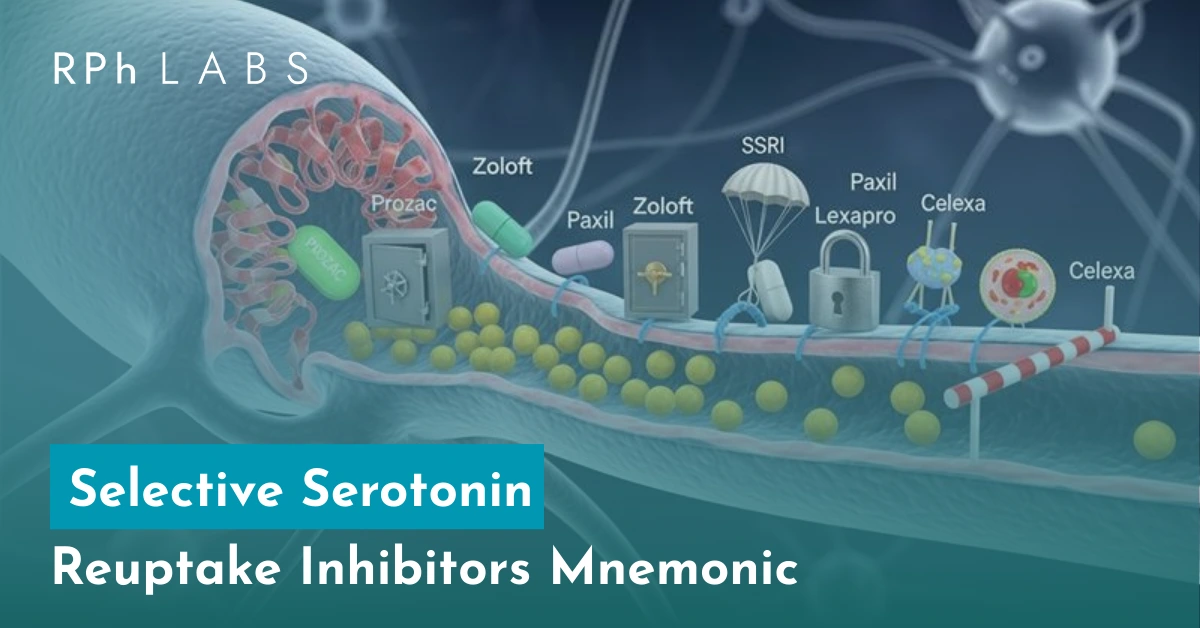
A serotonin reuptake inhibitors mnemonic is the fastest way to lock the SSRI drug names into memory, but exams and real patients both ask for more than a list. This guide adds the pieces that usually come next: what the mnemonic leaves out, how SSRIs differ from SNRIs, and which genes matter.
On this page
Selective serotonin reuptake inhibitors (SSRIs) are prescription medications used to treat a range of mental health conditions, including depression, anxiety, and obsessive-compulsive disorder (OCD). A selective serotonin reuptake inhibitors mnemonic is simply a memory aid for the drug names and what the letters in the class name stand for. The following are some uses:
Uses of SSRIs:
- Major depressive disorder
- Generalized anxiety disorder (GAD)
- Panic disorder
- Obsessive-compulsive disorder (OCD)
- Social anxiety disorder
- Posttraumatic stress disorder (PTSD)
- Premenstrual dysphoric disorder (PMDD)
- Bipolar depression, only together with a mood stabilizer and under specialist care, because an SSRI on its own can trigger a switch to mania
- Bulimia nervosa
- Treatment-resistant depression
1. Meaning of SSRIs
a) Serotonin – The “Feel-Good” Neurotransmitter
Serotonin is a neurotransmitter (chemical messenger in the brain) responsible for mood regulation, emotions, sleep, and appetite. It plays a key role in promoting feelings of well-being and happiness.
When serotonin levels are low, it can lead to depression, anxiety, and mood disorders. Many antidepressant medications aim to increase serotonin levels in the brain to improve mood.
b) Reuptake – The Process of Recycling Neurotransmitters
After serotonin is released from one neuron (nerve cell), it binds to receptors on another neuron to pass along the signal. Once serotonin has done its job, the first neuron “reabsorbs” it through a process called reuptake, which reduces the amount of serotonin available in the brain.
If too much serotonin is reabsorbed, there might not be enough left in the brain to regulate mood effectively, contributing to depression.
c) Inhibition – Blocking Reuptake to Increase Serotonin Levels
This is where SSRIs (Selective Serotonin Reuptake Inhibitors) come in. They block the reuptake of serotonin, preventing the brain from absorbing too much of it. This increases the amount of serotonin available in the synapses (the gaps between neurons), improving mood and alleviating symptoms of depression.
d) Selective – Targeting Only Serotonin
SSRIs are “selective” because they primarily affect serotonin rather than other neurotransmitters like dopamine or norepinephrine. This makes them different from older antidepressants, which affected multiple neurotransmitters and often caused more side effects.
2. Background & History of SSRIs
Before SSRIs, older tricyclic antidepressants (TCAs) and monoamine oxidase inhibitors (MAOIs) were used to treat depression, but they had significant side effects.
In the 1970s–1980s, researchers discovered that serotonin played a major role in depression.
The first SSRI, fluoxetine (Prozac), reached the market in the late 1980s and changed depression treatment because it was much better tolerated and safer in overdose than older antidepressants. Trials have not shown it to be more effective than TCAs, but the lighter side effect burden meant more people could stay on treatment.
Since then, several SSRIs have been introduced and are now widely used for depression, anxiety, PTSD, OCD, and panic disorders.
3. Mnemonic to Remember SSRIs
An easy mnemonic to recall common SSRIs is EFSPC:
“Effective For Sadness, Panic, & Compulsions“
- E → Escitalopram (Lexapro)
- F → Fluoxetine (Prozac)
- S → Sertraline (Zoloft)
- P → Paroxetine (Paxil)
- C → Citalopram (Celexa)
Above are some of the most commonly prescribed SSRIs.
4. Clinical Uses of SSRIs
Apart from depression, SSRIs are used to treat:
- Generalized Anxiety Disorder (GAD)
- Obsessive-Compulsive Disorder (OCD)
- Post-Traumatic Stress Disorder (PTSD)
- Panic Disorder
- Social Anxiety Disorder
- Premenstrual Dysphoric Disorder (PMDD)
5. How Long Do SSRIs Take to Work?
SSRIs do not work immediately. It usually takes 2 to 6 weeks for the full therapeutic effect. During this time, some people may experience mild side effects before noticing improvements in mood.
6. Side Effects of SSRIs
While SSRIs are generally well-tolerated, they can cause:
- Nausea
- Insomnia or drowsiness
- Sexual dysfunction
- Weight changes
- Increased risk of suicidal thoughts (in young adults, early in treatment)
- Serotonin syndrome (rare but serious condition due to excessive serotonin buildup)
7. Are SSRIs Addictive?
SSRIs are not addictive, but suddenly stopping them can cause withdrawal-like symptoms called SSRI discontinuation syndrome, leading to dizziness, mood swings, and flu-like symptoms. It is always advised to taper off SSRIs gradually under a doctor’s guidance.
8. Pharmacogenomics & SSRIs – How Genetics Affects Their Effectiveness
Not everyone responds to SSRIs the same way. Genetic variations in liver enzymes (CYP2C19 & CYP2D6) can affect how SSRIs are metabolized. Some people may:
- Metabolize SSRIs too fast – The Drug is less effective.
- Metabolize SSRIs too slow – Drug builds up, increasing side effects.
Pharmacogenomic testing gives your prescriber this metabolizer information, which is weighed alongside your symptoms, other medicines, and medical history when choosing an SSRI or a dose.
Using the serotonin reuptake inhibitors mnemonic without mixing up classes
The classic serotonin reuptake inhibitors mnemonic covers five drugs: escitalopram, fluoxetine, sertraline, paroxetine and citalopram. Fluvoxamine is the sixth SSRI and gets left out of most versions, so add it by hand or you will miss it when a question mentions obsessive-compulsive disorder.
The trap in every serotonin reuptake inhibitors mnemonic is class drift. Venlafaxine, desvenlafaxine, duloxetine and levomilnacipran are SNRIs. Amitriptyline, nortriptyline and imipramine are tricyclics. Phenelzine and tranylcypromine are MAOIs. Vortioxetine, mirtazapine and bupropion belong to none of those groups.
A useful habit is to attach one extra fact to each name as you learn it, rather than memorizing five names flat. For example: fluoxetine has the longest half-life, paroxetine the shortest and the strongest anticholinergic feel, sertraline the most gastrointestinal complaints, citalopram the QT caution, escitalopram the cleaner profile, fluvoxamine the biggest interaction list.
Remember what a mnemonic is for. It is recall for names, not a guide to prescribing, and it says nothing about which drug suits a given patient.
An ssri mnemonic for the side effect checklist
Drug names are the easy half. A second ssri mnemonic for effects is usually more useful in practice, and the letters of SSRI itself work well enough:
- S: Stomach upset, nausea and loose stools in the first weeks.
- S: Sleep changes, either insomnia or sedation depending on the drug and person.
- R: Restlessness and activation, including jitteriness and tremor early on.
- I: Intimacy problems, meaning reduced libido, delayed orgasm and erectile difficulty.
Then add the four that are easy to forget and matter clinically: hyponatremia, especially in older adults on diuretics; bleeding risk when combined with NSAIDs or anticoagulants; weight change over months; and the boxed warning about suicidal thinking in children, adolescents and young adults early in treatment.
If thoughts of suicide or self-harm appear at any point, call or text the 988 Suicide and Crisis Lifeline and contact the prescriber the same day. This ssri mnemonic is a study aid, and the safety items on it are the ones worth saying out loud to patients rather than only remembering for an exam.
Ssri vs snri: what the mnemonic does not cover
The ssri vs snri question comes up constantly, and the answer is more than one extra neurotransmitter. SNRIs block norepinephrine reuptake as well as serotonin, which changes both the benefits and the problems.
- Blood pressure and heart rate can rise with SNRIs, particularly venlafaxine at higher amounts, so monitoring is part of the plan.
- SNRIs are used for some pain conditions, and duloxetine carries labeled uses in neuropathic pain and fibromyalgia.
- Discontinuation symptoms are usually sharper with venlafaxine and paroxetine because both are short-acting.
- Sweating, dry mouth and constipation show up more with the norepinephrine effect.
- Both groups need a four to six week trial before anyone judges them.
For the ssri vs snri comparison in an exam, keep one anchor fact per drug: venlafaxine for the blood pressure caution, duloxetine for pain and hepatic caution, desvenlafaxine as the active metabolite of venlafaxine.
Neither group should be stopped abruptly. Discontinuation symptoms include dizziness, nausea, irritability, flu-like aches and electric shock sensations, and any taper is planned with the prescriber rather than attempted alone.
Serotonin syndrome symptoms and the combinations that cause them
Serotonin syndrome symptoms fall into three groups, and remembering the grouping is easier than remembering a list: mental status changes, autonomic instability and neuromuscular excitability.
- Mental status: agitation, confusion, restlessness.
- Autonomic: fever, sweating, fast heart rate, high or swinging blood pressure, dilated pupils, diarrhea.
- Neuromuscular: tremor, hyperreflexia, clonus, rigidity in severe cases.
Onset is usually fast, within hours of a new drug or an increase, which helps separate serotonin syndrome symptoms from other causes. High-risk additions include MAOIs, linezolid, methylene blue, tramadol, meperidine, triptans, dextromethorphan, lithium, St John’s wort and a second serotonergic antidepressant.
This is an emergency, not a wait-and-see situation. Call 911 for high fever, muscle rigidity, seizures or confusion, and call Poison Control at 1-800-222-1222 in the United States for advice about a suspected overdose or an accidental extra dose. Never combine an MAOI with an SSRI, and respect the washout period the prescriber sets in either direction.
Ssri side effects timeline and what to do about them
Splitting ssri side effects by timing makes them far easier to discuss with a patient, because the answer to the first group is usually reassurance and the answer to the second group is usually a plan.
- Days 1 to 14: nausea, headache, loose stools, jitteriness and disturbed sleep, most of which settle.
- Weeks 2 to 6: mood and energy begin to shift, while early physical effects are usually fading.
- Beyond week 6: sexual side effects, weight change, sweating and emotional blunting are the ones that persist and need a conversation.
- Any time: rash, bleeding, fainting, confusion, high fever with rigidity, or new suicidal thinking, all of which need urgent contact.
Counting the early ssri side effects as failure is a common mistake. Most trials that get stopped in week one are stopped before the drug had any chance to work, which is why setting expectations at the first visit matters as much as the prescription.
The rule for patients is the same in every case: report, do not adjust. Changing an amount, skipping days or stopping outright without the prescriber creates discontinuation symptoms and muddles the picture for everyone.
Which genes the ssri mnemonic cannot tell you about
Two enzymes carry most SSRI metabolism, and they map onto the drug list neatly enough to memorize. CYP2C19 handles citalopram, escitalopram and much of sertraline. CYP2D6 handles paroxetine and fluoxetine.
Poor metabolizers clear those drugs slowly, so a standard amount produces higher levels, which usually means more ssri side effects rather than more benefit. The citalopram label already sets a lower maximum in CYP2C19 poor metabolizers because of a QT interval concern, and CPIC publishes matching guidance at cpicpgx.org. Ultrarapid metabolizers sit at the other end, where a standard amount may never build up usefully.
Two honest caveats. Fluoxetine and paroxetine are strong CYP2D6 inhibitors themselves, so they can turn a normal metabolizer into a functionally poor one, a shift called phenoconversion that affects codeine, tramadol and metoprolol among others. And fluvoxamine leans heavily on CYP1A2, which a standard pharmacogenomic panel does not cover, so no gene report will settle that one.
Our guides to CYP2C19 rapid metabolizers and CYP2D6 inhibitors go deeper on both ends of the range.
Study tips and a quick reference to keep the mnemonic useful
A mnemonic sticks better when it hangs off something clinical. These six steps turn five drug names into usable knowledge.
- Write the five names from the serotonin reuptake inhibitors mnemonic, then add fluvoxamine yourself every single time.
- Beside each name, write its main enzyme: CYP2C19 or CYP2D6, and CYP1A2 for fluvoxamine.
- Beside that, write one caution: QT for citalopram, long half-life for fluoxetine, short half-life for paroxetine.
- Add a second column for SNRIs so the ssri vs snri boundary stays clean.
- List the four grouped serotonin syndrome symptoms and the drugs that trigger them.
- Finish with the counseling points: four to six weeks to judge, report rather than adjust, and never stop abruptly.
For the gene column, a real report is more concrete than a table. The RPh Labs at-home PGx kit is a cheek swab, costs $299 self-pay, is HSA and FSA eligible, and ships within one business day with free shipping both ways. Results come back 7 to 10 business days after the sample reaches the CLIA-certified Dallas lab, and every report is reviewed by a PharmD pharmacist.
The panel covers 20 genes, including CYP2C19, CYP2D6 and CYP2B6, and reports against more than 240 medications, which you can browse on the medication list. Results are for discussion with a prescriber, never for self-adjustment, and your DNA does not change, so one report keeps working for later prescriptions.
9. Summary of Selective Serotonin Reuptake Inhibitors Mnemonic
- Selective: Primarily affects serotonin.
- Serotonin: A neurotransmitter regulating mood.
- Reuptake Inhibitor: Blocks serotonin absorption, increasing its availability.
- Used for: Depression, anxiety, OCD, PTSD, and panic disorders.
- Common SSRIs: Fluoxetine, Sertraline, Escitalopram, Paroxetine, Citalopram.
Takes 2-6 weeks to work, side effects are usually mild, and pharmacogenomics can help tailor treatment.
Most Common SSRIs in the USA
The following SSRIs are widely prescribed:
- Fluoxetine (Prozac)
- Sertraline (Zoloft)
- Escitalopram (Lexapro)
- Citalopram (Celexa)
- Paroxetine (Paxil, Pexeva)
- Fluvoxamine (Luvox) – primarily used for OCD
Liver Enzymes Responsible for SSRI Metabolism
SSRIs are primarily metabolised in the liver by enzymes from the cytochrome P450 (CYP450) system. However, the specific enzymes vary by drug:
| SSRI | Primary Metabolising Enzymes | Metabolism Details |
| Fluoxetine (Prozac) | CYP2D6, CYP2C19, CYP3A4 (major contributing enzymes) | Strong CYP2D6 inhibitor, long half-life (~4-6 days). |
| Sertraline (Zoloft) | CYP2C19, CYP2B6 (major), CYP3A4 | Moderate CYP2D6 inhibition, active metabolite (norsertraline). |
| Escitalopram (Lexapro) | CYP2C19, CYP3A4 (minor CYP2D6) | CYP2C19 poor metabolizers may need dose adjustments. |
| Citalopram (Celexa) | CYP2C19, CYP3A4 (minor CYP2D6) | CYP2C19 poor metabolizers are at risk for prolonged QT intervals. |
| Paroxetine (Paxil) | CYP2D6 | Strong CYP2D6 inhibitor, short half-life (~24 hours). |
| Fluvoxamine (Luvox) | CYP1A2, CYP2C19, CYP3A4 | Strong CYP1A2 inhibitor, significant drug interactions. |
Important: Side effects of a dose that does not suit you range from mild to serious, which is why dose changes belong with your prescriber. A non-invasive PGx test (pharmacogenomics test) using a cheek swab adds genetic information to that conversation. For CYP2C19 and CYP2D6 with SSRIs, published CPIC guidance exists, so the results are one usable input rather than a dose on their own.
Why Does SSRI Metabolism Matter?
Drug-Drug Interactions: Some SSRIs (like fluoxetine and paroxetine) strongly inhibit CYP2D6, affecting the metabolism of other medications like codeine, tramadol, or certain beta-blockers.
Genetic Variability: People with CYP2C19 or CYP2D6 genetic variants may metabolise SSRIS too quickly (reducing drug effectiveness) or too slowly (increasing side effects).
Dose Adjustments: Based on a patient’s metabolism, a lower or higher SSRI dose may be needed for optimal efficacy and tolerability.
Pharmacogenomic Testing for SSRIs
Since genetic differences impact how people metabolise Selective Serotonin Reuptake inhibitors (SSRIs), pharmacogenomic testing, commonly known as PGx testing, can help doctors administer tailored doses to increase treatment efficacy and decrease adverse effects.
- CYP2D6 Poor Metabolizers: May experience stronger side effects with fluoxetine or paroxetine.
- CYP2C19 Poor Metabolizers: May need a lower dose of citalopram or escitalopram to prevent excessive drug accumulation.
PGx testing from RPh LABS provides insights into your genetic makeup, showing what type of metabolizer you are and how your body may respond to 240+ medications. Although the list is extensive, mental health medications are mainly included therein. Here is how this pharmacogenetic testing / Pharmacogenomics testing works.
References: NCBI FrontierSin.org
Serotonin reuptake inhibitors mnemonic FAQ
Which drugs does the ssri mnemonic leave out?
Most versions cover escitalopram, fluoxetine, sertraline, paroxetine and citalopram, and drop fluvoxamine, which is widely used for obsessive-compulsive disorder. Add it yourself each time. Also keep vortioxetine, mirtazapine and bupropion out of the group, since none of them is a selective serotonin reuptake inhibitor.
How do I keep ssri vs snri straight in an exam?
Anchor each SNRI to one fact: venlafaxine for the blood pressure caution, duloxetine for labeled pain uses, desvenlafaxine as venlafaxine’s active metabolite. SNRIs add norepinephrine reuptake blockade, which brings sweating, dry mouth and blood pressure effects along with the serotonin effects.
What are the first serotonin syndrome symptoms to look for?
Agitation or confusion, a fast heart rate with sweating and fever, and neuromuscular signs such as tremor, hyperreflexia or clonus, usually within hours of a new or increased serotonergic drug. It is a medical emergency. Call 911 for fever, rigidity, seizures or confusion.
Which ssri side effects usually fade and which do not?
Nausea, headache, loose stools and early jitteriness usually settle within two weeks. Sexual side effects, weight change, sweating and emotional blunting tend to persist and deserve a plan with the prescriber. Hyponatremia and bleeding risk need watching rather than waiting, especially in older adults.
Can genetic testing tell me which SSRI to take?
No test picks the drug for you. Results describe how quickly you are likely to process particular drugs and flag ones to approach carefully, which your prescriber weighs with your diagnosis, age and other medicines. See how PGx testing works for what a report includes.
Are SSRIs habit forming?
They are not addictive in the way controlled substances are, but stopping suddenly causes discontinuation symptoms such as dizziness, nausea, irritability and electric shock sensations. Any taper is planned with a prescriber. Our FAQ page answers more questions about medication reviews and testing.



Leave a Reply