
If your anxiety feel worse at night than at any other point in the day, there are physical reasons for it rather than a character flaw. This guide covers what actually helps, how to tell a panic attack from other night-time awakenings, and the honest limits of genetic testing for sleep and anxiety medicines.
On this page
The lights go off, the house goes quiet, and your mind picks that exact moment to start racing. Sleep anxiety, worry, racing thoughts, or a pounding heart that spikes right at bedtime is one of the most common patterns anxious people describe, and it rarely comes out of nowhere. Many people reach bedtime feeling exhausted but still can’t sleep because their mind refuses to slow down. Nighttime anxiety has real physical drivers: a natural dip in stress hormones, fewer distractions competing with your thoughts, and a nervous system that hasn’t had a chance to downshift.
This guide covers why anxiety feels worse at night, how to tell it apart from a nocturnal panic attack or a sleep disorder, and why the same anxiety medication can calm one person’s symptoms while barely touching someone else’s.
Why Is My Anxiety Worse at Night?
Anxiety at night often spikes because stress hormones naturally shift after dark, and the daytime noise that usually drowns out worry disappears. Once distractions fall away, your brain finally has room to process what it pushed aside all day. For many people, this shows up as racing thoughts, restlessness, or a wired, on-edge feeling right at bedtime.
- Cortisol dip: Cortisol, your main stress hormone, typically drops in the evening for some anxious people; that drop lines up with a sudden awareness of worry instead of calm.
- Fewer distractions: Work, errands, and conversation fill the day; at night, an anxious brain has nothing left to compete with.
- Nighttime rumination: Your brain’s “default mode network,” the part that runs when you’re not focused on a task, becomes more active at rest and starts replaying unresolved worries.
- Screen time: Scrolling right before bed keeps your nervous system alert instead of winding down.
What Does Sleep Anxiety Actually Feel Like?
Sleep anxiety symptoms usually mix mental and physical signs: a racing heart, a tight chest, an unsettled stomach, and thoughts that loop without resolving. Some people notice nighttime nausea or a heavy, dreadful feeling with no clear trigger. These symptoms can hit right at bedtime, or wake someone up hours later.
- Racing or looping thoughts that resist “just relaxing”.
- A pounding or fluttering heartbeat.
- Nausea or stomach unease, often tied to the gut-brain connection under stress.
- Restlessness, sweating, or feeling too warm or cold.
- Waking suddenly around 2 to 4 a.m. with a jolt of worry.
Can Anxiety Cause a Panic Attack While You’re Asleep?
Yes, nocturnal panic attacks are real and documented, not just an intense nightmare. They wake a sleeping person abruptly with a pounding heart, shortness of breath, sweating, and a sudden feeling of impending doom, usually peaking within about ten minutes. Unlike a nightmare, there’s no dream attached to it; the panic itself is what wakes the person.
| What you notice | Most likely explanation |
| Racing thoughts, worry loops, steady heart rate | Sleep anxiety or rumination |
| Sudden waking, pounding heart, choking feeling, fast peak | Nocturnal panic attack |
| Loud snoring, gasping, morning headache, daytime exhaustion | Possible sleep apnea, worth a conversation with a doctor |
Sleep apnea and anxiety overlap more than people expect. Repeated awakenings from blocked breathing send a surge of adrenaline and cortisol through your body, producing the same racing heart and dread as a panic attack, so an accurate diagnosis matters before anxiety alone gets the blame.
Is Being Afraid to Fall Asleep a Real Condition?
Yes, an intense, ongoing fear of sleep, sometimes called somniphobia or somnophobia, shows up more in people who’ve had frightening nightmares, sleep paralysis, or a scary nighttime experience in the past. It goes beyond typical bedtime anxiety because the fear centers on sleep itself, not just what might happen afterward.
- Often tied to nightmare disorder, sleep paralysis, PTSD, or panic disorder.
- Can look like stalling at bedtime, checking locks repeatedly, or needing a light on.
- Different from general nighttime anxiety because the trigger is losing control, not just racing thoughts.
- Usually responds to the same approaches used for other anxiety disorders: talk therapy, gradual exposure, and addressing the root cause.
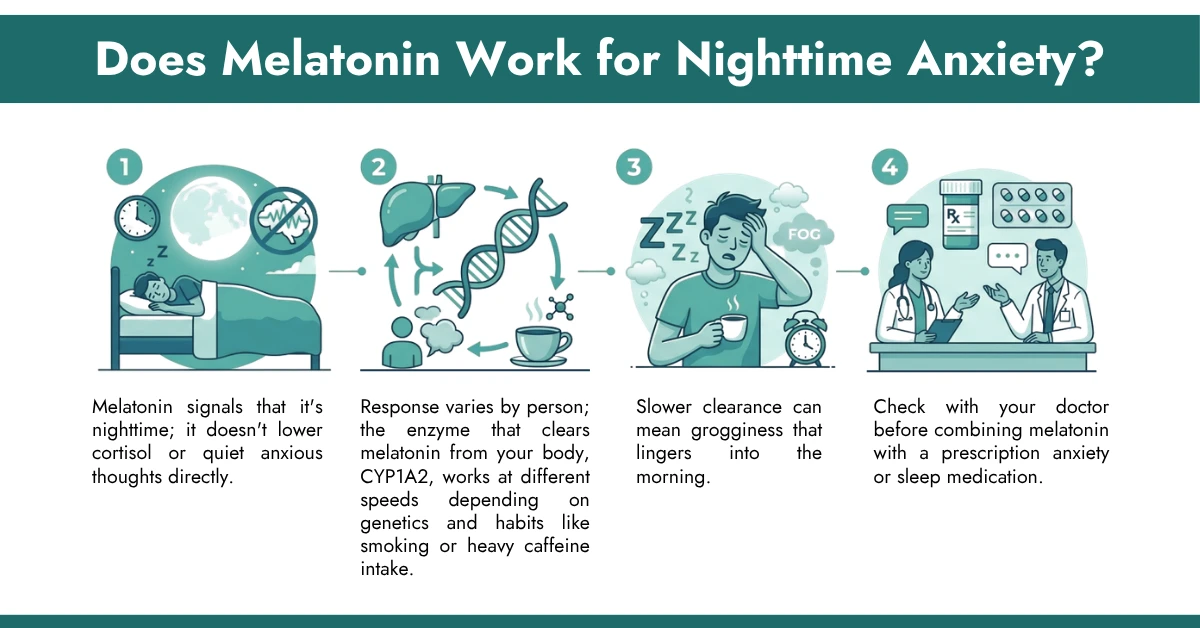
Does Melatonin Work for Nighttime Anxiety?
Melatonin sets your body’s internal clock; it isn’t an anti-anxiety medication. It can shorten the time it takes to fall asleep without necessarily calming a racing mind, and for some people it does the opposite: more vivid dreams, morning grogginess, or extra jitteriness the next day.
- Melatonin signals that it’s nighttime; it doesn’t lower cortisol or quiet anxious thoughts directly.
- Response varies by person; the enzyme that clears melatonin from your body, CYP1A2, works at different speeds depending on genetics and habits like smoking or heavy caffeine intake. CYP1A2 is not on the RPh Labs panel, and no guideline sets a melatonin dose from your genes.
- Slower clearance can mean grogginess that lingers into the morning.
- Check with your doctor before combining melatonin with a prescription anxiety or sleep medication.
Many commonly prescribed medications, including SSRIs like sertraline, citalopram, escitalopram, fluoxetine, and paroxetine, are metabolized differently from one person to another.
What Actually Calms Nighttime Anxiety?
Real relief comes from lowering physical arousal before bed, not from trying to think your way out of worry. A predictable bedtime routine, a screen-free wind-down window, and a way to offload racing thoughts onto paper all signal safety to your nervous system.
- Write down tomorrow’s to-do list and lingering worries earlier in the evening, not once you’re in bed.
- Keep a steady sleep and wake time, weekends included.
- Cut caffeine after early afternoon; it can trigger anxiety symptoms hours later as your body clears it.
- Try slow breathing with a longer exhale than inhale; this cues your nervous system to settle.
- Save your bed for sleep only, so your brain stops linking it to scrolling or worrying.
Why Do Anxiety Medications Work Differently for Different People?
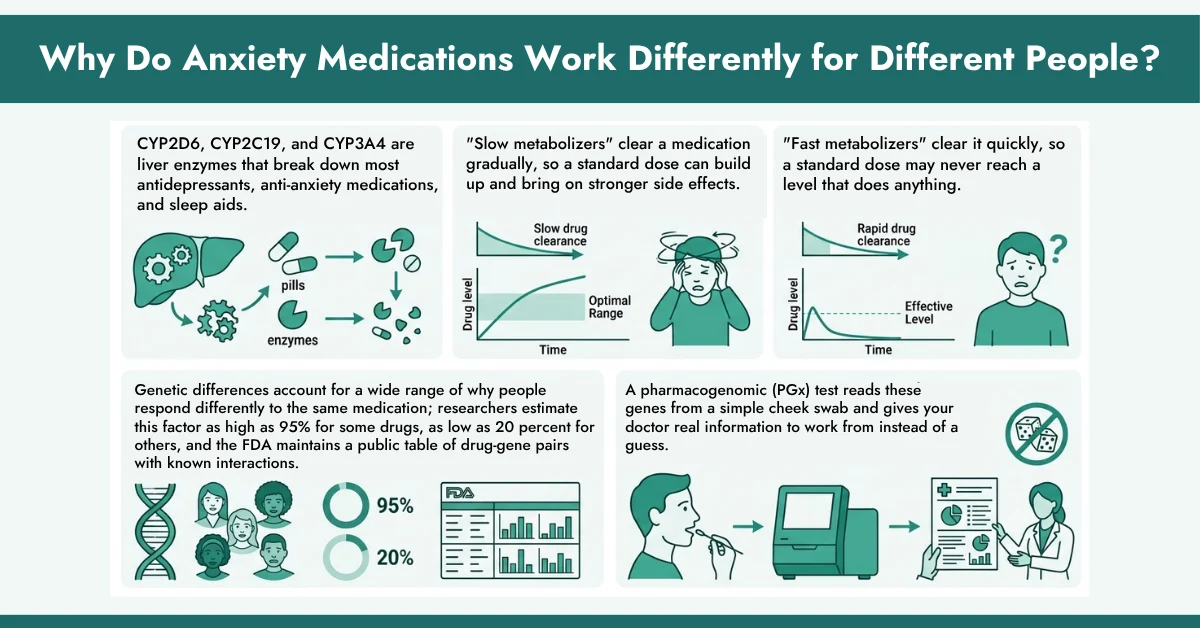
Two people can take the same anxiety or sleep medication and land in completely different places: one feels calmer within days, another feels nothing or gets hit with side effects. A real piece of that difference comes down to genetics, specifically how fast your liver enzymes break the medication down.
- CYP2D6, CYP2C19, and CYP3A4 are liver enzymes that break down most antidepressants, anti-anxiety medications, and sleep aids.
- “Slow metabolizers” clear a medication gradually, so a standard dose can build up and bring on stronger side effects.
- “Fast metabolizers” clear it quickly, so a standard dose may never reach a level that does anything.
- Genetics is one reason people respond differently to the same medication, and how much it matters varies from one drug to the next. The FDA maintains a public table of drug-gene pairs with known interactions.
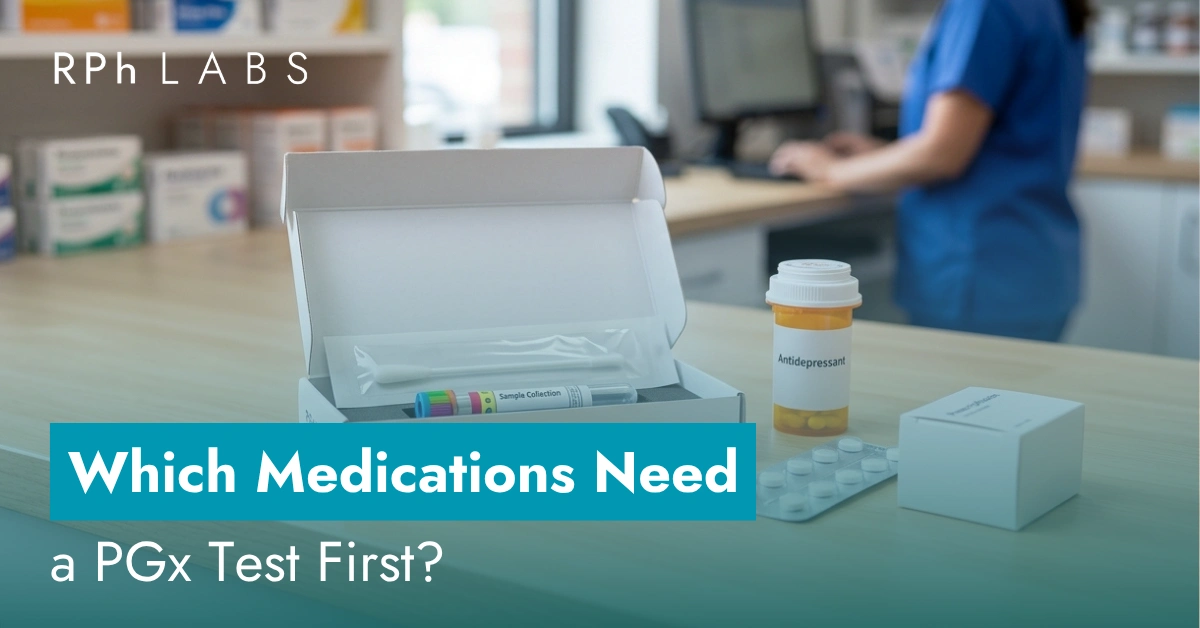
- A pharmacogenomic (PGx) test reads these genes from a simple cheek swab and gives your doctor real information to work from instead of a guess.
RPh Labs’ at-home PGx testing kit checks how your body is likely to process 240+ medications, including several used for anxiety and sleep, with results sent to a secure account in 7-10 business days. A PGx test doesn’t replace a doctor’s judgment; it’s one more piece of information a doctor can weigh alongside your history and symptoms, not a stand-alone diagnosis.
Why CBT for insomnia beats sleep hygiene advice
Most people whose anxiety feel worse at night have already heard the sleep hygiene list and are still awake. Cognitive behavioral therapy for insomnia is a different thing: a structured, short course of treatment with better evidence than any sleep medication for long-term results, and it is recommended as the first-line treatment for chronic insomnia.
The parts of CBT for insomnia that do the heavy lifting are the ones sleep hygiene leaves out.
- Stimulus control, which retrains your brain to associate the bed with sleep rather than with lying awake.
- Sleep restriction, which temporarily shortens time in bed to rebuild a solid sleep drive.
- A scheduled worry or planning period earlier in the evening, well before bed.
- Cognitive work on the beliefs that keep you awake, which is the part of CBT for insomnia people underestimate.
- A consistent wake time, which anchors the whole system more reliably than bedtime does when anxiety feel worse at night.
CBT for insomnia is usually four to eight sessions, delivered in person, by video, or through a structured digital program. Ask your clinician for a referral, and ask specifically for insomnia-focused work rather than general counseling.
The catch is that sleep restriction makes things feel worse for a week or two before it works. That is expected, and it is a reason to do CBT for insomnia with guidance rather than from a blog post, especially if your anxiety feel worse at night to begin with.
Racing thoughts at bedtime: techniques with something behind them
Trying to stop racing thoughts at bedtime rarely works, and trying harder makes it worse. The techniques that help work by redirecting attention, or by moving the thoughts somewhere else instead of suppressing them.
- Write the list. Putting tomorrow’s tasks and open worries on paper in the early evening gives racing thoughts at bedtime somewhere to go.
- Get out of bed after roughly twenty minutes awake, sit somewhere dim, and return only when sleepy.
- Slow breathing with a longer exhale than inhale, which nudges the nervous system toward settling and slows racing thoughts at bedtime.
- A dull, absorbing mental task, such as counting backwards in threes, which occupies the channel racing thoughts at bedtime use.
- A body scan or progressive muscle relaxation, which gives attention a physical anchor.
None of these clears racing thoughts at bedtime on the first attempt. They are practices that get better with repetition, which is why a week of half-hearted attempts is not a fair test.
Two things reliably make racing thoughts at bedtime worse: checking the clock, and scrolling. Turn the clock away, and put the phone somewhere you have to stand up to reach, since both feed racing thoughts at bedtime. If a specific unresolved problem keeps surfacing, write one concrete next step for it during your evening list, since an action is easier to put down than a worry.
Nocturnal panic attacks versus other night-time awakenings
Waking with a pounding heart does not always mean nocturnal panic attacks. Several conditions produce the same physical surge, and they need different treatment, so the distinction is worth making properly rather than assuming anxiety.
- Sleep apnea, suggested by snoring, gasping, morning headache and daytime sleepiness. Repeated breathing interruptions trigger adrenaline surges that feel exactly like panic.
- Reflux, which wakes people with chest discomfort, coughing or a sour taste, often worse lying flat.
- Low blood sugar, which matters if you use insulin or certain diabetes medicines.
- Heart rhythm disturbances, which need assessment rather than reassurance.
- Nightmares and night terrors, which differ because a dream or a confused arousal is attached.
- Restless legs and periodic limb movements, which fragment sleep without any dream content.
Nocturnal panic attacks have a recognizable shape: abrupt waking with a racing heart, breathlessness, sweating and a sense of dread, peaking within roughly ten minutes, with no dream attached. Nocturnal panic attacks are documented and treatable, usually with the same approaches used for daytime panic.
During nocturnal panic attacks the aim is not to stop the attack but to let it pass. Sit up, put the lights on low, breathe slowly, and remind yourself that it peaks and falls. Afterwards, note the time and what preceded it. If nocturnal panic attacks are happening weekly, ask your clinician about a sleep study as well as anxiety treatment, because the two can coexist. The NIMH overview of anxiety disorders covers what panic disorder involves.
Caffeine and anxiety symptoms: the arithmetic of a 3 p.m. coffee
Caffeine and anxiety symptoms overlap almost completely: raised heart rate, jitteriness, a tight chest, and a sense of being on edge. That overlap is not a coincidence, since caffeine acts on the same arousal systems anxiety does.
The half-life of caffeine in most adults sits around five to six hours, so a mid-afternoon coffee still has a meaningful amount circulating at bedtime. People clear it at very different rates, and slow clearers get a much longer tail.
- Set a personal cutoff time and hold it for two weeks before judging the result.
- Count everything that could drive caffeine and anxiety symptoms: tea, cola, energy drinks, pre-workout powders, chocolate and some headache tablets.
- Remember that a coffee taken to survive a bad night helps cause the next one.
- Watch alcohol too, since it shortens time to sleep and then fragments the second half of the night.
- Nicotine is a stimulant as well, and evening use raises the same arousal that caffeine does.
One honest note on genetics: the enzyme that clears caffeine is CYP1A2, and CYP1A2 is not on the RPh Labs panel. Neither is any gene that predicts caffeine and anxiety symptoms in a given person. Smoking speeds that enzyme up, which is part of why quitting can make the same coffee feel stronger.
If caffeine and anxiety symptoms are tangled together for you, cutting back is one of the cheapest experiments available, and it is reversible. Taper over several days rather than stopping abruptly, since withdrawal headaches are common.
Medicines used at night, and what to ask before starting one
Medication has a place, particularly where an anxiety disorder rather than poor sleep is the reason your anxiety feel worse at night. What matters is going in with the right questions.
- Ask what this drug is treating: the anxiety, the sleep, or both.
- Ask how long before you should expect an effect, since antidepressants take weeks while sedatives act the same night.
- Ask whether CBT for insomnia has been tried first, and what the plan is for stopping the drug.
- Ask what it interacts with, including alcohol, other sedatives and anything over the counter.
- Ask whether a structured talking therapy should run alongside it, since the combination usually holds up better.
- Ask what side effects would mean calling rather than waiting.
One safety point deserves its own line. Do not stop a benzodiazepine abruptly. Sudden discontinuation after regular use can cause severe rebound anxiety, and in some cases seizures. The same applies in a milder form to some antidepressants, where stopping suddenly causes dizziness, flu-like symptoms and a relapse of symptoms. Any taper is planned and supervised by your prescriber.
Never adjust a dose yourself because a night went badly. One poor night is normal noise, not evidence, and a change made at 3 a.m. is rarely the one you would make at 3 p.m.
Where genetics honestly fits when anxiety feel worse at night
Pharmacogenomic testing has a real but narrow role here, and it is worth being precise about it. A panel does not diagnose anxiety, does not predict whether you will develop it, and does not tell you why your anxiety feel worse at night rather than during the day.
What it reports is how you are likely to process specific medicines. CYP2D6 and CYP2C19 clear most SSRIs and SNRIs, and both have published prescribing guidance, so a metabolizer result can inform a starting dose or a choice of drug. Our explainer on CYP2C19 rapid metabolizers and our guide to genetic testing for antidepressants both cover what that looks like in a visit.
What the panel does not cover
- Zolpidem and most benzodiazepines, which are handled mainly by CYP3A4 and glucuronidation, with no gene-based dosing guideline. Diazepam is the partial exception, since CYP2C19 is involved.
- Melatonin and caffeine, both cleared largely by CYP1A2, which is not on the panel.
- Gabapentin and pregabalin, cleared by the kidneys rather than by liver enzymes.
- Hydroxyzine and most antihistamines used for sleep.
- Any prediction of whether a medicine will work, as opposed to how fast you clear it.
The RPh Labs panel reads 20 genes and reports them against more than 240 medicines from a cheek swab collected at home, reviewed by a PharmD pharmacist, with results 7 to 10 business days after the sample reaches the lab. Check your own prescriptions on the medication list before ordering the at-home PGx kit.
When night-time anxiety needs help now
Most cases where anxiety feel worse at night are managed over weeks in an outpatient setting. Some of it is not, and it helps to know the line in advance rather than deciding at 2 a.m.
If you have thoughts of harming yourself or ending your life, call or text 988 in the US to reach the Suicide and Crisis Lifeline, available 24 hours a day. For a medical emergency, call 911. Do not wait until morning and do not wait for an appointment.
- Chest pain, pressure spreading to the arm or jaw, or breathlessness that does not settle needs emergency assessment rather than reassurance, since panic and cardiac symptoms overlap.
- Repeated waking with gasping or choking needs a sleep study, not a stronger sedative.
- Several weeks with almost no sleep needs prompt medical review.
- A new medication followed by agitation, confusion or a marked change in mood warrants a same-day call.
Short of that, book an appointment if nocturnal panic attacks are frequent, if you have been awake most nights for a month, or if the pattern is affecting work, driving or caring for others. Bring two weeks of a simple sleep and symptom log, because a written record makes a short appointment far more productive.
Conclusion:
Nighttime anxiety has real, explainable causes: hormones, an overactive nervous system, and sometimes genetics are usually behind it. None of that makes it something to push through alone, especially when it happens most nights. If trial-and-error with anxiety or sleep medication has left you frustrated, a PGx test can give your doctor a clearer starting point instead of a guess.
Night-time anxiety: more questions answered
Does lack of sleep make anxiety worse the next day?
Yes. Missing sleep affects the parts of the brain that regulate emotions, making everyday stress feel more intense. Poor sleep raises anxiety levels, and anxiety makes it harder to sleep, creating a cycle that can repeat night after night.
Can caffeine in the afternoon really trigger anxiety at night?
It can. Caffeine has a half-life of about five to six hours, meaning a mid-afternoon coffee may still be active at bedtime. For people who are sensitive to caffeine, this can raise heart rate, increase alertness, and make it harder to fall asleep.
Is nighttime anxiety always a sign of an anxiety disorder?
Not always. Stressful life events can cause temporary anxiety at bedtime. If nighttime anxiety becomes frequent, disrupts sleep for weeks, or affects daily life, it’s worth discussing with a doctor since it may indicate an anxiety disorder or another sleep-related condition.
Why do I wake up with anxiety?
Many people wake up anxious because cortisol, the body’s natural wake-up hormone, rises before morning. Poor sleep, chronic stress, anxiety disorders, or conditions like sleep apnea can make this normal hormonal change feel much stronger, leading to a racing heart or overwhelming worry upon waking.
Can anxiety cause insomnia?
Yes. Anxiety is one of the most common causes of insomnia. Racing thoughts, muscle tension, and an activated fight-or-flight response can make it difficult to fall asleep, stay asleep, or return to sleep after waking during the night.
Does anxiety make you sleepy?
It can. Staying on high alert all day is tiring, so many people feel drained, foggy or sleepy during the day even though they felt wired the night before. Broken sleep from nighttime anxiety adds to that. Daytime sleepiness that keeps happening is worth mentioning to your doctor, since sleep apnea, thyroid problems, anemia and depression can cause the same thing.
Is sleep anxiety common in children?
Yes. Children can experience sleep anxiety, particularly during periods of stress, major life changes, or after frightening experiences. Persistent bedtime fears, repeated nightmares, or ongoing refusal to sleep alone should be discussed with a pediatrician or mental health professional.
Why does anxiety become worse at night in older adults?
Older adults may experience more nighttime anxiety due to changes in sleep patterns, chronic medical conditions, medications, loneliness, or cognitive changes. A medical evaluation can help identify whether anxiety, a sleep disorder, or another health condition is contributing to nighttime symptoms.
What should I do if I can’t sleep because of anxiety?
Leave the bed if you haven’t fallen asleep after about 20 minutes. Read a book, practice slow breathing, or try another quiet, relaxing activity under dim light until you feel sleepy. If insomnia or nighttime anxiety continues for several weeks, talk with your doctor to identify the underlying cause and discuss appropriate treatment options.
How do I find CBT for insomnia if there is no therapist nearby?
Ask your clinician about video-delivered treatment and about structured digital programs, several of which follow the same protocol as in-person care. Both forms of CBT for insomnia have evidence behind them. Look for a program that includes stimulus control and sleep restriction, since CBT for insomnia without those parts is closer to general sleep advice.
Can a genetic test tell me whether a sleep aid will work?
No. Zolpidem and most benzodiazepines have no gene-based dosing guidance, and melatonin is cleared by an enzyme the panel does not include. A panel can inform choices about antidepressants, sometimes used when anxiety feel worse at night for weeks on end, but it never predicts that a drug will work.
Is it normal to wake at the same time every night?
It is common, and it usually reflects a light-sleep window in the second half of the night rather than anything sinister. If you wake gasping, with a headache, or exhausted every morning, raise sleep apnea with your clinician. If you wake with a sudden surge of dread and no dream attached, nocturnal panic attacks are worth discussing with your clinician.
How long should I give a caffeine cutoff before deciding it did not help?
Two weeks is a fair trial, because the first few days include withdrawal headaches and poor concentration that muddy the result. Track sleep, caffeine and anxiety symptoms through the whole fortnight. If caffeine and anxiety symptoms are genuinely linked for you, the difference usually shows in the second week.
Does exercise help or hurt night-time anxiety?
Regular exercise improves sleep and lowers anxiety for most people. Timing matters less than people assume, though vigorous exercise in the hour before bed keeps some people alert. Try moving it earlier for two weeks and see whether your own pattern changes before ruling it out.
Should children with bedtime anxiety be treated the same way?
No. Children need assessment by a pediatrician or a child mental health clinician, and the approaches differ from adult care. Pharmacogenomic testing in children is a decision for their prescriber. Persistent bedtime fear, repeated nightmares or refusal to sleep alone are all reasons to seek that assessment.
Leave a Reply