
Pharmacogenomic testing for medication uses your DNA to show how your body is likely to process specific drugs, so you and your prescriber can make better-informed choices. This guide explains how it works, which drug-gene pairs matter most, what your results mean and how to use them safely.
On this page
Many patients face trial-and-error prescribing that leads to harmful side effects or ineffective treatment. In fact, about 66% of U.S. adults take at least one prescription, and 20% take five or more for managing chronic disease. But not all medications work as intended due to specific biochemistry. Adverse drug reactions contribute to hundreds of thousands of serious events and a significant number of deaths annually in the United States, making safer prescribing strategies critical for every patient.
Pharmacogenomic testing (PGx testing) can change this by using a person’s DNA to guide drug choice and dosing based on the specific gene. As the CDC explains, pharmacogenomics looks at how your genes affect drug response, helping providers predict in advance which medicines will be safe and effective. By tailoring prescriptions to your genetic profile, PGx testing tackles the pain points of uncertainty and side effects- leading to personalized medicine instead of guessing on apparent conditions.
What Is Pharmacogenomic Testing?
Pharmacogenomic tests or PGX tests, analyse key genes to see how you metabolize or respond to certain medications like amitriptyline, paroxetine, dextroamphetamine, doxepin and more. A small DNA sample via blood draw, saliva or cheek swab is sent to a lab for analysis. The test report shows genetic variants (in enzymes, receptors, transporters, etc.) that influence medication effects.
For example, different variants of genes like CYP2C19 or CYP2D6 determine whether you break down drugs quickly or slowly. These differences help explain why a drug that “works” for one person might cause side effects or no benefit in another. By revealing these genetic markers, PGx testing empowers doctors to choose drugs and doses best suited to you.
Pharmacogenomic testing analyzes how your DNA influences drug effects. For instance, CYP450 enzyme genes affect many common medications (antidepressants, painkillers, blood thinners, etc.), so a variant may cause faster or slower drug metabolism. Armed with this information, clinicians can predict if a medication will be safe or effective.
How Pharmacogenomic Testing Works
- Order the Test Kit: Get an at-home PGx kit online from RPh Labs.
- Collect a DNA Sample: Using a painless cheek swab. Return it in a prepaid envelope
- Laboratory Analysis: A CLIA-certified lab extracts your DNA and scans key genes (such as CYP450 enzymes, VKORC1, TPMT, SLCO1B1 and others). Advanced sequencing identifies variants known to affect drug response.
- Receive Your Report: 7 to 10 business days after the sample arrives, get a report showing which medications are likely to work, need dose adjustment, or may cause side effects.
This process gives both you and your doctor actionable insights.
Did You Know? Research published by NIH (National Institutes of Health) shows that pharmacogenomic testing adoption is rapidly increasing among major healthcare systems worldwide.
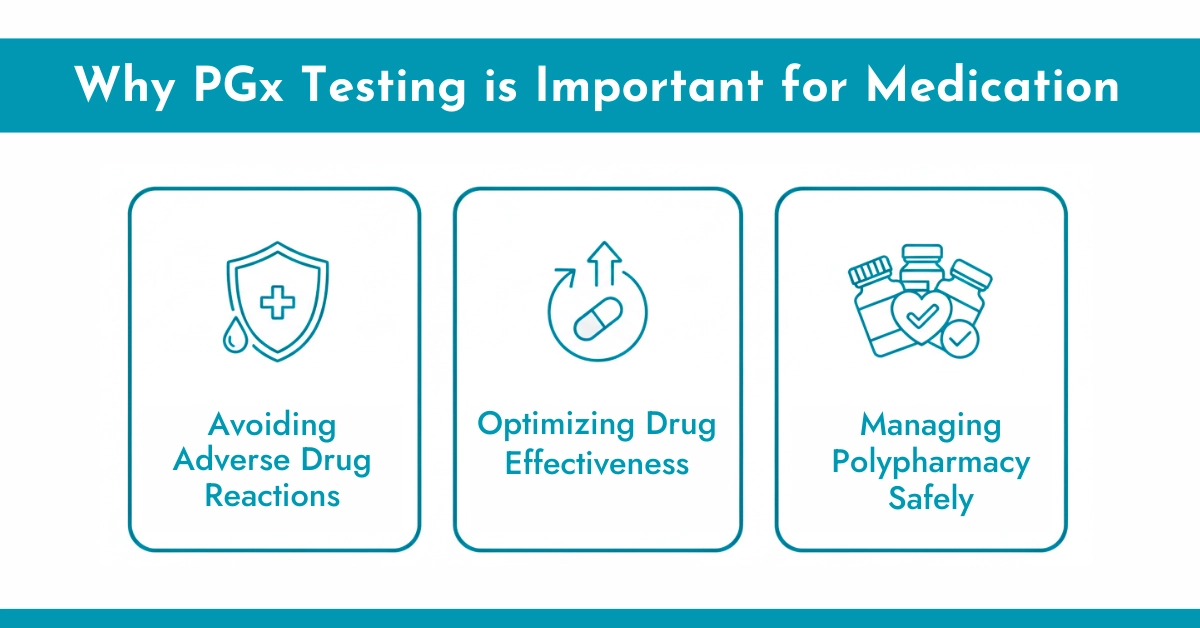
Why PGx Testing is Important for Medication
Avoiding Adverse Drug Reactions (ADRs)
Adverse drug reactions are a leading cause of emergency room visits and hospitalizations. The U.S. Food and Drug Administration (FDA) lists over 100 drug labels containing pharmacogenomic warnings.
Pharmacogenomic testing for medication response helps identify genetic variants, such as CYP2D6, CYP2C19, and HLA genes, that increase the risk of side effects before a drug is prescribed.
Optimizing Drug Effectiveness
Many medications fail not because the drug is ineffective, but because it is ineffective for that individual’s genetics.
- PGx testing for prescribing helps clinicians:
- Choose drugs more likely to work
- Adjust dosage based on metabolism
- Reduce trial-and-error medication changes
This is especially valuable in psychiatry, pain management, cardiology, and primary care.
Managing Polypharmacy Safely
Patients taking multiple medications face higher risks of interactions and toxicity. Pharmacogenomics for drug efficacy provides clarity when managing complex medication regimens, particularly for older adults and patients with chronic conditions.
Who Benefits from Pharmacogenomic Testing
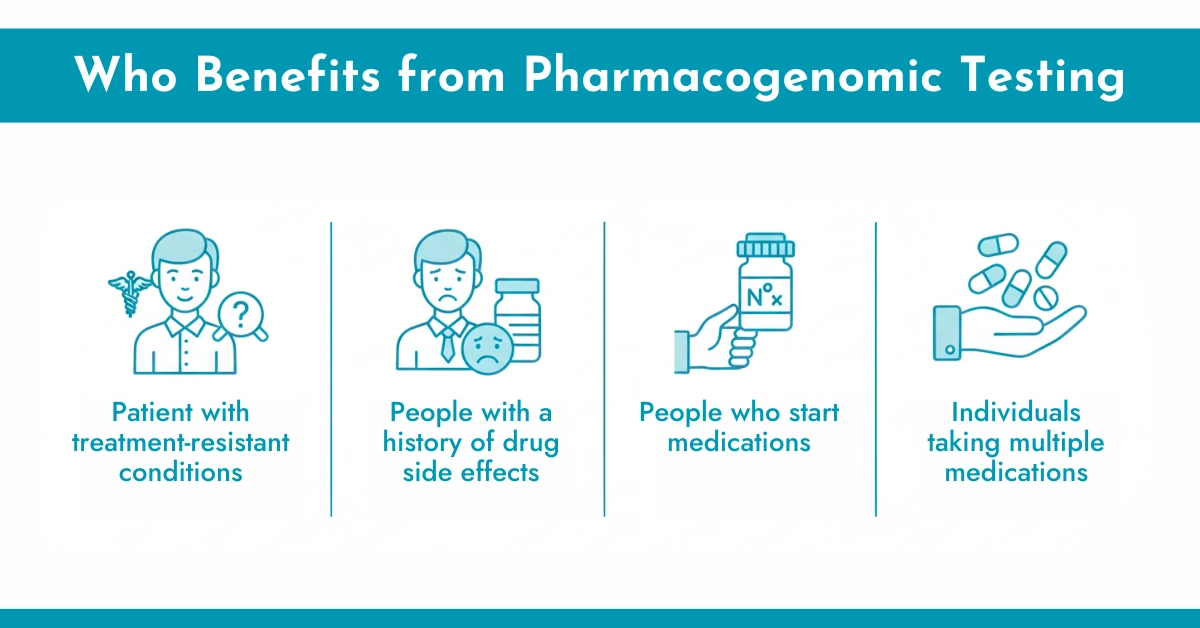
While anyone can benefit from PGx testing, certain groups see particularly dramatic improvements:
- Patient with treatment-resistant conditions
- People with a history of drug side effects
- Those about to start medications with a known genetic association
- Individuals taking multiple medications
According to the search from Genome.gov, around 113 FDA-approved drugs include pharmacogenomic information in their labelling, spanning categories from cancer treatment to chronic disease management.
How Your Doctor Uses PGx Results in Practice
Interpreting a PGx report doesn’t require a genetics degree. Modern reports use clear categories:
- Use as Directed: Standard prescribing is fine
- Use With Caution: Monitor closely or adjust dose
- Consider Alternatives: Choose a different medication
- Avoid: High risk of severe adverse reaction
Specialty-Specific Applications:
- Psychiatry: PGx testing reduces antidepressant trial failure. For a patient with poor CYP2D6 function, a doctor might prescribe an SSRI not dependent on that enzyme, avoiding months of ineffective treatment.
- Pain Management: Genetic variability in opioid metabolism (CYP2D6) explains why some patients overdose on standard codeine doses while others get no pain relief. PGx testing guides safe opioid selection.
- Cardiology: Variations in CYP2C19 affect clopidogrel activation, impacting post-stroke protection. Identifying poor metabolizers prompts alternative antiplatelet choices.
Implementing pharmacogenomic testing for medication can significantly improve treatment outcomes by aligning therapy with a patient’s genetic profile. For example, PGX testing is widely used in mental health to guide personalised medication plans, enhancing both efficacy and safety.
Benefits of Pharmacogenomic Testing for Medication
PGx testing tackles key pain points in clinical decision-making, such as trial-and-error prescribing that leads to frustration and delayed relief. Here’s how it helps:
- Avoiding Adverse Drug Reactions (ADRs): Genetic insights flag risks, reducing hospitalizations from side effects. The CDC emphasizes this for protecting health.
- Improve Drug Effectiveness: It identifies medications likely to work, cutting wasted time on ineffective ones.
- Managing Polypharmacy: Ideal for those on multiple drugs, like elderly patients or those with chronic conditions, to prevent interactions.
- Cost Savings: Less spending on failed meds and repeat visits. Quest Diagnostics reports potential $7,000 savings per patient over time.
- Improved Adherence: When meds work without surprises, patients stick to plans, boosting outcomes.
Did you know? RPH Labs reports include sections for Standard Precautions, Use with Caution, and Consider Alternatives, making clinical application immediate and straightforward.
Future of Pharmacogenomic Testing in Medicine
The pharmacogenomics field is experiencing rapid growth. The global pharmacogenomics market is projected to grow from $7-19 billion in 2024 to $12-52 billion by early 2035, driven by increasing recognition that genetics plays a crucial role in medication response, and this report is from the American Pharmacogenomics Association.
Integration with artificial intelligence and machine learning will make pharmacogenomic interpretation even more sophisticated. These technologies will analyze complex interactions between multiple genes and drugs, providing even more precise recommendations.
Pharmacogenomic testing is also becoming more accessible. What once required expensive laboratory visits is now available through simple at-home PGx test kits. RPh Labs offers testing in a CLIA-certified, COLA-accredited lab for $299, with HSA/FSA eligibility making it even more affordable. Plus, flexible payment plans let you split the cost into four equal instalments with zero interest.
Common drug-gene interaction examples by medicine type
A drug-gene interaction happens when a variant in one of your genes changes how a medicine is activated, broken down or carried in your body. Some of the best-studied pairs appear in everyday prescriptions.
Pain medicines
CYP2D6 converts codeine and tramadol into their active forms. People with low CYP2D6 activity may get little pain relief, while ultrarapid metabolizers can build up too much of the active drug. CYP2C9 also affects how some NSAIDs, such as celecoxib, are cleared.
Heart and cholesterol medicines
CYP2C19 activates clopidogrel, CYP2C9 and VKORC1 influence warfarin dosing, and SLCO1B1 decreased function raises the risk of muscle problems with simvastatin. See our guide to SLCO1B1 decreased function.
Mental health medicines
CYP2C19 and CYP2D6 process many antidepressants, including several SSRIs and tricyclics, and CYP2D6 handles a number of antipsychotics.
Other specialties
TPMT and NUDT15 affect thiopurines like azathioprine, DPYD affects fluorouracil and capecitabine, CYP3A5 affects tacrolimus, and MT-RNR1 variants raise the risk of hearing loss with aminoglycoside antibiotics. The FDA table of pharmacogenetic associations lists many more.
What it means to be a poor metabolizer
Being a poor metabolizer means the enzyme made by a particular gene works very little or not at all. It is one of the most important results on any report, but what it means depends on the drug.
For most medicines, the enzyme breaks down an active drug so your body can clear it. If you are a poor metabolizer for that enzyme, the drug can build up, and medication side effects become more likely at standard doses. Your prescriber may choose a lower dose or a different drug.
Some medicines are prodrugs, which the body must activate first. Codeine, tramadol and clopidogrel are well-known examples. Here a poor metabolizer may make too little of the active form, so the medicine may not work as expected.
Other phenotypes you may see include intermediate, normal, rapid and ultrarapid metabolizer. Each is gene specific, so you can be a poor metabolizer for CYP2D6 and a normal metabolizer for CYP2C19 at the same time. For the opposite end of the scale, see our explainer on the CYP2C19 rapid metabolizer.
How genes shape medication side effects
Not all medication side effects have a genetic cause. Dose, age, kidney and liver function, other drugs, alcohol and health conditions all play a part. Genes explain a meaningful share, though, and they tend to act in a few recognizable ways.
- Drug buildup. Slow enzymes, such as CYP2D6 or CYP2C19 in a poor metabolizer, can raise drug levels and make dose-related effects more likely.
- Transport problems. SLCO1B1 decreased function keeps more simvastatin in the blood, raising the risk of muscle pain and damage.
- Toxic byproducts. Reduced TPMT or NUDT15 activity can lead to dangerous bone marrow suppression with thiopurines. Learn more about TPMT testing.
- Immune reactions. Certain HLA types, such as HLA-B*15:02 with carbamazepine, are linked to severe skin reactions. HLA genes are not part of every PGx panel, so check what your test covers.
Because so many factors overlap, a normal result never guarantees you will avoid medication side effects. It simply removes one known source of risk from the picture.
How to use a PGx report with your medication list
A PGx report is most useful when you check it against every medicine you actually take. A little preparation makes the conversation with your prescriber or pharmacist far more productive.
- Write down all prescriptions, over-the-counter drugs and supplements, with doses.
- Find each medicine on your report or on our medication list of drugs by gene.
- Note any drug-gene interaction flagged for caution or an alternative.
- Look for medicines that inhibit enzymes. Fluoxetine, paroxetine and bupropion can make a normal CYP2D6 metabolizer act like a poor one, which is called phenoconversion.
- Bring the list and the report to your prescriber or pharmacist and review them together.
The RPh Labs report is reviewed by a PharmD pharmacist and covers 20 genes and more than 240 medications. A free pharmacist consultation is included, which is a good place to ask what the flags mean for your specific list.
Keep a digital copy of your PGx report on your phone. It is easy to forget at a new specialist visit, an urgent care trip or a hospital admission.
When to consider pharmacogenomic testing for medication
Timing shapes how much value you get. Pharmacogenomic testing for medication is often most helpful before starting a drug with strong gene-based guidance, such as clopidogrel, a thiopurine, a fluoropyrimidine or codeine.
It can also help partway through treatment, for example when a medicine is not working or medication side effects keep appearing. In that case your prescriber can check whether a drug-gene interaction may be part of the explanation.
Because your genotype does not change over your lifetime, one test can inform prescriptions for years. RPh Labs updates reports when guidelines change, so earlier results stay current as the science grows.
If a medicine needs to start right away, do not delay treatment to wait for results. Your prescriber can begin with standard care and adjust later if needed. For clinicians, our provider page explains ordering and reporting.
Limits of drug-gene interaction results
Knowing the limits of any drug-gene interaction result helps you use it wisely. PGx testing is a powerful tool, but it answers a narrow question.
- It covers the genes and variants on the panel, not every gene that might matter. Rare variants may not be detected.
- It cannot account for other drugs, diet, smoking or illness, all of which can change how enzymes behave.
- Evidence is stronger for some drug-gene pairs than others. Published guidance, such as the CPIC guidelines, rates how strong each recommendation is.
- It does not replace monitoring, such as blood tests for warfarin or blood counts for thiopurines.
- After a liver or bone marrow transplant, results may not reflect how your body handles some medicines.
None of this reduces the value of testing. It simply means your results work best as one input alongside the rest of your health information.
Talking with your prescriber about your PGx report
Your prescriber makes the final call, and the best results come from a shared conversation. Never stop, start or change a medicine on your own because of what a PGx report says, since some drugs can cause problems if stopped suddenly.
Helpful questions to bring to your next appointment:
- Are any of my current medicines flagged for my genotype?
- Does my poor metabolizer or other phenotype change the dose you would choose?
- Could any of my other medicines be changing how these enzymes work?
- Should we add these results to my medical record for future prescriptions?
If you do not have results yet, you can order the RPh Labs at-home PGx kit, a cheek swab test from a CLIA-certified, COLA-accredited lab. The self-pay price is $299, it is HSA and FSA eligible, and results arrive 7 to 10 business days after your sample reaches the lab.
Conclusion
If you’re tired of medication guesswork, experiencing side effects, or not getting the relief you need, pharmacogenomic testing offers real answers. This one-time test provides lifetime guidance that you and your healthcare providers can reference whenever new medications are prescribed.
Talk to your doctor about whether PGx testing makes sense for your situation. Many physicians now recognize its value, especially when traditional approaches haven’t delivered results. You can also order an at-home PGx testing kit directly and share results with your healthcare team.
Frequently Asked Question
Disclaimer:
This content is for informational purposes only and does not replace advice from a qualified healthcare professional. Always consult a qualified healthcare provider about medications or genetic testing. Some images or visuals are digitally created for illustration purposes only.
Pharmacogenomic testing for medication FAQ
How does pharmacogenomic testing work to personalize medication?
It examines your DNA to predict how your body will respond to medicines, helping doctors choose the safest, most effective drugs.
What are the different types of pharmacogenomic tests available for medication?
Tests use saliva, cheek swabs, or blood samples to check genes that affect how you metabolize or respond to medications.
Why should I consider pharmacogenomic testing for my medication?
It reduces side effects, improves effectiveness, and prevents trial-and-error prescribing, making your treatment safer and more personalized.
Why is pharmacogenomic testing important for mental health medications?
Genetic differences affect antidepressant and psychiatric drug metabolism, helping doctors select effective medications and avoid treatment delays.
Where can I get pharmacogenomic testing for medication?
You can order RPh Labs’ at-home PGx test kit online, collect your sample easily, and get results quickly.
Can PGx testing prevent all medication side effects?
No. Genes explain some medication side effects, but dose, age, kidney and liver function, other drugs and health conditions also play a role. A PGx test can flag known genetic risks for specific medicines, which helps your prescriber choose a drug or dose, but it cannot rule out every reaction.
Is being a poor metabolizer dangerous?
Not by itself. A poor metabolizer result simply means one enzyme works very little. It matters only when you take a medicine that depends on that enzyme. Your prescriber may then choose a different dose or drug. Many people live with a poor metabolizer status for years without knowing it.
What does a drug-gene interaction warning on my report mean?
It means your genotype may change how a specific medicine works for you, either raising the risk of side effects or reducing its effect. It is not an instruction to stop the medicine. Share the warning with your prescriber, who will weigh it alongside the rest of your health information.
How long is a PGx report valid?
Your genotype stays the same for life, so the genetic results in a PGx report do not expire. What can change is the guidance attached to them as new research is published. RPh Labs updates reports when guidelines change, so you can keep using the same results over time.


Leave a Reply