
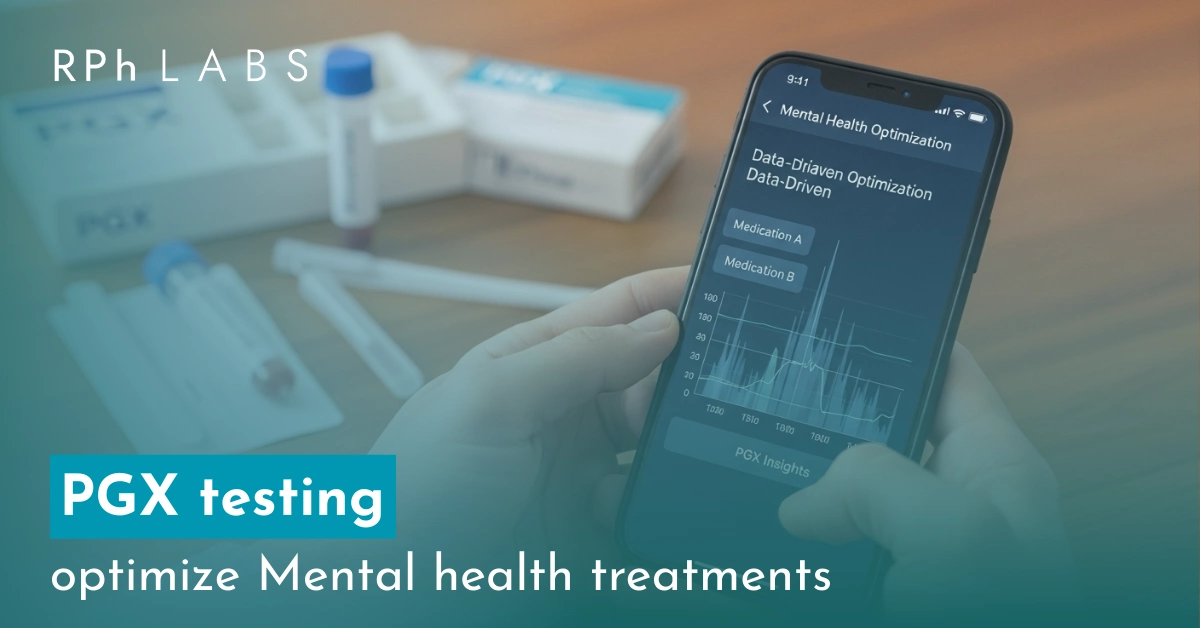
PGx testing looks at the genes that control how your body handles many psychiatric drugs, so you and your prescriber can plan mental health treatment with more information and less guesswork. Below you will find how it works, what it can and cannot tell you, and how to put the results to use.
On this page
Millions of people worldwide suffer from mental health conditions, including depression, anxiety, bipolar disorder, and schizophrenia. Each condition requires a unique approach to treatment, often involving medication. Finding the right medication and dosage, however, can be difficult and trial-and-error. Pharmacogenetic testing can help with this, offering a customized mental health treatment plan.
Treatments for Common Mental Health Conditions
Taking care of mental health conditions is critical. Early diagnosis and treatments can help in controlling the diseases better.
Depression and its medications
An individual with depression may experience persistent sadness, loss of interest in activities, and a variety of physical and emotional symptoms. Antidepressants such as selective serotonin reuptake inhibitors (SSRIs) or serotonin-norepinephrine reuptake inhibitors (SNRIs) are often prescribed for depression. Although these medications are effective for many, their choices and dosages can vary widely.
It is common to prescribe medications like SSRIs, SNRIs, and benzodiazepines for anxiety disorders, including generalized anxiety disorder (GAD), panic disorder, and social anxiety disorder. Nevertheless, these medications vary widely in their effectiveness and side effects.
As per World Health Organization, 1 in every 8 people suffer from mental disorder. And unfortunately, most people are unable to access effective care.
Some common mental disorders
Bipolar disorder.
It is characterized by extreme mood swings between mania and depression. Mood stabilizers, such as lithium and valproate, and antipsychotics, are often prescribed to treat bipolar disorder. Overmedication and undermedication can exacerbate symptoms, so finding the right balance in medication is crucial.
It should be kept in mind that people with bipolar disorder are at higher risk of attempting suicides. Thus, medical treatment and a pleasant social environment is important.
Schizophrenic state
A severe mental disorder, schizophrenia is characterized by distorted thinking, hallucinations, and delusions. Antipsychotic medications can help manage symptoms, but they can have varied effects, which can make finding the right one challenging.
As per World Health Organization, 1 out of every 300 people in the world suffer from Schizophrenia. And the life expectancy of people suffering from this mental disorder is 10 – 20 years less than other people.
The impact of PGx testing on treatment outcomes
Pharmacogenomic testing examines how an individual’s genetic makeup affects how they respond to medications. Healthcare providers can reduce the trial-and-error period and improve treatment outcomes by understanding these genetic factors through PGx testing, reducing the trial-and-error period.
Personalized Medication
Genetic variations can influence how a person metabolizes certain medications, such as those that affect how SSRIs are metabolized. If dosages are not adjusted accordingly, side effects may increase. By using PGx testing, doctors can choose medications that are metabolized efficiently by the body, reducing adverse effects and enhancing efficacy.
Reduced side effects
Mental health treatments can sometimes create side effects. Therefore, there are many individuals out there who are even afraid of getting the treatment. PGx testing Kit can flag a higher risk of side effects from some medications, although it cannot predict every reaction.
A number of genetic markers, for example, can indicate a higher risk of severe side effects from antipsychotics or mood stabilizers. Healthcare providers can then choose alternatives that are less likely to cause harm armed with this information.
Adjusted dosage
The right dosage of medication is crucial for treating mental health conditions. Based on genetic profile, PGx testing can help your prescriber decide whether a standard, lower or higher dose is likely to suit you, which can help protect patients from overmedication and undertreatment.
Improving adherence to treatment
When patients experience fewer side effects and more effective results, they are more likely to adhere to their treatment plans. Through PGx testing, patients receive customized treatment plans tailored to their genetic profile, increasing the chance that they will take their medication consistently and manage their mental health more effectively.
How pgx testing works for mental health medication
Most mental health medication is broken down in the liver by enzymes called cytochrome P450, or CYP, enzymes. Your genes decide how well each one works.
PGx testing reads the specific spots in your DNA that are known to change enzyme activity. The lab then translates those results into plain guidance your care team can use when choosing a drug or a starting dose.
For psychiatric drugs, two enzymes matter most. CYP2D6 handles many antidepressants, several antipsychotics and the ADHD drug atomoxetine. CYP2C19 handles citalopram, escitalopram and sertraline, among others. Other genes, such as CYP2B6 and CYP3A4, add detail for specific medicines.
The sample is simple. A cheek swab collects cells from the inside of your mouth, and the lab extracts DNA from them. Because your inherited genes do not change, the results apply for life. You do not need to repeat the test when you start a new prescription.
If you want a short background on the science first, the MedlinePlus overview of pharmacogenomics is a clear, non-commercial read. Our own guide to what PGx testing is covers the basics in more depth.
What your metabolizer status means
Your report sorts each gene into a metabolizer status. It describes how fast the enzyme is likely to process drugs that depend on it. There are usually five groups.
- Poor metabolizer: little or no enzyme activity. Drugs cleared by that enzyme can build up, which may raise the risk of side effects at a standard dose.
- Intermediate metabolizer: reduced activity. Drug levels may run somewhat higher than average.
- Normal metabolizer: expected activity. Standard dosing usually applies.
- Rapid metabolizer: somewhat increased activity, most often described for CYP2C19.
- Ultrarapid metabolizer: high activity. Some drugs may be cleared before they reach a helpful level.
One twist matters for prodrugs. A few medicines must be activated by an enzyme before they work. Codeine and tramadol, for example, rely on CYP2D6 to become their active forms. For these drugs a poor metabolizer may get too little effect, while an ultrarapid metabolizer may get too much.
Metabolizer status is not the same as a diagnosis or a verdict on a drug. It is one clue that helps explain why a dose that suits one person can feel too strong or too weak for another.
Antidepressant side effects and the genes behind them
Antidepressant side effects are one of the most common reasons people stop treatment early. Nausea, dizziness, sleep changes and a jittery feeling are often dose related, and dose is where genetics can help.
The Clinical Pharmacogenetics Implementation Consortium (CPIC) publishes guidelines for SSRIs and tricyclic antidepressants. Some examples of what those guidelines address:
- Citalopram and escitalopram: CYP2C19 poor metabolizers tend to have higher blood levels, so a lower dose or another option may be considered.
- Sertraline: CYP2C19, and in newer guidance CYP2B6, can shift blood levels.
- Paroxetine and fluvoxamine: CYP2D6 status can change exposure.
- Amitriptyline and nortriptyline: both CYP2D6 and CYP2C19 affect levels of these tricyclics.
A result does not predict every side effect. It helps your prescriber judge whether a starting dose is likely to fit you, or whether a drug that uses a different pathway may be a smoother first choice.
Keep a simple note of any side effects you notice, when they started and what dose you were on. Paired with your genetic report, that record gives your prescriber a much clearer picture than either piece of information alone.
Which mental health medication classes are covered
PGx testing is most useful for medications whose labels or guidelines already reference a gene. For mental health care, that includes several drug families.
- Antidepressants: SSRIs, SNRIs such as venlafaxine, and tricyclics.
- Antipsychotics: aripiprazole and brexpiprazole labels include CYP2D6 dosing information.
- ADHD medication: atomoxetine has CYP2D6 guidance on its label.
- Anxiety and sleep medicines: some benzodiazepines, such as clobazam and diazepam, are processed partly by CYP2C19.
Some psychiatric drugs are not guided much by these genes. Lithium, for example, is cleared by the kidneys rather than liver enzymes, so kidney function and blood levels matter far more than a CYP result.
You can search a drug by name on our medication list, which groups 263 medications by gene. The FDA table of pharmacogenomic biomarkers in drug labeling is another trusted source.
Is a dna test for depression right for you?
A dna test for depression, more accurately a pharmacogenomic test, is not a screening test for the illness itself. It is a tool for choosing and dosing medicine. That means it helps most in a few situations.
- You have tried one or more antidepressants that did not help or caused side effects you could not tolerate.
- You are about to start a first mental health medication and want extra information up front.
- You take several medicines and want to check how your genes may affect them together.
- A family member has had unusual reactions to psychiatric drugs.
- Your prescriber has suggested testing as part of a treatment plan.
It may add less if your current medicine works well with few side effects. In that case there is usually no reason to change anything. The results can still be useful later, since they stay valid for life.
If you are unsure, bring the question to your prescriber or pharmacist. They can weigh your history, age, other health conditions and current drugs to judge whether testing is likely to change your plan.
Testing can also help before a planned change. If your prescriber is thinking about adding a second drug, switching to a new class or raising a dose, a report already on file lets them check the gene-drug fit first rather than waiting to see how you react.
How to use pgx testing results with your prescriber
Results are most helpful when they reach the person who writes your prescriptions. A few simple steps make that conversation easier.
- Share the full report, not just a summary. Most reports list each drug with a clear flag such as standard use, use with caution or consider alternatives.
- Bring a complete list of everything you take, including over-the-counter drugs and supplements.
- Ask how your metabolizer status applies to your current medicine and to any drug you are considering next.
- Agree on a plan together. Never stop or change a psychiatric medication on your own, since stopping suddenly can cause withdrawal symptoms or a return of symptoms.
Other drugs can change what your genes predict. Fluoxetine, paroxetine and bupropion strongly block CYP2D6, so a person with a normal gene result can act like a poor metabolizer while taking them. This effect, called phenoconversion, is one reason your prescriber reads the report alongside your full medication list. Our guide to CYP2D6 inhibitors explains it in more detail.
If your prescriber is new to pharmacogenomics, point them to our page for providers.
Limits of a dna test for depression
Honest expectations help you get the most from testing. A pharmacogenomic report cannot tell you which single drug will relieve your symptoms. It can tell you how your body is likely to process certain drugs, which is a different and narrower question.
Response to mental health medication also depends on the diagnosis, how long you take the drug, therapy, sleep, alcohol use, other illnesses, kidney and liver function, age and other medications. Genes are one input among many.
Evidence is also stronger for some genes than others. Enzyme genes like CYP2D6 and CYP2C19 have published dosing guidelines. Many genes linked to brain receptors have weaker or mixed evidence and are not used to make firm prescribing decisions.
Finally, a test only reports the variants it checks. A normal result means no known variant was found in the tested regions, not that every possible difference was ruled out. For more on this, see our article on genetic testing for antidepressants.
Cost, insurance and getting started
The RPh Labs at-home PGx kit uses a cheek swab and costs $299 self-pay. It is HSA and FSA eligible, can be split into four interest-free installments and ships free both ways. Kits ship within one business day.
Results arrive 7 to 10 business days after the sample reaches our CLIA-certified, COLA-accredited lab in Dallas, Texas. A PharmD pharmacist reviews every report, and a free pharmacist consultation is included, so you can ask what your metabolizer status means before you see your prescriber.
Ordering is simple. You swab the inside of your cheek, seal the sample in the prepaid mailer and drop it in the mail. There is no clinic visit or blood draw, and you can follow the collection steps in the kit at your own pace.
The panel covers 20 genes, including CYP2D6, CYP2C19 and CYP2B6, reported against more than 240 medications. Reports are updated when guidelines change.
Insurance may also help. RPh Labs accepts plans including Medicare, Texas Medicaid (TMHP) and Blue Cross Blue Shield of Texas. See our insurance page and how it works for the full process, or call (888) 383-2181 with questions.
Conclusion:
Mental health treatments can sometimes cause side effects to some individuals. These side effects can be caused due to excessively prolonged treatments, consuming the drugs for lesser time than required, or consuming the drugs which are not suitable for your genes. PGx tests provide you with a list of medications and their reactions. See more about pharmacogenetic testing works.
PGx testing FAQ
Can PGx testing tell me which antidepressant will work?
No single test can promise that. Pharmacogenomic results show how your body is likely to process certain antidepressants, which helps your prescriber avoid doses that may be too strong or too weak for you. Whether a drug relieves symptoms also depends on your diagnosis, history, other medicines and time on treatment.
Can genes explain my antidepressant side effects?
Sometimes. If you are a CYP2C19 or CYP2D6 poor metabolizer, some antidepressants can build up to higher levels, which may make side effects more likely at a standard dose. Other causes are common too, such as drug interactions, dose changes or the medicine itself, so review side effects with your prescriber.
Do I need to stop my mental health medication before the swab?
No. Your medicines do not change the DNA in your cheek cells, so you can keep taking everything as prescribed. Do not stop or adjust any psychiatric medication without talking to your prescriber first. Just follow the collection steps in the kit instructions.
Will my metabolizer status change over time?
Your genes stay the same for life, so your genetic metabolizer status does not change. What can change is how your enzymes behave while you take certain drugs. Strong CYP2D6 blockers like fluoxetine, paroxetine and bupropion can make a normal metabolizer act like a poor one.
Is a DNA test for depression the same as a diagnosis?
No. Pharmacogenomic testing does not diagnose depression, anxiety or any other condition, and it does not predict whether you will develop one. Diagnosis comes from a clinical evaluation. The test only looks at how your body handles medications used in treatment.
Who reads my results with me?
At RPh Labs, a PharmD pharmacist reviews every report, and a free pharmacist consultation is included so you can ask questions. You can share the report with any prescriber, who will weigh it alongside your symptoms, medical history and current medications before making changes.

Leave a Reply