

Pancreatic cancer screening is not a test the general public should ask for. It is ongoing surveillance offered to a small group at high inherited or clinical risk. Here is who qualifies, what the imaging involves, how cysts are followed, and which gene tests matter and when.
On this page
Pancreatic cancer is often found late, when it is much harder to treat. The newest pancreatic cancer screening protocols aim to find it earlier, before symptoms are obvious. High-risk adults who once had few options now have MRI-based surveillance and endoscopic ultrasound (EUS), arranged through a specialist center. An at-home cheek swab is a different kind of test altogether: pharmacogenomic testing reports how your body may handle 240+ medications, and it does not look at hereditary pancreatic cancer genes.
This guide walks you through who qualifies for pancreatic cancer screening, which tests matter, which pancreatic cancer genes matter, and what to do next if you think you may be at risk.
Understanding Pancreatic Cancer and Its Risks
Pancreatic cancer results from cells in the pancreas dividing and spreading abnormally. It’s not always clear why it starts, but things like smoking, long-term pancreas inflammation, or being overweight can raise chances. Family ties play a role, too. If close relatives had it, your risk goes up.
What makes it tricky?
- Early stages often have no signs.
- As it grows, you might notice yellow skin, belly pain, weight loss without trying, or new diabetes.
- These aren’t unique to pancreatic cancer, so seeing a doctor is key if they pop up.
Did You Know? The MD Anderson Cancer Center notes that pancreatic cysts become more common with age and that most of them are harmless. Imaging helps identify which ones need watching.
Who Really Needs Pancreatic Cancer Screening?
It’s Not Everyone. Current expert guidance recommends screening only for high-risk individuals, not for the general population. Here are the specific details on who have to take this test.
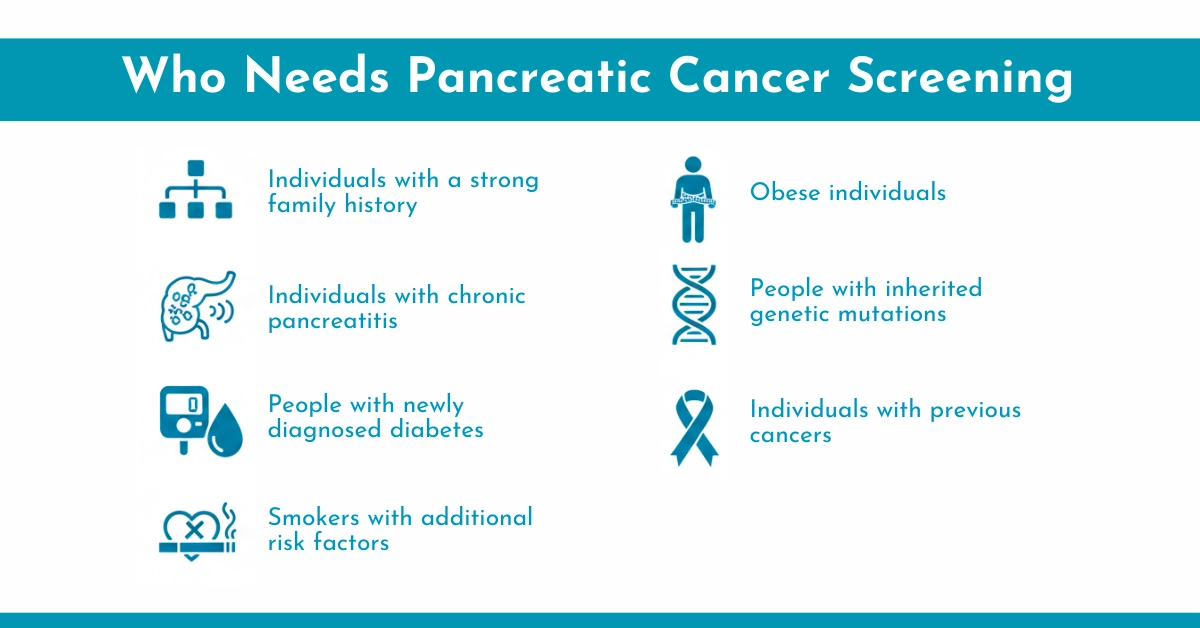
1. Individuals with a strong family history of pancreatic cancer (first-degree relatives like parents, siblings, or children).
2. People with hereditary cancer syndromes, such as:
- BRCA1 or BRCA2 mutations
- Lynch syndrome
- Peutz-Jeghers syndrome
Familial atypical multiple mole melanoma (FAMMM) syndrome
3. Individuals with chronic pancreatitis (long-term inflammation of the pancreas).
4. People with newly diagnosed diabetes after age 50, especially with other risk factors.
5. Smokers with additional risk factors like family history or genetic predisposition.
6. Obese individuals with metabolic syndrome and additional risk factors.
7. People with certain inherited genetic mutations linked to pancreatic cancer (PALB2, CDKN2A, ATM, STK11).
8. Individuals with previous cancers that increase risk, like breast, ovarian, or colorectal cancer linked to genetic syndromes.
When to Start Screening and How Often
Because not everyone benefits from screening, timing and intervals are carefully tailored for high-risk individuals.
- According to AGA guidance, screening generally begins at age 50, or 10 years younger than the earliest pancreatic cancer diagnosis in the family.
- For certain high-risk genetic conditions, screening starts earlier:
- CDKN2A/PRSS1 mutation carriers (hereditary pancreatitis/FAMMM) start around age 40
- STK11 mutation carriers (Peutz-Jeghers syndrome) as early as age 35
Once started, many experts recommend annual surveillance, often alternating between imaging methods (see next section) if no suspicious lesion is found. If a lesion is detected, follow-up intervals may be shortened (every 6-12 months), or more frequent if the lesion looks suspicious.
How to Get Tested for Pancreatic Cancer Risk
Wondering how to get tested for pancreatic cancer risk? Here’s your roadmap:
1. Know Your Family History
Document cases of pancreatic, breast, ovarian, prostate, and colorectal cancers in your family. Note the ages at diagnosis.
2. Consider Genetic Testing
Genetic testing for pancreatic cancer helps determine if you carry high-risk mutations. This information guides screening recommendations and helps family members understand their risk.
Understanding your genetics of pancreatic cancer risk isn’t just about finding cancer—it’s about prevention and early detection when treatment is most effective. When you know your genetic makeup, you and your doctor can create a personalized screening plan.
Note: Pancreatic Cancer Screening often involves assessing inherited genetic risks, similar to how genetic testing evaluates breast cancer susceptibility. Learn more about genetic testing and cancer risk management in our Genetic Testing for Breast Cancer Article for proper insights.
How Do You Screen for Pancreatic Cancer?
There is no single blood test that reliably detects early pancreatic cancer. Screening relies on imaging and genetic testing:
Imaging Methods
- MRI/MRCP: Non-invasive, detailed images of cysts or abnormalities
- Endoscopic Ultrasound (EUS): Scope via the mouth; can detect small lesions and allow biopsy
Recommended approach for high-risk individuals: Alternate MRI and EUS annually.
| Method | What It Involves | Pros | Cons |
| MRI | Lie in a machine | No radiation, detailed images | Closed-in feeling, may need contrast dye |
| EUS | Scope via mouth | Close-up view, biopsy option | Requires sedation, small procedure risk |
Did You Know? RPh Labs’ at-home PGx test reports how your body may process 240+ medications, so your prescriber and pharmacist have one more piece of information to work with. It is a medication-response test, not a cancer screen. It does not include hereditary cancer genes and it cannot detect or predict pancreatic cancer.
What Genetic Testing Does and What It Doesn’t
Genetic testing for pancreatic cancer risk helps identify inherited mutations that significantly increase lifetime risk — but it does not detect cancer itself.
- Multigene panel testing (BRCA1/2, PALB2, ATM, CDKN2A, STK11, and more) can reveal germline variants linked to higher risk.
- If a pathogenic variant is found (especially in a high-risk gene), the patient becomes eligible for surveillance screening even in the absence of symptoms.
- Positive results should lead to genetic counseling, discussion of screening advantages/risks, and potentially enrolling in a high-risk surveillance program, preferably at a specialized center.
Germline panels like these are about inherited cancer risk. They are a completely different kind of test from pharmacogenomic testing, which reports how you process certain medicines and says nothing about whether you will develop cancer.
Is There a Blood Test for Pancreatic Cancer?
Many people think about blood tests for pancreatic cancer. Currently, there isn’t a single reliable blood test for early detection in screening programs. However, research is advancing rapidly in this area. What is available and highly valuable is genetic testing for pancreatic cancer. These tests analyze your DNA to identify inherited genetic patterns that may increase your risk of developing pancreatic cancer.
Types of Genetic Testing
- Single-Gene Testing: Looks at specific genes like BRCA2 when there’s a known family mutation
- Panel Testing: Examines multiple genes simultaneously, including BRCA1, BRCA2, ATM, PALB2, CDKN2A, STK11, and Lynch syndrome genes
Did you know: Only a minority of people with a family history of pancreatic cancer turn out to carry an inherited mutation on panel testing. That is one reason genetic counseling comes before the test, so you know in advance what each possible result would mean.
Early Symptoms In Pancreatic Cancer: Never Ignore
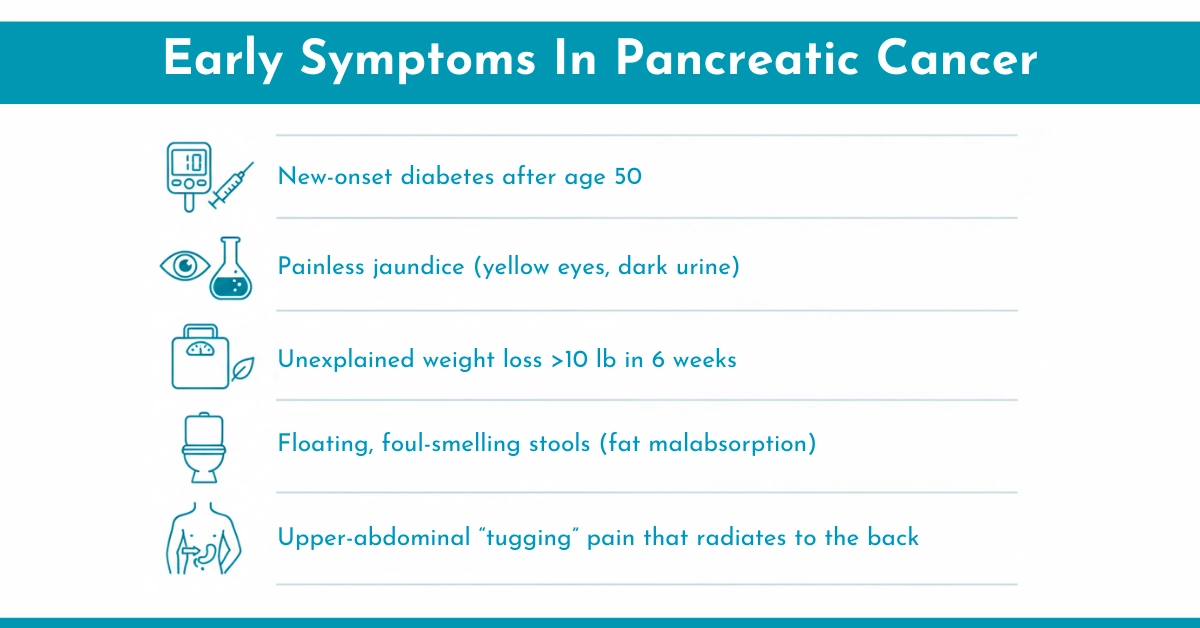
- New-onset diabetes after age 50
- Painless jaundice (yellow eyes, dark urine)
- Unexplained weight loss >10 lb in 6 weeks
- Floating, foul-smelling stools (fat malabsorption)
- Upper-abdominal “tugging” pain that radiates to the back
What You Should Do If You’re Concerned
If you believe you might be at increased risk (because of family history or a known mutation):
- Gather your family history document relatives with pancreatic cancer (or related cancers), their relationships, and ages at diagnosis.
- Seek genetic counseling/testing. A trained professional can advise whether you qualify for a screening program.
- Refer to a specialized center, ideally a pancreas disease or cancer center with experience in high-risk surveillance.
- Understand the pros and cons. Screening may detect early disease, but there are risks of overdiagnosis, cost, and uncertainty.
- Plan for long-term follow-up surveillance is ongoing (often yearly), not a one-time check.
What pancreatic cancer screening can and cannot do
The word screening usually means a test offered to everyone at a certain age, the way mammography or colonoscopy are. Pancreatic cancer screening does not work that way. The disease is uncommon enough in the general population that testing everyone would produce far more false alarms and unnecessary procedures than benefit.
What exists instead is surveillance: repeated imaging for people whose risk is high enough that finding an early lesion is plausible. It is offered through specialized centers, often with a registry or research program attached.
What it is trying to find
- Small solid lesions while they are still confined to the pancreas.
- Precursor lesions, including certain cysts, that can be followed or removed.
- Changes in the main pancreatic duct that warrant closer attention.
What it cannot do is guarantee anything. Surveillance can miss lesions between visits, and it can also find things that would never have caused harm, which leads to more scans, anxiety and sometimes surgery. Those tradeoffs are the reason pancreatic cancer screening is restricted to people whose risk justifies them.
It is also worth knowing that no blood test is used to screen. CA 19-9 is a tumor marker used in some situations after a diagnosis, not a test for finding disease in someone without symptoms.
Hereditary pancreatic cancer: genes and family patterns
Most pancreatic cancer is not inherited. When it is, the pattern usually shows up as more than one close relative affected, a relative diagnosed young, or a family history that also includes breast, ovarian, prostate, colorectal or melanoma cases.
Germline testing for hereditary pancreatic cancer reads the DNA you were born with, from blood or saliva. Panels commonly include BRCA1, BRCA2, PALB2, ATM, CDKN2A, STK11, TP53 and the Lynch syndrome mismatch repair genes, and hereditary pancreatitis panels add PRSS1 and SPINK1.
A positive result does two things. It may qualify you for a surveillance program even without symptoms, and it gives relatives precise information they can be tested for. That is why this testing belongs with a genetic counselor or cancer genetics clinic rather than ordered casually.
One thing to be clear about
These are not the genes on a pharmacogenomic panel. The RPh Labs 20-gene panel reports how you may process certain medicines. It does not include BRCA1, BRCA2 or any other hereditary cancer gene, it does not assess disease risk, and it cannot be used to evaluate hereditary pancreatic cancer. That testing has to come through your own clinician or a cancer genetics program.
Testing the right relative first matters too. If someone in the family has already had pancreatic cancer, testing that person is usually the most informative starting point, because a variant found there can then be looked for directly in everyone else.
What to expect from an endoscopic ultrasound
Endoscopic ultrasound, often shortened to EUS, puts an ultrasound probe on the tip of a flexible scope that passes through the mouth into the stomach and duodenum. Because the probe sits right next to the pancreas, it produces very close views of small lesions.
Practically, expect an appointment of a few hours with the procedure itself much shorter. You will be asked not to eat beforehand, sedation is given through an intravenous line, and you will need someone to drive you home.
- If something suspicious is seen, a needle can sample it during the same procedure.
- Risks are uncommon and include bleeding, inflammation of the pancreas and, rarely, a tear. Ask your endoscopist for their center’s figures.
- Sore throat and bloating for a day afterwards are normal; severe abdominal pain, fever or vomiting are not and should prompt a call.
- Results from any sample taken usually take several days.
In surveillance programs endoscopic ultrasound is often alternated with MRI, since each is better at seeing different things. Your center will tell you which one you are due for and when.
It is reasonable to ask how many of these procedures the endoscopist performs each year, and whether the center runs a dedicated pancreas program. Experience matters more here than convenience.
Pancreatic cysts: why most are watched, not removed
Pancreatic cysts are found often, frequently by accident on a scan done for something else, and become more common with age. Most never cause a problem, which is why the usual answer is follow-up imaging rather than surgery.
Cysts are not all the same. Some types have essentially no malignant potential, while mucinous types, including intraductal papillary mucinous neoplasms, are followed more carefully because they can change over time.
Features that get more attention
- Growth over successive scans.
- A solid component inside the cyst.
- Dilation of the main pancreatic duct.
- Jaundice, new diabetes or pain that points back to the pancreas.
When any of these appear, the usual next step is more detailed imaging or an endoscopic ultrasound with sampling, and the case is often reviewed by a multidisciplinary team before anything is removed. Pancreatic surgery is significant, so the bar for it is deliberately high.
If you have been told you have pancreatic cysts, the most useful things you can do are keep copies of the reports, keep the follow-up appointments, and make sure one clinician owns the surveillance plan. Cyst follow-up is easy to lose track of when care is split across systems.
How MRI surveillance runs in practice
MRI with MRCP sequences is the other main tool. It uses no radiation, shows the ducts well, and is usually the more comfortable of the two options, although lying still inside the scanner is difficult for some people.
A surveillance appointment generally means a scan without sedation, sometimes with contrast through an intravenous line. Tell the team beforehand about kidney problems, implanted devices, previous contrast reactions or claustrophobia, since all of them change the plan.
Most programs repeat imaging annually when nothing suspicious is seen, and shorten the interval when something needs watching. The start age is individualized, and for people with certain inherited variants it begins earlier than it does for family history alone.
- Ask who is responsible for tracking your next due date.
- Ask for your images and reports to be released to any other clinician you see.
- Ask what the plan is if an incidental finding appears somewhere other than the pancreas.
- Ask whether your program is linked to a registry or study you could join.
Coverage varies, and surveillance imaging is sometimes handled differently from diagnostic imaging by insurers. Ask the center’s financial team for an estimate before the first scan, and again if your plan changes.
Where a dpyd gene test fits during treatment
Pharmacogenomic (PGx) testing is a different thing from cancer risk testing. It does not look for cancer genes, cannot detect disease and cannot predict whether anyone will develop a condition. What it reads is how your body handles certain medicines, which starts to matter if treatment is ever needed.
A dpyd gene test is the clearest example in this setting. DPYD variants reduce the enzyme that clears fluorouracil and capecitabine, and people with reduced function can experience severe toxicity at standard doses. Guidelines support testing before the first dose so the oncologist can adjust the starting dose.
- DPYD and fluorouracil or capecitabine, where a dpyd gene test may change the starting dose.
- UGT1A1 and irinotecan, which appears in some combination regimens.
- CYP2D6 and ondansetron, used for nausea.
- CYP2C19 and voriconazole, sometimes needed for fungal infection during treatment.
Timing is the practical point. A dpyd gene test is most useful before chemotherapy starts, so it is worth raising early rather than after a bad reaction. Published gene and drug pairs are listed by CPIC and in the FDA table of pharmacogenomic biomarkers in drug labeling.
The RPh Labs panel includes DPYD, UGT1A1, CYP2D6 and CYP2C19 and reports against 240+ medications, which you can browse on our medication list. It does not include hereditary cancer genes and is not a cancer test. If an oncology team needs DPYD results urgently, tell them what testing you have or have ordered, and let them decide whether to wait or repeat it in their own workflow.
Habits and health problems worth addressing while under surveillance
Surveillance is about finding disease early. Reducing risk in the first place is a separate job, and a few of the factors involved are genuinely modifiable.
- Smoking is the most clearly established modifiable risk factor. Stopping helps, and your clinician can offer medicines and counseling that make it more likely to stick.
- Heavy alcohol use contributes to chronic pancreatitis, which itself raises risk.
- Body weight and metabolic health matter, and are worth working on with your clinician rather than through crash approaches.
- Diabetes control deserves attention, and new diabetes after age 50 should be mentioned to whoever manages your pancreatic cancer screening.
Report new symptoms between visits rather than waiting for the next scan. Painless yellowing of the eyes or skin, dark urine, unexplained weight loss, greasy or floating stools, or upper abdominal pain that radiates to the back all deserve prompt evaluation, whatever the last imaging showed.
Living with surveillance can be stressful, and that is normal. Ask your center what support they offer, since many pancreas programs have social workers or psychologists attached. If worry is affecting sleep or daily life, that is worth raising with your clinician too.
Questions to bring to your appointment
Bring these written down. Surveillance decisions are long-term, and the answers are easier to compare when you have them on paper.
- Do I meet the criteria for a surveillance program, and which criteria am I meeting?
- Should germline testing come first, and who orders it?
- Will my imaging alternate between MRI and endoscopic ultrasound, and how often?
- If a lesion or cyst is found, who decides the next step, and is there a multidisciplinary review?
- What are the costs, and what will my plan cover?
- Which symptoms should make me call before my next scheduled visit?
Ask also what would end surveillance. Programs do stop, for age, for other health conditions or because a finding is resolved, and it helps to know in advance that the plan can change.
If you are early in this process and unsure whether you qualify at all, the honest first step is a genetics or pancreas clinic consultation rather than ordering any test. A consultation costs less than a scan and can save you from a year of unnecessary imaging.
And if medication questions come up later, PGx is a separate order that you can read about in our overview of what PGx testing is or on the at-home kit page. It answers questions about medicines, not about cancer risk.
Conclusion:
Pancreatic cancer screening is not for everyone but for people with hereditary risk (genes or family history), it can be a lifesaving decision. The current best tools (MRI and EUS) are far from glamorous, but they represent our most effective way to detect early disease today. Meanwhile, keep the two kinds of genetic testing apart in your mind.
Germline cancer panels look at inherited disease risk, while RPh Labs’ PGx at-home test only reports how you may process certain medicines. If you know you’re genetically predisposed, or if you have a concerning family history, don’t wait. Talk to a doctor, consider genetic counseling and explore screening at a specialist center. With smart, personalized prevention and early-detection strategies, we have a fighting chance.
References:
Disclaimer:
Information provided here is for educational use only. It does not constitute a diagnosis, treatment, or medical advice. Some images are AI-generated to illustrate concepts and are not real medical images.
Pancreatic cancer screening FAQ
How do they test for pancreatic cancer if I hate needles?
MRI is needle-free, and EUS needs an IV for sedation. Genetic testing for inherited cancer risk usually uses a blood or saliva sample, depending on the laboratory.
Can pancreatic cancer be hereditary if only my cousin had it?
Unlikely unless a shared mutation is found; start with genetic counseling.
Is there a pancreatic cancer test kit I can mail from home?
Some hereditary cancer panels can be collected at home and mailed in, but they only report inherited risk genes. The RPh Labs kit is not one of those; it is a medication-response test. Imaging is still what detects early disease.
What is a pancreatitis panel versus a pancreatic cancer panel?
A hereditary pancreatitis panel looks at genes such as PRSS1 and SPINK1, which matter most if you have had recurrent pancreatitis. A hereditary pancreatic cancer panel looks at cancer-risk genes such as BRCA1, BRCA2, PALB2, ATM, CDKN2A and STK11. A genetic counselor can say which one fits your history.
Can I ask for pancreatic cancer screening just to be safe?
Not usefully. Surveillance is offered only to people whose inherited or clinical risk is high enough that the benefit outweighs false alarms and unnecessary procedures. For everyone else it produces more harm than help. If you are worried because of family history, the right first step is a genetics or pancreas clinic consultation, not a scan.
Is there a blood test that finds it early?
No test of this kind is used for screening today. CA 19-9 is a tumor marker with roles after a diagnosis, not a way to find disease in someone without symptoms. Research on blood-based detection is active, but until something is validated for screening, imaging and germline testing remain the tools in use.
Does an at-home DNA kit cover hereditary pancreatic cancer genes?
The RPh Labs kit does not. It is a pharmacogenomic panel that reports how you may process certain medicines and does not include BRCA1, BRCA2, PALB2, ATM, CDKN2A or STK11, and it does not assess disease risk. Germline testing for inherited cancer risk is ordered through a clinician or a cancer genetics program.
How often will I need an endoscopic ultrasound?
That depends on your program and your findings. Many centers alternate endoscopic ultrasound with MRI on an annual cycle when nothing suspicious is seen, and shorten the interval when something needs watching. Your center should tell you which test you are due for, when, and who tracks the schedule.
Should I worry about pancreatic cysts found on a scan?
Usually not immediately. Pancreatic cysts are common, especially with age, and most never cause trouble. What matters is knowing the type and following the imaging plan your clinician sets. Growth, a solid component inside the cyst, duct dilation or new symptoms are the changes that trigger closer evaluation.
Why would an oncologist want a dpyd gene test before chemotherapy?
Because DPYD makes the enzyme that clears fluorouracil and capecitabine, and reduced function can cause severe toxicity at usual doses. A dpyd gene test result before the first dose lets the oncologist choose a safer starting dose. It is most useful ordered early, and the dose decision stays with the oncology team.



Leave a Reply