
What Is Prenatal Genetic Testing and Screening
Prenatal testing is all about gathering samples, like blood or fluid, to analyze prenatal samples for clues. This helps spot issues early, often in the first or second trimester. Prenatal genetic testing and screening refer to two different types that check for genetic disorders or birth abnormalities before your baby is born. Many parents are confused about screening and diagnostic tests. Let’s clear these tests:- Screening tests: Estimate the risk that the fetus has a chromosomal/genetic problem. It doesn’t give you a final diagnosis
- Diagnostic tests (Invasive): Confirm if a genetic disorder is present or not. It is invasive (CVS, amniocentesis)
First Trimester Screening: Weeks 10-13
1. Cell-free fetal DNA testing (NIPT/cfDNA):
The most talked-about advancement analyzes tiny fragments of your baby’s DNA floating in your bloodstream. Performed after 10 weeks of gestation, it screens for trisomy 21 (Down syndrome), trisomy 18, and trisomy 13. Depending on the provider (e.g., Natera Panorama, Fulgent, LabCorp, etc.) it may also screen for:- Sex chromosome conditions
- Certain microdeletions
2. Nuchal translucency screening:
It uses ultrasound to measure the fluid at the back of your baby’s neck. This happens between 11-14 weeks. Thickened NT can indicate:- Chromosomal abnormalities
- Heart defects
- Some generic syndromes
3. Serum screening (PAPP-A & β-hCG)
It measures specific proteins in your blood that indicate chromosomal differences. It’s less precise than NIPT but:- Affordable
- Widely available
- Useful when NIPT is not accessible
Second Trimester Screening: Weeks 15-22
1. Quad screening:
It examines four substances (AFP, hCG, Estriol, Inhibin-A) in your blood to assess risk for neural tube defects, trisomy 21, and trisomy 18. Often done for people who:- Missed first-trimester screening
- Don’t choose NIPT
- Need additional risk assessment
2. AFP screening (alpha-fetoprotein):
It specifically checks for neural tube defects like spina bifida, other neural tube defects, and abnormal wall defects. Your provider draws blood between 15-22 weeks to measure these levels3. Fetal anatomy scan:
The detailed 20-week ultrasound examines the fetus’s anatomy, including:- Brain
- Heart
- Kidneys
- Limbs
- Organs
- Spine
Prenatal Diagnostic Tests to Find Definitive Answers
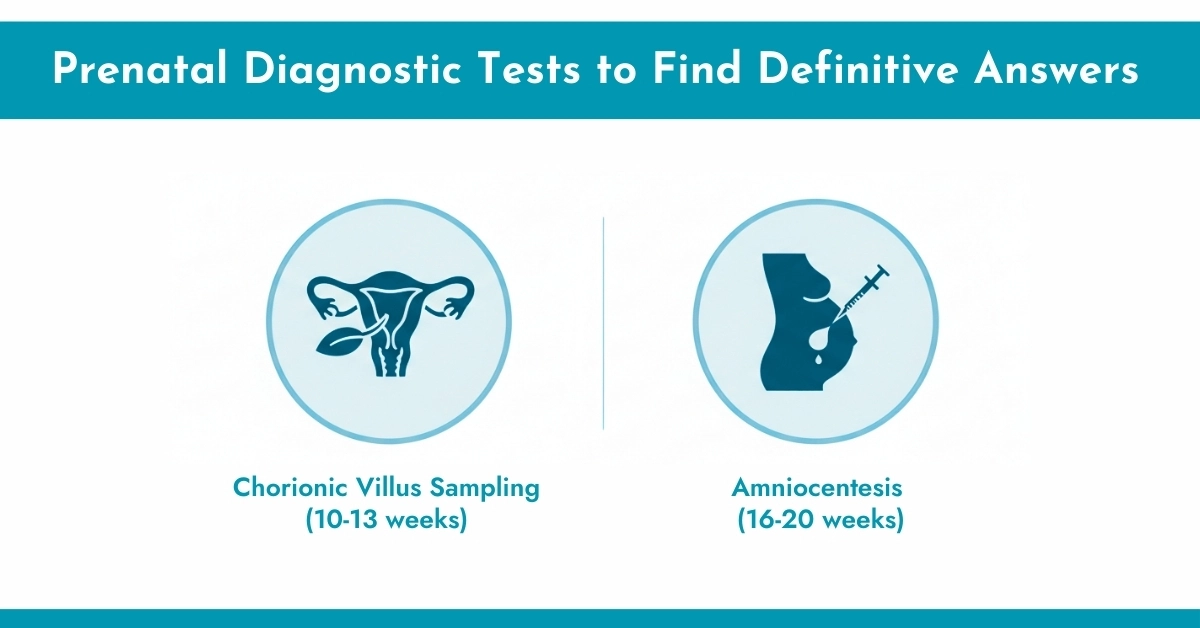
If screening tests show an elevated risk or if you have a known family history of genetic conditions, prenatal testing for genetic diseases enters its second phase: diagnostic testing.1. Chorionic Villus Sampling (CVS) (10-13 weeks)
- CVS is performed earlier than amniocentesis by sampling a tiny piece of placental tissue.
- It provides earlier results but carries a slightly higher miscarriage risk than amniocentesis.
2. Amniocentesis (16-20 weeks)
- This test uses a thin needle to collect a small sample of the amniotic fluid surrounding your baby.
- The sample contains fetal cells, allowing laboratories to confirm chromosomal conditions with more than 99% accuracy.
Who Should Consider Prenatal Genetic Testing
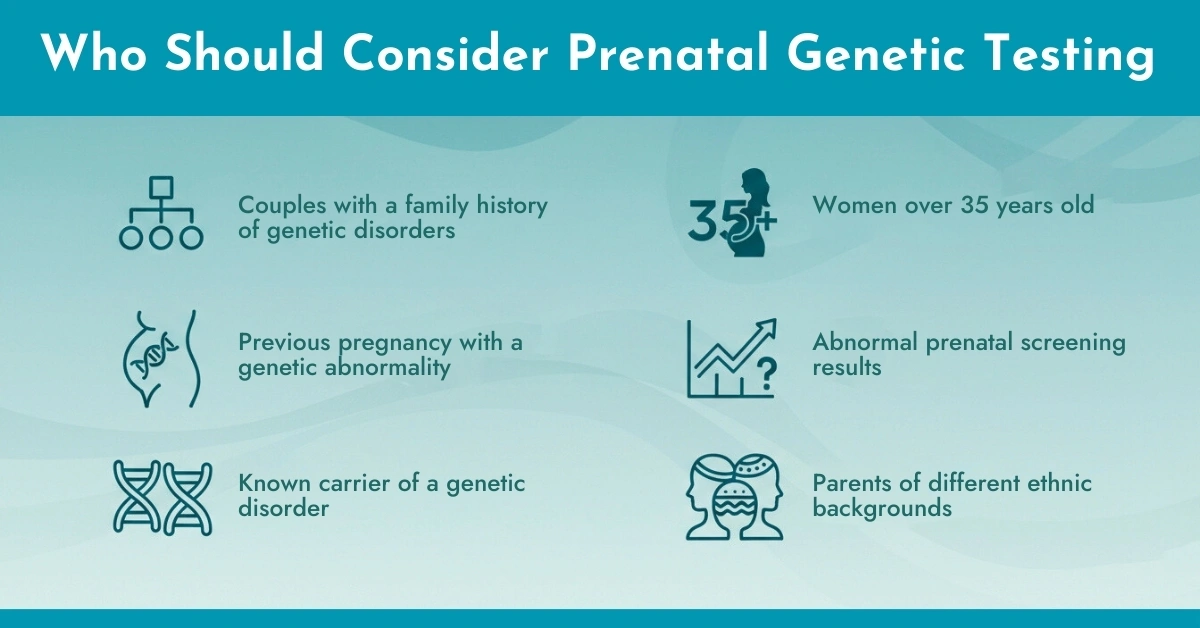
You should strongly consider prenatal genetic testing if:For your information: The Mayo Clinic Health System reports that carrier screening is a one-time test. If you plan multiple pregnancies, getting screened once gives you lifelong insight for future family planning.Couples with a family history of genetic disorders – If either parent has relatives with inherited conditions like cystic fibrosis, Tay-Sachs, or sickle cell anemia.
Previous pregnancy with a genetic abnormality – Parents who have had a child with a genetic disorder or experienced miscarriages due to chromosomal issues.
Known carrier of a genetic disorder – Either parent has been identified as a carrier through genetic testing.
Women over 35 years old – Advanced maternal age increases the risk of chromosomal abnormalities such as Down syndrome.
Abnormal prenatal screening results – Blood tests or ultrasounds indicating a higher likelihood of genetic conditions.
Parents of different ethnic backgrounds – Certain genetic disorders are more prevalent in specific ethnicities, so mixed heritage increases the value of testing.
While prenatal tests assess your baby’s genetic health, expectant parents can also benefit from RPH Labs’ PGx testing to understand how their own genetics affect medication response. This non-invasive, at-home test evaluates 250+ medications, helping your healthcare provider tailor safer treatments during pregnancy.
Understanding False Positives and False Negatives
No prenatal genetic test is perfect.- False positives (test shows high risk but baby is healthy) occur in 2-5% of screenings and often lead to unnecessary anxiety and invasive follow-up tests.
- False negatives (test shows low risk but baby has the condition) are much rarer, but still possible.
The Timeline: When to Do What
| Gestational Age | Test Type | What It Screens For |
| 10+ weeks | Cell-free DNA (NIPT) | Trisomy 21, 18, 13; fetal sex |
| 11-14 weeks | Nuchal translucency | Chromosomal & heart defects |
| 11-13 weeks | CVS (diagnostic) | Confirms chromosomal conditions |
| 15-22 weeks | Quad/AFP screening | Neural tube defects |
| 16-20 weeks | Amniocentesis | Confirms chromosomal conditions |
| 18-20 weeks | Anatomy scan | Structural abnormalities |
| Anytime | RPH Labs PGx Kit | Personal medication responses |
What Happens Next After the Results
If Results Are Normal
- You can breathe easier, but remember, no test detects every condition.
- Continue regular prenatal care and consider adding RPH Labs’ PGx testing to optimize medication safety throughout pregnancy and postpartum.
If Results Are Abnormal
Your provider will recommend genetic counseling. A counselor will:- Review your family history
- Explain what the results truly mean
- Help you decide on diagnostic testing (if not already done)
- Discuss your options moving forward
Conclusion
Prenatal genetic testing and screening offer powerful insights, but they should never feel like a requirement. The decision is entirely yours. Whether you choose every option or none at all, your choice deserves respect. Prenatal testing informs one chapter of your baby’s health story, but your genetics continue to matter long after birth. RPH Labs’ PGx testing helps tailor medications to your DNA during pregnancy, postpartum depression, future medical treatments, and beyond. Sources:- Clevenland Clinic: Chronic Villus Sampling For Prenatal Diagnosis
- Clevenland Clinic: Genetic Amniocentesis
- Mayo Clinic Health System: Carrier Screening for Family Planning
Frequently Asked Questions
What’s the difference between a prenatal panel and a pregnancy genetics test?
A prenatal panel typically combines multiple screenings (blood tests, ultrasound) into one package. A pregnancy genetics test usually refers to specific gene or chromosome analysis. Always ask your provider exactly what’s included.
Can I do prenatal genetic testing at home?
No. All prenatal genetic testing and screening require blood draws or ultrasounds at medical facilities.
How accurate is NIPT?
For Down syndrome, NIPT detects over 99% of cases with less than 1% false positives. But accuracy drops for rarer conditions like trisomy 13. Confirmatory testing is crucial.
Will testing tell me if my baby will have autism?
No current prenatal tests can predict autism spectrum disorder. Genetic testing focuses on chromosomal conditions and specific genetic disorders with known markers.
What happens to my DNA samples after testing?
Labs vary. Some discard prenatal samples after testing; others store them for research (with consent).

Leave a Reply