

Pharmacogenomic testing benefits reach well beyond one type of medicine. This guide looks at how PGx helps in mental health, cancer and autoimmune care, then adds heart care, pain management, transplant and infection treatment, along with the honest limits every patient should know.
On this page
While we tend to share unique genetic makeup, getting the same drugs and dosages without knowing how they may affect our bodies involves trial and error. Pharmacogenomics (PGx), by giving insights into our genome, allows healthcare specialists to tailor medication based on an individual’s genetic makeup. This lays out the major Pharmacogenomic Testing Benefits by decreasing the side effects while increasing its efficacy.
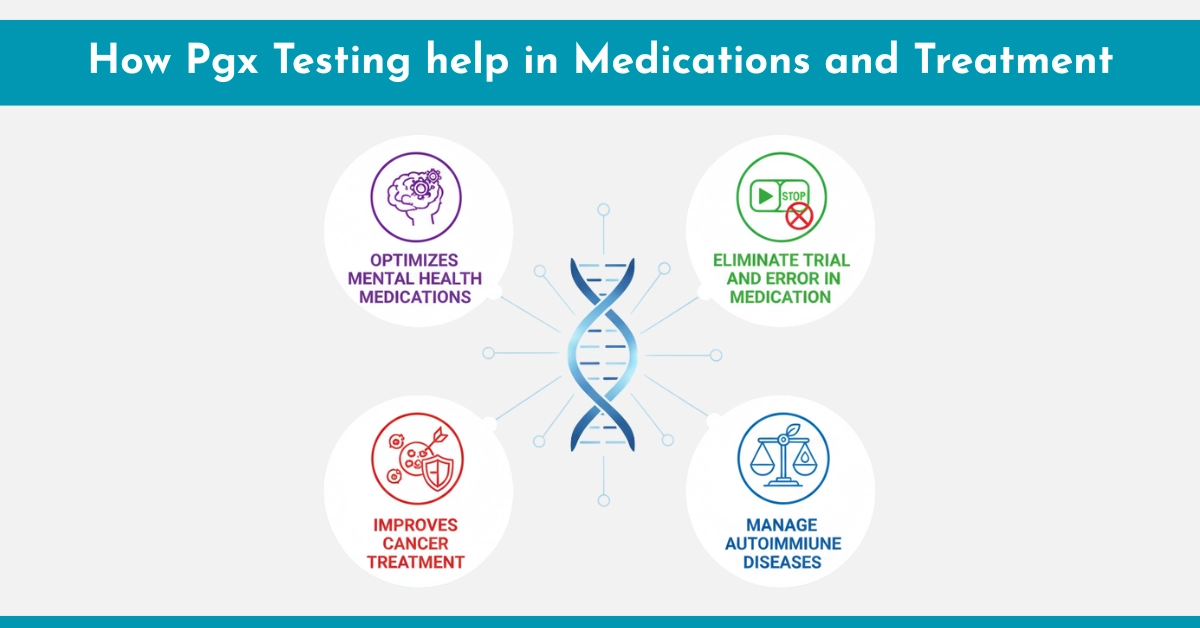
How PGx Testing Helps in Medications and Treatment
The pharmacogenomics test is commonly known as the PGx test. This test is typically non-invasive, requiring just your saliva or a cheek swab. Modern pharmacogenomics labs like RPh Labs offer at-home PGx testing options: a testing kit is mailed to you, and you simply do a cheek swab by running a buccal swab along the inside of your cheek. Once your sample reaches the lab, it is tested and your results are uploaded to a secure online portal, typically within 7 to 10 business days.
Let’s take a deep dive into how PGx benefits medication.
PGx Helps Reduce Trial and Error
- Problem: Trying multiple medications before finding the right one, especially in mental health medications, where doctors may give you a smaller dose, whereas you require a higher one, or vice versa.
- Solution: Pharmacogenomic testing (PGx testing) helps doctors select the most effective drug and the right dosage for each patient based on their genetic profile.
- Benefit: This approach can save time and money and spare you some of the trial and error.
Optimizes Mental Health Medications
- Problem: Often metabolized in the liver, mental health medications, such as venlafaxine, can be hit-or-miss, and the side effects sometimes even complicate the symptoms.
- Solution: Pharmacogenomic testing for mental health identifies genetic variations that impact how a patient may respond to different medications.
- Benefit: Based on how an individual’s body may respond, doctors can tailor treatments that perhaps increase the effectiveness of drugs and minimize adverse effects.
Did you know?
Venlafaxine XR is a mental health drug primarily metabolized by the CYP2D6 enzyme. While this drug is indicated for certain issues, including panic disorder, it comes with certain warnings and precautions as well, which are highlighted in the FDA label. If you want to learn more on CYP2D6 enzyme then pick Rph’s guide.
A Pharmacogenomic testing kit shows how your body may respond to different medications based on the type of metabolizer you are, reducing the chances of adverse side effects.
Improves Cancer Treatment
- Problem: Some cancer medications, such as fluorouracil and capecitabine (affected by DPYD) or thiopurines (affected by TPMT and NUDT15), work differently for individuals, and the wrong dose can cause severe side effects or be ineffective.
- Solution: PGx testing for cancer treatment may be recommended by doctors as it helps them choose the right drugs by analyzing the patient’s genetic makeup.
- Benefit: This targeted approach increases the likelihood of successful treatment while minimising unnecessary side effects and ineffective therapies.
Helps Manage Autoimmune Diseases
- Problem: Numerous autoimmune diseases like rheumatoid arthritis and lupus require long-term treatment with medications that can be hard to tailor to an individual’s needs.
- Solution: Pharmacogenomic testing identifies the drugs (along with the right dosage) most likely to work based on a patient’s genetic profile, supporting better management of chronic autoimmune conditions.
- Benefit: By prescribing the right drugs and right dosage from the beginning, PGx testing reduces the trial-and-error process and helps control symptoms more effectively.
We can take azathioprine as an example here, a drug that may be prescribed for autoimmune conditions such as lupus or rheumatoid arthritis. People with reduced TPMT or NUDT15 activity have a higher risk of serious side effects, so prescribers may lower the dose or choose another drug based on their genetic profile.
Pros and Cons of Pharmacogenomic Testing
A PGx test is simple and low risk, but it does have limitations. The following table sets out the main pros and cons:
| Pros | Cons |
| Reduced side effects – By choosing drugs that suit a person’s genetics. | Cost – The test can be expensive, and insurance may not always cover it. *To keep it affordable, the RPh Labs kit can be split into 4 interest-free installments. |
| Better drug efficacy – Medications are tailored to a person’s genetic makeup. | Availability – Not all healthcare providers offer PGx testing. |
| Personalized care – Helps make treatments more effective and safer for the individual. | Interpretation complexity – Understanding genetic results can sometimes be difficult. *RPh Labs reports are written to be easy to read, every report is reviewed by a PharmD pharmacist, and a free pharmacist consultation is included. |
| Faster recovery – Patients may reach an effective treatment sooner. | Limited scope – Not all medications are currently included in pharmacogenomic testing. |
Heart care: clopidogrel genetic testing and more
Some of the clearest pharmacogenomic testing benefits are in heart and blood vessel care. Clopidogrel, a common antiplatelet drug after a heart stent or stroke, is a prodrug. It needs the CYP2C19 enzyme to become active.
People who are CYP2C19 poor metabolizers make less of the active drug and may get less protection from clots. The FDA label for clopidogrel carries a boxed warning about this, and CPIC guidelines suggest considering another antiplatelet drug for poor and intermediate metabolizers in certain situations. Clopidogrel genetic testing gives the prescriber that information before or soon after the drug is started.
Heart care has other well-established gene links too:
- Warfarin: CYP2C9 and VKORC1 results help predict a starting dose. Medicare has a national coverage decision on warfarin pharmacogenomic testing.
- Simvastatin: SLCO1B1 decreased function raises the risk of statin muscle problems. See our guide to SLCO1B1 decreased function.
If you already take clopidogrel, do not stop it on your own. Clopidogrel genetic testing results should be reviewed with your cardiologist or prescriber, who can decide whether any change is needed.
Safer pain relief with opioid genetic testing
Pain management is another area where PGx can matter a great deal. Codeine and tramadol are converted by CYP2D6 into their stronger active forms. That makes the CYP2D6 result especially important.
- Ultrarapid metabolizers can turn these drugs into the active form too quickly, raising the risk of serious side effects such as dangerous drowsiness and slowed breathing.
- Poor metabolizers make little of the active form and may get poor pain relief.
Because of these risks, FDA labeling says codeine and tramadol should not be used in children under 12, and CPIC guidance recommends avoiding codeine in CYP2D6 ultrarapid and poor metabolizers. Opioid genetic testing helps a prescriber decide whether these drugs are a reasonable choice or whether a pain medicine that does not depend on CYP2D6 activation would be better.
Opioid genetic testing does not predict addiction risk, and it does not replace careful dosing and follow-up. Its main value is spotting people who are more likely to get too much or too little effect from specific drugs. Share the results with anyone who may prescribe pain medicine, including your dentist or surgeon.
Cancer care: why DPYD testing matters
Cancer care is one of the areas covered above, and some of the most important pharmacogenomic testing benefits there come from one gene: DPYD. The DPYD gene makes the enzyme that breaks down fluorouracil (5-FU) and capecitabine, two widely used chemotherapy drugs.
People with reduced DPYD function can build up much higher levels of these drugs and face severe, sometimes life-threatening toxicity at standard doses. DPYD testing before treatment lets the oncology team lower the starting dose or choose another option. CPIC guidelines and FDA labeling both address DPYD variants.
Other cancer-related gene links include:
- UGT1A1: reduced function raises the risk of side effects from irinotecan.
- TPMT and NUDT15: variants raise the risk of serious toxicity from thiopurines such as mercaptopurine, used in some leukemias.
If you or a family member is starting chemotherapy, ask the care team whether DPYD testing or other PGx testing is part of their plan. Cancer centers often order it directly, and existing results from a CLIA-certified lab can also be shared with them.
Specific gene links in mental health medications
Mental health is often where people first hear about PGx. Specific gene and drug pairs explain why. CYP2C19 affects how the body handles citalopram, escitalopram and sertraline. CYP2D6 affects paroxetine, fluvoxamine, several tricyclic antidepressants, some antipsychotics and atomoxetine for ADHD.
For some of these drugs, CPIC guidance suggests a lower starting dose, a slower increase or a different drug for poor or ultrarapid metabolizers. That can help a prescriber narrow the options, especially after one or two medications have not worked or have caused side effects.
Genes are only part of the picture in mental health. Diagnosis, symptoms, other medications and personal history all shape treatment. The NIMH guide to mental health medications is a good general resource, and our article on genetic testing for antidepressants goes into more detail.
Autoimmune disease: where the evidence is strongest
Many autoimmune conditions need long-term treatment, so avoiding serious side effects matters. The best-established PGx guidance in this area is for thiopurines. Azathioprine is used for conditions such as inflammatory bowel disease, lupus and rheumatoid arthritis, and after organ transplants.
People with low or absent TPMT or NUDT15 activity can develop dangerous drops in blood counts at standard thiopurine doses. Testing before treatment allows the prescriber to lower the dose or choose another drug. You can read more in our guide to TPMT testing and on MedlinePlus.
For some other autoimmune drugs, the genetic evidence is still developing. That is one reason to ask your prescriber which of your medications have firm guidance and which do not. Clear, well-studied gene links are where pharmacogenomic testing benefits are most reliable.
Transplant, infection and other areas of care
The value of one PGx result can surprise people because pharmacogenomic testing benefits reach into areas they may never have considered:
- Transplant: CYP3A5 affects how quickly tacrolimus is cleared, which can guide the starting dose.
- Tuberculosis: NAT2 slow acetylators clear isoniazid more slowly, which can raise the risk of side effects.
- Blood cell safety: people with G6PD deficiency can have red blood cell damage with certain drugs, such as rasburicase and dapsone.
- Hearing: MT-RNR1 variants raise the risk of hearing loss with aminoglycoside antibiotics.
- Anesthesia: BCHE variants can prolong the effect of succinylcholine.
The RPh Labs panel covers 20 genes, including all of those listed here, and reports on more than 240 medications. You can check your current prescriptions on our medication list by gene.
Limitations of pgx testing to keep in mind
A fair look at pharmacogenomic testing benefits also covers what the test cannot do. These limitations of pgx testing are worth knowing before you order:
- It cannot guarantee that a drug will work or be free of side effects.
- It covers a set list of genes and variants, so rare variants outside the panel can be missed.
- It does not account for other drugs that block or speed up enzymes, a process called phenoconversion.
- Some medications have limited or no genetic guidance yet.
- Results need to be read in context by a prescriber or pharmacist.
None of these limitations of pgx testing make the results less valid. They simply mean PGx is one important input alongside age, kidney and liver function, other medications and how you respond. Understanding the limitations of pgx testing helps you and your prescriber use the report wisely.
Questions to ask your prescriber about PGx results
Many people are not sure how to start the conversation about genetic results. These questions can help you get clear, practical answers at your next visit:
- Do any of my current medications have guidance linked to my results?
- Is there anything on my report that should change my dose, my drug choice or how often I am monitored?
- Could any of my other medications be affecting the same enzymes?
- Should my results be added to my medical record so other clinicians can see them?
- Which medications might I need in the future, such as for surgery or heart care, where my results could help?
If your prescriber is less familiar with PGx, they can find support on our page for providers. You can also use the free pharmacist consultation included with every RPh Labs report to prepare your questions in advance.
Bringing a printed or digital copy of your report to each visit makes it far more likely that the information is actually used when a new prescription is written.
Turning pharmacogenomic testing benefits into better care
A test only helps if its results are used. Share your report with your primary care provider, specialists and pharmacy, and mention it any time a new medication is suggested. Never stop or change a medication on your own based on a report.
RPh Labs offers an at-home PGx kit that uses a simple cheek swab. Results are ready 7 to 10 business days after the sample reaches our CLIA-certified lab, every report is reviewed by a PharmD pharmacist and a free pharmacist consultation is included. The self-pay price is $299, and insurance, including Medicare, is accepted in many cases. See our insurance page for details.
Conclusion:
Pharmacogenomic testing can help increase drug efficacy and reduce the risks of adverse reactions.
Typically, these tests are non-invasive, requiring just your saliva or a cheek swab. A PGx test may help in numerous treatments, such as cancer, autoimmune diseases, and most importantly, mental health medications.
Disclaimer: This blog is for informational purposes only and does not constitute medical, legal, or professional advice. While we strive for accuracy, errors or omissions may occur.
Some images in this blog may be AI-generated or for illustrative purposes only.
Pharmacogenomic testing benefits FAQ
Should I get clopidogrel genetic testing if I already had a stent?
It is worth asking your cardiologist. CYP2C19 results can show whether clopidogrel is likely to be activated well in your body. If you are a poor or intermediate metabolizer, your cardiologist may consider another antiplatelet drug. Do not stop clopidogrel on your own, since that can be dangerous after a stent.
Does opioid genetic testing show if I will become addicted?
No. Opioid genetic testing on a PGx panel looks at how you process certain pain medicines, mainly through CYP2D6. It helps predict whether drugs like codeine and tramadol may be too strong or too weak for you. It is not a test for addiction risk.
Is DPYD testing done before every chemotherapy?
Practices vary between cancer centers. DPYD testing is most relevant before treatment with fluorouracil or capecitabine. If you are starting either drug, ask your oncology team whether DPYD testing is planned, or share PGx results you already have.
What are the main limitations of pgx testing?
PGx testing cannot guarantee a drug will work, does not cover every gene or rare variant and does not account for drug interactions or organ function. Some medications also lack firm genetic guidance. The results are most useful when a prescriber reads them alongside your full health picture.
Do pharmacogenomic results expire?
No. Your genes do not change, so the results stay valid for life. Guidelines do change, though, and RPh Labs updates reports when guidance is revised. Share the current version of your report whenever a new medication is considered.


Leave a Reply