
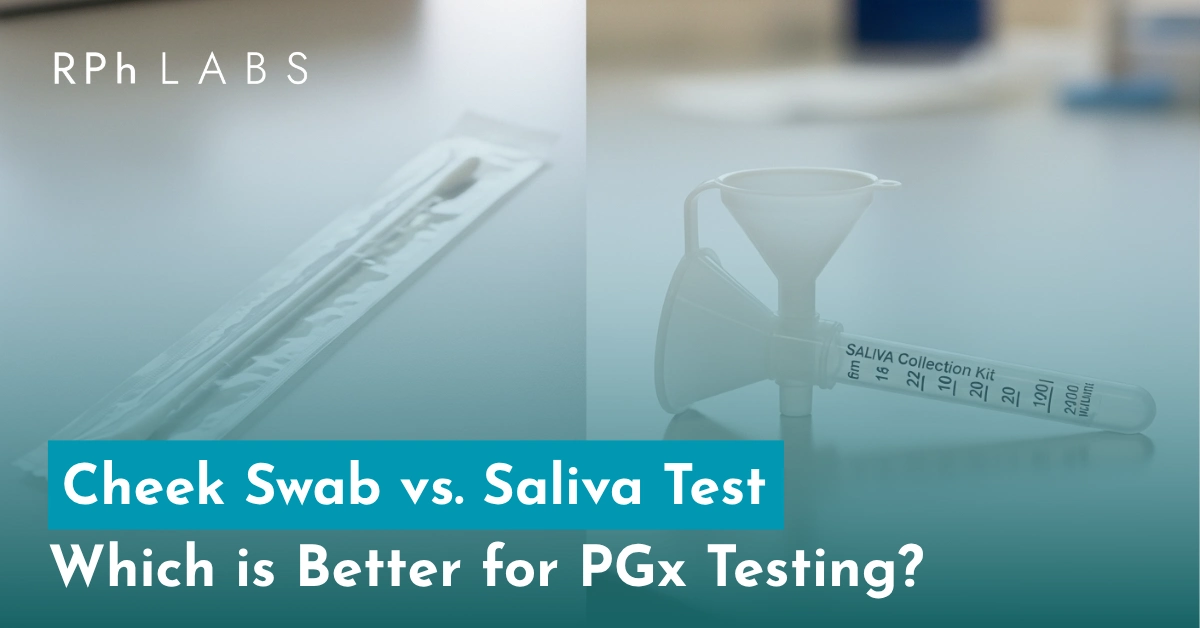
Choosing a cheek swab vs saliva test is usually the first practical decision in pharmacogenomic (PGx) testing, and it is simpler than it sounds. This guide compares the two methods, then walks you through collection step by step, the mistakes that delay results, and what really decides how reliable your report is.
On this page
Pharmacogenomic (PGx) testing requires a DNA collection, for which there are two methods typically used: cheek swabs (buccal swabs) and saliva samples. Both are non-invasive and have their own pros and cons. According to a report shared by PubMed, cheek swab tests have proven to be more stable and resilient. Following is a deep dive into the cheek swab vs. saliva test:
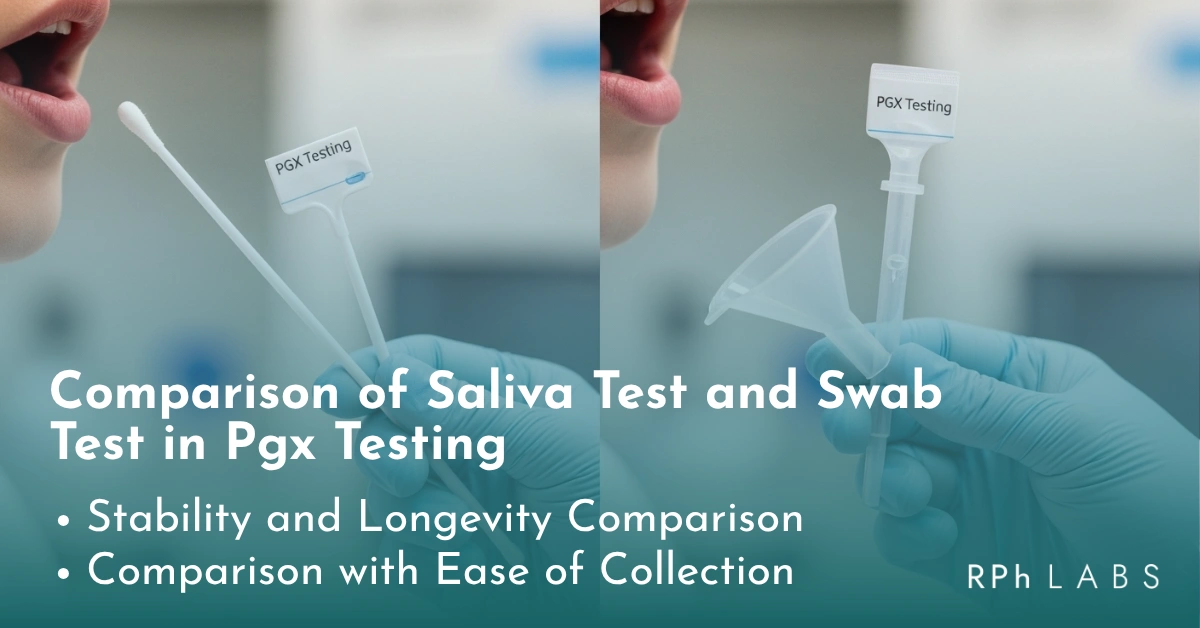
Comparison of Saliva Test and Swab Test in Pgx Testing
1. Stability and Longevity Comparison
- Cheek Swab: Collects cells (from the inside of the cheek), which are nucleated (contain a nucleus). While saliva also contains nucleic acids, it may have less DNA and a higher chance of contamination.
- Cheek Swab: Compared to a saliva test, a buccal swab may be a high-quality DNA source that is more resilient and stable over time. DNA extracted from cheek cells remains intact for longer periods, even with delays in processing or transport. Thus, cheek tests are better for long-term storage and retesting in PGx studies.
2. Comparison with Ease of Collection
- Cheek swab: Collection is straightforward and generally well-tolerated by most individuals. Just a gentle rub inside the cheek for a few seconds allows the collection of DNA. This process is quick, easy, and minimally uncomfortable.
- Saliva: This method can sometimes be difficult, particularly for individuals with dry mouth or older patients. However, saliva collection may be more convenient for patients who may be uncomfortable with cheek swabs or those who require multiple samples. Additionally, the ability to collect larger volumes of DNA can be beneficial in cases where a significant amount of material is needed.
Know your body’s response to 240+ medications:
Book an at-home PGx test today with RPh LABS and know how your body may respond to 240+ medications, especially the mental health ones.
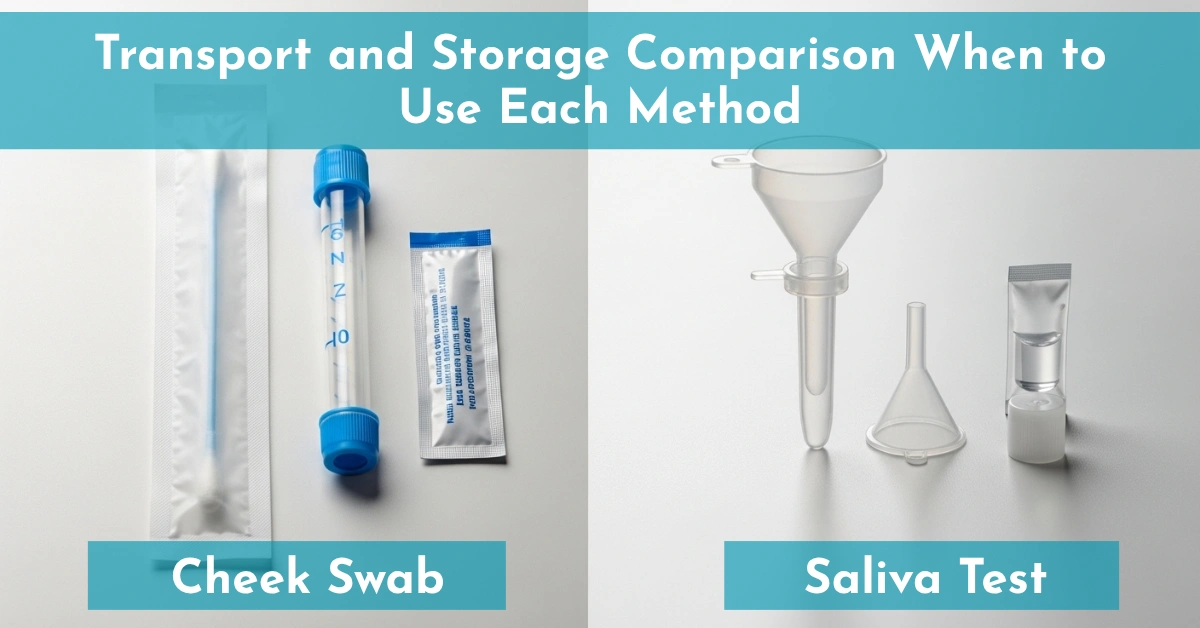
Transport and Storage Comparison
- Cheek Swabs (Buccal Swabs): Cheek swabs can be stored at room temperature – requiring no special storage conditions, such as refrigeration – cheek swabs provide easy stability during transport. Hence, making them ideal for long-distance shipping.
- Saliva: On the other hand, to maintain DNA, saliva samples require special storage conditions. Most saliva kits add a preservative liquid to prevent microbial contamination or DNA degradation. Some newer saliva collection kits thus include DNA stabilizing agents, making them less sensitive to temperature fluctuations and improving the overall PGx saliva test accuracy.
Saliva and buccal tests both have their advantages and disadvantages. Your preferences should actually be based on your requirements. While a saliva test may provide sufficient DNA, as shared by the Chicago geneticist, for more complex genetic tests, a blood test may be required.
While cheek swabs and saliva tests differ in process, both contribute to overall testing expenses. See our detailed breakdown on PGx testing costs
When to Use Each Method: Cheek Swab vs Saliva Test
The choice between a cheek swab and saliva test depends on DNA purity, sample stability, contamination risk, cost, ease of use, and regulatory compliance. Privacy, data security, and sample quality must also be considered.
Choose a Cheek Swab if:
- High purity and stability of DNA are needed in order to be able to perform accurate genetic analysis and ensure minimal bacterial contamination.
- The testing is done in a controlled clinical or forensic environment, and reliability is provided through professional supervision.
- The sample provided is a child, an old person, or a person with a dry mouth condition, thereby making it difficult to produce saliva and raising questions of low yield.
- Stability in transport and storage is essential, particularly in long-distance shipping, which is not refrigerated, which concerns the logistics, such as sample degradation.
Choose a Saliva test if:
- More DNA is required to be analyzed in more depth, e.g. a whole-genome sequencing, but this puts a person at greater risk of contamination by oral bacteria or recent food.
- It specialises in convenient at-home or direct-to-consumer genetic testing kits with an emphasis on convenience and accessibility, as well as in data management and user privacy.
- Comfort must be as non-invasive as possible, which is good when conducting a screening on a large scale, although there is a concern that the quality can be inconsistent unless obtained in a superior manner.
In the majority of genetic testing applications, such as ancestry, health diagnostics, or drug screening, the two approaches are both valid and reliable.
Cheek Swab vs Saliva Swab Comparison Summary
- Purpose: Cheek swabs mainly prepare genetic material (DNA), whereas saliva tests prepare a range of substances and molecules in oral fluid.
- Collection: The two are both non-invasive, yet the cheek swab isolates cells on the inner cheek, and a saliva test is a spit sample.
- Application: Cheek swabs tend to be better in a genetic analysis because they are more stable. In drug testing, the saliva is used the detect substances in the system.
How to do a cheek swab the right way
Knowing how to do a cheek swab well matters more than which kit you pick. A good sample means the lab can read your DNA the first time, so you avoid the wait of a recollection.
Always follow the exact instructions printed in your kit, since brands differ slightly. Most buccal swab kits follow the same basic steps:
- Skip eating, drinking, chewing gum, smoking and brushing your teeth for about 30 minutes before you start, unless your kit says otherwise.
- Wash and dry your hands, then open the swab without touching the soft tip.
- Place the tip inside one cheek and rub firmly up and down while rotating it, for the time your kit states (often 30 to 60 seconds).
- Repeat on the other cheek if the kit includes a second swab.
- Let the swab air dry if instructed, then seal it in the tube or envelope provided.
- Label everything with your name and date exactly as requested and complete any paperwork.
Firm pressure is the part people get wrong most often. A light tap collects mostly saliva, while a steady scrub picks up the cheek cells that hold your DNA. It should feel like brushing, not scraping, and it should never hurt.
If you use the RPh Labs at-home PGx kit, the step-by-step card in the box and our how it works page show the whole process, from swabbing to mailing.
What happens after DNA sample collection
Once your DNA sample collection is done and the kit is back at the lab, the work that actually produces your results begins. Understanding it helps explain why both sample types can succeed.
First, technicians extract DNA from the cells on your swab or in your saliva. They check that there is enough DNA, and that it is clean enough, to run the test. If there is not, the lab will usually ask for a new sample rather than guess.
Next, the lab looks at specific, well-studied spots in genes such as CYP2D6, CYP2C19 and SLCO1B1. PGx tests do not read your whole genome. They look for known variants that change how enzymes and transporters handle medicines.
Those variants are grouped into named versions of each gene, called star alleles, which are catalogued by PharmVar. Your two copies of a gene are then translated into a phenotype, such as normal, intermediate, poor or ultrarapid metabolizer.
At RPh Labs, results arrive 7 to 10 business days after the sample reaches the lab, and a PharmD pharmacist reviews every report before it is released.
Why a buccal swab suits PGx testing
PGx testing looks at the DNA you were born with. That DNA is essentially the same in the cells of your cheek, your blood and your saliva, so a buccal swab can answer the same questions a blood draw would for this type of test.
Targeted PGx panels also need only a small amount of DNA, because they check a limited set of sites rather than sequencing everything. That is a big reason a quick swab is enough for most people.
A few other practical points make the buccal swab popular for at-home PGx kits:
- No needle, no lab visit and no need to produce a large volume of spit.
- A caregiver can collect the sample for someone who cannot do it alone.
- Your genotype does not change over your lifetime, so one good sample usually covers you for life.
An important exception: transplants
If you have had a bone marrow or stem cell transplant, tell the lab and your prescriber before testing. Blood, and sometimes cheek or saliva samples, can carry donor DNA. After a liver transplant, the liver enzymes that process many drugs come from the donor, so your own genes may not predict how you handle those medicines.
Saliva DNA test: what to know before you spit
A saliva DNA test asks you to spit into a tube up to a fill line, then close a cap that releases a stabilizing liquid. The DNA comes mainly from white blood cells and cheek cells that are naturally present in saliva, not from the fluid itself.
Saliva kits share the same basic rule as swabs: no food, drink, gum or smoking for about 30 minutes beforehand, or as your kit directs. Beyond that, a few things are worth knowing:
- Filling the tube can take several minutes, and bubbles do not count toward the line.
- People with dry mouth may struggle to produce enough saliva.
- Many common medicines, including some antidepressants, antihistamines and bladder drugs, can cause dry mouth.
- Very young children and some older adults cannot spit on command.
None of this makes a saliva DNA test a poor choice. It simply means the easier method depends on the person. If you have dry mouth or are collecting for someone else, a swab is often the less stressful route.
Whichever you use, the lab must be set up for that sample type. Use only the collection device supplied with your kit, since labs validate their process for specific devices.
Common mistakes that delay your results
Most failed samples come down to small, avoidable errors during DNA sample collection. Watching for these can save you a second kit and a couple of extra weeks.
- Eating or drinking too soon. Food particles and drinks can dilute or contaminate the sample.
- Swabbing too gently. A light touch collects too few cells for the lab to work with.
- Touching the tip. Fingers, counters and sinks can transfer other material onto the swab.
- Sealing a wet swab. If your kit says to air dry, give it the full time before closing it.
- Mismatched labels. Names and dates on the tube and form must match, or the lab may not be able to accept the sample.
- Waiting to mail it. Send the kit back promptly so it reaches the lab in good condition.
RPh Labs covers shipping both ways, and kits ship within one business day of your order, so the main thing in your control is a clean, well-labeled sample returned quickly.
If the lab does report a problem with your DNA sample collection, it is not a sign that something is wrong with you. It usually just means another collection is needed.
Cheek swab vs saliva test for children, older adults and caregivers
The cheek swab vs saliva test question matters most for people who cannot easily follow instructions or produce saliva on demand. Here is how the two methods compare in real life.
Children
Young children often cannot spit into a tube, but most tolerate a quick swab, especially if a parent does it while the child sits on a lap. Make the rub firm but gentle and keep the time short and calm. Talk with your child’s prescriber about whether PGx testing is useful for the medicines being considered.
Older adults
Older adults are more likely to take several medicines, and many of those can cause dry mouth. A swab avoids the strain of filling a saliva tube. Dentures can usually stay in, but check your kit instructions.
Caregivers
If you are collecting for someone with dementia, a disability or limited hand control, a swab is usually easier to manage. Read up on how to do a cheek swab before you start so you can guide them calmly. Explain each step, wash your hands, and fill in the labels yourself so the details are clear and consistent.
Does the sample type change your PGx results?
When a sample passes the lab’s quality checks, your genotype should be the same whether it came from a buccal swab or a saliva DNA test. The sample type mainly affects how easy collection is, not what your genes say.
What matters more for accuracy is the lab itself. Look for CLIA certification and accreditation, a clear list of the genes and variants tested, and pharmacist or clinician review. RPh Labs is CLIA-certified and COLA-accredited, tests 20 genes, and reports on more than 240 medications.
Recommendations in PGx reports usually draw on published guidance such as the CPIC guidelines. Your prescriber then weighs those results alongside your age, kidney and liver function, other medicines and health history.
Never stop or change a medicine based on a report alone. Bring your results to your prescriber or pharmacist and decide together. For a plain-language overview, see what is PGx testing or browse our FAQ.
Conclusion
Both cheek swabs (buccal swabs) and saliva tests have their own pros and cons. Cheek swabs provide more resilient, high-quality DNA with low contamination risk and greater stability, making them ideal for long-term storage and reliable results. Saliva tests, on the other hand, are flexible and can provide larger volumes of DNA, making them ideal in certain contexts where higher sample quantities are required.
Disclaimer: This blog is for informational purposes only and does not constitute medical, legal, or professional advice. While we strive for accuracy, errors or omissions may occur. Some images in this blog may be AI-generated or for illustrative purposes only.
Cheek swab vs saliva test FAQ
Is a cheek swab or a saliva sample more accurate for PGx testing?
Both can give accurate PGx results when the sample passes the lab’s quality checks, because your DNA is the same in cheek cells and the cells found in saliva. Accuracy depends more on good collection technique and on the lab’s certification, validated methods and review process than on the sample type itself.
How long should I wait after eating before a buccal swab?
Most kits ask you to wait about 30 minutes after eating, drinking, chewing gum, smoking or brushing your teeth before a buccal swab. Food and drink can dilute or contaminate the sample. Always follow the exact timing printed in your kit, since instructions can differ between labs.
Can I use a saliva DNA test kit if I have dry mouth?
You can try, but a saliva DNA test can be hard to complete with dry mouth, which is a common side effect of many medicines. Filling the tube may take a long time or fall short of the line. A cheek swab kit is often the easier option in that situation.
What if my DNA sample collection fails?
If the lab cannot get enough usable DNA, it will usually ask you for a new sample rather than report uncertain results. This is typically caused by swabbing too lightly, eating too soon or a labeling mismatch. It does not mean anything is wrong with your health.
How to do a cheek swab on a young child?
Have the child sit comfortably, ideally on your lap, and rub the swab firmly along the inside of one cheek for the time your kit states. Keep it calm and quick, avoid touching the tip, and label the tube carefully. Check with the child’s prescriber first about whether testing is useful.
Do I need to repeat PGx testing later?
Usually not. Your genes do not change over your lifetime, so one successful test generally covers you for life. What can change is how results are interpreted as guidelines are updated, which is why RPh Labs updates reports when guidelines change. Your prescriber can tell you if anything new applies.

Leave a Reply