
Prices for gene-based medication tests vary a lot, and the label price rarely tells the whole story. This guide breaks down the pharmacogenetic testing cost in 2026, the seven factors that move the price up or down, and how to judge whether a test is good value for you.
On this page
The Pharmacogenetic Testing Costs vary based on the test complexity and insurance coverage. The FDA includes pharmacogenomic information in the labels of many medications, including some mental health ones, which is why this is often called genome-based medication. Depending on your plan and whether the test is medically necessary, Medicare (Part B) or Medicaid may cover some or all of the cost.
Medicare Advantage and commercial plans may also offer coverage, though what you pay out of pocket depends on your plan. The answer to ‘is genetic testing for antidepressants covered by insurance’ is sometimes yes, depending on your plan; GeneSight is one well-known example of this kind of testing, and the FDA lists medications whose labels include pharmacogenomic information. Here you can see the list and learn more about Genesight testing.
CYP450 Test Cost
The cyp450 family metabolizes a huge number of medications, including, Opioids, Antidepressants, Antipsychotics, Anticoagulants, Antihypertensives, Antiepileptics, Statins, and some other drugs such as Dextromethorphan. A PGx test by RPh Labs shows how your genes may affect your response to many of these medications and costs $299.00. You may also split it into 4 interest-free installments of $74.75.
What Is Pharmacogenetic Testing?
Built on research that goes back several decades, pharmacogenetic testing (PGx testing) is a medical approach that analyses how an individual’s genetic makeup influences their response to medications. By identifying genetic variants, PGx testing helps clinicians tailor drug prescriptions to enhance efficacy and minimise adverse effects. The FDA cleared the first such test, the AmpliChip CYP450, in 2004. This testing enables personalised medication plans, optimising drug choice and dosage based on individual genetic profiles.
How PGx Testing Enhances Cost-Effectiveness
While PGx tests may have an upfront cost, they may lead to long-term savings. An article in the AJMC discusses how PGx testing may lower costs by reducing adverse drug reactions and hospitalisations, and economic studies of drugs with CPIC guidelines suggest PGx testing can be cost-effective for some of them.
Buy an at-home PGx testing kit from RPh Labs at just $299, know your genetic makeup and how your body may respond to 240+ medications.
How to Select Right Lab for PGx Testing
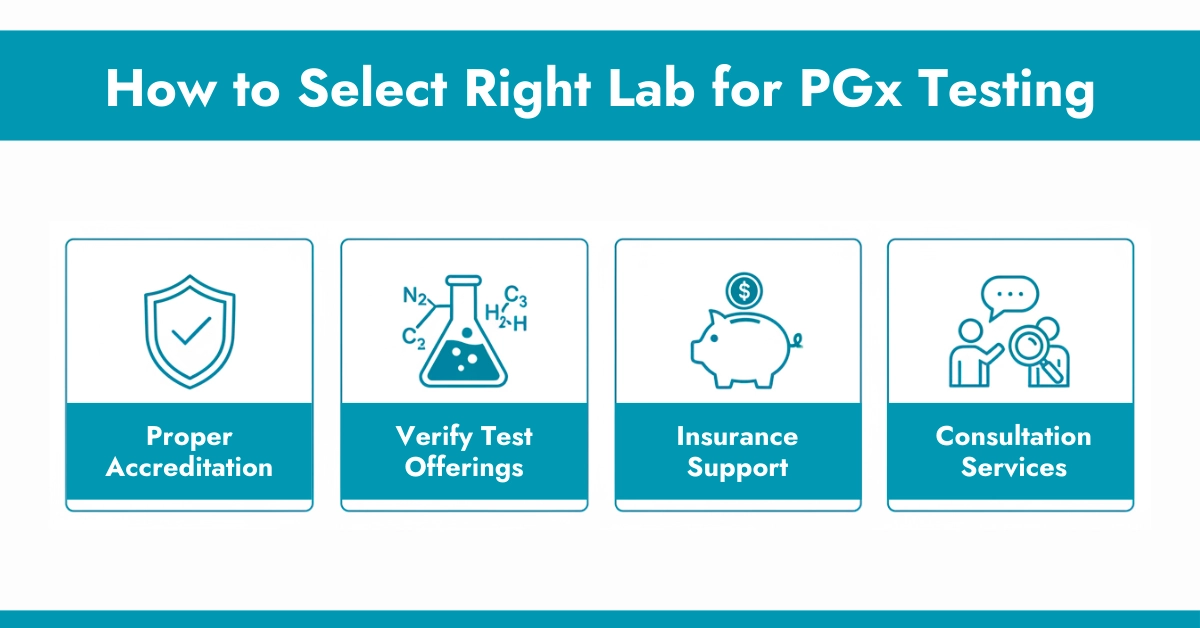
When choosing a laboratory for pharmacogenetic testing, consider:
- Accreditation: Ensure the lab is CLIA-certified, COLA-accredited and is HIPAA compliant to keep your data safe.
- Test Offerings: Verify that the lab provides tests relevant to your medications.
- Insurance Acceptance: Confirm that the lab accepts your insurance or offers affordable self-pay options.
- Consultation Services: Some labs offer genetic counselling or physician consultations to interpret results.
RPh Labs is CLIA-certified, has COLA accreditation, and offers HSA/FSA eligible flexible payments. On top, every report is reviewed by a PharmD pharmacist, and a free pharmacist consultation is included to help you understand it.
Insurance Coverage, FSA, and HSA
Insurance coverage for PGx testing varies:
- Medicare: May cover PGx testing under Part B when coverage criteria, such as medical necessity, are met.
- Medicaid: Coverage depends on the state program and medical necessity. RPh Labs accepts Texas Medicaid (TMHP).
- Private Insurance: Coverage is inconsistent; some plans may cover PGx testing if deemed medically necessary, while others may not.
Flexible Spending Accounts (FSA) and Health Savings Accounts (HSAs) can be used to pay for PGx testing if it’s prescribed by a healthcare provider.
How much is a PGx test in 2026?
If you are asking how much is a PGx test, the honest answer is that it depends on the lab, the number of genes and how you pay. Self-pay prices, insurance-billed prices and the amount you finally owe can all be different numbers for the same test.
As a reference point, the RPh Labs at-home PGx kit has a self-pay price of $299. That covers a 20-gene panel reported against 240+ medications, free shipping both ways and a free consultation with a pharmacist. You can split it into 4 interest-free payments, and it is HSA/FSA eligible.
When a lab bills insurance, the charge sent to your plan is often higher than a self-pay price, and what you owe depends on your deductible and coinsurance. That is why the same pharmacogenetic testing cost can look very different on two people’s bills.
The practical takeaway: before you order, ask for the total you will pay, not just the list price. For a detailed look at insurance, prior authorization and Medicare, see our companion guide on pharmacogenomics testing cost and insurance.
Seven factors that shape pharmacogenetic testing cost
Most of the price difference between labs comes down to a handful of factors. Knowing them helps you compare offers fairly.
- Number of genes. A single-gene test costs less than a panel, but a panel covers far more medications.
- Testing method. Targeted genotyping of known variants and full gene sequencing use different technology and are priced differently.
- Lab quality standards. A CLIA-certified, accredited clinical lab carries costs for audits, controls and licensed staff.
- Report depth. A report that lists affected medications and guidance takes more work than a raw genotype file.
- Professional review. Some labs include a pharmacist or clinician review and a consultation; others charge for it separately or do not offer it.
- Billing route. Self-pay, commercial insurance, Medicare and Medicaid each follow different pricing rules.
- Collection and shipping. An at-home cheek swab kit with prepaid return shipping avoids a separate blood draw visit.
A low PGx test cost that leaves out the report review or the consultation may not be the cheaper choice once you add those pieces back in.
CYP450 test cost versus a full PGx panel
Many people search for CYP450 test cost because their prescriber mentioned one enzyme, often CYP2D6 or CYP2C19. The cytochrome P450 (CYP450) family processes a large share of common drugs, so testing these genes is a sensible start.
A few well-established examples of what CYP450 genes affect:
- CYP2D6: converts codeine and tramadol into their active forms, and affects many antidepressants and some antipsychotics.
- CYP2C19: activates clopidogrel and affects some SSRIs, such as citalopram, escitalopram and sertraline.
- CYP2C9: affects warfarin, phenytoin and several NSAIDs.
- CYP3A5: affects tacrolimus dosing after transplant.
Several important genes sit outside the CYP450 family, though. SLCO1B1 affects simvastatin, TPMT and NUDT15 affect thiopurines, and VKORC1 affects warfarin. If you pay for a single CYP450 gene now and need another gene later, the combined CYP450 test cost can exceed the price of one panel.
Because your results do not change over your lifetime, a broader panel done once can cover medications you may be prescribed years from now. You can browse drugs by gene on our medication list.
What your PGx test cost pays for in the report
The value of a test lives in the report, so it is worth knowing what a good one contains before you compare any PGx test cost.
- Your genotype for each gene, usually written as star alleles such as CYP2D6 *1/*4. The naming system is maintained by PharmVar.
- Your phenotype, such as poor, intermediate, normal, rapid or ultrarapid metabolizer.
- A medication list showing which drugs may need a standard dose, a dose change or an alternative, based on sources like CPIC guidelines and FDA labeling.
- Plain-language notes your prescriber can act on quickly.
At RPh Labs, every report is reviewed by a PharmD pharmacist, and a free pharmacist consultation is included. Reports are updated when guidelines change, so the information stays current without buying a new test.
Keep in mind that a report guides decisions; it does not make them. Your prescriber combines it with your age, kidney and liver function, other medications and your health history. You can learn more about how guideline groups grade gene-drug evidence on our CPIC overview.
Is PGx testing worth it for you?
Whether a test is good value depends on your situation. Asking “is PGx testing worth it” is really asking how likely the results are to change a decision about your care.
Situations where testing is often most useful
- You are starting a drug with a known gene-drug interaction, such as clopidogrel, codeine, tramadol, simvastatin, warfarin or a thiopurine.
- You have tried several antidepressants or other medications with side effects or little benefit.
- You take several medications and your prescriber wants a clearer picture of how you process them.
- A family member had a serious reaction to a medication.
Situations where it may add less
If you take no regular medications and have no plans to start any, results may sit unused for a while. They remain valid for life, but the immediate value is lower. PGx also cannot predict every side effect, since many reactions have non-genetic causes.
So is PGx testing worth it? For many people on or starting affected medications, the answer is often yes, but the best way to decide is to review your current and planned medications with your prescriber or a pharmacist first.
Hidden costs to check before you buy
Two tests with similar prices can end up costing different amounts. Before you pay, ask each lab about these possible extras:
- A separate fee for a physician to authorize or order the test.
- Charges for genetic counseling or a results consultation.
- Return shipping, a lab draw fee or a collection site visit.
- Balance billing if your insurance pays less than the lab charges.
- Fees to access, update or re-issue the report later.
The full pharmacogenetic testing cost is the price plus any of these add-ons. A flat self-pay price with the review, consultation and shipping included is easier to compare because nothing is left to guess.
It is also worth asking whether the lab is CLIA-certified and accredited. RPh Labs is CLIA-certified (CLIA ID 45D2288954) and COLA-accredited (COLA ID 33822), and those standards are part of what you are paying for.
Comparing PGx test cost with the cost of trial and error
It is easy to compare a test price with zero. A fairer comparison is with what can happen without the information. Many medications, especially antidepressants, take several weeks before you and your prescriber can judge whether they work.
Each unsuccessful trial can mean extra office visits, extra prescriptions and extra weeks of symptoms or side effects. PGx cannot remove all of that, and no test can promise savings for a specific person. But for drugs where a gene result points to a different dose or a different choice, it can help your prescriber skip options that are less likely to suit you.
Some safety examples are well established. People with certain TPMT or NUDT15 variants face a higher risk of serious toxicity from standard thiopurine doses. People who carry HLA-B*15:02 face a higher risk of severe skin reactions to carbamazepine. In cases like these, the pharmacogenetic testing cost is small compared with the harm a result can help avoid.
Other drug choices can also shift results. Some medications, such as fluoxetine, paroxetine and bupropion, strongly inhibit CYP2D6 and can make a normal metabolizer act more like a poor one. This is called phenoconversion, and it is one more reason your prescriber reviews the report alongside your full medication list.
A fair way to compare PGx test cost between labs
Headline prices are hard to compare because panels differ so much. Two simple measures make it easier: the price per gene and the number of medications the report covers.
For example, a $299 panel that tests 20 genes works out to about $15 per gene. A cheaper single-gene test may cost less in total but more per gene, and it covers far fewer drugs. Neither number tells the whole story, but together they show what you are getting for the PGx test cost.
Then check which genes are included. A useful panel for everyday prescribing usually covers CYP2D6, CYP2C19 and CYP2C9, plus genes like SLCO1B1, VKORC1, TPMT and DPYD. The RPh Labs panel also includes CYP2B6, CYP3A4, CYP3A5, NUDT15, UGT1A1, G6PD and others, for 20 genes in total.
Finally, compare what happens after the report arrives:
- Is a pharmacist or clinician available to explain the results?
- Will the report be updated as guidelines change?
- Can your prescriber access the report easily?
- Is the lab CLIA-certified and accredited?
A test that answers yes to all four often delivers more value, even if the pharmacogenetic testing cost looks similar on paper. For background on how gene-drug links are catalogued, PharmGKB is a helpful public resource.
How to order and use a PGx test
Once you decide the price makes sense, the process itself is simple:
- Order the at-home PGx kit. It ships within one business day.
- Swab the inside of your cheek following the kit instructions.
- Mail it back in the prepaid return package.
- Get your pharmacist-reviewed report 7 to 10 business days after the sample reaches the lab.
- Book your free pharmacist consultation if you have questions.
- Share the report with every prescriber and your pharmacy.
Bring the report to your next appointment and ask your prescriber how it applies to your current medications. Never stop or change a medication on your own based on a result. You can read the full process on our how it works page.
Conclusion
PGx testing costs may seem a bit high. However, these tests help doctors tailor medicines based on your genetic makeup, thus, minimize trial & errors, optimize treatments, and save time – eventually resulting in improved patient outcomes.
Disclaimer: This blog is only for informational purposes. Always consult a doctor before taking any medical action.
Pharmacogenetic testing cost FAQ
How much is a PGx test from RPh Labs?
The self-pay price is $299 for a 20-gene panel reported against 240+ medications. It includes free shipping both ways, a PharmD-reviewed report and a free pharmacist consultation. You can pay in 4 interest-free installments or use HSA/FSA funds.
Is a CYP450 test cost lower than a full panel?
A single CYP450 gene test can be cheaper up front. However, many medications involve genes outside the CYP450 family, such as SLCO1B1, TPMT and VKORC1. If you may need several genes over time, one panel is often the better value.
Does pharmacogenetic testing cost the same with insurance?
Not usually. Labs bill insurance under different rules, and what you owe depends on your deductible, coinsurance and whether the plan approves the test. Ask your plan and the lab for your expected share before the sample is collected.
Is PGx testing worth it if I only take one medication?
It can be, if that medication has a known gene-drug interaction, such as clopidogrel, codeine or simvastatin. Your results also stay valid for life, so they can guide future prescriptions. Review the decision with your prescriber or a pharmacist.
Can I use HSA or FSA funds for the test?
Yes. The RPh Labs PGx kit is HSA/FSA eligible. Keep your order confirmation in case your plan administrator asks for documentation.
Will I have to pay again when guidelines change?
You should not need to retest for the same genes, because your DNA does not change. What changes is the guidance for some drugs as research grows. RPh Labs updates reports when guidelines change, so your existing results stay useful for future prescriptions.


Leave a Reply