
Personalized depression treatment is not only about genetics. It is a way of working that measures your symptoms, tracks side effects, and uses gene results as one input rather than a verdict. This guide covers the pieces that make the biggest difference and how to line them up with your prescriber.
On this page
If you have tried two or three different antidepressants and none of them worked the way your doctor hoped, you are not alone. Sometimes the side effects are hard to live with and you feel like giving up. Many people do not get enough relief from the first medication they try, and months can pass in trial and error. But what if there is a better way? Personalized depression treatment through pharmacogenomics testing is changing how we approach mental health care. This helps patients to find the right medication from the start.
In the US, depression affects over 21 million adults, according to the National Institute of Mental Health. The traditional approaches usually rely on guesswork, leaving the patient frustrated and hopeless. But the good news is that the pharmacogenomic testing for depression looks at your genes to help doctors choose the medications that are most likely to work for you, reducing the guesswork that has long been part of mental health treatment.
Understanding Depression Treatment Challenges
Depression is a complex thing if you think the two people experiencing the same way, that is not true. Researchers and doctors explain that standard antidepressant treatment can be unpredictable. According to Harvard researchers, depression includes many different symptom combinations, which often makes choosing the right medication a matter of trial and error.
According to Johnson & Johnson experts, a significant number of people with depression do not achieve full symptom relief. They may try too many treatments or use medication, but finding the right one can take time because each person responds differently
Challenges of Depression:
- Antidepressant side effects: SSRIs and SNRIs often cause problems (weight gain, sexual issues, fatigue) that cut treatment short.
- Ineffective depression medication: Genetic factors can make some drugs too strong or too weak
- Emotional impact: Prolonged trials can heighten hopelessness, but personalization offers hope
Understanding Your Unique Depression Profile
Not all depression is the same. Doctors often classify depression into subtypes, which can influence how well treatments work:
| Subtypes | Characteristics | Why Generic Treatment May Struggle |
| Melancholic Depression | Loss of pleasure (anhedonia), early morning waking, slowed or agitated movements | Standard SSRIs may not be enough may need specific medications or intensive therapy |
| Atypical Depression | Mood reacts to events, increased appetite/weight, heavy feeling in limbs, sensitive to rejection | Might respond better to different antidepressants than typical cases |
| Depression with Anxious Disorder | High tension, worry, and fear, along with a low mood | Treatment must target both depression and anxiety symptoms |
Understanding your subtype can help guide treatment decisions, but genetics also plays an important role
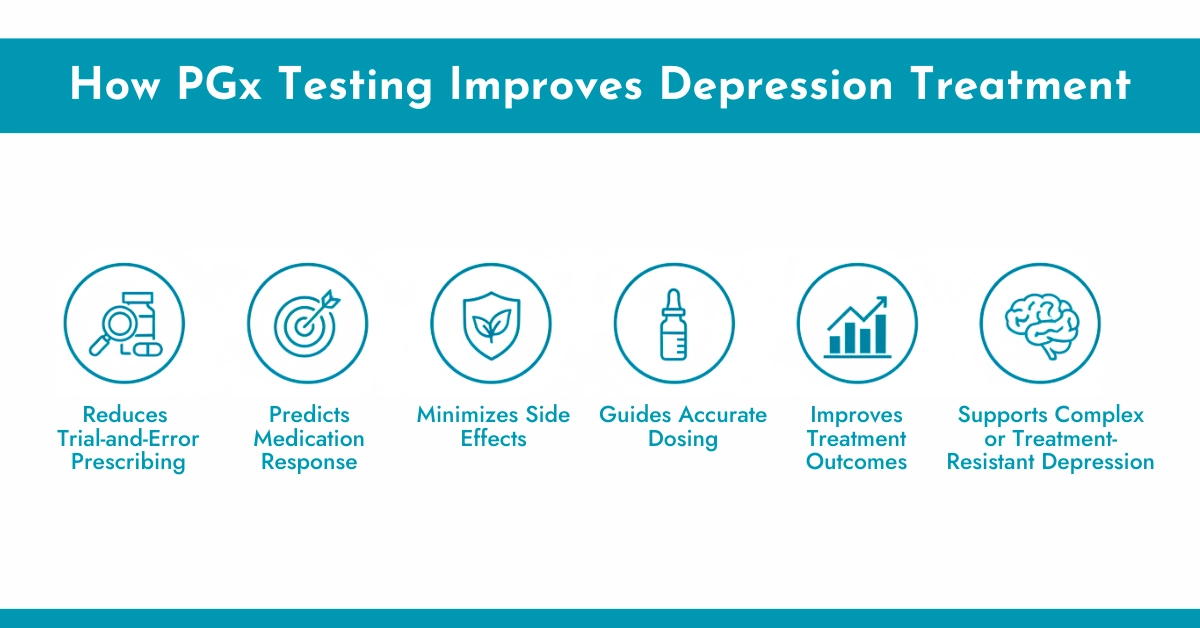
How PGx Testing Improves Depression Treatment
This is where pharmacogenomics genetic testing for depression comes in. Every person’s DNA carries clues about how they metabolize drugs. Key liver enzymes (notably CYP2D6 and CYP2C19) process many antidepressants.
1. Reduces Trial-and-Error Prescribing
Traditional depression treatment often involves trying multiple medications before finding one that works.
PGx benefit:
- Identifies medications more likely to work for you
- Flags drugs that may be ineffective or cause side effects
- Can shorten the time spent on a medicine your body is unlikely to handle well
2. Predicts Medication Response
Some people don’t respond to certain antidepressants due to genetic variations.
PGx testing helps by:
- Showing how your genes affect drug absorption and breakdown
- Identifying whether you’re a poor, normal, or rapid metabolizer
- Helping doctors avoid medications unlikely to be effective
3. Minimizes Side Effects
Side effects are a major reason patients stop antidepressants.
With PGx testing:
- High-risk medications can be avoided
- Dosing can be adjusted based on metabolism speed
- Safer alternatives are recommended upfront
This leads to better adherence and long-term outcomes.
4. Guides Accurate Dosing
Standard doses don’t work the same for everyone.
PGx results help clinicians:
- Start at a lower dose if you metabolize drugs slowly
- Increase dose safely if you metabolize drugs too quickly
- Reduce the risk of toxicity or underdosing
5. Improves Treatment Outcomes
When medication matches a patient’s genetic profile:
- Symptoms improve faster
- Fewer medication switches are needed
- Patient confidence in treatment increases
- Overall quality of life improves
6. Supports Complex or Treatment-Resistant Depression
PGx testing is especially helpful for patients who:
- Have tried multiple antidepressants without success
- Experience severe side effects
- Take multiple medications (polypharmacy)
- Have anxiety, bipolar disorder, or chronic conditions alongside depression
Note: Personalized depression treatment focuses on selecting the right medication based on an individual’s unique biology. As explained in Pharmacogenomic Testing for Medication helps identify how a patient metabolizes antidepressants, reducing trial-and-error and improving treatment outcomes.
Real-World Benefits for Patients
Patients often notice a big difference when treatment is personalized:
- Faster depression relief: Personalized medication selection can help symptoms improve sooner than traditional trial-and-error approaches.
- Fewer adverse side effects: By avoiding medications that your body may not process well, side effects are reduced.
- Higher treatment success: Having a clear, data-backed plan can help you feel more in control.
- Potential cost savings: Fewer ineffective treatments mean fewer doctor visits and less wasted medication.
Did You Know: Fewer ineffective medication trials can mean fewer follow-up visits and less wasted medication. How much that saves depends on your insurance, your plan of care, and which medicines you end up taking, so treat it as a possible benefit rather than a promise.
Who Might Consider PGx Testing:
Genetic testing isn’t just for people who have already tried multiple medications. it can help anyone seeking a personalized approach. It’s particularly helpful if:
- You’ve tried multiple antidepressants without much improvement.
- You’ve experienced unusual or strong side effects
- You or a family member has had unpredictable or extreme reactions to medications
- You want a proactive plan for future psychiatric treatments
In other words, depression genetic testing candidates include anyone frustrated with “one-size-fits-all” care. If you’re asking, “Who needs pharmacogenomics testing?”, the answer is often: anyone who wants a treatment plan made just for them. The science of personalized medicine for depression is advancing, and many psychiatrists now recommend considering genetic tests as part of a comprehensive treatment plan.
How to Get Started with Pharmacogenomic Testing
Getting a PGx test is easier than you might think, especially with at-home kits. Here’s a simple sequence:
Order a kit or get a doctor’s order: Many tests can be ordered online or via your healthcare provider.
Collect your sample: The kit includes an easy cheek swab. Just follow instructions to rub the swab inside your cheek; no needles or lab visits needed.
Mail it to the lab: Place the swab into the provided envelope (prepaid shipping). RPh Labs is a CLIA-certified and COLA-accredited laboratory in Dallas, Texas.
Review your results: Your report appears in your online portal 7 to 10 business days after your sample reaches the lab. This report will flag which medications are likely safe, which to avoid, and any dosage notes.
Discuss with your provider: Take the report to your doctor or pharmacist. Together, you can refine your treatment plan based on the insights. Every RPh Labs report is reviewed by a PharmD pharmacist, and a free one-on-one pharmacist consultation is included to talk the results through.
Throughout this pharmacogenomic testing process, look for accredited labs. For example, RPh Labs’ kit is CLIA-certified, HIPAA-compliant, and HSA/FSA-eligible, ensuring quality and affordability.
What personalized depression treatment includes besides genetics
The strongest parts of personalized depression treatment are unglamorous. They are measurement, follow-up and a clear plan for what happens if the first attempt falls short.
- Measurement-based care: a short weekly score such as the PHQ-9, so decisions rest on numbers rather than memory.
- A medical check for conditions that mimic or worsen depression, including thyroid problems, anemia, vitamin deficiency, sleep apnea and chronic pain.
- A screen for bipolar patterns, since an antidepressant alone can destabilize mood in that case.
- Therapy alongside medication, which outperforms either alone for many people.
- A frank look at alcohol, cannabis and sleep, all of which change how any medicine performs.
Genetics then answers a narrower question: how your body is likely to handle a particular drug. That is genuinely useful, and it is not the same as predicting whether a drug will lift your mood.
Set the review date in advance. Agreeing that you will both look at the numbers in four to six weeks is what turns personalized depression treatment from a phrase into a process.
Antidepressant metabolism: the genes that actually matter
Most antidepressant metabolism runs through two liver enzymes. CYP2C19 handles citalopram, escitalopram and much of sertraline. CYP2D6 handles paroxetine, fluoxetine, venlafaxine and several others.
Slow processing means a standard amount produces higher levels, which usually shows up as side effects rather than extra benefit. The FDA label for citalopram already sets a lower maximum for CYP2C19 poor metabolizers because of a heart rhythm concern. Fast or ultrarapid processing can mean a standard amount never reaches a useful level.
Antidepressant metabolism also shifts because of other drugs, not only genes. Bupropion, fluoxetine and paroxetine are strong CYP2D6 inhibitors, so they can make a normal metabolizer behave like a poor one, a change called phenoconversion. That is why your prescriber wants your full list, including supplements.
You can read the published gene and drug guidance at CPIC, and our own primer on what PGx testing is explains how a report is laid out. Note that some drugs, including fluvoxamine, depend heavily on enzymes such as CYP1A2 that a standard panel does not cover.
Switching antidepressants without losing the ground you gained
Switching antidepressants is a planned maneuver, not a swap you make on a Monday morning. Your prescriber decides between a cross-taper, a direct switch or a washout period based on the two drugs involved.
Things worth knowing before the appointment:
- Stopping abruptly can cause discontinuation symptoms: dizziness, nausea, irritability, electric shock sensations and flu-like aches.
- Short-acting drugs such as paroxetine and venlafaxine cause more of that than long-acting fluoxetine does.
- Monoamine oxidase inhibitors require a drug-free gap in either direction, which your prescriber will time.
- Combining serotonergic drugs carelessly risks serotonin syndrome, so overlaps are deliberate and supervised.
- A new drug needs its own four to six week trial before you judge it.
Never manage your own taper and never stop because you feel better, which is one of the most common reasons symptoms return. If the reason for switching antidepressants is depression medication side effects rather than lack of benefit, say that clearly, because it points toward a different class rather than a different amount.
Depression medication side effects that change the plan
Side effects are the main reason people quietly stop treatment, so they belong in every review rather than in the small print. Most depression medication side effects are worth reporting even when they feel minor.
- Early and often temporary: nausea, headache, loose stools, jitteriness and disturbed sleep.
- Persistent and worth a plan: sexual side effects, weight change, sweating, daytime sedation and emotional blunting.
- Urgent: unusual agitation, a racing mind with little need for sleep, high fever with muscle stiffness or twitching, confusion, fainting, or a rash with blistering.
If new or worsening thoughts of suicide or self-harm appear, especially in the first weeks or after a change, call or text the 988 Suicide and Crisis Lifeline and contact your prescriber the same day. For a suspected overdose call 911, and for advice about an accidental extra dose call Poison Control at 1-800-222-1222.
Write down when each effect started relative to your last change. That timeline is what lets your prescriber separate depression medication side effects from symptoms of the illness itself, which is one of the harder calls in psychiatry.
Treatment resistant depression: what happens after two failed trials
Treatment resistant depression usually means two adequate trials of different antidepressants, each at a full amount for a full duration, without meaningful improvement. The word adequate carries weight, because many so-called failures were short trials, low amounts or interrupted supplies.
At that point a prescriber, often a psychiatrist, reconsiders the whole picture:
- Re-examine the diagnosis, including bipolar spectrum, ADHD, trauma and substance use.
- Confirm adherence and check interactions that alter antidepressant metabolism.
- Treat co-occurring conditions such as insomnia, chronic pain, thyroid disease or alcohol use.
- Consider augmentation, where a second medicine is added to boost the first.
- Consider procedural and specialist options that exist for treatment resistant depression, which your psychiatrist would discuss and arrange.
Gene results earn more of their keep here than anywhere else, because polypharmacy is common and interactions multiply. Aripiprazole, sometimes used as an augmenting agent, is metabolized by CYP2D6 and has published dosing guidance, so knowing your status before it is added is genuinely practical. Treatment resistant depression is a reason for a more careful plan, not a sign that nothing will work.
Questions to bring to your next appointment
Personalized depression treatment works better when you arrive with specifics. Use these six.
- What score are we using to track this, and what number counts as remission for me?
- How long is a fair trial of this medicine before we decide?
- Which depression medication side effects should make me call you the same day?
- If this one does not work, is the next step switching antidepressants, adding something, or more therapy?
- Do any of my other medicines change how this one is broken down?
- Would pharmacogenomic results change what you prescribe next, and which genes matter for my list?
If the answer to the last question is yes, ask whether to test now rather than after another trial. Results do not expire, so having them before the next decision is more useful than having them after it.
How a PGx report fits a personalized depression treatment plan
The RPh Labs at-home PGx kit uses a cheek swab, costs $299 self-pay, is HSA and FSA eligible, can be split into four interest-free installments, and ships within one business day with free shipping both ways. Results come back 7 to 10 business days after your sample reaches the CLIA-certified Dallas lab.
The panel covers 20 genes, including CYP2D6, CYP2C19 and CYP2B6, and reports against more than 240 medications, which you can browse on the medication list. Every report is reviewed by a PharmD pharmacist, a pharmacist consultation is included, and reports are updated when guidelines change. Insurance including Medicare is accepted, with details on the insurance page.
Keep the limits in view. A report cannot diagnose depression, cannot promise that a given drug will work, and cannot replace the trial itself. What it does is describe your antidepressant metabolism, flag drugs likely to cause trouble, and give your prescriber a starting point that is yours rather than average. Your DNA does not change, so a single report supports every prescription that follows.
Conclusion
Depression doesn’t have to be treated with guesswork. Personalised Depression Treatment, guided by your genetics, offers a hopeful path out of the trial-and-error cycle. By pinpointing the antidepressants and dosages tailored to you, pharmacogenomic testing can speed relief, reduce side effects, and boost your confidence in treatment.
You don’t have to settle for “okay” results or endless medication switches. Talk to your healthcare provider about pharmacogenomic testing; it may be the missing piece in your care. The at-home PGx test from RPh Labs uses a cheek swab, and results come back 7 to 10 business days after your sample reaches the lab.
Frequently Asked Question
Disclaimer:
The content in this article is for general information only and should not be taken as medical advice. Always speak with a qualified healthcare professional before making decisions about medications, genetic testing, or treatment plans. Results may vary from person to person. Some images in this post are AI-generated and are used solely for illustrative purposes.
Personalized depression treatment FAQ
Does pharmacogenomic testing replace therapy for depression?
No, PGx testing supports medication choices, while therapy addresses emotional patterns; both work best together for effective depression treatment.
Can genetic testing guarantee antidepressant success?
No, genetic testing improves medication selection accuracy but cannot guarantee full recovery, as depression treatment involves multiple personal and clinical factors.
Is pharmacogenomic testing done more than once?
Usually, no, because your genetic makeup remains the same, allowing test results to guide medication decisions throughout life.
Can PGx testing help beyond antidepressant medications?
Yes, PGx testing can guide medication choices for anxiety, ADHD, pain management, and other conditions besides depression.
Is PGx testing useful for mild depression?
Yes, even mild depression cases can benefit from avoiding ineffective medications and reducing potential side effects early.
How is treatment resistant depression defined?
Most clinicians mean two adequate trials of different antidepressants, each at a full amount for four to six weeks or longer, without meaningful improvement. Short trials, low amounts and missed doses do not count as failures. Your prescriber will check those first before adding the label or changing strategy.
Does switching antidepressants mean starting over?
Not entirely. Your prescriber uses what the last trial showed, including which depression medication side effects appeared, to pick the next option. The new drug still needs its own four to six week trial. The taper or cross-taper is planned by your prescriber, never managed on your own.
Can genetics explain why a drug caused bad side effects?
Sometimes. Slow antidepressant metabolism through CYP2C19 or CYP2D6 leads to higher drug levels at a standard amount, which can explain nausea, sedation or agitation. Other times the cause is an interacting medicine or the drug itself. Results are one piece of evidence your prescriber weighs, not proof.
Is a PGx test worth it before my first antidepressant?
It can be, since it may steer your prescriber away from a drug likely to cause trouble for you. It cannot predict which medicine will lift your mood. Many people test after one or two confusing trials instead. See how testing works to judge the timing.
Do I need to repeat the test later?
No. Your DNA does not change over your lifetime, so one report keeps working for future prescriptions, and RPh Labs updates reports when guidelines change. What can change is your medicine list, since inhibitors like bupropion, fluoxetine and paroxetine alter enzyme activity temporarily.
Does insurance cover pharmacogenomic testing?
Coverage varies by plan and by reason for testing. RPh Labs accepts insurance including Medicare, Texas Medicaid and Blue Cross Blue Shield of Texas, and the self-pay price is $299 with HSA and FSA eligibility. Billing and Medicare forms are on the forms page.

Leave a Reply