
Paying for a gene test yourself can feel like a guessing game. This guide explains the genetic testing cost without insurance, then walks through practical ways to lower it, from exact self-pay quotes and financial assistance to HSA and FSA funds and interest-free payment plans.
On this page
How much does genetic testing cost without insurance? The answer depends heavily on what type of test you need and why you need it. Without insurance coverage, patients face costs ranging from $100 to over $2500. That wide range confuses most people. Some tests are genuinely affordable. Other, especially advanced clinical tests, require significant out-of-pocket investment.
Fortunately, options like pharmacogenomics (PGx) testing from CLIA-certified labs offer real clinical value at a manageable price. This guide breaks down everything, like costs, factors, free alternatives, privacy concerns, and practical tips to save money in 2026.
Average Genetic Cost Without Insurance
The average out-of-pocket cost for most genetic tests falls between $200 and $1,000, though this can vary by test type and lab.
Here’s a breakdown of typical ranges:
| Test Type | Cost Without Insurance |
| Direct-to-consumer (DTC) tests | $50-$300 |
| Pharmacogenomics (PGx) | $150-$600 |
| Carrier Testing | $100-$400 |
| BRCA/Hereditary Cancer | $149-$3,000+ |
| Whole Exome Sequencing (WES) | $600-$2,500+ |
| Chromosomal Microarray (CMA) | $1,000-$2,500+ |
For example, RPh Labs Pgx Testing Kit offers a CLIA-certified, COLA-accredited pharmacogenomics (PGx) test at $299, giving actionable insights on how your body responds to 240+ medications, a strong value point in the clinical middle range of uninsured genetic testing.
Factors Influencing Genetic Testing Cost Without Insurance
Several variables determine your final bill. Understanding them helps you compare options accurately.
- Genes analyzed: More genes are equal to a higher price
- Sequencing technology: Next-generation sequencing (NGS) is accurate but expensive
- Lab standards: CLIA labs like RPh Labs add reliability cost
- Report detail: Actionable guidance costs extra
- Hidden fees: Counseling $150-$300
According to the FDA, hundreds of drug labels now include pharmacogenomic information, which is why rigorous, accredited testing matters for clinical decisions.
Why Is Genetic Testing So Expensive Without Insurance
Without insurance, you absorb the full operational cost of a clinical lab. That includes DNA extraction, sequencing equipment, bioinformatics analysis, certified staff, and regulatory compliance.
Clinical labs must meet CLIA standards, which are overseen by CMS. Meeting CLIA certification and COLA accreditation requires ongoing audits, equipment calibration, and quality controls, none of which are cheap. Additionally, sequencing even a targeted panel involves highly specialized instruments. A single sequencing run covers many patients, but fixed lab costs remain high regardless of volume.
That said, self-pay rates are sometimes significantly lower than what insurance companies are billed. When you pay directly, labs skip the costly billing infrastructure and may pass some savings to you.
Important for You: If you want to know the cost of genetic testing with insurance, you can check this blog and then compare it to decide whether to purchase.
Can I Get Genetic Testing Done for Free or Lower Cost?
Yes, in some cases. But free options come with important limitations.
- Medical Assistance Programs: Some labs offer income-based patient assistance.
- Cash or Self Pay Discounts: Many labs reduce list prices for direct payment.
- Flexible Accounts: FSA/HSA funds may cover certain genetic tests if they provide health information.
Important limitation:
Free programs typically have long wait times, narrow eligibility criteria, and limited test scopes. If you need comprehensive PGx results quickly, especially for medication management, a paid CLIA-certified lab delivers far faster, more complete results.
Is Genetic Testing Worth the Money Without Insurance?
For medication management, the ROI is compelling. Consider the math: a $299 one-time PGx test can help avoid months of ineffective prescriptions, each costing $30-$150+ per month. For patients managing psychiatric medications, anticoagulants, or cancer treatments, this is not an optional expense. It is a strategic one.
Think of it this way:
Your DNA doesn’t change. A single PGx test delivers lifetime value. Every new prescription your doctor writes can be cross-referenced against your genetic profile, forever.
How Long Does Genetic Testing Take?
Turnaround time varies by test; simple tests often take a few days to a few weeks, as in RPh Labs scenarios, where you can get reports 7 to 10 business days after your sample reaches the lab. More comprehensive genetic testing can take longer due to the depth of analysis required
What GINA Has Insights on Insurance
The Genetic Information Nondiscrimination Act (GINA) protects you from genetic discrimination in two key areas:
- Health insurance: No denial or premium hikes
- Employment: Employers with 15+ employees. No hiring or firing bias
Important caveat:
GINA does not currently cover life insurance, disability insurance, or long-term care insurance. If these policies matter to you, discuss this with a genetic counselor before testing.
For Your Credibility: RPh Labs is HIPAA-compliant, meaning your genetic data is handled under strict federal privacy standards. Your results stay between you and your healthcare provider.
Self-Pay vs. Insured: What Will Benefits
Many patients assume insured = cheaper. That is not always true.
When insurance covers a test, labs bill at inflated rates to account for negotiated discounts, prior authorization overhead, and claims processing. Self-pay patients skip that entire billing infrastructure. RPh Labs PGx test costs $299 flat. No hidden fees. After deductibles and co-paying, the insured patients often pay some or more.
Choose self-pay for the genetic testing cost without insurance. Save time and money. RPh Labs makes it simple for you.
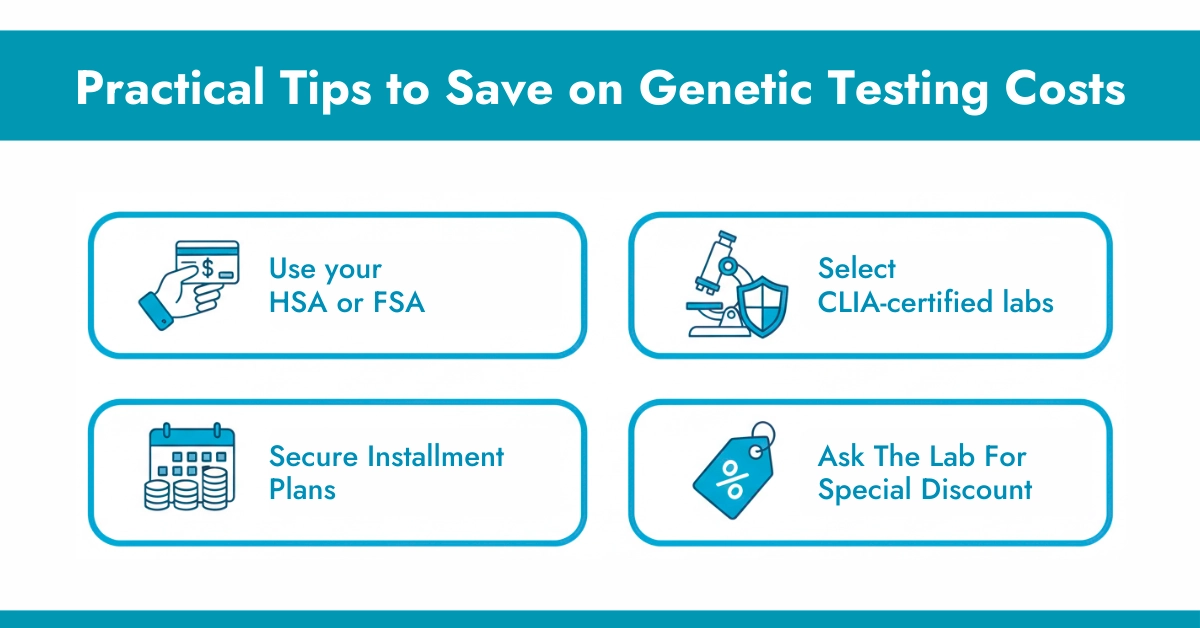
Practical Tips to Save on Genetic Testing Costs
- Use your HSA or FSA; clinical PGx testing qualifies.
- Choose labs with zero-interest instalment plans.
- Use the RPh Labs instalment plan to pay in 4 chunks.
- Select CLIA-certified labs for clinical-grade accuracy.
- Call the lab directly and ask for a self-pay discount.
How RPh Labs Makes Genetic Testing Affordable
RPh Labs offers a CLIA-certified, COLA-accredited PGx testing kit at $299, with competitive pricing for clinical-grade pharmacogenomics testing available in 45 states. The kit covers your body’s response to 240+ medications, including antidepressants, anticoagulants, and pain medications. It analyses critical genes, including CYP2D6, CYP2C19, VKORC1, and TPMT, the exact biomarkers for the FDA references in drug labelling.
The process is entirely at-home:
- Order online
- Collect a cheek swab
- Return prepaid envelope
- Receive results within 7-10 business days
The $299 fee is fully HSA/FSA eligible. A zero-interest 4-instalment payment plan brings your upfront cost to just $74.75. RPh Labs is CLIA-certified, COLA-accredited and HIPAA-compliant.
Curious how genetic testing costs with insurance compare? RPh Labs’ pharmacogenomics pricing page covers both options in full detail.
For You:
Genetic testing is not “one price fits all,” but with knowledge and smart choices, you can get useful, personalized health information without breaking the bank.
Self-pay genetic testing: how to get an exact quote
Price ranges are a starting point, but you need a real number before you order. Self-pay genetic testing prices are usually set by the lab, and many labs will give you a firm quote if you ask the right questions.
- Ask for the self-pay or cash price, not the price billed to insurance.
- Ask exactly which genes or conditions the test covers.
- Ask whether the quote includes the collection kit, shipping, the report and any consultation.
- Ask whether a physician order is needed and whether that costs extra.
- Ask for the quote in writing or by email.
A written quote protects you from surprise add-ons and shows the true genetic testing cost without insurance. It also makes it easy to compare two labs line by line.
For example, the RPh Labs pharmacogenomic (PGx) kit has a flat self-pay price of $299. It includes the cheek swab kit, free shipping both ways, a 20-gene report reviewed by a PharmD pharmacist and a free pharmacist consultation. See the details on the PGx test kit page.
Match the test to your question before you pay
The single biggest way to keep your genetic testing cost without insurance down is to buy the right type of test. Genetic tests answer very different questions, and a cheaper test that answers the wrong one is not a saving.
- Medication response (PGx): shows how your genes may affect the way you process certain drugs, such as clopidogrel, codeine, simvastatin or some antidepressants.
- Hereditary disease risk: looks for inherited variants linked to conditions like certain cancers. These results often carry major decisions and are best ordered with a genetic counselor or physician.
- Carrier screening: checks whether you carry a variant you could pass to a child.
- Ancestry and wellness kits: designed for interest and general information, not for medical decisions.
If your main goal is safer, better-matched prescriptions, a PGx panel is the test built for that question. It will not tell you your cancer risk, and a hereditary cancer test will not tell you how you process codeine. MedlinePlus has a clear overview of what pharmacogenomics covers.
Genetic testing financial assistance: where to look
If the genetic testing cost without insurance is still out of reach, there are several places to look for help. Availability varies, so check each one before you order. Genetic testing financial assistance is usually easier to arrange before the sample is collected than after.
- Lab patient assistance programs. Some labs reduce or waive fees based on household income. Ask the lab directly whether it has a program and what documents it needs.
- Hospital financial assistance. Nonprofit hospitals are required to have financial assistance policies, which may apply if the test is ordered through the hospital.
- Disease-specific foundations. Some patient groups help with testing costs for particular conditions.
- Research studies. Some studies include genetic testing at no cost, though you may not choose the test or get results quickly.
Genetic testing financial assistance often has eligibility rules and waiting periods, and a small program may run out of funds during the year. Have recent tax returns or pay stubs ready, since many programs ask for proof of income.
If you need results soon to guide a prescription, discuss timing with your prescriber. A genetic testing payment plan can be a faster alternative to waiting on an application. Waiting for assistance may not always be practical.
Is genetic testing HSA eligible?
A common question is whether you can use tax-advantaged accounts to cover the genetic testing cost without insurance. Is genetic testing HSA eligible? In general, tests done for a medical purpose, such as guiding treatment or assessing a health condition, are considered qualified medical expenses. Kits bought only for ancestry or curiosity usually are not.
The RPh Labs PGx kit is HSA/FSA eligible, so you can pay with pre-tax dollars from a Health Savings Account or a Flexible Spending Account.
A few practical tips:
- Keep your receipt and order confirmation.
- Some FSA administrators ask for a letter of medical necessity for certain purchases. Check with yours before you buy.
- FSA funds often expire at the end of the plan year, so a test you already planned can be a sensible use of the balance.
- HSA funds roll over, so there is no rush if you prefer to wait.
If you are unsure whether a specific test qualifies, your plan administrator has the final word. When the answer to “is genetic testing HSA eligible” is yes, using those funds lowers your real genetic testing cost without insurance.
How a genetic testing payment plan works
A genetic testing payment plan spreads the price over several payments so you do not pay it all at once. Plans come in two main forms, and the difference matters.
- Interest-free installments. The total stays the same; it is just divided up. RPh Labs lets you split the $299 price into 4 interest-free payments of $74.75.
- Medical financing or credit. A third-party lender pays the lab and you repay the lender, sometimes with interest or fees.
Before you sign up for any genetic testing payment plan, read the terms. Check the number of payments, whether interest applies and what happens if a payment is late. Some promotional financing charges interest back to the start if the balance is not paid in full by a deadline.
An interest-free genetic testing payment plan is usually the simpler choice when it is offered. It keeps the total predictable, which is the main point of choosing self-pay genetic testing in the first place.
What you give up with the cheapest consumer tests
The lowest prices usually come from consumer ancestry and wellness kits. They can be fun and informative, but they are not designed for clinical decisions, and the savings come with trade-offs.
- They may test only a few variants in a gene, so they can miss results a clinical panel would find.
- Raw data files are not validated for medical use, and interpreting them without support can mislead.
- Reports may not list which medications are affected or how a prescriber could use the result.
- There is usually no pharmacist or clinician to answer questions.
If a consumer test suggests something important about a medication, most prescribers will want it confirmed in a CLIA-certified clinical lab before acting on it. That means paying twice. For medication decisions, starting with a clinical PGx test often costs less overall, which makes it the more practical form of self-pay genetic testing.
The FDA keeps a public table of pharmacogenomic biomarkers in drug labeling if you want to see which drugs mention genes on their labels.
Getting the most value from a self-pay genetic testing result
Once you have paid, make sure the results actually get used. A PGx result only helps if your prescribers and pharmacy know about it.
- Book the free pharmacist consultation included with your RPh Labs report and write down your questions first.
- Share the report with every prescriber, including specialists and dentists.
- Give a copy to your pharmacy so it can be checked with new prescriptions.
- Bring it up whenever a new medication is suggested.
Never stop or change a medication on your own because of a result. Your prescriber weighs the report together with your age, kidney and liver function and other drugs. Some medicines, such as fluoxetine, paroxetine and bupropion, can also block CYP2D6 and change how your body behaves compared with your genes alone.
Because your genes do not change, one self-pay genetic testing result can guide prescriptions for years. RPh Labs also updates reports when guidelines change. To see which drugs each gene affects, browse our medication list, or read which medications need a PGx test first.
Conclusion
Understanding genetic testing costs without insurance comes down to knowing your test type, your clinical needs, and the practical tools available to reduce your bill. PGx testing sits at the most practical intersection of cost and clinical value. A $299 CLIA-certified, COLA-accredited test from RPh Labs covers over 240 medications, delivers results 7 to 10 business days after your sample arrives, and comes with flexible payment options, all without leaving home. For most people managing medications without insurance, this is not a luxury. It is the most efficient route to personalized, evidence-based prescribing.
Follow RPh Labs on Facebook and Instagram for updates on genetic testing, new medication coverage additions, and patient education content.
References
Disclaimer
This blog offers general information on genetic testing costs without insurance, not medical advice. Consult your doctor before testing. RPh Labs results guide (don’t dictate) care; outcomes vary. We follow CLIA, HIPAA, and FDA rules with strict data privacy. No health guarantees. Some images here come from AI tools. We use them just to illustrate points clearly.
Genetic testing cost without insurance FAQ
Does Medicare or Medicaid cover genetic testing costs?
Sometimes. Medicare may cover PGx testing when coverage criteria such as medical necessity are met, and Medicaid coverage depends on the state program. RPh Labs accepts Medicare and Texas Medicaid (TMHP), and the $299 self-pay option is there if you are not covered.
How long does it take to get genetic test results?
RPh Labs PGx delivers results in 7-10 business days. Direct-to-consumer kits typically take 4-6 weeks for processing and analysis.
Can I use HSA or FSA for genetic testing payments?
Yes, completely eligible! RPh Labs $299 PGx testing qualifies 100% for HSA/FSA reimbursement, save on taxes with your health spending account.
Will my employer or health insurer access my genetic results?
GINA bars health insurers from using your genetic information for coverage or pricing, and bars employers with 15 or more employees from using it in hiring or firing. HIPAA protects the privacy of your health records. GINA does not cover life, disability or long-term care insurance.
What is the lowest price for CLIA-certified genetic testing?
RPh Labs PGx testing costs just $299. CLIA-certified, COLA-accredited, reports on 240+ medications with clinically actionable, doctor-ready reports.
What is the genetic testing cost without insurance for a PGx test at RPh Labs?
The RPh Labs PGx kit costs $299 with no insurance. That includes the cheek swab kit, free shipping both ways, a 20-gene report reviewed by a PharmD pharmacist and a free pharmacist consultation. Results arrive 7 to 10 business days after the sample reaches the lab.
How do I ask a lab for a self-pay genetic testing price?
Call or email the lab and ask for the self-pay or cash price. Ask what it includes, such as the kit, shipping, report and consultation, and whether a physician order costs extra. Request the quote in writing so you can compare labs fairly.
Where can I find genetic testing financial assistance?
Start with the lab itself, since some offer income-based programs. Nonprofit hospitals have financial assistance policies, and some disease foundations help with testing. Research studies may include free testing, though usually with less choice over the test and timing.
Can I send a self-pay genetic testing receipt to my insurer?
Sometimes. Some plans accept a claim you file yourself, especially for out-of-network services, and may credit part of it toward your deductible. It is not guaranteed, so call your plan first, ask what forms and codes it needs, and keep an itemized receipt from the lab.
Does a genetic testing payment plan add interest?
It depends on the plan. RPh Labs offers 4 interest-free payments of $74.75. Third-party medical financing may charge interest or fees, so read the terms, including late payment rules, before you sign up.
Can I use a consumer ancestry test instead of a clinical PGx test?
Consumer kits are not designed for medical decisions and may test only a few variants. If one suggests a medication issue, your prescriber will likely want it confirmed in a CLIA-certified clinical lab, so a clinical PGx test is usually the better first step.


Leave a Reply