
A trichomoniasis test for men is only useful if you get the right one, because the quick microscope check used for women misses most infections in men. Here is which test to ask for, how to prepare, and what happens after a positive result.
On this page
Trichomoniasis is a prevalent sexually transmitted infection (STI) caused by the parasite Trichomonas vaginalis. While both men and women can get it, the infection and its testing process differ slightly between the genders. Here, we have not only discussed Trichomoniasis Test for Men and Women, but have also covered the types of Trichomoniasis Tests, causes, symptoms, and more.
Before we dive into the causes and symptoms, let’s discuss some common Trichomoniasis tests.
Common Types of Trichomoniasis Tests
Several tests can diagnose trichomoniasis. These tests vary based on the patient’s gender and the method of collection. Below are the common test options:
| Test Type | How It Works | Accuracy |
| Urine Test (Men) | A urine sample is collected to detect the parasite. | Depends on the method used on the sample; ask for a NAAT |
| Vaginal Swab (Women) | A sample is taken from the vagina using a cotton swab. | Depends on the method used on the sample; ask for a NAAT |
| Swab (Men) | A sample is collected from the urethra (penis opening). | Depends on the method used on the sample; ask for a NAAT |
| Rapid Test | Results provided in 15 minutes using a swab sample. | Faster but less sensitive than a NAAT, so a negative may need repeating |
| NAAT Test | Detects genetic material (DNA) from the parasite in urine or a swab sample. | The most sensitive option and the preferred test |
Home test kits for trichomoniasis may be suitable for individuals who prefer privacy. Home test kits generally offer results in 15 minutes; however, they may offer lower accuracy than lab tests.
Most Common Causes and Symptoms of Trichomoniasis
Trichomoniasis is an STI caused by a parasite (a tiny organism that lives off another organism). The infection is primarily spread through sexual contact (vaginal, anal, and even oral sex).
Transmission of Trichomoniasis:
Trichomoniasis is easily spread when sexual fluids or genital contact occurs, making it important to get tested regularly, especially if you’re sexually active.
Example: If someone has unprotected sex or shares bodily fluids with an infected person, the parasite can be passed along.
Symptoms of Trichomoniasis:
In Women: Symptoms include yellow-green vaginal discharge, an unpleasant odor, pain during sex, and genital itching.
In Men: Symptoms often include discharge from the penis, painful urination, and itching inside the penis. However, men can carry the infection without showing symptoms.
Did you know?
Many medicines are processed by liver enzymes, and for some of them your genetics changes how well that works. Metronidazole and tinidazole, the drugs used for trichomoniasis, are not in that group: there is no pharmacogenomic dosing guideline for either one.
For other prescriptions, a simple at-home pharmacogenomic test from a CLIA-certified and COLA-accredited lab like RPh Labs can give you and your doctor insight into how you may process certain medications. It does not test for trichomoniasis or any other infection, and it will not change how this one is treated.
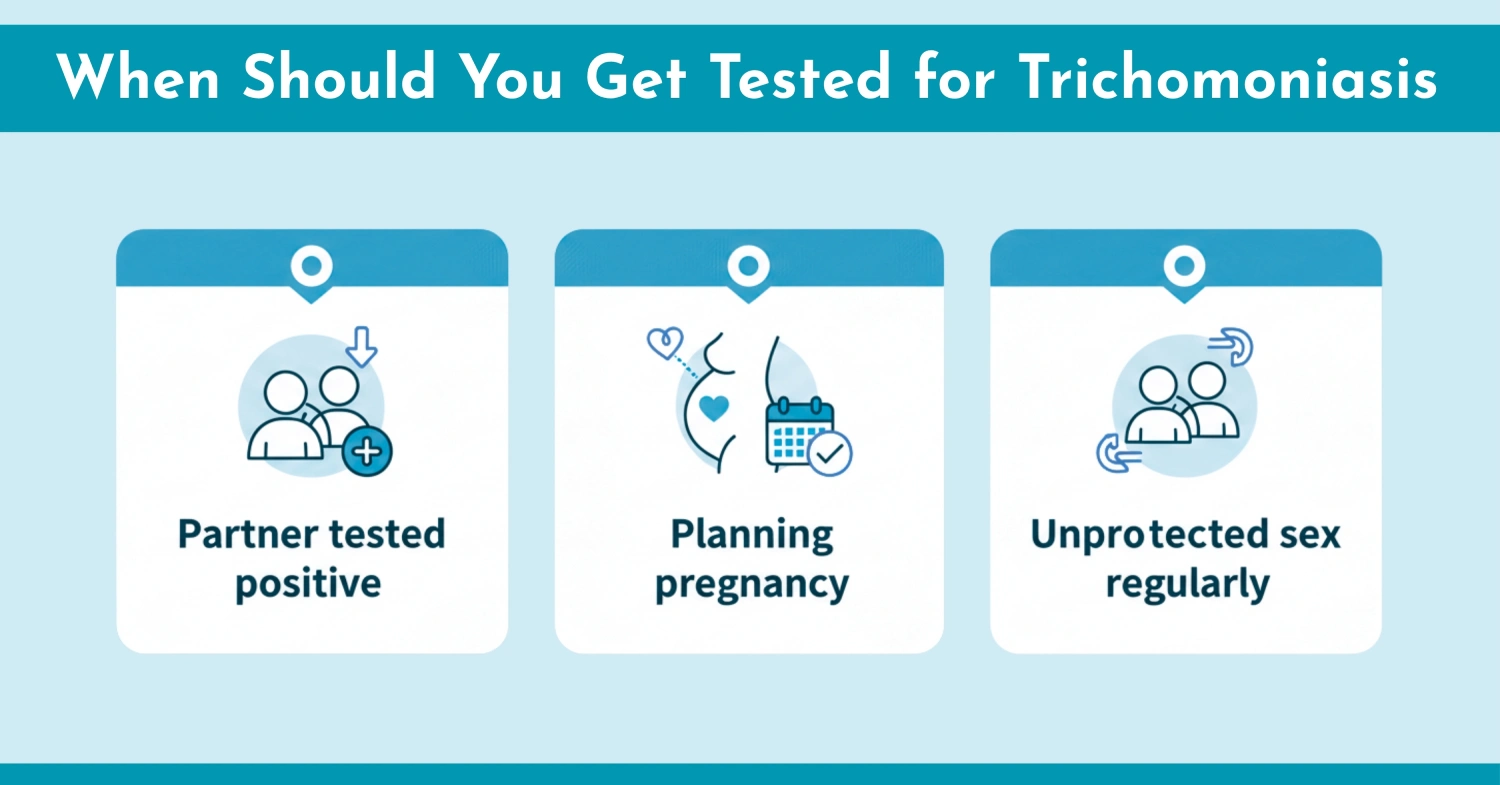
When Should You Get Tested for Trichomoniasis
If you notice any of these symptoms, you should get tested. You may find it useful to get tested in the following cases as well:
- Your partner has been diagnosed with trichomoniasis.
- You are planning to have a baby.
- Individuals who are sexually active and do not practice protection should also get themselves tested on a regular basis.
In Case of a Positive Trichomoniasis Test
A positive test result indicates that you have the Trichomonas vaginalis parasite and need to seek treatment. Here’s what to expect:
- Treatment: The infection is easily treatable with antibiotics, such as metronidazole or tinidazole, which are very effective in curing the infection.
- For Men: Even if men don’t exhibit symptoms, they can still transmit the infection to others.
- For Women: If left untreated, trichomoniasis can lead to serious health issues, including pelvic inflammatory disease (PID), which can affect the reproductive organs and result in infertility.
Do you know?
Just like chlamydia, trichomoniasis is a common sexually transmitted infection that often goes unnoticed. Learn more about how infections like chlamydia spread and why early testing matters here
Does a Trichomoniasis Test Check for Other STDs?
A trichomoniasis test will only tell you if you have that specific infection. It does not detect other STDs such as chlamydia, gonorrhea, or HIV. Regular testing for a range of STDs is essential, especially if you have multiple partners or engage in unprotected sex.
Example: Even if your trichomoniasis test is negative, you could still have other STDs like chlamydia or syphilis, which require their own tests.
Trichomoniasis test for men: what to ask for
Men are the blind spot in trichomoniasis testing. The parasite is harder to find in male samples, the older methods were designed around vaginal specimens, and many routine sexual health panels leave trichomoniasis out altogether.
That means the useful question at the appointment is specific: which test are you using, and is it a nucleic acid amplification test? A trichomoniasis test for men based on microscopy alone misses a large share of infections.
- Nucleic acid amplification testing, usually on urine or a urethral swab, is the most sensitive option and the one to request.
- Wet mount microscopy, where a sample is examined immediately under a microscope, performs poorly in men and a negative result is not reassuring.
- Culture is more sensitive than microscopy but slower, and it is rarely used now.
- Rapid antigen tests were validated mainly on vaginal samples, so they are not a reliable trichomoniasis test for men.
If your partner has been diagnosed, say so at the start of the visit. It changes how a clinician interprets any result, and in many cases treatment is offered to partners regardless of the test outcome.
You are also entitled to ask whether trichomoniasis is included in the panel being ordered. Assuming it is included is one of the most common reasons infections get missed. Partner diagnosis is the strongest single reason to book a trichomoniasis test for men.
Trichomoniasis symptoms in men, and why most men have none
Most men with this infection feel nothing at all, which is the single most important fact about it. Trichomoniasis symptoms in men, when they do appear, are mild and easy to attribute to something else.
- A thin discharge from the penis, often clear or slightly cloudy.
- Burning during urination, or shortly after.
- Burning or discomfort after ejaculation.
- Itching or irritation inside the penis.
- A need to urinate more often.
Because those overlap with other causes of urethritis, the symptoms cannot tell you which infection you have. Men treated for urethritis who do not improve are often found to have trichomoniasis that nobody tested for. Trichomoniasis symptoms in men are also easy to mistake for irritation after sex.
Less commonly, the infection reaches the prostate or the epididymis and causes pelvic or testicular pain. That deserves prompt assessment rather than waiting to see whether it settles.
The absence of trichomoniasis symptoms in men is exactly why testing after a partner’s diagnosis matters. Feeling fine is not evidence that you are not carrying it, and it is not evidence that you cannot pass it on.
Naat test for trichomoniasis: how it works and how to prepare
A naat test for trichomoniasis looks for the genetic material of Trichomonas vaginalis and amplifies it, so it can detect very small amounts. That sensitivity is why it finds infections that microscopy misses.
For men, the sample is usually first-catch urine, which means the first portion you pass rather than a midstream sample, or a swab from just inside the urethral opening. The urine option is painless, which removes the main reason men avoid testing.
- Try not to urinate for at least an hour before giving a urine sample, since flushing reduces what the test can detect.
- Collect the first part of the stream, not the midstream portion used for other urine tests.
- If a swab is taken, it goes only a short distance into the opening and takes a few seconds.
- Ask when results will be available and how they will be delivered, so nothing gets lost in a portal.
- Get tested for other infections at the same visit, since one sample often covers several tests.
A naat test for trichomoniasis is also available through mail-in kits. If you use one, check that trichomoniasis is actually on the panel and that the laboratory processing it is CLIA-certified, which is the US quality standard for clinical laboratories.
Retesting too soon after treatment can pick up remnants of dead organisms, so follow the interval your clinician gives you rather than testing again immediately. A mail-in naat test for trichomoniasis is still a laboratory test, not a home reading.
How long does trichomoniasis last if you do nothing?
How long does trichomoniasis last without treatment is a question with an uncomfortable answer: potentially a very long time. This is not an infection that reliably clears on its own, and untreated infections have been documented persisting for months and in some cases years.
Symptoms are not a guide to whether the parasite is still there. They can come and go, so a man whose discharge settles after a week may reasonably assume he is better while still carrying and transmitting the infection.
Some men do appear to clear it without treatment, which is part of why the infection is under-appreciated in men. The problem is that you cannot know which group you are in, and in the meantime partners keep getting reinfected.
With treatment, the picture changes completely. The infection is curable, usually with a short course of medicine, and symptoms typically improve within days. So the practical answer to how long does trichomoniasis last is: as long as it goes untested, or about a week once someone actually treats it.
Trichomoniasis treatment: what to expect
Trichomoniasis treatment uses a nitroimidazole antibiotic, either metronidazole or tinidazole. Both are effective, and the choice, the dose and the length of the course are set by your clinician rather than by a chart online.
Current US guidance uses a multi-day course for women and a shorter regimen for men in most situations, and your prescriber will pick based on your situation, other medicines and any allergies. Take the whole course as prescribed even if symptoms disappear after a day.
- Avoid alcohol during treatment and for the period stated on your prescription label, because combining it with these medicines can cause severe nausea, vomiting and flushing.
- Common side effects include a metallic taste, nausea, headache and a dark color to your urine, which is harmless.
- Tell your prescriber about every other medicine you take, including blood thinners, since interactions exist.
- If you have had a reaction to metronidazole before, say so. Specialist options exist and should not be improvised.
- Partners need trichomoniasis treatment at the same time, or reinfection is close to guaranteed.
- Ask your pharmacist to review the whole list when you collect trichomoniasis treatment, since interactions are easy to miss.
Avoid sex until you and your partners have all finished treatment and symptoms have resolved. Your clinician will tell you when that is, and it is usually about a week.
If symptoms persist after finishing trichomoniasis treatment, go back rather than repeating the same course on your own. Persistent infection can reflect reinfection or, less often, reduced susceptibility to the drug, and those are handled differently.
Retesting, reinfection and telling partners
Reinfection is the single most common reason this infection keeps coming back, and it is entirely preventable with a coordinated approach.
- Notify recent sexual partners so they can be tested and treated. Health departments will often do this confidentially on your behalf.
- Make sure everyone completes treatment before sex resumes, not just you.
- Follow your clinician’s advice on retesting. Retesting within a few months is recommended for people who have had trichomoniasis, because repeat infection is common.
- Use condoms consistently afterwards, which reduces but does not eliminate transmission.
- Get tested again if a new partner is diagnosed, even if you have no symptoms.
The conversation is easier than most people expect. Trichomoniasis is one of the most common curable sexually transmitted infections worldwide, it often causes no symptoms, and neither of you can reliably know who had it first.
There is no useful blame here, only a short course of medicine and a follow-up plan.
Why an untreated infection matters
It is easy to dismiss an infection that causes little discomfort. There are solid reasons not to.
- Trichomoniasis increases the risk of acquiring and transmitting HIV, through inflammation of genital tissue.
- In pregnancy, it is associated with preterm birth and low birth weight, so a partner’s pregnancy makes prompt treatment more urgent.
- In women, untreated infection contributes to vaginitis and can accompany other infections that damage reproductive organs.
- In men, it can cause urethritis, and less commonly prostatitis or epididymitis.
- Persistent inflammation is unpleasant on its own, even when it never becomes severe.
None of these outcomes is inevitable, and all of them are avoided by the same short treatment. That is the argument for asking about a trichomoniasis test for men rather than waiting for something to hurt. Left alone, how long does trichomoniasis last is not a question anyone can answer for you.
Seek care promptly, not eventually, if you develop fever, testicular pain, swelling or difficulty passing urine. Those need assessment the same day.
Test for other infections at the same time
A trichomoniasis result tells you about trichomoniasis and nothing else. Since these infections travel together and many cause no symptoms, a broader screen is usually the better use of one appointment.
- Chlamydia and gonorrhea, tested by amplification methods, with throat and rectal swabs added if you have had oral or anal sex, because urine alone misses those sites.
- HIV and syphilis, which are blood tests with their own window periods after exposure.
- Hepatitis B and C where indicated, and vaccination for hepatitis A and B if you are not already protected.
- Repeat testing after the window period if an exposure was recent, since early tests can be negative.
If you prefer testing at home, choose a panel that names trichomoniasis explicitly and includes the sites you need. Then take any positive result to a clinician, because treatment, partner notification and follow-up all need a prescriber.
Routine screening intervals depend on your number of partners and your exposures. Ask what schedule fits you rather than guessing.
Where pharmacogenomic testing fits, and where it does not
You will see claims that a genetic test can personalize your antibiotic for this infection. That overstates the science, so here is the straight version.
Pharmacogenomic (PGx) testing reads your own genes to see how you may process certain medicines. Metronidazole and tinidazole are not among them: there is no established gene-based dosing guidance for either drug, and the CPIC guideline list does not cover them. Dose and choice rest on the site of infection, pregnancy status, allergies and your other medicines.
PGx testing also does not detect infections. It cannot confirm or rule out trichomoniasis symptoms in men, and it is not a substitute for a naat test for trichomoniasis or any other diagnostic test. Nor does it shorten trichomoniasis treatment or change which drug you are given.
Where it earns its place is the rest of a medicine list. If you take a medicine on the covered medication list, such as certain antidepressants, statins or blood thinners, an at-home cheek swab kit gives your prescriber information that does not expire, since your genes do not change. That is a separate errand from getting tested today.
Conclusion
Trichomoniasis tests for men and women are carried out a bit differently. While the infection is treatable, early detection is necessary for effective management. Men may carry this infection without any visible signs, so men who have multiple partners should test themselves regularly. Moreover, if your partner has been diagnosed positive for Trichomoniasis, you should get yourself tested too. Couples planning to have a baby should also opt for a test.
A pharmacogenomic test will not speed up trichomoniasis treatment, since the standard drugs have no gene-based dosing. It is worth considering for other medicines you take long term, as a separate conversation with your prescriber.
Disclaimer: This blog is for informational purposes only and does not constitute medical, legal, or professional advice. While we strive for accuracy, errors or omissions may occur.
Some images in this blog may be AI-generated or for illustrative purposes only.
Trichomoniasis test for men: frequently asked questions
Can I be tested if I have no symptoms?
Yes, and you should if a partner has been diagnosed. Most men have no trichomoniasis symptoms in men at all, so testing after a known exposure is the only way to find it. Ask specifically for an amplification test on first-catch urine, because microscopy misses most male infections.
Is a urine sample as good as a swab?
For amplification testing, first-catch urine performs well in men and is far more comfortable than a urethral swab. The key is the method, not the sample: a naat test for trichomoniasis on urine beats microscopy on a swab. Avoid urinating for about an hour beforehand so the sample is not diluted.
How soon after treatment can I have sex again?
Wait until you and all partners have completed trichomoniasis treatment and symptoms have gone, which is usually around a week. Your clinician will give you the exact timing for the regimen you were prescribed. Resuming earlier, or before a partner is treated, is the usual route to reinfection.
Why do I keep getting it back?
Almost always because a partner was not treated at the same time, or sex resumed too early. Less commonly, the infection is less responsive to the standard drug and needs a different approach. Return to your clinician rather than repeating a course yourself, and ask about retesting and partner treatment.
Does it go away by itself eventually?
Do not count on it. How long does trichomoniasis last without treatment can be months or longer, and symptoms that fade do not mean the parasite is gone. Some men clear it, but there is no way to know in advance, and in the meantime partners are exposed repeatedly.
Can I drink alcohol while taking the medicine?
No. Combining metronidazole or tinidazole with alcohol can cause severe nausea, vomiting, flushing and headache. Avoid alcohol during the course and for the period stated on your label, which differs between the two drugs. Ask your pharmacist if you are unsure, and check other medicines for hidden alcohol content.



Leave a Reply