
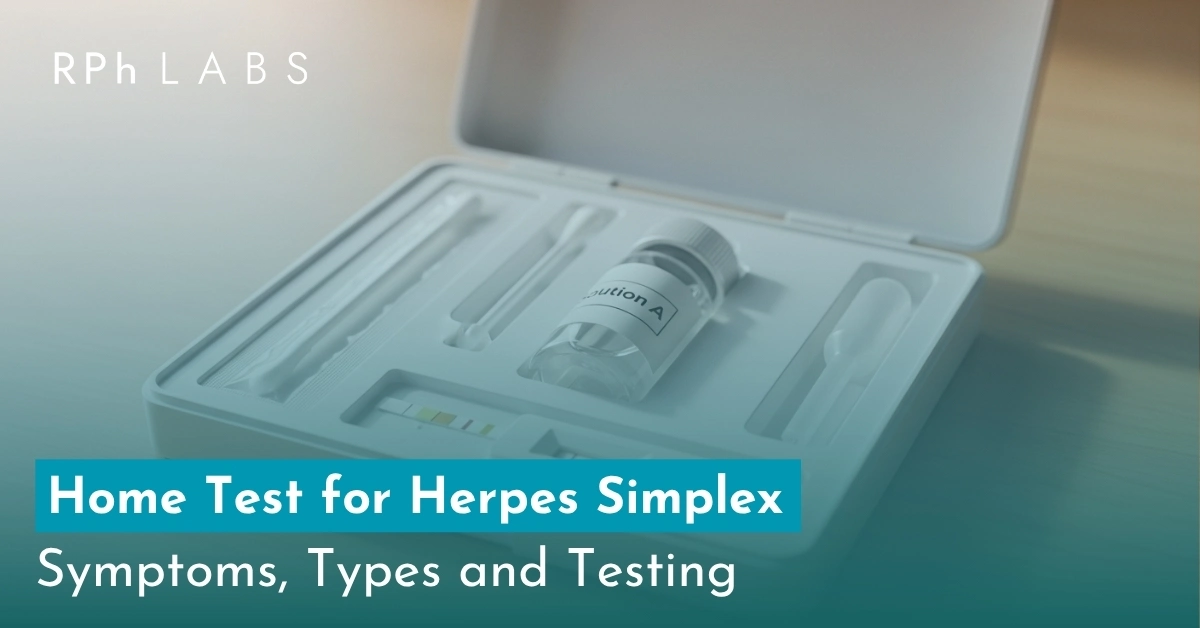
A home test for herpes simplex gives you privacy and a quick answer, but only if you pick the right test and read the result correctly. Here is how the swab and blood options differ, where each one fails, and what to do with whatever comes back.
On this page
Yes, a Home Test for Herpes Simplex is possible from home, and perhaps convenient for those hesitant to visit a clinic. A positive test does not always mean you have the infection or disease. You should visit a doctor immediately in such cases. The doctor will review your medical history and current condition. They may also recommend a lab test to confirm the disease or infection.
Here, we have discussed almost everything you should know, including but not limited to herpes, its types, herpes symptoms, and directions you may require before trying a hsv testing at home for herpes simplex.
What Is Herpes Simplex?
Herpes simplex virus (HSV) is a common viral infection. According to hopkinsmedicine, between 50 to 80 percent of Americans are HSV-1 infected. This infection has two main types, and both share similarities. However, the recurrence rate is higher in HSV-2. A bit more on
Herpes Simplex types:
- HSV-1: While not always, it is typically associated with oral herpes (cold sores).
- HSV-2: While not always, it is commonly linked to genital herpes.
Both can appear on the mouth, genitals, or other areas of skin. The virus stays in your body for life, often remaining dormant before reactivating. If you’d like to learn more about oral sexually transmitted diseases, their symptoms, and treatment options, check out this detailed guide on Oral STD Symptoms, Causes, and Treatments.
Common Symptoms of Herpes Simplex (HSV)
Small, painful blisters or ulcers on the skin, lips, or genital area.
Untreated Herpes Simplex Can Lead to:
- Frequent outbreaks
- Discomfort during urination or intercourse
- Possible complications in newborns (if transmitted during delivery)
- Increased risk of HIV transmission
Did you know?
A report shared by the NCBI shows that HSV-2 is mainly transferred during sexual activity and that its prevalence in developing countries is much higher.
What Is a Home Test for Herpes Simplex?
A home test for herpes simplex (also called an at-home herpes test, HSV test kit, or herpes testing at home) is a testing method that allows users to collect samples privately and mail them to a certified lab.
Sample Types in Home Testing:
Blood sample through finger-prick (requiring just a drop of blood) is a common method used to detect antibodies to HSV-1 or HSV-2.
Other herpes virus test kits detect viral DNA from a swab of an active sore. Follow the instructions that come with the kit rather than improvising, and do not scrape or open a blister to get a better sample.
A swab works best on a fresh sore, in the first day or two. If the sore is already crusting over, a clinic swab is the better option.
Accuracy of Home Herpes Tests
If instructions are followed accurately, Home Herpes Tests are generally reliable as a screen; however, they cannot be used on their own for a medical diagnosis. Errors run in both directions. A test can read negative when you do carry the virus, especially when the exposure or the outbreak is recent and antibodies have not developed yet.
A positive result is not automatically a true positive either. This matters most for HSV-2 IgG antibody tests: results just above the cut-off, often called low positive or low index values, are a well recognised source of false positives. Anyone with a low positive HSV-2 IgG result should have it confirmed, usually with a different antibody method or with a PCR swab of a sore, before accepting the result or telling a partner. Take any positive home result to a clinician and ask what confirmatory test they recommend.
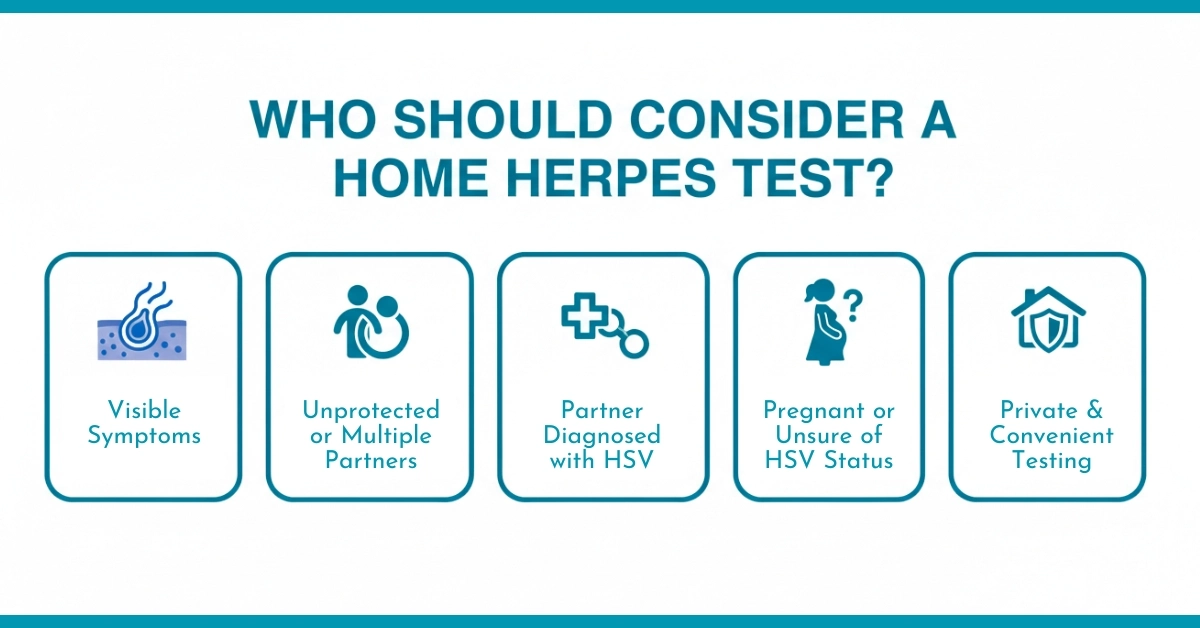
Who Should Consider a Home Herpes Test?
You may benefit from a home herpes test kit if:
- You have symptoms (sores, tingling, itching, or pain).
- You’ve had unprotected sex or multiple partners.
- Your partner has been diagnosed with HSV.
- You’re pregnant and unsure of your HSV status.
- You want a private, convenient screening option.
When a Home Herpes Test May Not Be Right for You
Avoid at-home genital herpes tests if:
- You have active sores — a PCR swab test from a clinic is more accurate.
- Your immune system has weakened (consult your doctor).
- You’re testing a newborn or suspect neonatal herpes.
- You require immediate diagnosis for treatment decisions.
When to Consider a Herpes Simplex Test
Consider testing when:
- You notice recurrent blisters or unusual rashes.
- You’ve had sexual contact with someone who has herpes.
- You’re planning to conceive or are pregnant.
- You’re undergoing STD screening for general sexual health.
Key reminder: You can have herpes and no symptoms at all.
Should You Take Other Tests Alongside a Herpes Test?
Yes — since herpes can co-occur with other sexually transmitted infections, consider a comprehensive at-home STD test.
| Test Name | Reason to Include |
| HIV Test | HSV increases HIV transmission risk by 2–3 times |
| Syphilis Test | Similar lesions may mimic herpes |
| Chlamydia & Gonorrhea | Often co-exist and are asymptomatic |
| HPV Test | Common in sexually active adults; causes genital warts or cancer risk |
Many at-home STD test herpes panels combine HSV with HIV, syphilis, and chlamydia screening for a fuller picture of sexual health.
Did you know?
For some medications, your genetics changes how your body processes the drug, which can mean less trial and error with your prescriber. A simple at-home pharmacogenomic test (PGx test) from a CLIA-certified and COLA-accredited laboratory, such as RPh Labs, reports that information. It is a medication-response test only: it does not test for herpes, HIV or any other infection.
Cost, Accessibility & Where to Buy
Herpes home test kits are widely available online, from telehealth providers and from some pharmacies. Prices change often and vary with the lab, the turnaround time and whether HSV is bundled into a wider panel, so check the current price on the seller’s own page rather than trusting a figure quoted in an article.
A single HSV test usually costs less than a full panel that adds HIV, syphilis, chlamydia and gonorrhea. Many local health departments and sexual health clinics offer STI testing free or on a sliding scale, which is worth checking before you buy anything. Whichever route you take, confirm that samples go to a certified laboratory and that the result comes with access to a clinician.
What a home test for herpes simplex can and cannot tell you
Before you order anything, it helps to know exactly what you are buying. A home test for herpes simplex is a collection kit plus a lab service: you take the sample, mail it, and a laboratory runs the same kind of assay a clinic would order.
- It can tell you whether antibodies to HSV-1 or HSV-2 are present in your blood, or whether virus is detectable in a sore you swabbed.
- It cannot tell you when you were infected, or from whom.
- It cannot tell you where on your body the virus lives. A positive HSV-1 antibody result does not separate oral from genital infection.
- It cannot replace a clinician’s assessment, and no at-home result should be treated as a final diagnosis.
- A negative result soon after exposure may simply be too early to show anything.
- A weakly positive antibody result is not always a true positive and often needs confirming.
- Results still need a plan: treatment, partner conversations and sometimes repeat testing.
Two practical checks before you pay. Confirm that the laboratory running the sample is CLIA-certified, since that is the US standard for clinical testing quality, and confirm which specific assay is used, because that determines how the result should be read.
Treat a home test for herpes simplex as a first step that gets you information, not as the end of the process.
PCR test for herpes versus an antibody blood test
There are two fundamentally different questions a lab can answer, and mixing them up is the most common mistake people make with home kits. One is a PCR test for herpes; the other is an antibody test, and they answer different things.
Testing the virus directly
A PCR test for herpes looks for viral genetic material in a sample taken from a sore. When you have an active blister or ulcer, this is the better choice. It confirms that the sore really is herpes, and it reports which type, HSV-1 or HSV-2, which matters for what to expect later.
The limitation is timing. A PCR test for herpes needs a fresh lesion. Once a sore has crusted and started healing, the amount of virus drops and a negative result becomes much less meaningful.
Testing your immune response
A type-specific antibody blood test looks for the proteins your immune system made in response to HSV. It works between outbreaks and stays positive for life, which is useful if your sores have healed or you never had any.
Antibody testing cannot tell you whether a current sore is herpes, only that you have been infected at some point. That is why a clinician will often order both: a swab now for the sore in front of them, and blood work for the longer view. If a sore appears while you are waiting on blood work, ask about adding a PCR test for herpes then.
Herpes blood test accuracy: window periods and false positives
Herpes blood test accuracy is the part most kit instructions gloss over, and it is where most distress comes from. Two issues matter. Herpes blood test accuracy depends far more on timing and on the index value than on the brand of kit.
First, timing. Antibodies take weeks, and sometimes a few months, to reach detectable levels. A test taken days after a risky encounter can be negative even when infection has occurred, so results near an exposure often need repeating later.
Second, weak positives. Antibody assays report a numerical index, and low positive values for HSV-2 are the least reliable part of the whole system. False positives at those low values are well recognized, which is why a clinician may repeat the test or order a different confirmatory assay before anyone accepts the result.
- Ask for a type-specific test. Older assays that cannot separate HSV-1 from HSV-2 are not useful.
- IgM antibody testing is not recommended for herpes. It does not reliably distinguish new from old infection.
- Ask for the index value, not just positive or negative, and take that number to your clinician.
- Do not make a permanent decision about a relationship or a pregnancy plan on one low positive result.
Understanding herpes blood test accuracy is what separates a useful screen from months of unnecessary worry. Any result that surprises you is a reason for a conversation, not a conclusion.
When to get tested for herpes, and when to skip it
There is a real medical debate here, and knowing it helps you decide. US preventive guidance does not recommend routine herpes antibody screening for adults and adolescents who have no symptoms, including during pregnancy, largely because of false positives and the anxiety and relationship strain they cause.
That does not mean testing is pointless. It means the question of when to get tested for herpes has good answers and poor ones. Thinking through when to get tested for herpes before you order saves money and worry.
- Good reasons: you have sores, tingling, unexplained genital pain or recurrent unexplained rashes; a partner has been diagnosed; you are about to start a new relationship and want to make informed decisions together; a clinician has a specific reason to check.
- Timing matters: swab a sore while it is fresh, and if you are testing after a recent exposure, plan on a repeat antibody test weeks later.
- Poor reasons: general curiosity with no symptoms and no known exposure, since a weak positive is likely to cause more harm than the information is worth.
- If you are pregnant, raise it with your obstetric team rather than deciding alone, because the plan depends on your history and your partner’s.
In short, when to get tested for herpes is best answered by your symptoms and your exposures, not by a subscription reminder.
How to collect a sample at home without wasting the kit
Poor collection is a common cause of unclear results. A few minutes of care protects the money you already spent.
- Read the whole instruction sheet first, then set out everything you need on a clean surface and wash your hands.
- For a lesion swab, use the newest sore you have, ideally within the first day or two, and rub the swab firmly against the base of the sore rather than dabbing the surface.
- Do not apply antiviral cream, ointment or antiseptic before collecting, since that can interfere with the sample.
- For a fingerstick, warm your hand first, let your arm hang down for a moment, and fill each collection circle completely without squeezing hard, which can spoil the sample.
- Label everything with the exact name and date of birth that you registered, or the lab cannot match the sample.
- Mail the kit the same day if you can, and avoid posting it just before a weekend or a holiday.
If anything goes wrong, stop and contact the company rather than improvising. Most will send a replacement, and a sample collected badly is worse than no sample because it can produce a falsely reassuring result. Collection quality matters as much as herpes blood test accuracy when you are working without a phlebotomist.
Anyone using a home test for herpes simplex while symptoms are active should also consider being seen in person, since a clinician can swab the sore properly and start treatment the same day.
Reading your result without panicking
Results arrive as a short report with very little context. Here is how the common combinations are usually interpreted, with the caveat that your clinician has the final word.
- Positive HSV-1 antibodies, no symptoms: extremely common worldwide, usually acquired in childhood, and does not tell you where the virus is.
- Positive HSV-2 antibodies with a strong index value: likely genital infection, and a good reason to discuss treatment options and partner conversations.
- Low positive HSV-2 index value: treat as unconfirmed until repeated or confirmed by another method.
- Negative antibodies but you have symptoms now: get a swab, because it may be too early for antibodies to show.
- Positive swab: a confirmed diagnosis, and the type reported guides what to expect about recurrence.
Whatever the result, nothing about it says anything about your character or your choices. HSV is one of the most common infections on earth, and most people carrying it have never had a symptom they noticed. That is worth remembering whichever result a home test for herpes simplex returns.
Bring the full report, including index values and the assay name, to your appointment. It saves repeating tests and lets a clinician judge herpes blood test accuracy in your specific case.
At home std test panels: what to include and what they miss
Because herpes rarely travels alone, many people order a broader panel. An at home std test can be genuinely useful, provided you know the gaps. Decide what you actually want from an at home std test before comparing prices.
- Chlamydia and gonorrhea are the infections most worth catching early, because untreated infection can damage fallopian tubes. They are also curable.
- Site matters. A urine sample will not detect a throat or rectal infection, so tell the provider about oral or anal exposure and choose a kit that includes those swabs.
- HIV, syphilis and hepatitis B and C are usually blood tests, each with its own window period, so a negative soon after exposure may need repeating.
- Trichomoniasis is often left off cheaper panels even though it is common and treatable.
- Many panels deliberately exclude herpes antibody testing, for the same reason preventive guidance advises against routine screening.
An at home std test is also only half of the job. A positive result needs treatment, and most curable infections need partner notification so that reinfection does not happen a month later. Many health departments will help with that conversation confidentially.
If you have symptoms now, or any pelvic or abdominal pain, fever, or a sore that is spreading, go to a clinic instead of waiting for a mailed result. An at home std test cannot examine you, and that is its real limit.
After the result: treatment, partners and where PGx testing fits
A confirmed herpes diagnosis has a well-worn management path. Episodic antiviral treatment shortens outbreaks when started at the first tingle, and daily suppressive treatment reduces both outbreak frequency and the chance of passing the virus on. Which one suits you is a decision for your prescriber.
Costs for home kits vary widely between providers, and pricing changes, so compare the actual assay and the laboratory rather than the headline number. Local health departments and sexual health clinics often test at low or no cost, and they can treat you the same visit. A clinic visit also answers when to get tested for herpes again, if repeat testing is needed.
The honest pharmacogenomics note
Pharmacogenomic (PGx) testing is a different kind of test that reads your own genes to see how you may process certain medicines. It does not detect infections of any kind, so it is not an alternative to a home test for herpes simplex or to any at home std test.
It also does not guide herpes antivirals, which are cleared mainly by the kidneys rather than by the liver enzymes a PGx panel reports on. Where it does help is other medicines: if you take an antidepressant, a statin or a blood thinner from the covered medication list, results can inform your prescriber’s choice. The overview of PGx testing explains the scope, and MedlinePlus gives an independent introduction.
Final Thoughts:
Herpes home testing kits are readily available and useful as a first step, but the result is a screen, not a diagnosis. A negative test soon after exposure can be wrong, and a low positive HSV-2 antibody result needs confirming before you act on it. Take either one to a clinician. Herpes can be treated but not cured, so recurrences are part of what you plan around.
If you are prescribed a medicine where genetics genuinely matters, for example a thiopurine such as azathioprine, which has TPMT and NUDT15 guidance, a PGx test from RPh Labs is worth discussing with your prescriber. It reports how you may process certain medications and does not test for infections.
Disclaimer: This blog does not constitute medical, legal, or professional advice, but is for informational purposes only. And while we strive for accuracy, errors or omissions may occur.
Some images in this blog may be AI-generated or for illustrative purposes only.
Home test for herpes simplex: frequently asked questions
How accurate are home herpes tests?
It depends on the kit and the timing. A swab of a fresh sore tested by PCR is the most dependable option. Antibody tests can miss a recent infection, and a low positive HSV-2 IgG result is a known source of false positives. Treat a home result as a screen and ask a clinician about confirmatory testing.
Can I test myself for herpes at home?
Yes, many at-home kits allow you to collect your own sample safely. Most require a finger-prick blood sample or genital swab to detect HSV antibodies or viral DNA.
What is the gold standard test for herpes simplex virus?
The gold standard is the PCR (Polymerase Chain Reaction) test, which detects the virus’s genetic material with high precision and can distinguish between HSV-1 and HSV-2.
Can a urine test detect herpes?
No, herpes is not typically detected through urine tests. Swab or blood tests are used instead to diagnose the infection accurately.
How soon after exposure will a test show anything?
A swab can detect virus as soon as a sore appears, which is why a PCR test for herpes is the better choice when you have symptoms. Antibodies are slower and can take weeks to a few months to become detectable, so a blood test taken in the first days after an exposure may be negative and need repeating later.
Can a home kit tell me whether my infection is oral or genital?
No. Antibody tests report HSV-1 or HSV-2 in your blood, not the site. HSV-1 commonly causes oral infection but also causes many genital infections, and HSV-2 can appear orally. Only a swab of an actual sore says where virus is present, which is one more reason to test a lesion while it is fresh.
Why do some panels leave herpes out entirely?
Because routine antibody screening of people without symptoms is not recommended in the US. Weak positives are common, follow-up is complicated and the result rarely changes care. An at home std test focused on chlamydia, gonorrhea, HIV and syphilis targets infections where a diagnosis leads directly to treatment or cure.
My result was borderline. What happens next?
Take the report, including the numerical index value, to a clinician. They may repeat the test after an interval, order a different confirmatory assay, or swab a sore if one appears. Herpes blood test accuracy is weakest exactly in that borderline range, so a single ambiguous number is not a diagnosis.
Do I need to test if I have no symptoms at all?
Usually not, unless a partner has been diagnosed or a clinician advises it. That is the practical answer to when to get tested for herpes: symptoms and known exposures drive the decision. Testing with no symptoms and no exposure mainly risks a false positive and the worry that comes with it.
Will a genetic test show whether I have herpes?
No. DNA tests read your own genome and do not look for viruses. A PGx panel reports how you may process certain medicines, not whether you carry an infection, and it does not guide antiviral dosing. Detecting HSV needs a test aimed at the virus or at your antibody response to it.
Leave a Reply