
Telomere length testing is sold as a window into how fast you are aging, and it is genuinely interesting biology. It is also one of the easiest results to over-read. This guide separates the established science from the marketing so you know what you would be buying.
On this page
Have you ever wondered why some people seem to age gracefully while others face health challenges earlier in life at the age of even 20s or 30s? It turns out that the answer might lie at the very ends of your chromosomes. Telomere length testing is emerging as a powerful tool in understanding telomeres and aging, offering clues about your biological age and potential health risks. As a cellular aging biomarker, telomere length can reveal how your body is holding up on a molecular level, beyond just the years on your calendar.
Let’s explore how telomere length testing, telomeres and aging, how to measure telomeres, and related key concepts come together to help you make smarter health decisions.
What Are Telomeres and Why Do They Matter
Telomeres are repeating DNA sequences at the ends of chromosomes. They protect the genetic information in your DNA.
Research shows telomere length declines by about 23-38 base pairs per year. (Source: ScienceDirect)
How telomeres relate to aging.
- Whenever the cell is divided, the telomere gets short. Eventually, when they become critically short, the cell may stop dividing (cellular senescence) or die.
- Shorter telomere length has been associated with older chronological age, but also with lifestyle and disease risk factors such as smoking, obesity, stress, and chronic conditions.
Did you know?
Recent studies from NIH suggest that even space travel impacts telomere length, with astronauts showing temporary changes during missions. On Earth, ongoing research from places like the National Institutes of Health highlights how maintaining telomere health checks could support longer, healthier lives.
Leukocyte Telomere Length (LTL): Why it’s important
Many telomere diagnostics rely on blood testing, and many studies measure telomeres in white blood cells. Studies that compare tissues have found leukocyte telomere length tracks reasonably well with telomere length in other tissues, such as skin, lung and kidney.
Takeaway: Telomeres give us a window into cellular aging, not just your calendar age. They might reflect your “biological age”, how fast your cells are aging. That’s why telomere length for longevity and health risk assessment can be of interest.
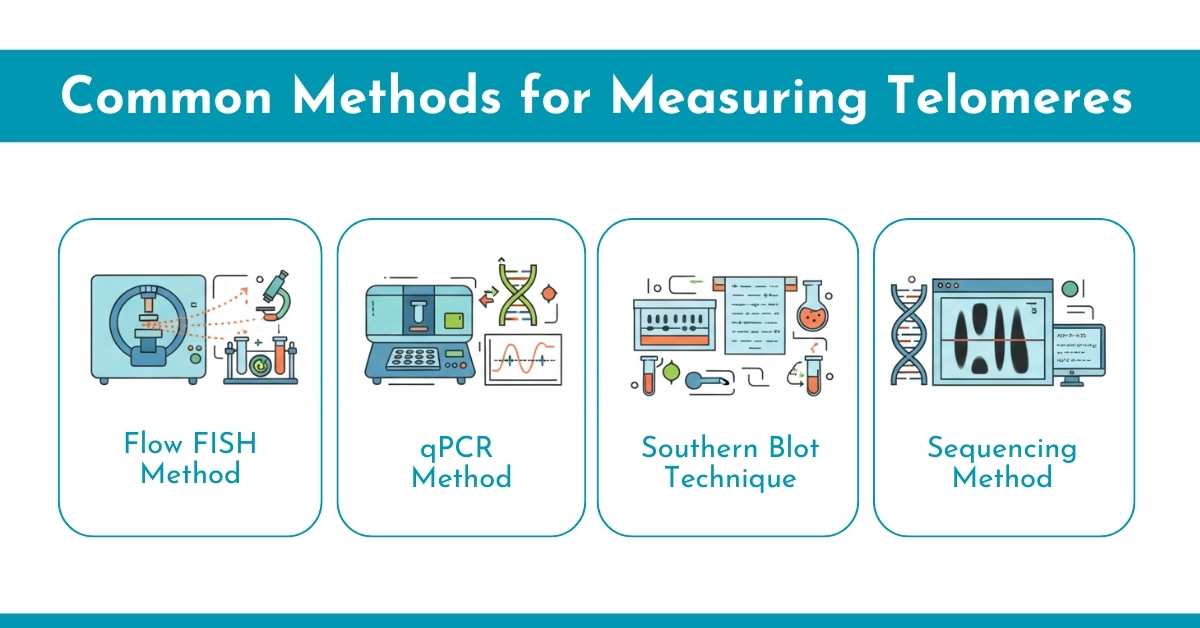
Common Methods for Measuring Telomeres
Several methods exist to measure telomere length, each with unique advantages:
1. Flow FISH
- Combines flow cytometry with fluorescent probes.
- Measures telomere length in specific cells like blood cells.
- Accurate and clinically used for diagnosing very short telomere conditions.
2. qPCR
- Estimates telomere length by comparing telomere DNA to other genes.
- Faster and cost-effective.
- Slightly less precise for extreme values.
3. Southern Blot
- Older, precise method to measure exact telomere lengths in base pairs.
- Time-intensive, mainly for research.
4. Digital Telomere Measurement / Sequencing
- Emerging technology for detailed telomere distributions.
- Primarily used in advanced research.
Testing process:
- Blood draw or cheek swab.
- Lab analysis compares results to age-group averages.
- Results indicate if telomeres are shorter, average, or longer than expected.
Always talk with your healthcare professional to pick the right one that is best for you.
Benefits of Telomere Length Testing
Why consider telomere length testing?
- Early health risk detections (lung disease, immune problems or other age-related conditions)
- Lifestyle motivation
- Exercise, a balanced diet, and stress management help preserve telomere length
Factors That Influence Telomere Shortening
Telomere shortening is influenced by lifestyle and environment:
- Smoking is consistently linked to faster telomere shortening.
- Pollution and chronic stress do the same, triggering inflammation that wears down telomeres.
Here’s a quick list of ways to support telomere health check:
- Eat well: Focus on fruits, nuts, and fish for omega-3s that fight oxidative damage.
- Move more: Regular activity, such as 30 minutes of brisk walking most days, is associated with longer telomeres in population studies.
- Manage stress: Practices like meditation have been studied for their effect on telomerase, the enzyme that helps rebuild telomeres, though the evidence is still early.
- Sleep enough: Aim for 7-9 hours to reduce shortening risks.
How to Choose the Right Telomere Test:
Consider the following for reliable telomere testing services:
- Does the lab say which method it uses (qPCR, Flow-Fish, etc.)
- Is the laboratory CLIA-certified or similarly accredited? This is a basic quality standard.
- What sample type is used (blood, saliva and the leukocytes subset)?
- How is the data reported (your average health vs. shortest telomeres)?
- How reliable is the method? qPCR results can vary noticeably between runs and between labs, so numbers are not directly comparable across providers.
Because methods and comparisons vary, you should interpret any result in context and avoid expecting exact numerical precision.
Understanding Your Telomere Length Test Results
If you ever hear a term like telomere length test or the different forms like telomere length measurement, test telomere length, or telomere length assay, they all refer to the process of measuring how long your telomeres are. It is typically in white blood cells, but sometimes in other tissues or cell types.
The your results tell you:
- Your average telomere length compared to a reference population of similar age/gender.
- An indication of whether your telomeres are shorter or longer than expected.
- Possibly a “biological age” inference (i.e., your cells appear older or younger than your chronological age).
- Some labs may link shorter telomeres to a higher risk of age‐related conditions (though individual prognostic value remains debated).
What they can’t tell you:
It cannot definitively predict your lifespan or guarantee you will avoid age‐related disease. In fact, experts caution that telomere length alone is not a fully reliable clinical biomarker of aging.
- It doesn’t specify which diseases you will or won’t develop.
- Changes in telomere length from one test to another may be hard to interpret — measurement variability and technical factors matter a lot.
Bottom line: A telomere length test can provide an interesting snapshot of your cellular aging status but should be interpreted in the context of other health factors, lifestyle, and clinical biomarkers.
Using Telomere Testing for Longevity & Wellness
Here’s the best thing to make your telomere test meaningful:
Step 1: Pre-test preparation
- Choose a lab with clear methodology and a solid reference population.
- Understand what the report will provide: telomere length, percentile, biological age estimate (if any).
- Consider ordering alongside other biomarker tests (e.g., inflammatory markers, metabolic panels).
Step 2: Post-test interpretation
- If your telomeres are shorter than expected: review lifestyle factors (smoking, stress, obesity, inactivity) known to correlate with accelerated telomere shortening.
- If your telomeres are average or longer: that’s good news — but maintain healthy habits and don’t use this as a free pass.
- Use your result as a snapshot, not a fixed destiny. Consider retesting only if methodological consistency exists (same lab, method, cell type).
Step 3: Lifestyle and maintenance strategies
- Prioritize lifestyle changes: regular exercise, adequate sleep, good nutrition, stress management.
- Avoid known accelerators of telomere shortening: chronic inflammation, heavy smoking, extreme stress, and poor sleep.
- Engage your healthcare provider: Use telomere results as part of your overall health plan rather than the only measure.
Step 4: Integrating telomere testing with precision health
- Combine telomere testing with genomic risk, epigenetic clocks, and other biomarkers.
- Use the full dataset to guide personalized wellness strategies and track biological aging over time.
At RPh Labs, our PGx Test Kit helps you and your doctor understand how your genes may influence your response to certain medications. It is a medication-response test, not a test of biological age or disease risk.
Telomere Shortening and Disease Risks
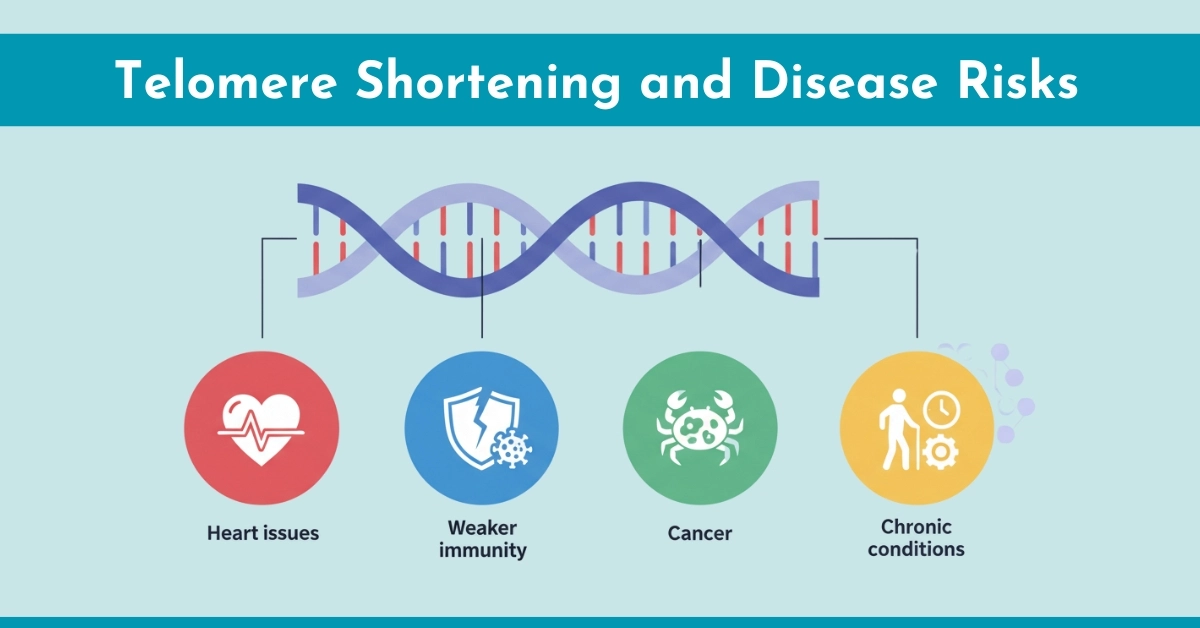
Telomeres shorten as cells divide, acting like a “cellular clock”. Shorter telomeres mean cells stop working well, leading to tissue breakdown and signs of getting older, like wrinkles or lower energy.
Studies show links between leukocyte telomere length and health risks such as:
- Heart issues
- Weaker immunity
- Cancer
- Chronic conditions
Telomere shortening is also linked to genomic instability, which connects to the cellular changes discussed in our guide on assessing oncogenicity’s role in drug development and safety.
Telomere length testing: 4 clear facts to start with
If you are deciding whether to order a kit, four points matter more than everything else written about telomere length testing online.
- It measures an average, not a verdict. Most consumer reports give one number compared with a reference group of similar age.
- Measurement variability is real. Different methods, and even repeat runs of the same method, can give meaningfully different answers.
- It does not diagnose disease and it cannot tell you what you will develop or when.
- There is a genuine clinical use, but it sits in specialist hematology and genetics for suspected inherited telomere disorders, not in wellness testing.
That is not a reason to dismiss the field. Telomere biology is one of the better-understood parts of cell aging, and it has produced real clinical medicine for a small group of patients.
It is a reason to be clear about which product you are buying. A specialist diagnostic test and a consumer wellness report share a name and very little else, and the sections below explain why that distinction changes how much weight the number deserves.
What a biological age test can and cannot claim
A biological age test converts a biological measurement into a number of years, which is an appealing idea and a considerable simplification. Telomere-based versions compare your measured length with the average for your age group and translate the gap into years.
That translation is a modeling choice made by the laboratory, not a measurement. Two labs can take the same sample, use different reference populations and different assumptions, and report different biological ages. Neither is lying. They are answering slightly different questions.
Questions a biological age test cannot answer
- Which conditions you will or will not develop.
- How long you will live.
- Whether a specific supplement, diet or program is working for you.
- Whether a change between two results is real or is measurement noise.
Other approaches to the same idea, including epigenetic clocks based on DNA methylation, are being studied heavily and have their own limitations. None of them is an established clinical test for individual prediction, and professional bodies have been cautious about their use for exactly that reason.
The honest use of a biological age test is as a conversation starter about habits you already know matter. If it prompts you to stop smoking or start walking, it has done something useful. If it prompts you to buy an expensive intervention, be skeptical.
Telomeres and aging: correlation is not causation
The link between telomeres and aging is real but looser than headlines suggest. On average, telomeres are shorter in older people, and shorter average length has been associated with several chronic conditions in large population studies.
Two things complicate that picture. First, the association at population level is modest, which means it says something about groups and very little about any individual. Second, the direction is not settled: shorter telomeres may reflect the wear of disease and inflammation as much as they cause it.
Why individual prediction is so hard
Telomere length at birth varies a lot between people, and much of that variation is inherited. Someone can start with long telomeres and shorten quickly, or start short and shorten slowly. A single measurement cannot distinguish those histories, which is the core limitation when people try to read telomeres and aging from one snapshot.
There is also a genuine tension in the biology. Very short telomeres are associated with cells failing, while mechanisms that keep telomeres long are involved in how tumor cells divide indefinitely. Longer is not automatically better, and any product that frames it that simply is oversimplifying a field that is still active.
The fair summary is that telomeres and aging are connected, the connection is population-level, and no consensus exists that measuring it changes what any one person should do.
Leukocyte telomere length and what blood measures
Almost all research and almost all testing uses leukocyte telomere length, measured in white blood cells, because blood is easy to collect and those cells are easy to isolate.
That convenience carries an assumption: that white blood cells represent the rest of you. Correlations between tissues have been reported, but the immune system is a fast-dividing, highly responsive system. Recent infection, inflammation and the mix of cell types in your sample can all influence the reading.
Why the method matters
- Quantitative PCR is inexpensive and gives a relative ratio rather than a length in base pairs, with reported variability that is not trivial.
- Flow-FISH measures specific cell populations and is the approach used clinically for suspected inherited telomere disorders.
- Southern blot gives lengths in base pairs but is slow and mainly a research tool.
- Sequencing-based methods are emerging and are not yet standardized across laboratories.
Because there is no single standardized assay, leukocyte telomere length results are not portable. A number from one laboratory cannot be compared with a number from another, and comparing your result to a figure quoted in a study is not meaningful either.
If you do retest, use the same laboratory, the same method and the same sample type, and expect some movement that is measurement rather than biology.
Short telomere syndromes: the real clinical use
There is a group of inherited conditions, often called telomere biology disorders, in which telomeres are abnormally short because of variants in the genes that maintain them. Here measurement is a legitimate diagnostic tool used by specialists.
These conditions can involve bone marrow failure, lung fibrosis, liver disease and characteristic changes in skin and nails, and they can present in childhood or in adulthood. Family patterns are often the clue, particularly unexplained pulmonary fibrosis or bone marrow problems across generations.
When to ask a clinician rather than a website
- Unexplained low blood counts or bone marrow failure, especially at a young age.
- Pulmonary fibrosis in a younger adult, or in more than one family member.
- Unexplained liver disease alongside either of the above.
- A known family diagnosis of a telomere biology disorder.
This is not something to pursue with a consumer kit. Diagnosis involves specialist testing, usually Flow-FISH in a reference laboratory alongside genetic testing, interpreted by hematology and clinical genetics together. Treatment decisions, including transplant and transplant conditioning, depend on getting it right.
If any of that list describes your family, ask your clinician for a referral. A consumer telomere length testing report is not a substitute and may be falsely reassuring.
Lifestyle, cellular aging and what has evidence
The advice that follows from telomere research turns out to be the advice that follows from everything else. That is either disappointing or reassuring depending on what you were hoping for.
Smoking, obesity, chronic psychological stress, poor sleep and inactivity have all been associated with shorter telomeres in observational studies. The same factors are associated with most markers of cellular aging and with the diseases those markers track, which is part of why untangling cause from effect is so hard.
What is worth doing anyway
- Do not smoke, and avoid secondhand smoke.
- Move regularly, in whatever form you will keep doing.
- Sleep enough, consistently, and treat insomnia as a health issue rather than a personality trait.
- Eat a diet built around vegetables, fruit, legumes, whole grains and fish if you eat it.
- Treat high blood pressure, high cholesterol and diabetes properly, with your clinician.
- Address chronic stress with something that works for you, including professional support.
Be careful with products marketed as telomerase activators or anti-aging supplements. Evidence in humans is limited, quality control in the supplement market is inconsistent, and the underlying biology includes a reason for caution given the role of telomere maintenance in cancer cells. Discuss anything you are considering with your clinician or pharmacist.
Nothing here requires a test first. If measuring cellular aging motivates you, that is a reasonable personal choice, but the interventions do not depend on the number.
Direct-to-consumer testing: cost, regulation and privacy
Wellness genomics sits in a different regulatory space from the tests your doctor orders, and that is worth understanding before you hand over a sample and a card number.
In the US, laboratories performing clinical testing on human samples operate under CLIA, which covers how a laboratory runs and documents its work. Many wellness tests are laboratory-developed tests that have not been reviewed by the FDA for clinical validity, meaning nobody outside the company has verified that the number predicts what the marketing implies.
What to check before ordering
- Is the performing laboratory CLIA-certified, and is that stated plainly with an ID you can check?
- Which method is used, and is the expected variability published?
- What reference population is your result compared against, and does it resemble you?
- Will a clinician or genetic counselor be available to discuss the result?
- What happens to your sample and your data afterwards, and can you have both deleted?
That last point gets skipped most often. Consumer testing companies are generally not covered entities under HIPAA in the way a clinical laboratory is, so your protections come from the company’s own privacy policy and from state law. Read what it says about research use, third-party sharing and what happens if the company is sold.
Also think about what you will do with the answer. If a worse-than-expected result would lead to anxiety rather than action, or a better-than-expected result would lead you to relax habits you should keep, the test may cost more than its price.
How pharmacogenomic testing differs from this
It is worth being direct, because these two ideas get blended in a lot of online writing. RPh Labs does not offer telomere length testing. What we do is pharmacogenomic (PGx) testing, which answers a narrower and more actionable question.
PGx testing looks at genes that affect how your body processes specific medicines. It does not diagnose disease, does not predict whether you will develop a condition, and says nothing about cellular aging or life expectancy. Any test claiming to do all of that at once is overselling.
What the panel actually covers
The RPh Labs panel covers 20 genes, including CYP2D6, CYP2C19, CYP2C9, VKORC1, SLCO1B1, TPMT, NUDT15 and DPYD, and reports against more than 240 medications. Well-established examples include codeine and tramadol through CYP2D6, clopidogrel through CYP2C19, statin muscle risk through SLCO1B1, and thiopurine toxicity through TPMT and NUDT15.
Those results do not change over your lifetime, which is the practical difference from a telomere measurement. The genes reported are fixed, so one sample informs prescribing decisions for years, always in discussion with your prescriber rather than instead of one.
If you want to see the evidence base, clinicians use the CPIC guidelines and the PharmGKB knowledge base. The RPh Labs at-home cheek swab kit is $299 self-pay and HSA or FSA eligible, performed in a CLIA-certified laboratory, and you can check your own medicines against our medication list by gene before deciding.
Conclusion:
Telomere length testing gives you a snapshot of how your cells are aging. It is a separate question from how your body handles medication, which is what pharmacogenomic testing looks at.
RPh Labs is a CLIA-certified and COLA-accredited lab, and its PGx test kit helps you and your doctor weigh medication choices using your genetic results. Knowing how you process certain drugs can lower the chance of side effects and of a medicine that does not work well for you. It is one input into your care, always used together with your prescriber.
Disclaimer:
This content is for informational purposes and should not replace consultation with a qualified healthcare professional. Some images in this blog are AI-generated for illustration purposes only.
Telomere testing: more questions answered
How accurate is telomere length testing?
Accuracy varies by method. qPCR is quick and useful for group averages but less precise for one person, while Flow-FISH is more precise in specific cell types and is the method used clinically. Use a CLIA-certified laboratory and ask which method it runs.
Can telomere length be increased?
While you can’t lengthen them directly, lifestyle changes like exercise and diet can slow shortening and support enzyme activity.
What diseases are associated with short telomeres?
Shorter telomeres have been associated with heart disease, diabetes and lung conditions such as interstitial lung disease. An association is not a diagnosis.
How often should I get telomere testing?
There is no established retesting schedule for general wellness. If you do retest, use the same lab and method so the numbers are comparable, and discuss it with your doctor.
Is telomere testing covered by insurance?
It depends on your plan and medical need—often not for general wellness.
Is a biological age test a medical test?
Generally not. Most consumer versions are wellness products, often laboratory-developed tests that have not been reviewed for clinical validity, and the years-based figure comes from a modeling choice made by the laboratory. A biological age test can prompt useful habit changes, but no clinical decision should rest on it. Discuss any worrying result with your clinician.
Can I compare results from two different companies?
No, and this catches people out. There is no standardized assay, so quantitative PCR ratios, Flow-FISH measurements and sequencing-based results are not interchangeable, and reference populations differ. If you retest, use the same laboratory, method and sample type, and treat small changes as likely measurement variation rather than real biological change.
Does having short telomeres mean I will get sick?
No. Associations between telomere length and chronic disease are seen across large populations and are modest, which means they say little about any individual. Short telomeres may also reflect existing inflammation or illness rather than cause future disease. Inherited telomere biology disorders are a separate, specialist situation assessed by hematology and genetics.
Can supplements lengthen telomeres?
There is no good human evidence that supplements marketed as telomerase activators improve health outcomes, quality control across the supplement market is inconsistent, and telomere maintenance is also a feature of cancer cells, which is a reason for caution. Discuss anything you are considering with your clinician or pharmacist before starting it.
Does RPh Labs offer telomere testing?
No. RPh Labs performs pharmacogenomic testing, which reports how your body may process certain medicines so that you and your prescriber can choose more carefully. It does not measure cellular aging, does not estimate life expectancy and does not diagnose disease. Telomere measurement for a suspected inherited disorder is arranged through a specialist.
Is any of this covered by insurance?
Wellness testing is usually self-pay, because insurers cover tests with an established clinical indication. Specialist telomere testing ordered by a hematologist for a suspected inherited disorder is a different situation and is assessed on medical necessity. Ask the laboratory for its self-pay price and its billing policy in writing before ordering.



Leave a Reply