
TCHP chemo is a four-drug regimen used for HER2 positive breast cancer, usually before surgery. This guide explains what each drug does, what the treatment schedule feels like in practice, which side effects need urgent attention, and what typically happens next.
On this page
If you or a loved one has been diagnosed with HER2-positive breast cancer, you may have heard the term TCHP chemo. One regimen that often comes up is TCHP chemo, a targeted approach that’s helping many people fight back effectively. This powerful treatment regimen combines chemotherapy and targeted therapy into a single treatment.
Understanding what TCHP involves and how it fits into your treatment plan can make the journey less overwhelming. In this RPh Labs guide, we’ll explain what the TCHP regimen includes, how it’s used, and what to expect during treatment.
What is TCHP Chemo and How Does It Work
Definition
TCHP chemo is a group of drugs used to treat breast cancer with extra HER2 that’s caught early. It’s more than just basic cancer drugs; it adds special targets for HER2 to make it stronger against the cancer.
How TCHP Works?
- Docetaxel & Carboplatin: Disrupt cancer cell division and DNA replication to reduce tumour growth.
- Trastuzumab & Pertuzumab: Target the HER2 protein on cancer cells, blocking growth signals and enhancing immune response.
Here’s an easy table to show the parts of the TCHP chemotherapy mix:
| Drug | Everyday Name | Kind | Main Job |
| Taxotere | Docetaxel | Cancer drug | Stops cancer cells from splitting and spreading |
| Carboplatin | Carboplatin | Cancer drug | Hurts the inside of cancer cells so they can’t copy themselves |
| Herceptin | Trastuzumab | Target drug | Blocks the HER2 protein to slow cancer growth |
| Perjeta | Pertuzumab | Target drug | Teams up with trastuzumab to block HER2 even more |
Informative Note: NIH Studies show 56-64% of patients achieve a pathologic complete response (pCR) with TCHP, meaning no detectable cancer is found at surgery. This is linked to improved long-term outcomes.
Who Should Consider TCHP Chemo?
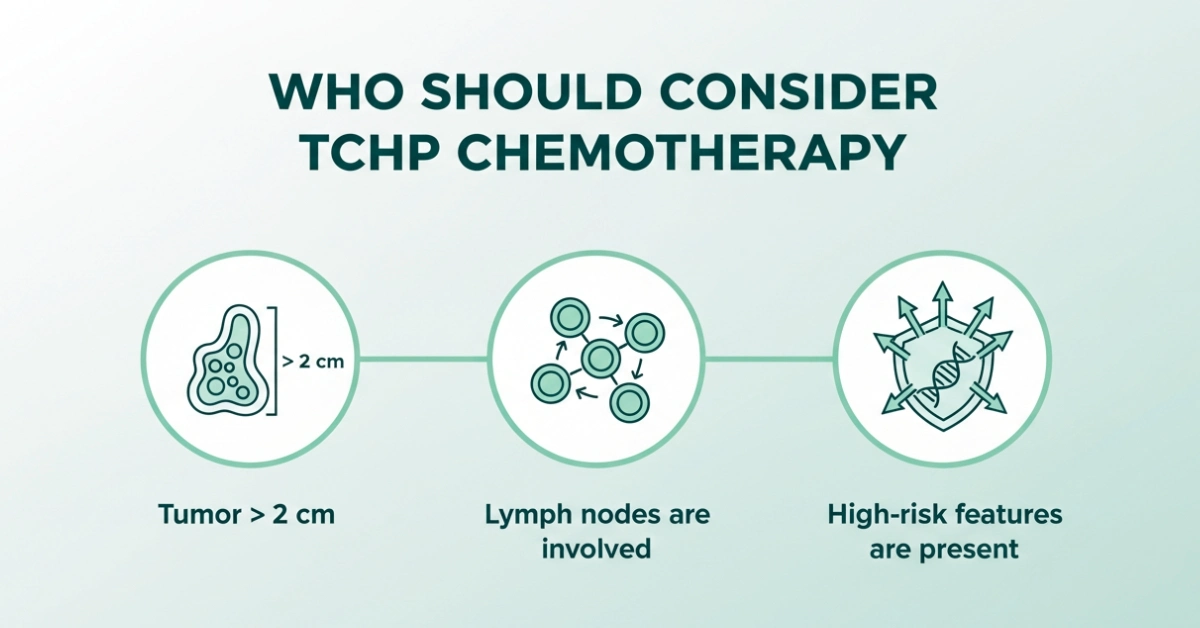
TCHP is usually recommended for early-stage HER2-positive breast cancer (stages I–III), particularly if:
- Tumor >2 cm
- Lymph nodes are involved
- High-risk features are present
Your oncologist will consider your overall health, age, genetic markers, and lab results, including HER2 testing, before recommending TCHP.
TCHP chemotherapy is used when breast cancer is diagnosed early enough for treatment to be given before surgery. Your oncologist considers your overall health, age, tumor features and lab results, including HER2 testing, before recommending it.
The TCHP Treatment Schedule: Cycles and What to Expect
How do breast cancer chemo cycles work with TCHP? Typically, it’s given in six cycles, every three weeks, totaling about 18 weeks for the chemo part. Each session happens in a clinic via IV infusion, lasting 4-6 hours.
| Day | What Happens |
| Day 1 | IV infusion of all four drugs. Trastuzumab and pertuzumab start with a loading dose. |
| Days 2–21 | Recovery, supportive meds as needed. |
| Maintenance | Trastuzumab and pertuzumab continue for up to a year to maintain HER2 blockade. |
Typical Doses:
- Docetaxel: 75 mg/m²
- Carboplatin: AUC 6 (adjusted for kidney function)
- Trastuzumab: 8 mg/kg loading, 6 mg/kg maintenance
- Pertuzumab: 840 mg loading, 420 mg maintenance
Do you know?
De-escalation, meaning less intensive treatment for lower-risk tumors, is an active area of research in HER2-positive breast cancer. Whether it applies to you is a question for your oncologist, based on your tumor’s features.
Benefits of TCHP Chemotherapy:
TCHP chemotherapy offers several significant advantages for patients with HER2-positive breast cancer:
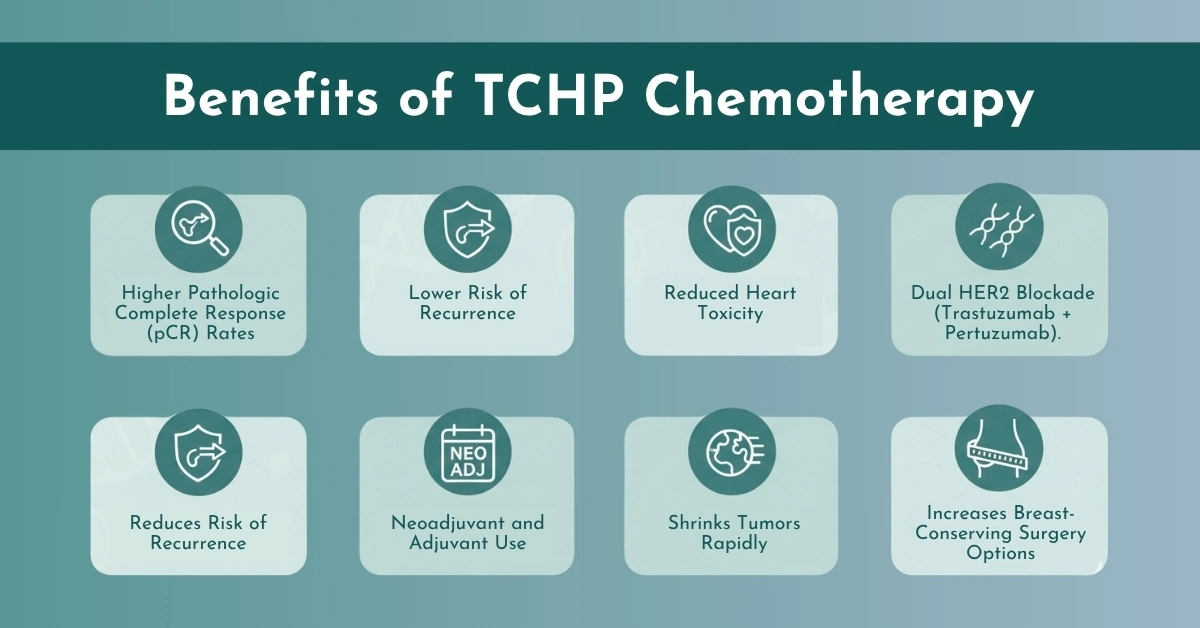
- Higher Pathologic Complete Response (pCR) Rates: 56-64% achieve complete response before surgery.
- Lower Risk of Recurrence: Combining chemotherapy with HER2-targeted therapy reduces cancer returning.
- Reduced Heart Toxicity: TCHP avoids anthracyclines, lowering risk of heart damage.
- Dual HER2 Blockade (Trastuzumab + Pertuzumab): Two targeted therapies work together to block cancer cell growth more effectively than single-agent therapy.
- Reduces Risk of Recurrence: Greatly lowers the chance of cancer coming back.
- Neoadjuvant and Adjuvant Use: Used before surgery to shrink tumors or after surgery to kill remaining cancer cells.
- Shrinks Tumors Rapidly: Often leads to significant tumor reduction, improving surgical outcomes.
- Increases Breast-Conserving Surgery Options: Tumor shrinkage may allow lumpectomy instead of full mastectomy.
Common HER2-Targeted Therapy Side Effects of TCHP Chemo
| Side Effect | When | Management |
| Nausea | Days 1–4 | Anti-nausea meds like Zofran, ginger tea |
| Fatigue | Cumulative | Short naps, gentle walks |
| Hair loss | After cycle 1 | Wigs, cold caps, scalp care |
| Neuropathy | Mid-treatment | Warm baths, exercise, and medications |
| Diarrhea | Variable | Hydration, BRAT diet, Imodium |
Less common but important risks
- Cardiac function decline (especially with HER2-targeted agents)
- Rarely: Leukemia, lung inflammation.
From National Cancer Institute insights, heart risks stay low with checks. Everyone’s experience differs—track yours.
Remember:
Not everyone experiences all side effects, and the severity varies. Heart function is monitored due to HER2-targeted therapy risks.
Tips for Managing TCHP Chemo Side Effects
You got this, and little hacks make a difference. For nausea, sip peppermint tea or use prescribed meds. Fatigue? Break days into short activities and rests. Dry mouth? Suck on ice chips. And for emotional dips, lean on loved ones or apps for mindfulness. Medical News Today tips include staying ahead with anti-diarrhea aids.
Here’s a simple table to help:
| Side Effect | Common Timing | Easy Management |
| Nausea | Days 1-4 | Ginger, meds like Zofran |
| Fatigue | Week 2 onward | Naps, gentle walks |
| Hair Loss | After cycle 1 | Wigs, scalp care |
| Neuropathy | Mid-treatment | Warm baths, exercise |
| Diarrhea | Variable | BRAT diet, hydration |
Latest Updates on TCHP Chemo
2025’s oncology scene is buzzing. At ASCO 2025, trials showed THP (minus carboplatin) matched TCHP’s effectiveness with better tolerability in some HER2-positive cases.
Did you know?
ESMO 2025 highlighted trastuzumab deruxtecan shifting to earlier use, potentially enhancing TCHP outcomes. PubMed data from neoCARHP backs de-escalation, keeping high response rates.
FDA updates include more biosimilars for accessibility. Cleveland Clinic echoes focus on precision medicine in oncology to cut sides.
Success Rates and Life After TCHP Chemo
- Success rates: Up to 90% event-free at three years.
- Follow-up: Regular imaging, lab tests, cardiac monitoring.
- Lifestyle tips: Exercise, diet, mindfulness, and support groups help recovery.
Case to Consider: A Breast Cancer Organization story shares a stage II survivor thriving after TCHP, with diet and yoga aiding recovery. Focus on follow-ups, exercise, and mindset for the long haul.
How RPh Labs PGx Testing Can Help
Everyone’s body reacts to medications differently because of their genes. Rph PGx testing kit shows how your body may respond to medications, including those used for cancer or side-effect management.
RPh Labs PGx Kit Features:
- CLIA-certified, at-home test using a simple cheek swab.
- Reports 20 drug-processing genes against more than 240 medications, none of which is TCHP itself.
- Helps your doctor adjust doses or choose safer drugs.
- Reduces trial-and-error with medications.
You can also use RPh Labs’ Drug-Gene List to see which medications are included in the test. This makes it easy to check how your genetics may affect your treatment and supportive care medications.
What tchp chemo is and why four drugs
The letters stand for the four components: docetaxel, carboplatin, trastuzumab and pertuzumab. Two are chemotherapy and two are antibodies that target HER2, which is why it is described as chemotherapy plus targeted therapy rather than chemotherapy alone.
- Docetaxel, a taxane, interferes with the cell’s internal scaffolding so dividing cells cannot complete division.
- Carboplatin, a platinum agent, damages DNA in dividing cells so they cannot replicate.
- Trastuzumab binds the HER2 receptor on the cancer cell surface, blocking growth signals and flagging the cell to the immune system.
- Pertuzumab binds a different part of the same receptor, preventing it from pairing with related receptors.
Trastuzumab and pertuzumab work at different sites, which is the reason for using both. Blocking one route while leaving another open allows signaling to continue, and the dual blockade closes more of it.
A note on doses. Standard doses and schedules exist for tchp chemo, and your team calculates yours from body size, kidney function, blood counts and how you tolerate each cycle. Doses are frequently adjusted during treatment, and that is planned management rather than a setback.
Her2 positive breast cancer explained
HER2 is a protein on the surface of cells that signals for growth. In her2 positive breast cancer the gene is amplified and the protein is overexpressed, so the cancer receives a constant growth signal.
It accounts for a minority of breast cancers. Before targeted therapy existed it carried a worse outlook, and the arrival of HER2-directed drugs changed that substantially, which is one of the clearest success stories in modern oncology.
- Status is determined on tumor tissue by immunohistochemistry, with borderline results confirmed by in situ hybridization.
- Hormone receptor status is assessed at the same time, since many tumors are both hormone receptor positive and HER2 positive, which affects the treatment plan.
- A newer category, HER2-low, matters for certain drugs in advanced disease and does not change this regimen.
- Testing is occasionally repeated on a recurrence, because status can change.
- None of this is read from a blood test or a cheek swab. It comes from the tumor itself.
Ask for your pathology report and keep a copy. Knowing your HER2 status, hormone receptor status, tumor size, grade and node status makes every later conversation clearer.
Neoadjuvant chemotherapy and why treatment comes first
Neoadjuvant chemotherapy means treatment given before surgery, which is the usual sequence for this regimen in early HER2 positive disease.
- It shrinks the tumor, which can allow breast-conserving surgery instead of mastectomy and can reduce the extent of axillary surgery.
- It shows whether the cancer responds to the drugs, information you cannot get if surgery comes first.
- It allows treatment after surgery to be tailored to what is found in the removed tissue.
- It treats any cells that have spread beyond the breast early rather than after a delay.
The most important result is whether any invasive cancer remains at surgery. A pathologic complete response, meaning no residual invasive cancer is found, is associated with better long-term outcomes in this subtype. It is a strong signal rather than a guarantee, and a partial response is not a failure.
Treatment is typically given as cycles every three weeks over several months, with the HER2-directed antibodies continuing afterward for around a year in total. Infusions take several hours, and the first cycles usually take longer because of monitoring.
Chemotherapy side effects and how they are managed
Most chemotherapy side effects with this regimen are predictable, which means they can be planned for rather than only reacted to.
- Low white cells, with a genuine risk of febrile neutropenia. A growth factor injection is often given to reduce it.
- Diarrhea, particularly from pertuzumab, which is why an antidiarrheal plan is usually given in advance.
- Nausea and vomiting, now well controlled with modern antiemetics given before and after infusions.
- Hair loss, which is expected with docetaxel and typically regrows after treatment. Scalp cooling is offered in some centers.
- Peripheral neuropathy: tingling or numbness in hands and feet, which should be reported early because dose adjustment can prevent it worsening.
- Fatigue, mouth soreness, nail changes, taste change, and fluid retention with docetaxel.
- Infusion reactions, most likely during the first doses, which is why you are watched closely then.
Call the team the same day for a temperature at or above the threshold they give you, shaking chills, uncontrolled diarrhea or vomiting, inability to keep fluids down, mouth ulcers preventing eating, or any new breathlessness. A fever during chemotherapy is an emergency, not something to sleep on.
Supportive care is part of the treatment, not an optional extra. Ask about antiemetics, mouth care, skin and nail care, physical activity, and referral to a dietitian or physiotherapist.
Heart monitoring with trastuzumab and pertuzumab
HER2-targeted antibodies can reduce the heart’s pumping function, which is why cardiac monitoring is built into the treatment plan from the start.
- An echocardiogram or MUGA scan is done before treatment to measure baseline ejection fraction, then repeated at intervals.
- Most reductions are asymptomatic, detected on scanning, and reversible when treatment is paused.
- Treatment may be held and restarted once function recovers, a decision your oncologist and sometimes a cardio-oncology service makes.
- Report new breathlessness, ankle swelling, a persistent cough at night, palpitations or unusual fatigue promptly.
- Blood pressure control, managing other cardiac risk factors and avoiding smoking all matter during treatment.
Trastuzumab and pertuzumab are also available in a combined subcutaneous injection in some centers, which takes minutes rather than hours once the chemotherapy portion is finished. It is worth asking whether that is an option for the maintenance phase.
Pregnancy must be avoided during treatment and for a period afterward, and these drugs are harmful to a developing fetus. Raise fertility preservation before treatment starts if that is relevant, because the window closes quickly.
After surgery: what happens next
The pathology from surgery drives the next phase, which is one of the strongest arguments for the neoadjuvant chemotherapy approach.
- If no invasive cancer remains, HER2-directed treatment usually continues to complete about a year in total.
- If invasive cancer remains, switching to a different HER2-directed drug after surgery has been shown to improve outcomes compared with continuing trastuzumab alone.
- Radiotherapy is given where indicated by the surgery and the original disease extent.
- Endocrine therapy follows for hormone receptor positive tumors, and it continues for years rather than months.
- Follow-up includes clinical review, imaging as indicated and ongoing cardiac monitoring while on HER2 treatment.
Ask your oncologist to write down the plan in sequence. Treatment for this subtype involves several phases over more than a year, and having the sequence on paper makes it far easier to live with.
Genetic testing: three different kinds
Genetics comes up repeatedly in breast cancer care, and the three types answer different questions.
Tumor testing looks at the cancer: HER2 status, hormone receptors, and in some settings mutations that open up other treatments. Inherited testing looks at you, including BRCA1, BRCA2 and other genes, and it can affect surgical decisions, treatment options and screening for relatives. Both are arranged through oncology or a genetics service.
Pharmacogenomic testing is the third and narrowest: how your body processes medicines. There is no validated pharmacogenomic test guiding tchp chemo itself. Docetaxel involves CYP3A4, where activity is not reliably predicted from genotype, and the antibodies are proteins, which are not handled by drug-metabolizing enzymes at all.
Where it genuinely helps during cancer treatment is supportive medicines. Ondansetron for nausea involves CYP2D6, codeine and tramadol depend on CYP2D6 to work, and antidepressants used during treatment involve CYP2D6 and CYP2C19. The RPh Labs panel covers 20 genes reported against more than 240 medications from an at-home cheek swab, reviewed by a PharmD pharmacist. See the testing kit page and the medication list by gene, and the CPIC guidelines for the recommendations. Never change a cancer treatment based on a report.
Conclusion:
Dealing with HER2-positive breast cancer and treatments like TCHP chemotherapy can feel scary and confusing. RPh Labs does not provide cancer treatment. Our at-home pharmacogenomic test reports how your body processes medicines, which is relevant to supportive medicines such as ondansetron and pain relief rather than to the chemotherapy regimen itself. This includes drugs used to manage side effects or other supportive treatments during your cancer journey.
With this information, your doctor can choose the safest medicines and the right doses for you, reducing trial-and-error and unwanted side effects. Knowing your genetic profile gives you more control and confidence, helping you stay informed and supported throughout your treatment.
Disclaimer:
Content is provided for learning purposes and may not apply to every patient. Consult your oncologist before acting on this information. Some images in this guide are created using AI for visual reference.
Tchp chemo FAQ
What is the typical duration of TCHP treatment?
Six infusions over ~18 weeks (every 3 weeks), followed by HER2-targeted maintenance up to 1 year.
Does everyone respond to TCHP?
No, response rates vary; some studies show ~64% pCR in real-world settings.
Can I skip chemotherapy and only use targeted therapy?
Usually not for high-risk HER2+ cases; guidelines list TCHP as a preferred regimen.
If I have side-effects, will the treatment still work if dose is reduced?
Yes, evidence suggests dose intensity may be reduced without significantly impacting pCR.
How does genetic testing fit into this?
Genetic (pharmacogenomic) testing helps tailor not just chemo choices but supportive meds, adjusting for metabolism, side-effects and drug interactions.
What does TCHP stand for?
Docetaxel, carboplatin, trastuzumab and pertuzumab. Two are chemotherapy drugs and two are antibodies targeting HER2 at different sites on the receptor, which is why both are used together rather than one alone.
Why is neoadjuvant chemotherapy given before surgery?
It shrinks the tumor, may allow less extensive surgery, shows whether the cancer responds to the drugs, and lets treatment after surgery be tailored to what is found in the removed tissue.
What is a pathologic complete response?
No residual invasive cancer found at surgery. In HER2 positive breast cancer it is associated with better long-term outcomes. It is a strong signal rather than a guarantee, and residual disease is not a treatment failure.
Which chemotherapy side effects need a same-day call?
Fever at or above the threshold your team gives you, shaking chills, uncontrolled diarrhea or vomiting, inability to keep fluids down, mouth ulcers preventing eating, or new breathlessness. Fever during chemotherapy is an emergency.
Why is my heart scanned during treatment?
Because trastuzumab and pertuzumab can reduce the heart’s pumping function. Scans measure ejection fraction before and during treatment. Most reductions are asymptomatic and reversible when treatment is paused.
Does a pharmacogenomic test guide this regimen?
No. Docetaxel involves CYP3A4, which is not reliably predicted from genotype, and the antibodies are proteins that drug-metabolizing enzymes do not handle. Testing is more useful for supportive medicines such as ondansetron and pain relief.



Leave a Reply