

Pristiq withdrawal is one of the most common reasons people search for help with an antidepressant, and the discomfort is real rather than imagined. Desvenlafaxine leaves the body fairly quickly, so dose gaps register fast. Here is what drives the symptoms, how long they usually last and what a supervised plan looks like.
On this page
Pristiq, also known as desvenlafaxine, is a prescription medication commonly prescribed for major depressive disorder. An antidepressant medication that falls into the class of serotonin-norepinephrine reuptake inhibitors, it is used to improve mood and energy over several weeks of treatment. However, discontinuing Pristiq, whether due to side effects, switching medications, or completing treatment, may lead to withdrawal symptoms. This blog will explore what to expect during Pristiq withdrawal and how to navigate it safely.
Why Do Withdrawal Symptoms Occur?
When you are on Pristiq, your serotonin and norepinephrine balance in the brain changes, and your brain gets accustomed to this change in time. If this is stopped or reduced abruptly, it tends to break off this balance, causing withdrawal symptoms. This is sometimes termed as antidepressant discontinuation syndrome.
Common Withdrawal Symptoms
The withdrawal symptoms are different in degree and duration and depend on variables such as dose, length of time on the drug, and general health. Some common symptoms include:
1. Flu-like Symptoms
- Fatigue
- Muscle aches
- Chills
2. Emotional Changes
- Anxiety
- Irritability
- Mood swings
3. Cognitive Symptoms
- Brain fog
- Difficulty concentrating
- Confusion
4. Physical Symptoms
- Nausea or vomiting
- Dizziness
- Headaches
5. Sensory Disturbances
- “Brain zaps” (electric shock-like sensations)
- Tingling sensations
6. Sleep Issues
- Insomnia
- Nightmares
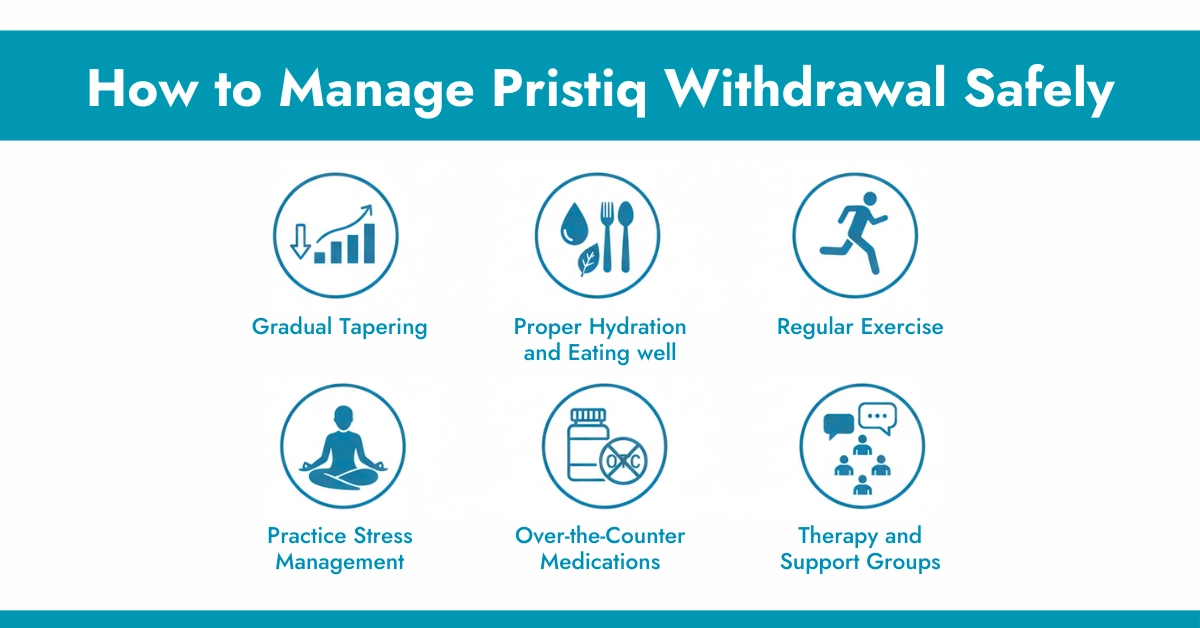
How to Manage Pristiq Withdrawal Safely
It is essential to stop Pristiq under the care of a doctor. Stopping this medication abruptly will increase the severity of withdrawal symptoms. Some ways to help with the process are as follows:
1. Gradual Tapering
Work with your physician to taper gradually. Tapering gives your brain time to adjust to the change in serotonin and norepinephrine, which usually reduces how strong the withdrawal symptoms are. It does not always prevent them, so tell your prescriber if the symptoms are hard to live with and the pace can be slowed.
2. Proper Hydration and Eating well
Poor nutrition and dehydration will make the effects worse. And malnutrition only weakens recovery. Keep hydrated and enjoy a well-rounded diet with plentiful vitamins and minerals for your overall body recovery process
3. Regular Exercise
Light to moderate exercise can improve mood and help alleviate some withdrawal symptoms. Activities like walking, yoga, or swimming can be particularly beneficial.
4. Practice Stress Management
Techniques such as mindfulness meditation, deep breathing exercises, and progressive muscle relaxation can help alleviate anxiety and emotional symptoms.
5. Over-the-Counter Medications
Over-the-counter medications can temporarily alleviate milder symptoms like headaches or nausea. Always consult your doctor before using these.
6. Therapy and Support Groups
One can obtain both emotional support and tips and advice from a therapist and by joining a support group from peers who have actually gone through that process.
When to Seek Medical Attention
Even though withdrawal symptoms usually are temporary, more severe and lengthy symptoms may mandate medical attention. Call your provider if you develop any of these:
- Persistent suicidal thoughts
- Severe mood swings
- Uncontrollable anxiety or panic attacks
- Physical symptoms that do not improve over time
Role of PGx Testing in Pristiq Withdrawal
Pharmacogenomic, or PGx testing of RPh Labs looks at how your body processes medicines, and it is honest to say the role here is limited. Desvenlafaxine is mainly cleared by glucuronidation and the kidneys, so no gene on the panel sets its dose and no genetic result predicts withdrawal symptoms or the right taper speed.
Where results do help is the wider picture: if you and your prescriber are considering a different antidepressant, genes such as CYP2D6 and CYP2C19 carry published guidance for several of them. Your prescriber reads that alongside your kidney function, other medicines, and how you have responded before.
Tips for a Smooth Transition
- Keep a Journal: Track your symptoms and progress. This can help you and your doctor identify patterns and adjust your tapering schedule.
- Stay Connected: Inform close friends or family members about your withdrawal journey so they can offer support.
- Be Patient: Withdrawal symptoms can take days or weeks to resolve fully. Remember, this is a temporary phase.
Pristiq withdrawal: 8 important facts to start with
These points cover the questions people ask most. Each one is expanded in the sections below.
- Pristiq withdrawal reflects physical adaptation to the medicine, not addiction. It does not mean you misused anything.
- Desvenlafaxine is the active metabolite of venlafaxine, which is why the two drugs share a similar discontinuation pattern.
- The tablet is an extended-release formulation. It is swallowed whole, never crushed, split or chewed, because breaking it changes how fast the dose is released.
- Symptoms usually appear within a few days of a reduction and often settle over one to two weeks, though some people need longer.
- Dizziness, electric shock sensations, nausea, headache, irritability, vivid dreams and flu-like aches are the usual complaints.
- Returning depression looks different from withdrawal, and telling them apart changes what your prescriber does next.
- Because the tablet comes in limited strengths, a taper needs planning rather than improvising at home.
- Genetics affect how you process related antidepressants, but they do not replace a careful taper.
Nothing below is a schedule to follow alone. Every dose change belongs to the prescriber who wrote the prescription.
Why desvenlafaxine discontinuation hits so quickly
Desvenlafaxine discontinuation symptoms come down to timing. The drug clears the body over hours rather than days, so once a dose is missed, levels fall before the nervous system has adjusted.
There is a second reason this medicine gets attention. Desvenlafaxine is the active form that venlafaxine is converted into, so anyone who found Effexor hard to stop has reason to plan carefully here too.
Risk of a rough time is higher after a long course of treatment, after a higher daily dose, after previous difficult dose changes, and when doses are missed by accident. Refill timing matters more with short-acting antidepressants than with long-acting ones.
Kidney function is part of the picture as well, since desvenlafaxine is partly cleared unchanged by the kidneys. That is one of several reasons dose decisions belong with a clinician who knows your lab results.
For a general, non-commercial explanation of how genes and enzymes shape drug handling, the MedlinePlus pharmacogenomics overview is a clear read.
Brain zaps and other sensory symptoms
The strangest symptom is also the most reported. Brain zaps feel like a quick electrical jolt inside the head, sometimes with a flash of light or a sound, and they often fire when you move your eyes.
They are usually brief and not harmful, but they can be unsettling and can make driving feel unsafe. They tend to appear in the days after a reduction and fade as levels level out.
- Brain zaps are most associated with short-acting antidepressants, including desvenlafaxine, venlafaxine and paroxetine.
- Dizziness, imbalance or a rocking sensation frequently come along with them.
- Tingling or pins and needles in the hands and feet, ringing in the ears and light sensitivity are also described.
- Vivid or unpleasant dreams often show up in the same window.
If brain zaps are frequent or interfere with work or driving, call your prescriber rather than pushing through. Holding at the current dose for longer, or taking a smaller next step, is a routine adjustment.
Do not manage these sensations with alcohol, cannabis or a friend’s leftover medication. Each adds its own risk and makes the pattern harder to interpret.
A realistic snri withdrawal timeline
Every snri withdrawal timeline is individual, so treat the pattern below as a rough map rather than a promise. Your dose, your length of treatment and the speed of the taper all shift it.
- Days one to three. Physical symptoms usually start. Dizziness, nausea, headache and electric shock sensations are most common early.
- First week. Symptoms often peak. Sleep may be broken, dreams vivid and mood short-tempered.
- Weeks one to two. Most people notice a steady decline in intensity if the step size was reasonable.
- Beyond two weeks. Some people, particularly after years of treatment or a high dose, take longer. Persisting symptoms are a reason to review the plan, not to abandon it.
One useful marker sits inside that snri withdrawal timeline. Withdrawal symptoms usually ease within hours to a day or two if the previous dose is resumed under medical advice, whereas returning depression does not respond that quickly.
Write down the date of each change and how you felt on the following days. That simple record is what turns a vague account into something your prescriber can act on at the next visit.
If low mood deepens, or thoughts of suicide or self-harm appear at any point, treat that as urgent. In the United States you can call or text the 988 Suicide and Crisis Lifeline, and call 911 if anyone is in immediate danger.
What a pristiq taper schedule usually involves
A pristiq taper schedule is designed by your prescriber, not copied from a forum. The tablet comes in a small number of strengths and must be swallowed whole, which limits how finely a dose can be reduced and makes planning essential.
These are the tools clinicians commonly reach for. They are listed so you can ask informed questions.
- Reducing by a proportion of the current dose rather than a fixed amount, so each step feels similar.
- Holding at a dose for longer before the next step whenever symptoms flare.
- Smaller steps near the end, since the final stretch is often the hardest part.
- Switching to a different antidepressant with a longer duration of action, then tapering from that medicine instead.
- Using alternate-day dosing only when a prescriber specifically directs it, since this is not suitable for every drug.
The practical side matters as much as the pharmacology. Order refills early, keep tablets somewhere you will not forget them, and set a daily alarm. An accidental missed dose can undo a good week of a pristiq taper schedule.
Never stop this medicine abruptly on your own. Stopping some medications suddenly is genuinely risky, and antidepressants and benzodiazepines are the usual examples. There is no benefit to rushing.
How genes fit in, and where they do not
Desvenlafaxine is already the active form, so it depends less on CYP2D6 than venlafaxine does, and a good share of it leaves the body unchanged through the kidneys. That is an honest limit on what a genetic report can say about this specific drug.
Where a report does earn its place is the next decision. Most alternatives your prescriber may consider, including many SSRIs and SNRIs, are cleared by CYP2D6 or CYP2C19, and those genes carry published dosing guidance.
Other medicines can mimic a genetic change. Bupropion, fluoxetine and paroxetine strongly inhibit CYP2D6, so starting or stopping one of them shifts how you handle several antidepressants. Our guide to CYP2D6 inhibitors lists the common ones, and the CPIC guidelines set out the recommendations themselves.
The RPh Labs at-home PGx kit uses a cheek swab, covers 20 genes reported against more than 240 medications, and every report is reviewed by a PharmD pharmacist with a free consultation included. Results follow 7 to 10 business days after your sample reaches the Dallas lab, and since inherited genes do not change, one test lasts a lifetime.
What testing will not do is predict how comfortable your taper feels or set the step size. Keep expectations in the right place and it is genuinely useful information for your chart.
Living through the first two weeks
Small logistics make the difference between a hard fortnight and a manageable one. None of this replaces a slower taper if symptoms are severe.
- Schedule a reduction for a quieter week rather than before travel, a deadline or a family event.
- Be cautious with driving and machinery while dizziness or shock sensations come and go.
- Keep meals, fluids and sleep as regular as you can, because skipped meals sharpen nausea and lightheadedness.
- Tell one or two trusted people what you are doing so someone else can notice a mood shift.
- Ask a pharmacist before adding any over-the-counter remedy, including motion sickness tablets, sleep aids and supplements.
Therapy is worth considering during this window. Beyond coping skills, it gives you a regular place to report how the taper is going, which often catches trouble earlier than a three-month review would.
Expect an uneven line. A harder day after a good one is normal and does not mean the plan has failed.
When to call, and when it is an emergency
Most people get through this with a slower plan and good communication. A few situations should not wait for the next appointment.
- Thoughts of suicide or self-harm, or a sharp drop in mood. Call or text 988 in the United States, and call 911 if there is immediate danger.
- Fainting, a seizure, chest pain, severe confusion or a very fast heartbeat.
- Vomiting or diarrhea that stops you keeping fluids or medication down.
- Possible serotonin syndrome if another serotonergic drug has been added, with agitation, sweating, shivering, muscle twitching, stiffness or fever.
- Any suspected overdose. Call 911 in an emergency, or Poison Control in the United States at 1-800-222-1222 for advice.
Keep your prescriber’s number and your pharmacy’s number where you can find them quickly. If you cannot tell whether something is urgent, make the call. Our FAQ page covers how the testing side works if that is your next question, and how it works explains the process end to end.
Conclusion
Quitting Pristiq can be very challenging, but with proper planning and support, you can successfully handle this transition. Always ask your healthcare provider before making medication changes, and try to take better care of yourself during this process. Withdrawal is one step toward excellent health, and being patient and following the proper guidelines will help you become much stronger on the other side.
References
Pristiq withdrawal FAQ
What is Pristiq withdrawal?
Pristiq withdrawal refers to the symptoms that people experience when trying to stop or reduce the dosage too quickly.
How long do symptoms last?
Symptoms can last for several days and up to weeks, according to the dosage and period of use.
Can PGx testing help me or anyone with withdrawal?
Not directly. Desvenlafaxine is cleared mostly by glucuronidation and the kidneys, so no gene on the panel predicts withdrawal or sets a taper. Results are more useful if you and your prescriber are weighing a different antidepressant, where CYP2D6 and CYP2C19 have published guidance.
Is it safe to withdraw from Pristiq cold turkey?
No. Severe withdrawal symptoms have been reported to occur when taken off Pristiq abruptly. Always consult your doctor to taper safely.
What can I do when symptoms worsen?
You should seek professional help immediately if the symptoms become uncontrollable or severe enough.
How soon do brain zaps start after a dose change?
Most people notice them within one to three days, because desvenlafaxine clears quickly. They usually cluster for several days and then fade. If brain zaps are frequent, severe or make driving feel unsafe, contact your prescriber before the next planned reduction rather than waiting it out.
Can I cut a Pristiq tablet to make a smaller dose?
No. It is an extended-release tablet, and cutting, crushing or chewing it changes how fast the medicine is released. If a smaller step is needed, ask your prescriber which strengths or which alternative formulation can be used and exactly how to take it.
What does a typical snri withdrawal timeline look like?
Symptoms often begin within a few days of a reduction, peak in the first week and ease over one to two weeks. Some people take longer, especially after years of treatment or a high dose. A longer snri withdrawal timeline is a reason to review the plan with your prescriber, not to stop abruptly.
Is desvenlafaxine discontinuation the same as withdrawal from a controlled substance?
No. Desvenlafaxine discontinuation reflects your nervous system adapting to a change in drug level, not craving or drug seeking. It is uncomfortable rather than a sign of addiction, and it responds to a slower, supervised reduction.
Does a PGx test help with pristiq withdrawal?
Not directly. Desvenlafaxine depends less on the CYP enzymes than most antidepressants, and part of it leaves the body unchanged. A report is more useful for choosing the next medicine or starting dose, since many alternatives are cleared by CYP2D6 or CYP2C19.
What if symptoms come back every time the dose is lowered?
That usually means the steps are too large or too close together, and it is common information to bring back to your prescriber. They may hold the dose, shrink the next step, or change the approach entirely. Repeated flares are a signal to adjust the plan, not to push harder.



Leave a Reply