
Asking is gout a genetic disease gets you a cleaner answer than most conditions: inherited variants strongly shape how your kidneys handle urate, but they do not decide on their own who has attacks. This guide covers the genes involved, how gout is confirmed, and how treatment and diet fit together.
On this page
Arthritis, a common disease with more than 100 types, among which some of the most common are Rheumatoid arthritis, Osteoarthritis, Gout, Juvenile arthritis, and some more. Your genes increase the risk of you getting numerous diseases, Gout arthritis is one of them.
This raises a concern: ‘Is Gout a Genetic Disease?’ The answer is that gout is partly genetic, but it is not a single-gene inherited disease. It is a polygenic trait: many common gene variants each nudge your uric acid levels, while diet, weight, alcohol, kidney function and some medicines decide whether attacks actually happen.
Let’s dive into, what causes gout, how genetic mutations play a role, and why hyperuricemia (high uric acid levels) remains the central culprit.
What Is Gout Disease with Mechanism
The following points may help you understand the mechanism behind Gout:
- Gout, also called gouty arthritis, is a form of inflammatory arthritis.
- It occurs when uric acid crystals build up inside joints, most commonly the big toe.
- Uric acid forms when the body breaks down substances called purines, found in both food and human cells.
- When blood uric acid rises (hyperuricemia), these crystals can trigger sudden, intense pain, swelling, and redness.
- Not everyone with hyperuricemia develops gout — meaning genes and environment both matter.
Gout Inheritance Pattern
Gout is a complex condition influenced by both genetics and lifestyle. Twin and family studies point to a substantial inherited component, and genes like SLC2A9 and ABCG2 help regulate urate levels. Many genetic loci have been linked to urate, though together they explain only part of the variation between people, and having a close relative with gout raises your own risk. Management combines urate-lowering drugs, such as allopurinol, with lifestyle changes. Genetic risk testing for gout is not routine.
Did you know?
Before starting allopurinol, people of Han Chinese, Thai, Korean and some other Asian backgrounds are often tested for HLA-B*58:01, because carriers have a higher risk of a severe skin reaction. Your prescriber orders that test, and HLA-B is not on the RPh Labs 20-gene panel. A pharmacogenomic (PGx) test reports how your body may process other medicines instead. It does not predict whether you will develop gout.
Genetic Causes of Gout: The Key Players
Mutations are simply changes to the DNA. The effect of that change can be harmful, beneficial, or, most often, neutral. Modern research identifies that there are several genetic mutations (that control uric acid transport) linked to gout:
| Gene | Function | Effect of Problematic Mutation |
| SLC2A9 (GLUT9) | Helps reabsorb urate in the kidneys | Raise uric acid levels in blood |
| ABCG2 | Excretes uric acid through urine and gut | Strongly linked to early-onset gout |
| SLC22A12 (URAT1) | Reabsorbs uric acid in kidneys (decodes the rate at which urate is returned to bloodstream and excreted through urine) | Poor excretion → hyperuricemia |
| GCKR, LRRC16A, ALDH16A1 | Influence purine metabolism | Subtle effects on urate balance |
Remember! While certain genetic mutations increase uric acid levels, high-purine diets, alcohol, obesity, and certain medications like diuretics and low-dose aspirin remain powerful triggers of this disease.
Note: Genetic factors can play a significant role in many autoimmune and metabolic disorders. If you’re interested in learning how heredity affects lupus, read our article.
What Causes Gout If Not Genetic?
When gout isn’t inherited, metabolic and lifestyle factors are the main culprits.
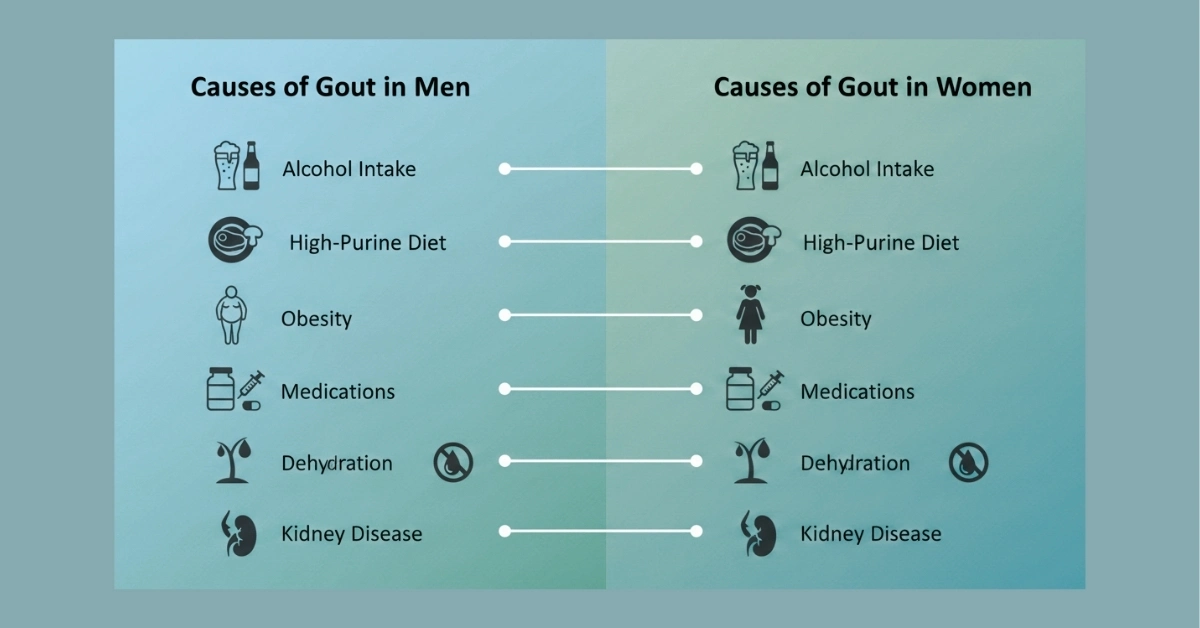
Common causes of gout and gout risk factors include:
- Alcohol intake (especially beer and spirits) – can alcohol cause gout? Yes, it raises uric acid production.
- High-purine diet – red meat, shellfish, organ meats.
- Obesity – increases uric acid synthesis.
- Medications – diuretics and aspirin reduce uric acid clearance.
- Dehydration – favors crystal formation.
- Kidney disease – reduces uric acid excretion.
According to the Cleveland Clinic, too much of uric acid can be the main cause of Gout.
Major Cause of Gout Arthritis
The main cause of gout is hyperuricemia (excessive uric acid in the blood). This happens when the body produces too much uric acid or can’t remove enough of it.
Over time, uric acid crystals deposit in joints, causing inflammation and pain.
Can Gout Run in Families?
Can gout run in families? Yes, though not because of one hereditary mutation. What runs in families is a combination of common gene variants that nudge uric acid levels up. Family history is one of the strongest predictors of gout. Here is how:
- If your parents or siblings suffer from gout, you have a higher chance of developing hyperuricemia yourself.
- However, lifestyle still matters. Maintaining a healthy weight, staying hydrated, and moderating or simply restricting alcohol can offset much of the risk.
Genetic Mutation: A change in the DNA instructions. This change can be caused by mistakes during cell division, exposure to environmental factors, or viral infections.
Once it exists, it can then be inherited by future generations if it occurs in a parent’s reproductive cells. And this will be called as germline mutation.
Is gout a genetic disease, or a polygenic risk?
It helps to separate two ideas. Is gout a genetic disease in the sense of a single faulty gene passed down through a family? No. Gout is polygenic, which means many common variants each nudge uric acid levels a little, and the total effect varies between people.
That is different from an inherited disease such as cystic fibrosis, where one gene explains the condition. In gout, urate handling is strongly heritable, while the step from high urate to an actual attack depends on other things entirely: kidney function, body weight, alcohol, certain medicines, and even injury to a joint.
The clinical consequence is encouraging. Plenty of people with a strong family history never have an attack, and plenty with no family history do. Inherited risk sets your baseline, and what you and your prescriber do about uric acid levels determines most of the rest.
Rare single-gene disorders of purine metabolism do exist and can cause very early onset gout, sometimes in the teens or twenties, often with kidney stones or kidney disease. That pattern warrants a specialist referral rather than a general assumption about inheritance.
What the gout genes actually do
Almost all of the well-established gout genes control urate transport in the kidney and gut rather than purine production. Knowing which direction a gene pushes makes the rest of the picture easier to follow.
- SLC2A9 (GLUT9): reabsorbs urate from urine back into the blood. Variants that increase reabsorption raise uric acid levels.
- ABCG2: pumps urate out through the gut and kidney. Reduced-function variants leave more urate in the blood and are linked to earlier onset.
- SLC22A12 (URAT1): the main reabsorption transporter, and the target of some urate-lowering drugs.
- SLC17A1 and SLC22A11: additional transporters with smaller effects.
- PDZK1: a scaffolding protein that organizes several of these transporters.
One nuance is worth stating plainly, because it is easy to misread. ABCG2 is on the RPh Labs 20-gene panel, but it is reported there for medication response, mainly how the body handles rosuvastatin and similar drugs, not as a gout risk marker. A pharmacogenomic panel does not report disease risk.
So a gene report will not tell you whether gout is coming. Serum urate testing and your own history do a better job, and they cost far less. For background on how gene-drug reporting differs from risk testing, see the PharmGKB knowledge base.
Gout symptoms and how an attack unfolds
Classic gout symptoms are hard to mistake once you have seen them. An attack usually starts overnight or in the early hours and reaches full intensity within about 12 to 24 hours.
- Sudden severe pain in one joint, most often the base of the big toe, but also the ankle, knee, wrist, or fingers.
- Swelling with red or shiny skin that can peel as the attack settles.
- Extreme tenderness, where even a bedsheet is uncomfortable.
- Warmth over the joint, sometimes with a low fever.
- Gradual resolution over a week or two, even without treatment.
- Tophi, firm lumps of urate under the skin over the elbows, fingers, or ears, after years of high urate.
Two warnings belong here. A hot, swollen joint with fever can also be a joint infection, which is an emergency, so a first attack should be assessed rather than self-diagnosed. And gout symptoms in a joint that stays painful between attacks may mean joint damage that needs longer-term gout treatment.
Keep a note of the date, joint, and likely trigger for each attack. The frequency over a year is one of the main things a clinician uses when deciding whether to start daily urate-lowering therapy.
How gout is confirmed, and what uric acid levels mean
Gout is often diagnosed from the pattern alone, but confirmation changes management when the picture is atypical.
- Joint fluid aspiration is the definitive test. Urate crystals seen under a polarizing microscope confirm gout and also rule out infection.
- A serum urate level supports the diagnosis, though it can be normal or low during an acute attack, which confuses many people.
- Repeat urate testing a couple of weeks after an attack gives the more useful number.
- Kidney function, blood glucose, lipids, and blood pressure are usually checked, because gout travels with metabolic and kidney disease.
- Ultrasound or dual-energy CT can show urate deposits when aspiration is not possible.
Interpreting uric acid levels needs one key idea: high urate alone is not gout. Many people have raised levels for years without an attack, and treating a number in someone with no symptoms is usually not recommended. The threshold that matters clinically is the point at which urate crystallizes, which is why treatment targets are set below roughly 6 mg/dL once therapy starts.
Ask for your actual numbers rather than a verbal all clear. Tracking uric acid levels over time is how you and your prescriber tell whether treatment is working.
Gout treatment during an attack
Acute gout treatment aims to shut down inflammation quickly. The choice depends on your kidney function, heart condition, other medicines, and how soon you started, and it is set by your prescriber rather than by a general article.
- NSAIDs such as naproxen or indomethacin, avoided or adjusted in kidney disease, heart failure, or with blood thinners.
- Colchicine, most effective when started early, and adjusted in kidney or liver impairment.
- Corticosteroids, oral or injected into the joint, often chosen when NSAIDs and colchicine are unsuitable.
- Interleukin-1 blockers, reserved for people who cannot use the options above.
Practical measures help as well: rest the joint, elevate it, apply a cold pack for short periods, and keep fluids up. Do not start daily urate-lowering therapy in the middle of an attack unless your prescriber tells you to, and if you already take it, do not stop it because of a flare.
Get medical advice urgently if you have a fever with a hot swollen joint, if more than one joint is involved for the first time, or if pain is not improving after a few days of treatment.
Long-term gout treatment and lowering urate
Repeat attacks, tophi, joint damage on imaging, kidney stones, or chronic kidney disease all push toward daily therapy. Long-term gout treatment is a treat-to-target plan, not a course you finish.
- Allopurinol is usually first line. It is typically started at a low dose and increased gradually while urate is rechecked.
- Febuxostat is an alternative when allopurinol is not tolerated, with heart disease taken into account.
- Probenecid increases urate excretion and depends on reasonable kidney function.
- Pegloticase is reserved for severe, refractory gout.
- Flare cover, often low-dose colchicine or an NSAID, is commonly used for the first months, because starting urate-lowering therapy can temporarily trigger attacks.
That early flare is the most common reason people abandon treatment, which is a shame because the alternative is years of attacks. If flares increase after starting, tell your prescriber rather than stopping the medicine yourself.
Review the rest of your medication list too. Thiazide and loop diuretics, low-dose aspirin, and some transplant medicines raise urate, and sometimes an alternative exists. Never swap a blood pressure medicine on your own.
Gout diet, alcohol, and weight: what actually moves the needle
Diet gets the most attention and delivers the least dramatic effect. A careful gout diet typically lowers urate modestly, which is useful alongside medication and rarely enough by itself once attacks are frequent.
- Limit: organ meats, game, anchovies, sardines, mussels, scallops, and large amounts of red meat.
- Limit: beer and spirits, which raise urate and are strongly linked to attacks. Beer contributes purines as well as alcohol.
- Limit: sugar-sweetened drinks and anything high in fructose.
- Favor: low-fat dairy, vegetables, whole grains, cherries, coffee, and plenty of water.
- Do not avoid: beans, lentils, and most vegetables. Plant purines have little effect on gout risk despite older advice.
Gradual weight loss lowers uric acid levels and helps blood pressure and blood sugar at the same time. Crash dieting and fasting can do the opposite by raising urate short term, so steady change beats an aggressive gout diet.
Dehydration is an underrated trigger, especially in hot weather, after intense exercise, or during illness. Keeping fluids up is the simplest habit on this list.
Where pharmacogenomics fits with gout medicines, and where it does not
First the limit: a pharmacogenomic (PGx) test does not answer whether you will get gout, does not report disease risk, and does not replace a serum urate test. It describes how your body may process certain drugs.
Two gene-drug links matter in gout, and only one sits on the RPh Labs panel. HLA-B*58:01 is associated with severe skin reactions to allopurinol and is screened for in some populations before starting, and HLA is not on the 20-gene panel. G6PD deficiency, which is on the panel, matters for pegloticase and rasburicase because these drugs can cause serious red blood cell breakdown when G6PD activity is low.
Everything else in common gout treatment, including allopurinol dosing, febuxostat, colchicine, probenecid, and the NSAIDs, is guided by kidney function, interactions, and response rather than by genotype. Saying so is more useful than implying a panel guides the whole plan. Published gene-drug recommendations are freely available from CPIC.
Where a report often helps people with gout is the rest of the cabinet, since gout rarely travels alone. Statins depend on SLCO1B1 and ABCG2, warfarin on CYP2C9 and VKORC1, and many antidepressants on CYP2D6 and CYP2C19. Our medication list maps drugs to genes, and the at-home cheek swab kit covers all 20 in one sample.
Takeaway
Genes increase the chances of Gout, however, there are other factors that may stimulate the condition as well. In short, genes may start the process, but diet and kidney function determine how severe it becomes. Even if you inherit genes that raise uric acid levels, lifestyle choices determine whether gout develops.
Managing weight, diet, hydration, and alcohol use can dramatically reduce your risk. If you have a family history of gout, talk to your doctor about monitoring uric acid levels early and making preventive lifestyle changes.
If you take several long-term medicines, you may want to ask your doctor whether a PGx test from RPh Labs would help. It shows how your body may process 240+ medications. It does not test for gout or for any disease risk.
Is gout a genetic disease? Frequently asked questions
What causes gouty arthritis?
Too much uric acid in your blood is the major reason for gouty arthritis. Excessive uric acid crystals deposit inside joints, triggering inflammation and pain.
Can gout run in families?
Yes, especially when close relatives have gout or kidney problems. However, your lifestyle choices still play a huge role. Even after diagnosis, the right lifestyle may help limit the severity.
Can alcohol cause gout?
Yes, alcohol increases uric acid production and reduces kidney excretion, leading to hyperuricemia, which is the major cause of gout arthritis.
What genes are linked to gout?
Gout risk ties to genes like SLC2A9 and ABCG2, which regulate uric acid transport and excretion, so variants there can raise uric acid levels and make joint crystals more likely. Other genes such as SLC22A12 and PDZK1 may contribute. No single gene causes gout.
If my parents have gout, am I at risk?
Yes, a parent with gout raises your risk through inherited variants that affect uric acid levels, though it is not a certainty. Early monitoring and steady habits can reduce that risk.
How much does genetics influence gout development?
Inherited variants in uric acid genes account for a meaningful share of gout risk, which is why it clusters in families. Lifestyle changes can still offset much of that genetic load.
Is gout more common in certain families?
Yes, it clusters in families due to passed-down gene changes that elevate uric acid. This generational pattern allows for targeted prevention.
Can lifestyle prevent hereditary gout?
Habits like weight control, a lower-purine diet, staying hydrated and limiting alcohol lower uric acid levels and can reduce how often gout flares, even when the risk is inherited.
Are children of gout patients likely to get gout?
Children inherit higher odds from gene variants, but it’s not inevitable—lifestyle can greatly reduce the chance. Screening helps catch it early.
Can hereditary gout be managed effectively?
Yes, meds like allopurinol lower uric acid, combined with lifestyle for long-term control and few flares. Genetic factors don’t doom outcomes with proper care.
Can a gene test tell me whether I will get gout?
No. Gout risk is spread across many common variants, each with a small effect, so no panel predicts it for an individual. A serum urate test, your kidney function, and your attack history give far more useful information, and they are what clinicians actually use to plan gout treatment.
Why did my urate test come back normal during an attack?
Uric acid levels often fall during an acute attack, because urate is moving into the joint as crystals. A normal result in that moment does not rule out gout. The informative test is taken a couple of weeks after the attack settles, when the number reflects your usual state.
Do I have to take allopurinol for life?
Often yes, if it was started for repeat attacks or joint damage, because urate rises again when it stops. It is a treat-to-target therapy rather than a course. Discuss any plan to stop with your prescriber, and never stop during a flare, which is the most common mistake.
Will cherries or cherry juice stop attacks?
Cherries are associated with fewer attacks in observational studies, and they are a harmless addition to a gout diet. The effect is modest and not a substitute for urate-lowering therapy when attacks are frequent. Sweetened cherry juice also adds sugar, which works against you.
Can women get gout?
Yes. Gout is less common in women before menopause, because estrogen helps urate excretion, and it becomes considerably more common afterwards. Kidney disease and diuretics raise risk further. Gout symptoms in women more often involve multiple joints and the hands, which can delay diagnosis.
Is high uric acid without symptoms worth treating?
Usually not with medication. Raised uric acid levels without attacks, tophi, or kidney stones are generally monitored rather than treated, alongside attention to weight, alcohol, and medicines that raise urate. Your clinician may treat sooner if kidney disease or very high levels are present.



Leave a Reply