
Gilbert syndrome is a common, harmless variation in how the liver clears bilirubin, caused by reduced activity of the UGT1A1 enzyme. It matters for two practical reasons: mild jaundice can be mistaken for liver disease, and a few medicines genuinely need extra care.
On this page
Most people think Gilbert’s syndrome is just a minor liver condition that can cause mild jaundice. In reality, the benefits of Gilbert’s syndrome go much further.
If you are suffering from this condition, it will raise the level of unconjugated bilirubin in your blood, and these changes are due UGT1A1 gene, which plays a crucial role in the detoxification process in the liver. In most people it causes no harm and needs no treatment. Observational studies have also linked mildly raised bilirubin with lower rates of heart disease, type 2 diabetes, metabolic syndrome and chronic inflammation, and with healthier ageing.
Those are associations seen across groups of people, not proven effects, so they are best read as promising rather than settled.
In this article, we explain the genetics, how it works in the body, and the possible health benefits of Gilbert syndrome that researchers are studying. We also show how PGx testing from RPh Labs can tell your prescriber how you may process certain medicines, since UGT1A1 is one of the genes it reports.
What is Gilbert’s Syndrome?
It is an inherited condition that changes how the liver handles bilirubin. Bilirubin is not an enzyme. It is the yellow pigment your body produces when it breaks down heme from old red blood cells.
Key Points Include:
- A change in the UGT1A1 gene lowers the activity of an enzyme that is present in the liver called UDP-glucuronosyltransferase.
- This leads to a slight increase in bilirubin levels in the blood, known as unconjugated hyperbilirubinemia.
- Most people have very few symptoms that are mostly neglected, just like sometimes mild jaundice, occasional fatigue, or minor digestive discomfort.
Unlike serious liver diseases, Gilbert’s syndrome is a benign liver disorder, a non-cancerous liver condition that affects liver function but does not cause serious or life-threatening damage and typically requires no treatment.
Mild unconjugated hyperbilirubinemia is increasingly being studied for possible protective effects against oxidative stress and chronic disease, though that work is still at the research stage.
The Genetics Behind Gilbert’s Syndrome
The key to understanding Gilbert’s syndrome lies in the UGT1A1 gene:
- This condition affects the enzyme responsible for helping the liver process and eliminate bilirubin from the body.
- Common variants in this gene reduce enzyme activity enough for unconjugated bilirubin to build up slightly in the blood.
- The condition is inherited in an autosomal recessive pattern, meaning you need the gene change from both parents to have the syndrome.
Some researchers have suggested that this common polymorphism could be an evolutionary adaptation, on the idea that slightly elevated bilirubin helps counter oxidative stress. That remains a hypothesis rather than a demonstrated benefit.
Understanding Bilirubin’s Protective Role
Long treated as just a waste product of heme breakdown, bilirubin is now studied as an antioxidant with cytoprotective properties in laboratory work.
- Reduces oxidative stress by normalising the harmful free radicals.
- Protects blood vessels from injury.
- Supports your cellular defence systems through interactions with glutathione.
- Anti-inflammatory effects that lower chronic immune activation in your body.
In Gilbert’s syndrome, bilirubin stays at safe but elevated levels—enough to deliver consistent protection.
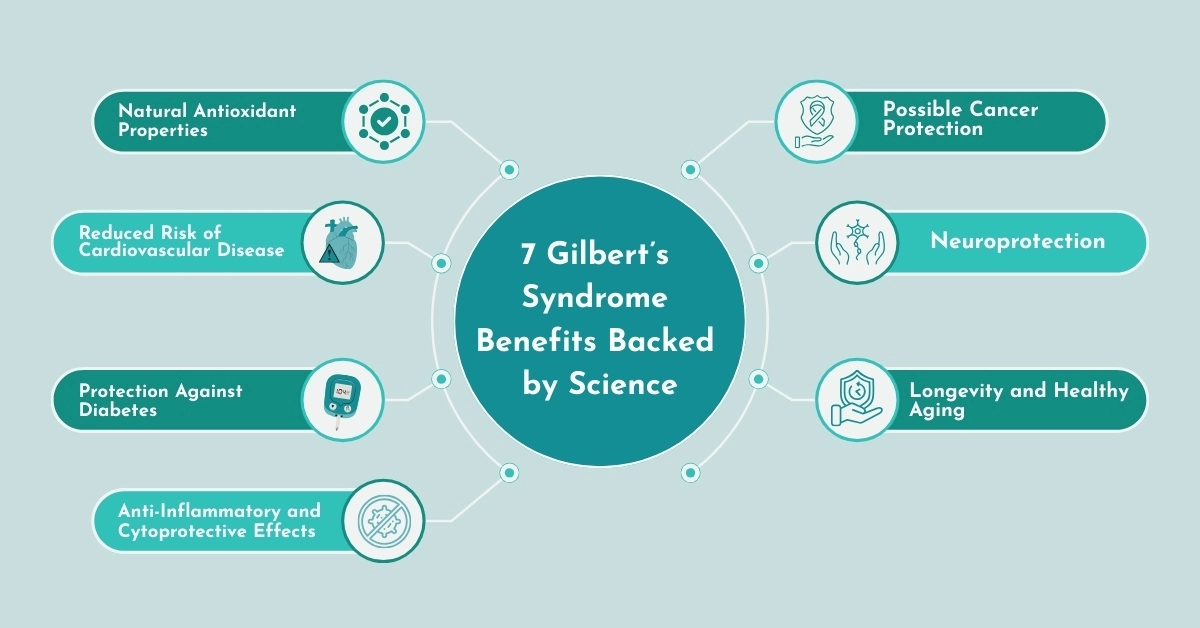
Gilbert Syndrome Benefits: What Research Suggests So Far
1. Natural Antioxidant Properties
The UGT1A1 variant that defines Gilbert’s syndrome leads to mild bilirubin accumulation, and in laboratory studies bilirubin behaves as an antioxidant.
- Increases bilirubin levels, which provides powerful antioxidant protection.
- Reduces the lipid peroxidation that is linked to ageing and cancer risk.
- Protects the tissues from oxidative injury.
So what starts as reduced enzyme activity may not be a disadvantage at all, although the human evidence is still observational.
2. Reduced Risk of Cardiovascular Disease
- Population studies have reported lower cardiovascular disease rates among people with higher bilirubin levels.
- Due to reduced plaque formation, the patients have less chances of atherosclerosis risk
- Antioxidant has a unique property that protects the heart and the blood vessels
FDA labeling lists UGT1A1 as a pharmacogenomic biomarker for medicines such as irinotecan and atazanavir. That is about drug safety, not about cardiovascular risk, and no guideline uses bilirubin levels to predict heart disease.
3. Protection Against Diabetes and Metabolic Disorders
- A person with Gilbert’s syndrome has less risk of metabolic syndrome.
- Some studies report lower rates of type 2 diabetes, possibly related to insulin sensitivity.
- Improves healthier cholesterol levels.
This suggests Gilbert’s syndrome may be more than a harmless condition, though a metabolic advantage has not been proven.
4. Anti-Inflammatory and Cytoprotective Effects
- Bilirubin has a unique property because it has anti-inflammatory properties that are used for reducing cytokine activity in the body.
- Provides cytoprotective effects at the cellular level.
- Anti-inflammatory and cytoprotective must support cellular health and also lower the autoimmune-related damage in the patient body.
Thus, the genetic basis of Gilbert’s syndrome helps the body maintain a healthier balance between the immune system and inflammation.
5. Possible Cancer Protection
- Some observational studies have reported lower rates of certain cancers in people with higher bilirubin levels. This does not show that Gilbert’s syndrome prevents cancer.
- This is linked to bilirubin’s antioxidant and anti-inflammatory mechanisms.
Much more study is needed before anyone can say Gilbert’s syndrome carries a longevity advantage. Observational data cannot show cause and effect, and people with Gilbert’s syndrome still need the same cancer screening as everyone else.
6. Neuroprotection
- Researchers have looked at whether higher bilirubin relates to Alzheimer’s disease and Parkinson’s disease risk. Findings are mixed and no protective effect is established.
- Mechanisms include oxidative stress reduction and improved neuronal health.
7. Longevity and Healthy Aging
- Because higher bilirubin is associated with lower rates of cardiovascular disease, diabetes and chronic inflammation, some researchers have asked whether it relates to life expectancy. That question is open.
- Research indicates that people with UGT1A1 gene variations often experience healthier aging with fewer metabolic issues.
Lifestyle Recommendations for Gilbert’s Syndrome Patients
| Lifestyle Factor | Recommendation | Reason/Benefit |
| Diet & Hydration | Balanced meals, avoid extreme fasting, stay hydrated | Supports bilirubin clearance & liver stability |
| Stress Management | Relaxation, adequate sleep | Prevents jaundice flare-ups |
| Alcohol & Drugs | Avoid excessive alcohol, hepatotoxic drugs | Reduces liver strain |
| Exercise | Moderate physical activity | Improves circulation & metabolic health |
| Medical Checkups | Routine liver function monitoring | Confirms benign course, excludes other diseases |
Related Conditions & Differential Diagnosis
It’s important to distinguish Gilbert’s syndrome from other disorders:
- Gilbert’s Syndrome vs. Crigler-Najjar Syndrome: Crigler-Najjar is severe, with dangerously high bilirubin.
- Gilbert’s Syndrome vs. Hemochromatosis: Hemochromatosis involves iron overload, unlike bilirubin elevation.
- Hemolysis: Also causes high unconjugated bilirubin, but with anaemia and red cell destruction.
- Liver disease differential diagnosis: Unlike cirrhosis or hepatitis, Gilbert’s syndrome does not cause permanent liver injury.
Future Research on Gilbert’s Syndrome Benefits
Emerging studies suggest new applications for the heme oxygenase pathway and bilirubin biology:
- Exploring genetic therapies that mimic Gilbert’s state.
- Using bilirubin as a biomarker for cardiovascular risk reduction.
- Investigating cancer-preventive mechanisms.
- Gilbert’s syndrome might be reclassified not as a disorder, but as a genetic adaptation that benefits human health.
Foods and Lifestyle Considerations
While Gilbert’s Syndrome has potential health benefits, certain dietary triggers can worsen symptoms.
| Avoid / Limit | Better Choices |
| High-fat, processed foods | Lean proteins, whole grains |
| Alcohol | Herbal teas, hydration |
| Prolonged fasting | Balanced small meals |
| Excessive sugar | Fruits, vegetables rich in antioxidants |
Personalized Insights with PGx Testing from RPh Labs
Gain knowledge of your genetic makeup with the pharmacogenomic test (PGx test) offered by RPh LABS. In case of a diagnosis of Gilbert’s syndrome, PGx tests add an extra level of safety with the identification of the ways genetic variation, for instance, mutation of the UGT1A1 gene, affects drug metabolism. This aspect comes prominently into play with pharmaceutical agents like irinotecan, atazanavir, or certain analgesics, where incorrect dosing can cause serious side effects.
By adopting PGx results as part of treatment plans, clinical professionals can tailor drug choices, minimise the chances of drug-related adverse events, and improve clinical efficacy. Obtain the comfort of at-home PGx test kits offered by RPh Labs and enjoy the satisfaction of knowing your genetic data aids safer and more efficient healthcare decisions.
Warning: Reduced UGT1A1 activity can raise the risk of side effects from a few specific drugs, such as irinotecan. Knowing your UGT1A1 status before treatment gives your prescriber one more piece of information to work with.
Do you know?
PGx (pharmacogenomic) tests have the ability to reveal how your genes affect your body’s reaction to specific medications. Enter your drug name to see if it’s included in the actionable PGx list.
How the ugt1a1 gene changes bilirubin handling
Bilirubin is not an enzyme. It is a yellow pigment produced when old red blood cells are broken down, and the liver has to attach a sugar group to it before it can leave the body in bile. That attachment step is glucuronidation, and the enzyme that performs it is UDP-glucuronosyltransferase 1A1, encoded by the UGT1A1 gene.
In Gilbert syndrome, a variation in the promoter region of the UGT1A1 gene, most often the UGT1A1*28 allele, reduces how much of that enzyme is produced. Clearance slows, so unconjugated bilirubin builds up slightly in the blood while everything else about the liver stays normal.
The pattern of inheritance is usually described as autosomal recessive, meaning the reduced-activity variant generally has to come from both parents before bilirubin levels rise noticeably. Carriers of one copy are typically unaffected, though other UGT1A1 variants exist and the picture can be less tidy in practice.
That is the whole mechanism. There is no scarring, no inflammation, and no progressive damage, which is why Gilbert syndrome is classed as a benign variation rather than a liver disease. Background on gene naming and star alleles is maintained by PharmVar.
What makes bilirubin levels rise on a given day
People with Gilbert syndrome often notice their eyes look faintly yellow in some weeks and not others. Bilirubin levels fluctuate with predictable stressors, which is a useful thing to recognize rather than worry about.
- Fasting or skipping meals, including a long gap before a blood test.
- Dehydration, particularly after exercise or in hot weather.
- Illness and infection, even a common cold.
- Physical exertion and poor sleep.
- Alcohol, especially binge drinking.
- Menstruation in some people.
- Surgery and general anesthesia, which is why jaundice occasionally shows up after an operation.
Mild jaundice in these settings is not an emergency for someone already diagnosed. What does need attention is dark urine, pale stools, itching all over, abdominal pain, or feeling genuinely unwell, because those point away from Gilbert syndrome and toward something else.
Regular meals, steady hydration, and moderate alcohol intake keep bilirubin levels in their usual range for most people. There is no treatment to lower them, and none is needed.
How gilbert syndrome is diagnosed
Most diagnoses are made by accident when routine bloodwork shows a mildly raised bilirubin with everything else normal. Confirming it is a matter of excluding alternatives rather than finding a single positive test.
- A split bilirubin measurement shows that most of the excess is unconjugated bilirubin rather than the conjugated form.
- Liver enzymes (ALT, AST, alkaline phosphatase) and albumin are normal, which points away from hepatitis or bile duct obstruction.
- A full blood count and reticulocyte count, and sometimes a haptoglobin or blood film, rule out hemolysis, where red cells are being destroyed too fast.
- Viral hepatitis serology is checked when the history or enzymes suggest it.
- Results are repeated after a few weeks, ideally not immediately after fasting or illness.
- Genotyping for UGT1A1*28 is available but is rarely needed for diagnosis, since the biochemical picture is usually enough.
An important practical point: a raised bilirubin on its own should never be dismissed as Gilbert syndrome without that basic work-up, because hemolysis and bile duct problems can look similar at first glance.
Once confirmed, it does not need specialist follow-up. Ask that the diagnosis is recorded clearly in your chart, so a future clinician does not repeat the whole investigation.
Reading the unconjugated bilirubin research honestly
You will see Gilbert syndrome described as protective against heart disease, diabetes, cancer, and dementia. There is a real scientific idea behind this: bilirubin is an antioxidant in the laboratory, and population studies have repeatedly found lower rates of cardiovascular disease in people with higher bilirubin levels.
The gap is in what those studies can prove. They are observational, which means they show an association rather than cause and effect, and they cannot rule out other explanations. No trial has raised someone’s bilirubin and shown fewer heart attacks as a result.
So the fair summary is that mildly raised unconjugated bilirubin looks metabolically favorable and is certainly not harmful, while claims of proven protection against cancer, Alzheimer disease, or a longer life go beyond the evidence. Treating Gilbert syndrome as a health advantage to be relied on is not warranted.
What you can take from it is reassurance. This is a variation to know about for medication safety, not a condition to manage, and not a reason to skip the ordinary things that do protect your heart.
Medicines that need extra care with gilbert syndrome
This is the part of Gilbert syndrome with genuine clinical weight, because a few drugs rely on the same UGT1A1 enzyme or share its pathway. Decisions here are made with your prescriber, who weighs the gene result alongside kidney function, liver tests, and your other medicines.
- Irinotecan, a chemotherapy used in colorectal and other cancers. Reduced UGT1A1 activity raises the risk of severe neutropenia and diarrhea, and the FDA label and pharmacogenomic guidelines address genotype-guided starting doses.
- Atazanavir, an HIV protease inhibitor. Reduced UGT1A1 activity makes visible jaundice much more likely, which is uncomfortable rather than dangerous, and often prompts a switch to an alternative.
- Nilotinib and pazopanib, targeted cancer therapies where raised bilirubin is common and can complicate dose decisions.
- Acetaminophen in high or repeated doses, which is glucuronidated in the liver. Stay within the labeled maximum and tell your prescriber about Gilbert syndrome.
The FDA maintains a public table of pharmacogenomic biomarkers in drug labeling that lists UGT1A1 among them. Never adjust a chemotherapy or antiviral dose yourself; the point of knowing your genotype is that the prescriber can set it correctly from the start.
What a ugt1a1 gene result on a pgx panel does and does not tell you
UGT1A1 is one of the 20 genes on the RPh Labs panel, which makes Gilbert syndrome one of the few topics where a pharmacogenomic (PGx) report genuinely connects to a named condition. It is worth being precise about the boundary.
A PGx result describes your predicted UGT1A1 activity, which is prescribing information for drugs like irinotecan and atazanavir. It is not a diagnosis of Gilbert syndrome, does not measure your current bilirubin, and does not assess your liver. Only blood tests do those things.
Equally, a PGx panel does not report disease risk. It says nothing about your chances of heart disease, diabetes, or cancer, whatever the bilirubin literature suggests. That is a different kind of testing, ordered through a clinician or genetic counselor.
Where the report earns its place is timing. Knowing your UGT1A1 status before oncology or HIV treatment begins is more useful than discovering it after a severe reaction. Our medication list shows which drugs map to which genes, and the at-home cheek swab kit reports all 20 genes against more than 240 medications, with a PharmD review of every report.
Living with it, and what to tell a new clinician
Day to day, Gilbert syndrome asks very little of you. There is no diet that fixes it and no supplement that lowers bilirubin levels, so the practical work is mostly about communication.
- Say you have Gilbert syndrome whenever bloodwork is ordered, so a mildly high bilirubin is not treated as a new problem.
- Mention it before surgery, chemotherapy, or starting HIV therapy, since the timing of a UGT1A1 result matters most before treatment.
- Keep meals regular and fluids steady, particularly during illness or before a fasting blood draw.
- Ask for a copy of the liver function tests that established the diagnosis, and keep it with your records.
- Report dark urine, pale stools, persistent itching, or right upper abdominal pain rather than assuming it is your usual pattern.
Family members sometimes ask whether they should be tested. Since the condition is harmless on its own, testing is usually only worth it when a relative is about to start a UGT1A1-relevant medicine, and that is a conversation for their prescriber.
If you take several medicines and want a plain-language explanation of what a gene report covers, start with what PGx testing is.
When liver function tests point away from gilbert syndrome
Because mild jaundice is easy to attribute to a known diagnosis, it is worth knowing the conditions that look similar. Each one is separated by the pattern of bilirubin and the accompanying liver function tests.
- Hemolysis: raised unconjugated bilirubin with anemia, a high reticulocyte count, and low haptoglobin. Causes include G6PD deficiency and autoimmune hemolysis.
- Crigler-Najjar syndrome: a rare, much more severe UGT1A1 deficiency that presents in infancy with very high bilirubin.
- Dubin-Johnson and Rotor syndromes: benign conditions where the raised bilirubin is conjugated rather than unconjugated.
- Viral or drug-induced hepatitis: raised ALT and AST alongside the bilirubin.
- Bile duct obstruction: raised alkaline phosphatase, pale stools, dark urine, and often pain or itching.
- Alcohol-related and fatty liver disease: abnormal enzymes and imaging changes.
Any new symptom or a change in the usual pattern deserves repeat liver function tests rather than reassurance from an old diagnosis. Gilbert syndrome does not protect you from developing another liver problem later.
Bring your previous results to that appointment. A clinician comparing today’s numbers with a stable baseline can usually sort this out quickly.
Conclusion
On initial observation, Gilbert’s syndrome appears as a benign liver disease due to a mutation of the UGT1A1 gene. Research suggests it may be more than that. The variant leads to mildly elevated bilirubin, which behaves as an antioxidant in laboratory studies. Observational studies have linked it with lower rates of cardiovascular disease, type 2 diabetes and chronic inflammation, though none of that is proven.
Rather than a defect, Gilbert’s syndrome may be an interesting example of how a common variant in a gene’s promoter region, which simply dials down how much enzyme is made, might protect rather than harm.
Gilbert syndrome questions people ask
What foods should people with Gilbert’s syndrome avoid?
People with Gilbert’s syndrome should avoid highly processed foods, excess alcohol, and crash diets. Eating balanced meals with fruits, vegetables, lean protein, and hydration helps maintain stable bilirubin levels.
What percentage of people have Gilbert’s syndrome?
Gilbert’s syndrome is common, and prevalence estimates vary widely between populations and by how it is defined. It is reported more often in men than women, and is often picked up in adolescence or early adulthood.
What supplements are good for Gilbert’s syndrome?
Supplements like vitamin D, folate, and B-complex may help support liver health. However, it’s best to consult a doctor before starting any supplement with Gilbert’s syndrome.
Can I fast with Gilbert’s syndrome?
Fasting can raise bilirubin levels in people with Gilbert’s syndrome. Short fasts may be tolerated, but long or frequent fasting is not recommended without medical advice.
Is Gilbert’s syndrome inherited?
Yes, Gilbert’s syndrome is inherited. It happens due to changes in the UGT1A1 gene. A person must inherit the altered gene from both parents to develop this condition.
Does Gilbert’s syndrome protect against heart disease?
Research suggests that bilirubin in Gilbert’s syndrome acts like an antioxidant. This protective effect may reduce the risk of heart disease, making cardiovascular problems less common in these patients.
Can Gilbert’s syndrome increase life expectancy?
Some observational studies have reported lower rates of chronic disease in people with higher bilirubin levels, but no study shows that Gilbert’s syndrome makes people live longer. It is an open research question.
Can PGx testing help people with Gilbert’s syndrome?
Pharmacogenomic testing reports your UGT1A1 status, which matters for a few drugs such as irinotecan and atazanavir. It does not diagnose Gilbert’s syndrome, and your prescriber decides what to do with the result.
Do I need treatment for Gilbert syndrome?
No. There is no treatment and none is needed, because the liver is structurally normal and the raised unconjugated bilirubin does not damage tissue. The useful steps are recording the diagnosis in your chart and telling prescribers before starting medicines that rely on the same UGT1A1 enzyme.
Will my liver function tests always be abnormal?
Only the bilirubin should be raised, and usually mildly. ALT, AST, alkaline phosphatase, and albumin are normal in Gilbert syndrome. If those enzymes become abnormal, something else is going on and it needs investigating rather than being attributed to your existing diagnosis.
Should I get a ugt1a1 gene test if I have already been diagnosed?
Not for the diagnosis itself, which the blood pattern already establishes. Genotyping becomes useful when a UGT1A1-relevant medicine is being considered, particularly irinotecan or atazanavir, because the prescriber can then set the starting dose or choose an alternative in advance.
Can I drink alcohol with Gilbert syndrome?
Moderate drinking is generally tolerated, though alcohol and binge drinking often push bilirubin up temporarily and can make jaundice visible. The usual health limits still apply for everyone. Ask your own clinician, particularly if you take medicines processed by the liver.
Is Gilbert syndrome linked to fatigue or digestive problems?
Reported often, but the evidence is mixed and mild fatigue is common in the general population too. Bilirubin levels do not track symptoms reliably. It is worth checking for other causes such as thyroid problems, anemia, sleep issues, or celiac disease rather than assuming.
Does Gilbert syndrome affect pregnancy?
It is not considered a risk to pregnancy, and bilirubin may fluctuate with nausea, vomiting, or reduced eating. Mention the diagnosis at your first prenatal visit so abnormal results are interpreted correctly, and review any regular medicines with your prescriber as you would otherwise.



Leave a Reply