

Does adderall increase metabolism is one of the most searched questions about this medicine, and the answer has two halves. Does adderall speed up metabolism at all? A stimulant does nudge the body’s resting energy use, but most of the weight change people notice comes from eating less. Separating those two makes the rest of the topic much clearer.
On this page
Introduction
People diagnosed with attention-deficit/hyperactivity disorder (ADHD) are normally prescribed Adderall, and their focus, along with impulse control, markedly improves. In clinical settings and public discussions, one question that does come up is “Does Adderall Increase Metabolism?”. The answer is complex: the response to the medication is complex due to an individual’s unique physiological responses and genetic factors.
In this article, we will analyse the impact of Adderall on metabolism, with a particular focus on genetic factors. and explain how RPH Labs’ genetic testing kit can aid in formulating safe, efficient, and tailored approaches to treating ADHD.
Learning About Adderall and How It Works
What is Adderall and its working? Adderall consists of two medications: dextroamphetamine and amphetamine, and falls under the class of stimulants. Adderall works by increasing the concentration of norepinephrine and dopamine in the body’s system, particularly in the brain. These two neurotransmitters are responsible for performing executive functions such as behavioural inhibition and focusing on tasks. Also, interestingly, Adderall affects the sympathetic division of the nervous system, the one which drives body functions like heart rate and energy use.
This is because Adderall is used as a primary treatment for attention deficit hyperactivity disorder (ADHD). Its effects do not stop there, however. Many patients report perceived increases in metabolic rate, particularly when they sense changes in their appetite or weight.
The Metabolic Effects of Adderall
Adderall’s metabolic effect is due to its capacity to induce physiological stimulation. It elevates levels of catecholamines, i.e., epinephrine, norepinephrine, and dopamine that possess the potential of increasing an individual’s basal metabolic rate (BMR). The term is intended to be used to describe the energy the body uses when it is resting or fasting.
Some people do use a little more energy at rest while taking it, though how much is not well established and varies from person to person. This increase can be a factor in weight loss, a phenomenon that has been noted by many Adderall users in the initial stages of their use.
The drug also affects hypothalamic regulation of appetite, the appetite control center of the brain, making you feel less hungry. Eating less will maximise weight loss, especially when combined with an increased BMR. But responses may vary between individuals. Some reduce pounds quickly, while others see little changes in their body. Your age, daily routine, and genetics all shape how Adderall affects your metabolism, proving it’s far from a universal fix.
The Genetic Role in Adderall Metabolism
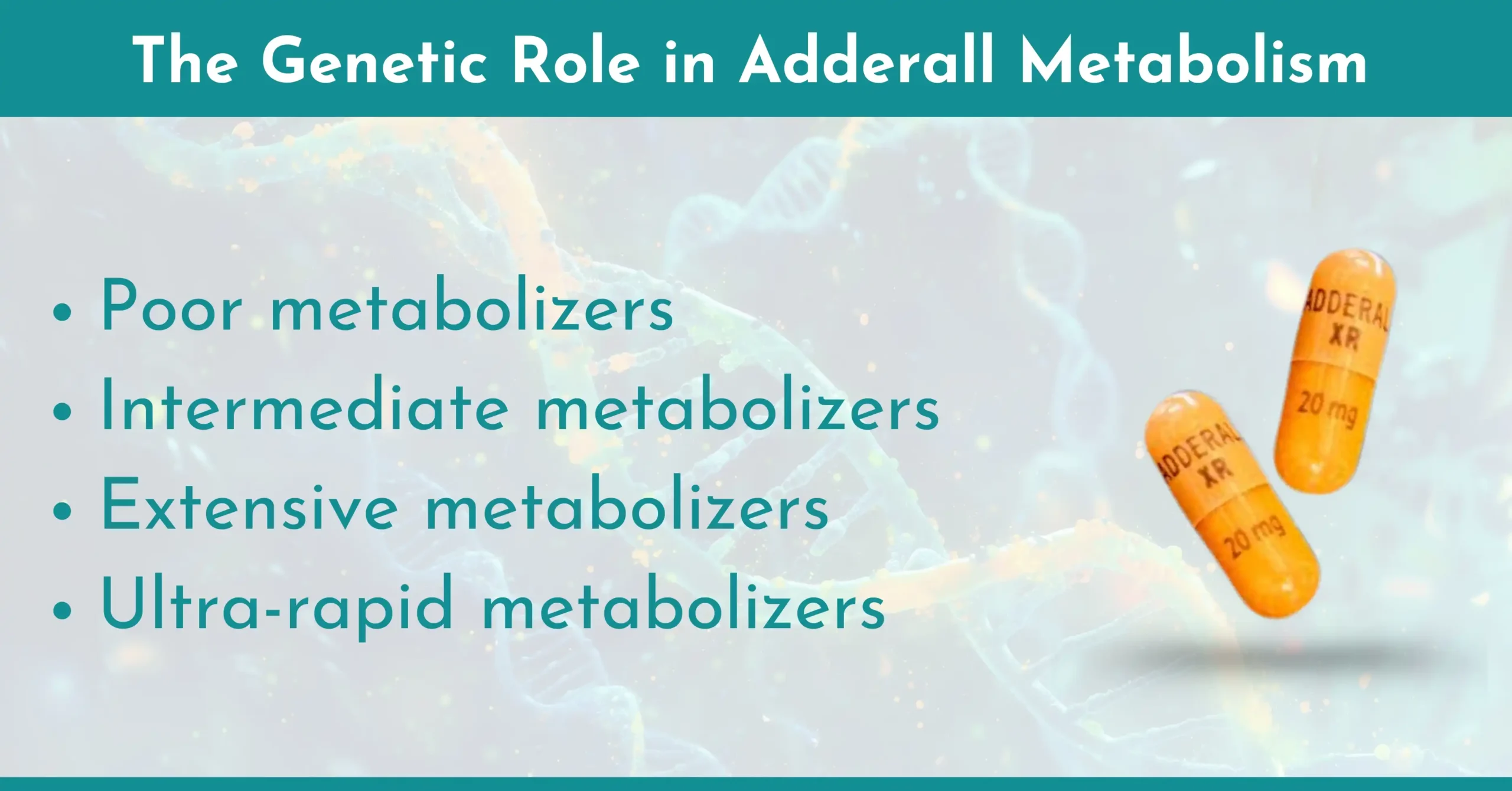
Why would Adderall have such a profound metabolic effect on some individuals, and in effect, none at all on others? Part of the answer lies in your DNA, in the CYP2D6 gene. That gene shapes an enzyme in your liver that helps break down amphetamine in Adderall, although a large share of each dose leaves the body unchanged in the urine, so genetics is only one of several things that affect how long the drug is active and how strongly you feel it.
Based on their CYP2D6 gene, people fall into four categories:
- Poor metabolizers process Adderall more slowly, exhibiting prolonged systemic retention. This can worsen adverse drug reactions like appetite loss or jitters, often leading to more noticeable weight changes.
- Intermediate metabolizers move at a moderate pace, with slightly longer effects but generally steady results.
- Extensive metabolizers, the better group, handle Adderall at a normal rate, getting typical outcomes.
- Ultra-rapid metabolizers clear the drug quickly, so the effect can wear off sooner than expected. Any change to the dose is a decision for your prescriber, since no guideline sets an amphetamine dose from CYP2D6.
These genetic factors in drug response explain why Adderall’s metabolic effects, like Adderall as weight loss, vary so much. A slow metabolizer might drop more weight due to longer-lasting appetite suppression, while a fast metabolizer may experience negligible metabolic changess. Knowing your CYP2D6 profile is one piece of the picture, and your prescriber weighs it alongside how you actually respond.
Customised Treatment Based on Genetic Testing
Pharmacogenomics is revolutionising how ADHD is treated, and for a good reason. For Adderall, a CYP2D6 result is background rather than a dosing rule, because no published guideline converts CYP2D6 activity into an amphetamine dose. It is one more piece of information the clinician can weigh while adjusting the plan from how you respond.
As an example, a slow metabolizer who reports side effects like insomnia or tachycardia gives the prescriber one more reason to move slowly. Someone whose dose seems to wear off early may do better with a different formulation or schedule. A gene test does not diagnose ADHD, and the response seen in the clinic still leads the decision.
Introducing RPH Labs’ Genetic Testing Kit
RPH Labs is leading the charge in personalised ADHD care with its gene testing for medication metabolism kit. This easy-to-use tool checks genes like CYP2D6 to show how you process Adderall and other drugs. You just collect a cheek (buccal) swab, send it to the CLIA-certified lab in the prepaid mailer, and get a clear report reviewed by a PharmD pharmacist. This report helps you and your doctor adjust your ADHD treatment, making it both effective and safe.
What makes the RPH Labs kit stand out is its simplicity and precision. It doesn’t just cover Adderall—it gives insights into other medications, making it a handy treatment for long-term health planning.
Integrating Genetic Insights into ADHD Management
Adding genetic testing to ADHD care is a game-changer. Data from the RPH Labs genetic testing kit gives doctors extra context about how you process many medications. For Adderall it does not select the dose, but it can flag other prescriptions where genotype really does change the guidance. A slow metabolizer might start with a low dose to avoid experiencing stimulant-induced overstimulation, while a typical metabolizer could stick with a standard plan and regular check-ins.
For patients, genetic testing brings a sense of ownership. Knowing how your body handles Adderall makes you feel more in tune with your care, boosting confidence and commitment. It also helps with long-term planning across the other medications you may be prescribed, and it sits alongside lifestyle changes that complement the therapy. This approach makes ADHD management more effective and is built just for you.
Does adderall speed up metabolism, or mainly reduce appetite?
Amphetamines act on the sympathetic nervous system, the branch that drives the fight or flight response. That raises heart rate, blood pressure and body temperature a little, and a body running slightly warmer and faster does use somewhat more energy at rest.
So when people ask does adderall speed up metabolism, the fair answer is that there is a real but modest effect on resting energy use, and it is not the main reason the scale moves. Published figures vary widely and depend on dose, body size and how long someone has been taking the medicine, which is why we do not quote a percentage here.
Two meanings of the word metabolism
Much of the confusion comes from one word carrying two jobs. Metabolic rate means how much energy your body burns. Drug metabolism means how your liver enzymes break down a medicine. They are unrelated questions, and a faster drug metabolizer does not burn more calories.
Keeping them separate matters when reading claims online, because does adderall speed up metabolism and how fast you clear the drug are different questions, because does adderall increase metabolism gets answered with gene test marketing that is really about drug clearance.
How adderall appetite suppression plays out over a day
Adderall appetite suppression is usually the bigger driver of weight change. Stimulants act on brain circuits involved in hunger signaling, so many people simply do not feel like eating while the medicine is active.
Adderall appetite suppression follows a fairly predictable pattern. Breakfast is fine because it comes before or with the dose, lunch gets skipped, and hunger arrives in the evening once coverage fades. That can mean far fewer calories across the day even with no intention to diet.
- Immediate release doses tend to blunt appetite in blocks, with hungry gaps between.
- Extended release capsules can flatten appetite for most of the working day.
- Evening rebound hunger is common and is not a sign of weakness.
- Thirst signals can be dulled too, so dehydration and headaches are easy to miss.
If adderall appetite suppression is costing you meals or weight, that belongs in your next appointment. Prescribers can change the timing or the formulation, and a dietitian referral is sometimes the more useful fix.
Adderall weight loss is a side effect, not a treatment
This point is worth stating plainly. Adderall is approved for ADHD and narcolepsy. It is not approved as a weight loss drug, and adderall weight loss is listed among side effects rather than benefits.
Pursuing adderall weight loss on purpose carries real risks: higher blood pressure and heart rate, poor sleep, anxiety, dependence and, with a Schedule II controlled substance, legal consequences for taking someone else’s prescription. Weight lost this way also tends to return when the medicine stops.
There is a further concern. Stimulants can mask or worsen disordered eating, and appetite suppression can make restriction feel effortless. If food, weight or body image are becoming a preoccupation, tell your prescriber, because that changes how the medicine should be handled.
For general background on the condition Adderall is actually approved to treat, the National Institute of Mental Health keeps a plain overview of attention deficit hyperactivity disorder.
Eating well when appetite is low
You cannot always argue with a suppressed appetite, but you can plan around it. None of these steps involves changing your prescription.
- Eat breakfast before or at the same time as the dose, while hunger is still present.
- Put a scheduled lunch in the calendar and eat it whether or not you feel hungry.
- Choose foods that deliver protein and calories in a small volume, such as eggs, yogurt, nut butters or milk based drinks.
- Drink water on a schedule, since thirst cues can be blunted.
- Keep an evening meal available so rebound hunger does not turn into a late night binge.
- Weigh yourself at the same time of day once a week rather than daily.
Adderall appetite suppression is not a reason to add diet products either, so ask your prescriber or pharmacist before adding supplements or protein products, especially anything marketed for energy or weight loss, because many contain stimulants that stack with your medicine.
If adderall weight loss continues despite these steps, or if you feel faint, weak or unusually cold, contact your prescriber. Those are reasons for review rather than for pushing through.
Children, growth and what should be monitored
In children and teenagers, adderall appetite suppression matters more, because growth is happening. Height and weight are usually plotted at each visit for exactly this reason, and a slowing of expected growth is one of the things prescribers watch for.
Parents often find that the school day is the problem, since coverage lands exactly over lunch. Practical answers include a bigger breakfast, a calorie dense packed lunch, and a substantial after school meal, all discussed with the clinician.
Never adjust a child’s dose, skip doses on weekends or take a medication holiday on your own. Those decisions are sometimes made deliberately by a prescriber, and sometimes they are the wrong call, but they should not be improvised at home.
What to bring to a growth review
A simple log of meals actually eaten, weekly weights, sleep times and appetite patterns gives the clinician much more to work with than a general impression. Bring it to every visit while growth is a concern.
Adderall weight gain after stopping the medicine
Many people notice adderall weight gain after stopping, and it usually has a simple explanation: appetite returns to normal while eating habits built around a suppressed appetite stay in place for a while.
Because the answer to does adderall increase metabolism was only a modest effect on resting energy use to begin with, the rebound is mostly about food intake rather than a damaged metabolism. Sleep normalizing and activity levels changing both play a part as well.
Stopping a stimulant after long regular use can also bring a stretch of heavy fatigue and low mood, which makes cooking and exercise harder in the first weeks. That is another reason to plan any stop with your prescriber rather than doing it abruptly, and to call or text the 988 Suicide and Crisis Lifeline in the United States if hopelessness or thoughts of self harm appear.
If adderall weight gain after stopping worries you, ask for a plan that covers meals, sleep and activity rather than restarting a stimulant for weight reasons. Also know the emergency line: for a suspected overdose, call 911 or Poison Control at 1-800-222-1222.
What genes can honestly say about does adderall increase metabolism
Nothing about your genes tells you how many calories you will burn on a stimulant. Where pharmacogenomics has something to say is drug clearance, and even there the picture for amphetamine is limited.
CYP2D6 contributes to amphetamine metabolism, but a large share of the dose leaves the body unchanged in the urine and other routes share the rest. There is no CPIC dosing guideline for amphetamine, which you can confirm on the CPIC guidelines site. So a gene result does not set your dose, and it certainly does not answer does adderall increase metabolism for your body.
Where a panel does carry real weight is the rest of a prescription list. Many antidepressants depend on CYP2D6 and CYP2C19, atomoxetine has published CYP2D6 guidance, and codeine, tramadol, clopidogrel and simvastatin all have well established gene pairs. Our page on which medications need a PGx test first ranks them by evidence.
The RPh Labs at home PGx kit uses a cheek swab, covers 20 genes and reports against more than 240 medications, with every report reviewed by a PharmD pharmacist and a pharmacist consultation included. Ask us what it will and will not answer before you order.
What to track and what to ask your prescriber
Questions like does adderall increase metabolism get answered faster when you bring numbers instead of impressions.
- Weekly weight, measured the same way at the same time of day.
- Meals actually eaten, not meals intended.
- Dose times and the hours appetite disappears.
- Sleep start and wake times.
- Blood pressure and pulse readings if you have a cuff at home.
- Any new supplement, energy drink or over the counter product.
Then ask the direct questions: is this amount of weight change acceptable? Should the timing or formulation change? Do we need a dietitian, a growth review, or a blood pressure check? What should make me call before the next visit?
Do not raise, lower or stop the medicine yourself, and do not use it for adderall weight loss purposes. If you want to understand how gene guided prescribing works before that appointment, what is PGx testing explains it in plain language, and our FAQ covers the practical questions about testing.
Conclusion
Adderall can increase metabolic activity, often boosting calorie burn and decreasing appetite, which may lead to weight loss. But its effects differ wildly, driven by your genes. Genes such as CYP2D6 are one part of these differences, though they are not the whole story and no gene test sets an Adderall dose. RPH Labs’ genetic testing kit offers a clear, practical way to understand how Adderall works in your body, opening the door to personalised ADHD treatment.
Disclaimer: This content is based on extensive research and is for informational purposes only. Always consult a healthcare professional before making medical decisions.
Does Adderall increase metabolism FAQ
Will the metabolic effect of Adderall fade over time?
The rise in heart rate, blood pressure and temperature tends to become less noticeable as your body adjusts, and appetite suppression often eases somewhat too. Any lasting change in resting energy use is modest either way. If weight is still falling months in, that is a reason for review rather than reassurance.
Is it safe to take Adderall for weight loss if I also have ADHD?
Treatment should target ADHD, not the scale. Tell your prescriber if weight has become a motivation, since that changes monitoring and may change the medicine. Using a stimulant deliberately to lose weight raises cardiovascular risk, harms sleep and can conceal disordered eating.
Does adderall appetite suppression mean I should skip meals?
No. Skipping meals leads to headaches, shakiness, poor concentration and unintended weight loss, which works against the reason you are taking the medicine. Eat on a schedule even without hunger, and choose foods that deliver protein and calories in a small volume.
How much weight comes back after stopping?
It varies. Adderall weight gain after stopping usually reflects appetite returning rather than a broken metabolism. Building regular meals, sleep and activity before stopping helps. Plan the stop with your prescriber, since abrupt discontinuation after long use can bring a stretch of fatigue and low mood.
Can a gene test tell me whether I will lose weight on Adderall?
No. Genes do not predict calorie burn, and amphetamine has no gene based dosing guideline either. A panel is more useful for antidepressants, atomoxetine, codeine, clopidogrel and statins, where published guidance exists. Ask your prescriber whether your medication list makes testing worthwhile.
Should I use caffeine or diet products alongside Adderall?
Check with your prescriber or pharmacist first. Many energy and weight loss products contain stimulants that stack with amphetamine, adding to a fast heart rate, jitteriness and insomnia. Combining them can make a reasonable dose feel far too strong and makes side effects hard to interpret.



Leave a Reply