

Are ear infections contagious is one of the most common questions in a pediatric waiting room, usually asked by a parent with a second child at home. The short answer is no, but the germs behind them do spread. Here is what that means in practice.
On this page
Ear infections are very common, especially in children. Many individuals, especially parents, ask: Are ear infections contagious? The answer is not that straight, while ear infections are not contagious, but you can catch the cold or flu virus which often leads to one. Think of it this way—your friend’s ear pain is not contagious, but their sneeze might still give you the cold that could later turn into your own ear infection.
Are Ear Infections Contagious?
No, ear infections are not contagious. However, here is how they may spread;
- The infection in the ear itself does not spread from person to person.
- What can spread are the viruses and bacteria that cause the infection in the first place.
- Example: If your child has an ear infection because of a cold virus, their sibling may catch the cold—not the ear infection. But after catching the cold, the sibling might develop their own ear infection a few days later.
How Do Ear Infections Spread if Not Contagious?
You can’t spread the fluid or inflammation in the ear. What spreads are the germs that get into the nose and throat. These germs travel to the middle ear and cause infection.
Everyday examples:
A child in daycare sneezes on toys. Another child touches the toy, rubs their nose, and later develops a cold. That cold blocks the Eustachian tube and leads to an ear infection.
Adults sharing utensils, kissing on the cheek, or being in close contact with someone sick can catch the virus—but not the ear infection itself.
| Type of Spread | Example | What Actually Spreads |
| Viral (cold/flu) | Coughing, sneezing, sharing drinks | Cold or flu virus |
| Bacterial | Sharing utensils, touching contaminated hands | Bacteria like Strep pneumoniae |
| Direct contact | Hugging/kissing someone with a cold | The germs, not the ear infection |
Causes and Types of Ear Infections
The following are some of the causes behind ear infections;
- Otitis Media (Middle ear infections): Usually after a cold. Fluid gets trapped behind the eardrum. Bacteria or viruses grow in that fluid.
- Outer ear infections (swimmer’s ear): Water stuck in the ear canal after swimming or showering creates a moist place where bacteria thrive.
- Inner ear infections (labyrinthitis): Usually caused by viruses, leading to dizziness or balance problems.
Simple example: Imagine the ear like a sink with a drain. If the drain (Eustachian tube) gets blocked by mucus from a cold, water (fluid) collects in the sink (middle ear). That still water is the perfect place for germs to multiply.
Did you know?
The medicines used for ear infections are acetaminophen, ibuprofen and antibiotics such as amoxicillin. None of them has pharmacogenomic dosing guidance, and a PGx panel does not guide their dosing, which is based on age, weight and your clinician’s advice. PGx testing is useful for other medicines, not for these.
Symptoms of Ear Infections
On top of ear fullness/pain, loss of hearing, or headache, the following may be the symptoms:
Middle ear infection symptoms
- Ear pain
- Trouble hearing or muffled sounds
- Fever and irritability
Outer ear infection symptoms
- Pain when you touch or pull the ear
- Redness or swelling around the ear canal
- Fluid or pus draining from the ear
Inner ear infection symptoms
- Sudden dizziness (vertigo)
- Nausea or vomiting
- Balance problems
Know your body’s response to medications
Book an at-home FSA/HSA eligible, PGx test from RPh Labs (a CLIA-certified, COLA-accredited lab) today, and see how your body may respond to 240+ medications.
Prevention and Natural Support for Ear Infections
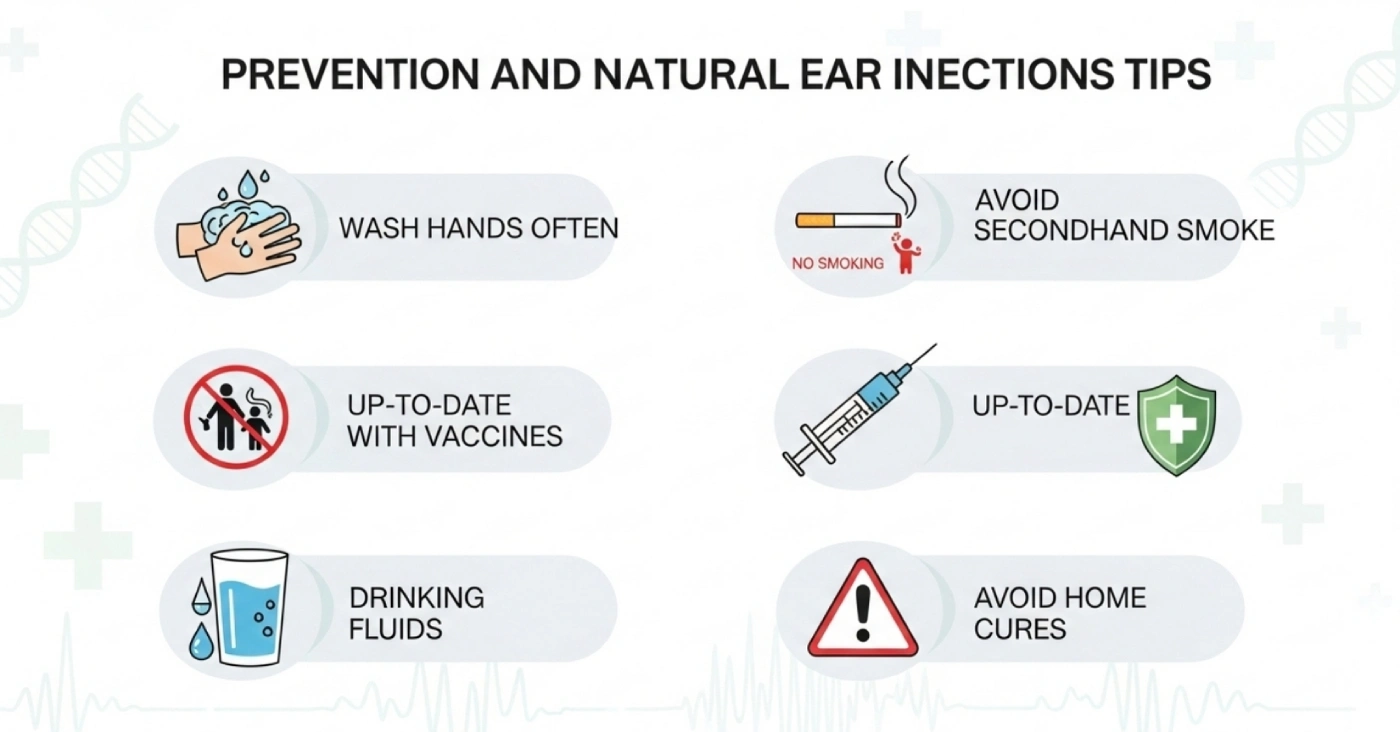
Prevention of ear infection may be possible with:
- Wash your hands often: This reduces the risk of catching colds and flu.
- Avoid secondhand smoke: Smoke irritates the airway and increases infections in children.
- Stay up-to-date with vaccines: Shots like the flu vaccine and pneumococcal vaccine protect against germs that cause ear infections.
- For swimmer’s ear: dry your ears after swimming or bathing. Tilt your head to let water drain or use a hair dryer on low, held at arm’s length.
Natural support may include:
- Warm compress on the ear for comfort
- Drinking fluids and resting so the body heals faster
- Avoid home “cures” like ear candling, garlic oil, or pouring liquids into the ear—they can do more harm than good
Does a Strong Immune System Help?
Yes. Your body’s immune system is your “security guard.” If the guard is strong, it can prevent colds and flu from causing trouble in the ears.
Ways to strengthen the immune system:
- Get enough sleep (7–9 hours for adults)
- Eat fruits, vegetables, lean protein, and whole grains
- Exercise regularly
- Stay hydrated
- Reduce stress
Example: Two kids are exposed to the same cold virus. The child who is well-rested and vaccinated may fight it off quickly, while the tired child may develop a cold that later turns into an ear infection.
Common Medications for Ear Infections
Pain relievers, Antibiotics, and ear drops are commonly used to treat ear infections. Pain relievers like Acetaminophen (Tylenol) and ibuprofen are used to reduce pain and fever.
Doctors prescribe antibiotics only if the infection is bacterial and doesn’t improve on its own. The most common is amoxicillin. The ear drops are usually used for outer ear infections (often in swimmer’s ear).
Are ear infections contagious? 6 clear answers
Most people asking are ear infections contagious want to know whether to keep a child home, share a bed, or worry about a sibling. These six points settle the practical questions.
- The infection inside the ear does not pass from person to person. Fluid behind an eardrum cannot travel to someone else.
- The colds and flu viruses that set ear infections off absolutely do spread, which is where the confusion comes from.
- A sibling who catches that virus may or may not develop an ear infection. Many people get the cold and never get the ear problem.
- An ear infection alone is not a reason to keep a child off daycare or school. A fever, significant pain or feeling unwell usually is.
- Draining fluid from an ear should be treated with ordinary hygiene: wash hands, do not share towels, and get it assessed.
- Swimmer’s ear is a slightly different story, because it comes from water and the ear canal rather than from a cold, and it is still not passed between people.
So the honest framing when someone asks are ear infections contagious is that the trigger is contagious and the ear infection is not. That is why outbreaks of ear infections follow cold season in a nursery without the ears themselves ever infecting each other.
Everything below is the part that usually gets skipped: what is happening in each part of the ear, what to look for in a child too young to explain it, and when treatment actually helps.
Middle ear infection: what happens behind the eardrum
A middle ear infection, called acute otitis media, sits in the small air-filled space behind the eardrum. That space drains and equalizes pressure through the Eustachian tube, which runs down to the back of the nose.
A cold swells the lining of that tube. Drainage stops, pressure changes, and fluid collects. Bacteria or viruses already present in the nose and throat then multiply in the trapped fluid, which is why the ear problem arrives a few days after the runny nose rather than at the same time.
Why children get more of them
- A child’s Eustachian tube is shorter, narrower and more horizontal, so it blocks more easily and drains less well.
- Young immune systems meet each virus for the first time, and colds come in quick succession.
- Enlarged adenoids can sit near the opening of the tube and add to the blockage.
- Group settings mean more exposure to the viruses that start the whole process.
Most of the time a middle ear infection settles on its own without antibiotics for ear infection as the cold clears and the tube reopens. Fluid can linger for weeks afterwards without any infection being present, which is a separate situation called otitis media with effusion and matters mainly for hearing.
Outer ear infection and swimmer’s ear
An outer ear infection, otitis externa, affects the canal between the outside world and the eardrum. It has a different cause, different symptoms and different treatment from the middle ear version, which is why lumping them together leads people astray.
With an outer ear infection the problem is usually moisture. Water sitting in the canal after swimming or showering softens the skin and changes its acidity, and bacteria take advantage. Scratching the canal with cotton buds, fingernails or earbuds gives them an easier entry.
How to tell them apart
- Pain when you tug the outer ear or press in front of it points to an outer ear infection.
- Visible redness or swelling at the canal opening, and sometimes discharge, also point outward.
- Pain with a recent cold, fever and muffled hearing points to the middle ear instead.
- Itching in the canal is common with otitis externa and unusual with otitis media.
Treatment for an outer ear infection is usually ear drops rather than tablets, because the medicine can reach the problem directly. Keep the ear dry while it heals, skip swimming until your clinician says otherwise, and do not put anything in the canal to clean it.
One caution: if there is any chance the eardrum is perforated, or if you have had ear surgery or grommets, some drops are not appropriate. That is a reason to have the ear looked at rather than reaching for leftover drops from last summer.
Ear infection in toddlers: signs before they can tell you
A verbal child says their ear hurts. A one-year-old cannot, so an ear infection in toddlers is usually diagnosed from behavior plus a look inside the ear.
- Crying or waking at night more than usual, often worse when lying flat because pressure changes.
- Tugging, rubbing or batting at one ear, though plenty of well toddlers do this too.
- Refusing feeds or the bottle, because sucking and swallowing change middle ear pressure.
- A fever, irritability or unusual clinginess after several days of a cold.
- Not responding to quiet sounds or their name, which can reflect temporary muffled hearing.
- Fluid or pus on the pillow, which suggests the eardrum has drained.
None of these alone proves anything. With a suspected ear infection in toddlers, the combination of a recent cold, a miserable night and one ear being favored is what usually prompts the visit. An examination with an otoscope is what actually confirms an ear infection in toddlers, and that is not something to attempt at home.
Parents often ask a follow-up to are ear infections contagious: what a drained eardrum means. Sudden relief of pain with discharge is common and usually a good sign that pressure has released. It still needs assessment, because it changes what treatment is appropriate.
When antibiotics for ear infection are needed
Plenty of ear infections are viral, and plenty of bacterial ones resolve without treatment. That is why antibiotics for ear infection are no longer automatic, and why a clinician may suggest waiting 48 to 72 hours with good pain control instead.
That watchful waiting approach is a decision made with a clinician, not a reason to skip an appointment. It generally suits older children who are not very unwell, with one ear affected and no complicating factors.
Situations that usually tip toward treating
- Infants and very young children, where thresholds are lower.
- Both ears affected, high fever, or a child who looks genuinely unwell.
- Discharge from a perforated eardrum.
- Symptoms that are not improving, or are worsening, after a couple of days.
- Underlying conditions, immune problems, or a history of complications.
Amoxicillin is the usual first choice in the US when antibiotics for ear infection are prescribed, with alternatives for people with allergies or recent antibiotic exposure. The dose depends on weight and the course length is set by the prescriber, so follow the label and finish the course as directed rather than stopping when pain eases.
Tell the prescriber about any previous reaction to penicillin, any antibiotic used in the last month, and any other medicines. Leftover antibiotics from a previous illness should never be used for a new one.
Pain and fever relief while you wait
Pain control is the part that matters most in the first day or two, and it is often under-done. Ear pain is genuinely severe, and treating it well is what makes watchful waiting bearable.
- Acetaminophen and ibuprofen are the usual options. For children they are dosed by weight, so use the labeled dose for your child’s weight or the dose your clinician gives you, and use the measuring device that comes with the bottle.
- Do not exceed the labeled frequency, and check that no other product you are giving contains the same ingredient. Combination cold remedies frequently do.
- Ibuprofen is generally avoided in very young infants and in dehydration unless a clinician advises it.
- Never give aspirin to a child or teenager because of the risk of Reye syndrome.
- A warm compress against the ear is soothing and carries no risk.
- Keeping the head slightly raised for sleep can reduce pressure pain.
Skip anything poured into the ear canal, including oils, hydrogen peroxide, onion or garlic preparations and ear candles. They do not help, and if the eardrum is perforated they can do real harm. The original advice on this point in our guide above is worth repeating.
If pain is not controlled by appropriate doses of these medicines, that is a reason to be seen rather than a reason to add more. Ask your pharmacist if you are unsure which product suits your child’s age and weight.
Warning signs that need urgent assessment
The large majority of ear infections are uncomfortable and uneventful. A small number are not, and the signs that separate them are worth knowing before you need them.
Seek same-day medical care for swelling, redness or tenderness over the bone behind the ear, a bulging or pushed-forward ear, severe headache, a stiff neck, confusion or drowsiness, weakness of the face on one side, or sudden severe dizziness with vomiting.
Also seek prompt care for a fever in an infant under three months, a child who is not drinking or has had no wet diapers, pain that keeps worsening despite treatment, or any hearing loss that does not recover once the infection has cleared.
For a child who is very unwell, hard to rouse, struggling to breathe or having a seizure, call 911 or your local emergency number rather than waiting for an appointment. Trust your instinct if something feels different from the usual ear infection.
None of this is a reason to panic about an ordinary earache. It is a reason to know the short list, so that you are watching for the right things instead of worrying about everything.
Recurrent infections, fluid and hearing checks
Some children get one middle ear infection and never another. Others get them repeatedly, and the question shifts from treating each episode to reducing the pattern.
Repeated episodes in a year, or fluid that persists for months after the infection has gone, are both reasons for an ENT opinion. Persistent fluid can muffle hearing, and in the years when a child is learning to talk that matters more than the fluid itself.
What that assessment usually involves
- A hearing test appropriate to the child’s age, which is painless.
- Tympanometry, which measures how the eardrum moves and detects fluid.
- A discussion of adenoid size and nasal symptoms.
- A conversation about ear tubes, also called grommets, if fluid and hearing loss persist.
Ear tubes are a considered decision, not a default. They can help when hearing is affected over months or when infections are frequent enough to disrupt a child’s life. Your ENT weighs the benefits against the small risks and the fact that many children improve with time alone.
Meanwhile, the things that reduce colds reduce ear infections. Avoiding tobacco smoke, keeping vaccinations current, feeding infants upright rather than lying flat, and hand hygiene in group settings all reduce how often the cycle starts.
Where a medication-response panel fits, and where it does not
Pharmacogenomic (PGx) testing reports how your body may process certain medicines. It is worth being precise about it here, because ear infections are mostly treated with medicines that have no gene-guided dosing at all.
There is no established pharmacogenomic guidance for acetaminophen, ibuprofen or amoxicillin, which covers almost everything used for a routine ear infection. Anyone implying a panel will tell you how fast your child processes acetaminophen is overstating what the science supports.
Where it does matter
The clearest example is CYP2D6 and the opioid painkillers codeine and tramadol, which the FDA warns against in children partly because of that gene. Ondansetron, sometimes used for the vomiting that accompanies inner ear problems, is also affected by CYP2D6. Both are on the RPh Labs 20-gene panel.
Longer term, the panel is aimed at people managing ongoing medicines such as antidepressants, statins, clopidogrel or warfarin, not at a one-week course of antibiotics. If you want the underlying evidence, clinicians use the CPIC guidelines.
If it is relevant to your household’s medicine list, the RPh Labs at-home cheek swab kit is $299 self-pay and HSA or FSA eligible, and you can check what is covered on our medication list by gene. For an earache tonight, the right answer is pain relief and a clinician, not a genetic test.
Conclusion
Ear infections are not actually transferred from someone’s ear directly. Instead, it is spread through the cold or flu virus that sometimes leads to one. Good hygiene, vaccines, and a healthy immune system help protect you. In any case, if you experience these conditions, seek urgent help from your doctor for evaluation and treatment.
Disclaimer: This blog is for informational purposes only and does not constitute medical, legal, or professional advice. While we strive for accuracy, errors or omissions may occur.
Some images in this blog may be AI-generated or for illustrative purposes only.
Ear infection questions parents ask most
Can my child go to daycare with an ear infection?
Usually yes, if they are comfortable, have no fever and feel well enough to take part. The ear infection itself does not spread to other children. Keep them home for fever, significant pain, or if there is discharge that has not yet been assessed. Check your daycare’s own policy as well.
How long does a middle ear infection last?
Pain usually improves within two to three days, whether or not antibiotics are used, and most episodes settle within about a week. Fluid behind the eardrum can linger for several weeks afterwards without infection, which may cause muffled hearing. Mention any hearing that has not returned to normal after a month.
Can adults get an outer ear infection too?
Yes, and it is common in swimmers and in anyone who cleans their ears with cotton buds. The symptoms are the same: itching, pain on touching the ear, and sometimes discharge. Treatment is usually drops. Adults with diabetes or a weakened immune system should be seen promptly rather than waiting.
Is ear pain when flying an infection?
Usually not. It is most often pressure that cannot equalize through the Eustachian tube, which is worse during a cold. Swallowing, yawning, or feeding a baby during descent helps. If pain persists for days after the flight, or hearing stays muffled, have the ear examined.
Do antibiotics work faster than waiting?
They shorten symptoms modestly in some children and make no difference in many others, which is why the decision depends on age, how unwell the child is and whether both ears are affected. When antibiotics for ear infection are prescribed, give the full course as directed and go back if there is no improvement in two to three days.
Will repeated infections affect my child’s speech?
Repeated infections are not usually the issue. Persistent fluid causing months of muffled hearing during the years a child is learning to talk can be, which is why hearing tests and ENT review are offered when fluid lingers. Raise any concern about speech or hearing with your clinician early.



Leave a Reply