
The podn gene encodes a protein called podocan, part of the scaffolding that holds tissues together. It appears in cardiovascular and cancer research, and almost never in a clinic. This guide sets out what is genuinely known and what is still laboratory work.
On this page
The PODN gene, also known as Podocan, is part of the family of genes that encode proteins involved in various biological processes. Specifically, it plays a critical role in the structure and function of the extracellular matrix (ECM), which is a complex network of proteins, sugars, and other components that provide structural and biochemical support to surrounding cells. The ECM is essential for maintaining tissue integrity, as it helps to anchor cells in place, facilitating the formation of organized tissues and organs.
Additionally, the ECM is crucial for cellular communication, as it influences various cellular processes such as migration, differentiation, and wound healing. Irregular activities of the PODN gene can lead to a range of symptoms, particularly related to skeletal and connective tissue disorders.
Common Symptoms of Irregular PODN Gene Activities
Research indicates that PODN may serve as a prognostic biomarker in certain cancers, such as gastric cancer. However, currently there is limited direct evidence linking PODN gene (Podocan) dysfunction to specific clinical symptoms in humans.
Studies suggest that this protein could function to inhibit smooth muscle cell proliferation and migration following arterial injury. Moreover, while these findings provide insights into the potential roles of PODN, further research is necessary to determine the exact impact of podocan dysfunction on human health.
What are Genes?
Genes are segments of DNA that contain the instructions for building proteins, which perform most life functions. They are essential for biological inheritance and influence traits, health, and susceptibility to diseases. Variations or mutations (change in a DNA sequence) in genes can disrupt normal function and lead to various health issues.
Does PODN Gene Code for Protein?
Yes, the PODN gene does code for a protein. Specifically, it encodes the podocan protein, which is involved in the regulation of the extracellular matrix. This protein is crucial for cellular structure and function, particularly in the kidney and other connective tissues. Additionally, this gene may play a role in regulating other genes, impacting their expression and function within the cellular environment. According to a study shared by the genecards, “this protein could function to inhibit smooth muscle cell proliferation and migration following arterial injury.”
Important: As the PODN gene (Podocan gene) is not widely recognized in pharmacogenomics, currently a PGx test may not show PODN gene variations. A pharmacogenomic panel covers drug-processing genes rather than structural proteins such as podocan. The at-home RPh Labs test reports 20 of those genes against more than 240 medications, including ADHD medicines and blood thinners such as warfarin.
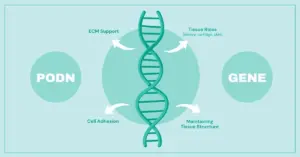
Common Signs of Podocan Irregular Working
Currently, there is no direct evidence linking PODN gene (Podocan) dysfunction to specific clinical symptoms in humans. However, studies in mice have provided insights into its potential role:
- Increased Arterial Lesion Formation: Mice lacking the podocan gene exhibited larger arterial lesions following injury compared to normal mice.
- Enhanced Smooth Muscle Cell (SMC) Proliferation and Migration: The absence of podocan led to increased growth and movement of SMCs in these mice.
These findings suggest that podocan may act as a negative regulator, helping to control the growth and movement of smooth muscle cells after arterial injury.
While these animal studies offer valuable insights, further research is necessary to determine the exact impact of podocan dysfunction on human health.
What is PODN Gene Responsible For?
It plays a vital role in various biological processes, particularly in maintaining the health and functionality of our tissues. Here’s a deeper look at its primary responsibilities:
Producing Podocan Protein
The PODN gene is responsible for producing a specific protein known as podocan. This protein is crucial for the structural integrity of the extracellular matrix (ECM). The ECM is like a scaffold that provides support to cells, helping them maintain their shape and organization within tissues. Podocan contributes to this structure by interacting with other components of the ECM, ensuring that tissues remain resilient and functional.
When podocan levels are normal, tissues can withstand stress and maintain their proper architecture. However, if the PODN gene is not functioning correctly, it can lead to weakened tissue structures, making them more susceptible to damage and disease.
Facilitating Cellular Adhesion and Communication
Another important function of the PODN gene is its role in cellular adhesion and communication. Cells in our body need to stick together to form tissues, and podocan helps facilitate this adhesion. It acts like a glue that holds cells in place, allowing them to work together effectively. Additionally, podocan is involved in signaling pathways that enable cells to communicate with each other.
This communication is essential for coordinating various biological processes, such as growth, repair, and immune responses. When the PODN gene is not functioning properly, it can disrupt these processes, leading to issues such as impaired healing or abnormal tissue development.
Regulating Cellular Activities in Tissues
The PODN gene also plays a significant role in regulating cellular activities in specific tissues, including the kidney, cartilage, and skin. In the kidneys, for example, podocan is involved in maintaining the function of podocytes, which are specialized cells that help filter blood. Proper regulation of these cells is crucial for kidney health. In cartilage, podocan contributes to the maintenance of cartilage structure and function, which is vital for joint health and mobility.
In the skin, it helps maintain the integrity of connective tissues, influencing skin elasticity and resilience. When the PODN gene is disrupted, it can lead to various health issues, including kidney disease, joint problems, and skin disorders.
Variations in PODN Gene
Variations in the PODN gene can lead to several health conditions, which can significantly impact a person’s quality of life. Let’s break down some of these conditions in simple terms to understand how they relate to the PODN gene.
Osteogenesis Imperfecta
One of the health conditions associated with variations in the PODN gene is osteogenesis imperfecta (OI), often referred to as “brittle bone disease.” This genetic disorder makes bones fragile and more prone to fractures, even with minimal or no trauma. Imagine a glass that is very thin and can break easily; that’s similar to how bones in someone with OI behave.
The PODN gene’s role in producing podocan protein is crucial for maintaining the structural integrity of bones. When there are variations in this gene, it can disrupt the normal formation of bone tissue, leading to the characteristic fragility seen in OI. People with this condition may experience frequent fractures, which can lead to chronic pain and mobility issues.
Ehlers-Danlos Syndrome
Another condition linked to variations in the PODN gene is Ehlers-Danlos syndrome (EDS). This is a group of connective tissue disorders that affect the skin, joints, and blood vessels. In simpler terms, connective tissues are like the glue that holds our body together, providing support and elasticity.
In EDS, the connective tissues are too stretchy, which can lead to symptoms like overly flexible joints (joint hypermobility) and skin that is very elastic and fragile. This means that people with EDS might be able to bend their fingers back further than most people or have skin that bruises easily. Variations in the PODN gene can disrupt the normal function of connective tissues, leading to these symptoms and making daily activities more challenging.
Kidney Diseases
Variations in the PODN gene can also be associated with kidney diseases, particularly those related to the function of specialized cells called podocytes. Podocytes are essential for filtering blood in the kidneys, helping to remove waste while retaining important substances like proteins. When the PODN gene is not functioning correctly, it can lead to abnormalities in these podocytes, which can impair kidney function.
This can result in conditions such as nephrotic syndrome, where the kidneys leak too much protein into the urine, leading to swelling and other health issues. Essentially, if the PODN gene is not doing its job, it can have serious consequences for kidney health.
Podocan protein and the small leucine-rich proteoglycans family
This gene provides instructions for making podocan, a protein secreted into the space between cells. That space is the extracellular matrix, and it is far from inert filler.
Podocan protein belongs to the small leucine-rich proteoglycans, a family that includes decorin, biglycan, lumican and fibromodulin. These proteins bind collagen and help organize it into properly formed fibers, which is why the family matters for tissue structure, repair and signaling.
- They regulate how collagen fibrils assemble, affecting tissue stiffness and strength.
- They bind growth factors, influencing how strongly cells receive signals.
- They participate in wound healing and in the fibrosis that follows injury.
- Several members have been studied in cardiovascular disease and in cancer.
- Their effects are usually modulatory rather than switch-like, which makes them harder to study.
That family context is the most useful way to understand it. It is not a lone actor with a single job; it is one component of a system that tunes how tissue is built and repaired.
The extracellular matrix in plain terms
If cells are bricks, the extracellular matrix is the mortar, the scaffolding and the wiring at once. It is a mesh of collagens, elastin, proteoglycans and glycoproteins that surrounds cells in every tissue.
It does three jobs at the same time. It provides mechanical support, so tissues hold their shape and resist force. It anchors cells and tells them where they are. And it stores and releases signaling molecules, so the matrix influences how cells behave, divide and migrate.
When it goes wrong, the consequences are recognizable. Excess deposition produces fibrosis in the liver, lungs, kidneys and heart. Faulty collagen or elastin underlies inherited conditions such as Ehlers-Danlos syndromes and Marfan syndrome. Remodeling of the matrix is also part of how tumors invade surrounding tissue.
That is why proteins such as podocan attract research attention. A protein that helps organize collagen sits close to processes that matter in heart disease, kidney disease, wound healing and cancer.
What research on this gene has actually shown
Being precise here matters, because this is a topic where a small literature is easily overstated.
- In vascular biology, podocan has been studied as a brake on smooth muscle cell proliferation and migration after arterial injury, with mice lacking it developing larger lesions.
- That work is relevant to how arteries respond to injury, including after stenting, though it has not produced a clinical application.
- In cancer research, PODN expression has been examined as a possible prognostic biomarker in several tumor types, including gastric cancer, with mixed and often small studies.
- Some studies report associations with immune cell infiltration in tumors, which is a very active research area across many genes.
- There is no established human disease caused by variants in the podn gene.
Almost all of this is laboratory and database work: cell lines, mouse models and computational analyses of public expression datasets. That is a legitimate and necessary stage of science. It is also several steps away from anything a doctor would order.
How to read expression studies carefully
Studies of gene expression in tumor databases generate a large number of associations, and many do not replicate. Before treating any such finding as meaningful, look for independent replication in a separate cohort and for a proposed mechanism that has been tested experimentally rather than inferred.
What a prognostic biomarker actually has to prove
The phrase prognostic biomarker gets used loosely, so it helps to know the standard that separates a research finding from a clinical tool.
- Association: does the marker correlate with outcome in one cohort? This is where most candidates stop.
- Independence: does it still predict once stage, grade, age and established markers are accounted for?
- Replication: does it hold in independent cohorts, ideally from different populations and laboratories?
- Assay standardization: can it be measured reproducibly, with an agreed cutoff, in routine laboratories?
- Clinical utility: does using it change a decision and improve outcomes, rather than simply describing risk?
A prognostic biomarker describes likely outcome regardless of treatment. A predictive biomarker indicates whether a specific treatment will work. The two are frequently conflated in headlines, and only the second changes which drug someone receives.
Against that framework, PODN is at the first step, sometimes the second. It is a candidate discussed in papers rather than a test available to patients.
Why this gene is not on a pharmacogenomic panel
This is the practical question most people arrive with, so the answer should be unambiguous. It is not on the RPh Labs 20-gene panel, and it is not part of pharmacogenomic testing anywhere, because it is not a drug-processing gene.
Pharmacogenomic panels cover enzymes and transporters that determine what happens to a medicine in your body: CYP2D6, CYP2C19, CYP2C9, CYP3A4, CYP3A5, CYP2B6, SLCO1B1, ABCG2, TPMT, NUDT15, DPYD, UGT1A1, G6PD, NAT2, VKORC1, CYP4F2, MT-RNR1, BCHE, APOE and CYP2C.
Podocan protein has no role in drug metabolism or transport, so testing it would not inform a prescribing decision. A laboratory offering it as part of a medication-response panel would be selling something that cannot do what it implies.
It is equally important to say that our panel does not assess disease risk of any kind. It reports drug processing, and nothing on it predicts cardiovascular disease or cancer. The medication list by gene shows exactly which drugs are paired with which genes, and the testing kit page explains the process.
If you are researching a gene you saw in a report
People usually reach a page like this after seeing a gene name somewhere, and the right next step depends on where it came from.
- From a clinical genetics report: ask the ordering clinician or a genetic counselor what it means for you. Interpretation depends on the rest of the report and on your history.
- From a research paper: check whether the work was done in cells, animals or people, and whether it has been replicated.
- From a consumer testing raw data file: treat it with caution. Third-party interpretation of raw consumer data has a high false positive rate and is not a clinical result.
- From a company selling a test or supplement: ask for the evidence that acting on it changes an outcome. Most cannot provide it.
- From a family member’s diagnosis: family history is the most valuable genetic information most people have, and it belongs in a conversation with your clinician.
Reliable starting points are MedlinePlus Genetics for plain-language explanations and, for drug-related genes specifically, PharmGKB. Both distinguish between established knowledge and active research, which is exactly the distinction that matters for a gene like this one.
Why basic research on matrix proteins still matters
It would be easy to read this article as saying the gene does not matter. That is not the conclusion.
Understanding how the extracellular matrix is built and remodeled underpins work on fibrosis, on how arteries respond to injury, on wound healing and on how tumors spread. Several members of the small leucine-rich proteoglycans family are being investigated for exactly those reasons.
The honest framing is about timing. A gene can be scientifically interesting for years before anything testable emerges, and many never produce a clinical test at all. Presenting early-stage work as though it were ready for patients is what erodes trust in genetics generally.
So: worth following, not worth testing. If a clinical application for podocan protein emerges, it will arrive through cardiology or oncology with trial evidence behind it, not through a direct-to-consumer panel.
Conclusion:
Currently, the PODN gene (Podocan gene) is not widely recognized in pharmacogenomics research like genes such as CYP2C19, CYP2D6, VKORC1, or TPMT. However, some studies suggest that PODN gene variants may be linked to fibrosis, cardiovascular health, and cancer progression (e.g., prostate cancer and colorectal cancer). A pharmacogenomic test reports how your body may process more than 240 medications, and does not include PODN – more about pharmacogenomics testing at home along with some FDA labelled drugs that suggest genome-based dosing.
Podn gene FAQ
What does the podn gene do?
It encodes podocan protein, a member of the small leucine-rich proteoglycans family that is secreted into the extracellular matrix and helps organize collagen. Its effects are modulatory, influencing tissue structure, repair and signaling rather than switching a process on or off.
Is there a disease caused by PODN variants?
No established human disease has been linked to variants in this gene. Research has examined podocan in arterial injury responses in mice and as a possible prognostic biomarker in some cancers, all at the laboratory stage.
Is the podn gene included in pharmacogenomic testing?
No. Pharmacogenomic panels cover drug-metabolizing enzymes and transporters, and podocan protein plays no role in drug metabolism or transport. It is not on the RPh Labs 20-gene panel and testing it would not inform prescribing.
What makes something a prognostic biomarker?
Association with outcome, independence from established factors, replication in separate cohorts, a standardized assay, and evidence that using it improves decisions. A prognostic marker describes likely outcome; a predictive marker indicates whether a treatment will work.
Why does the extracellular matrix matter clinically?
It provides mechanical support, anchors cells and stores signaling molecules. Excess deposition causes fibrosis, faulty collagen or elastin underlies conditions such as Marfan and Ehlers-Danlos syndromes, and matrix remodeling is part of how tumors invade tissue.
I saw this gene in my raw consumer data. What now?
Treat third-party interpretation of raw consumer data with caution, since its false positive rate is high and it is not a clinical result. If something concerns you, take it to a clinician or genetic counselor rather than acting on it.



Leave a Reply