
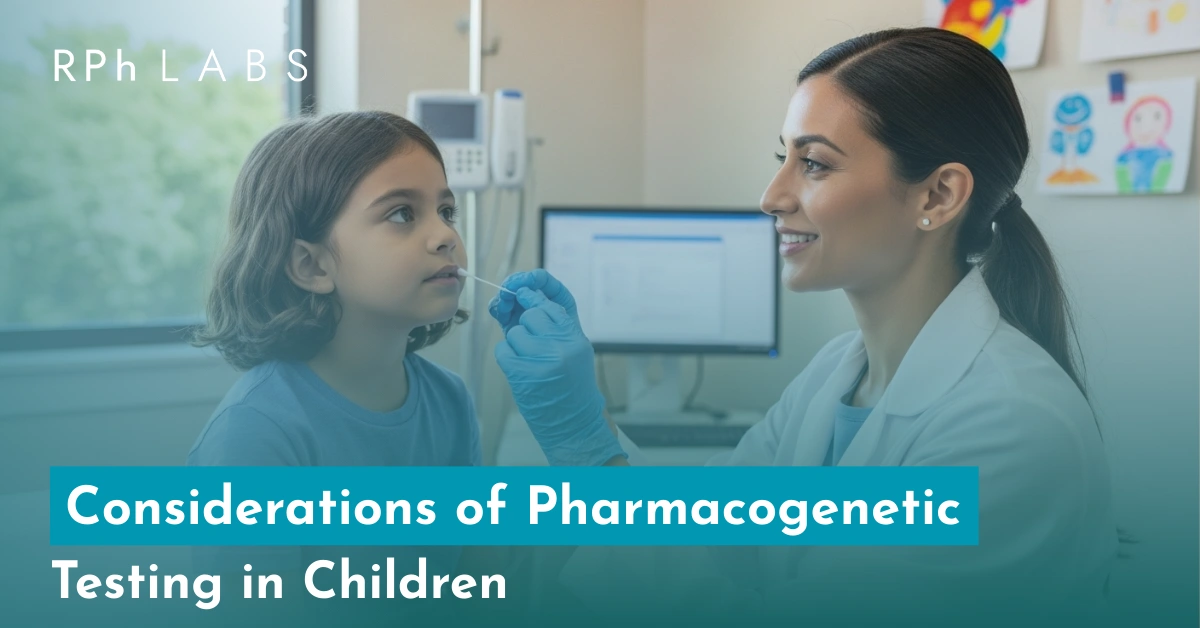
Pharmacogenetic testing in children looks at how a child’s genes affect the way their body handles medicines. For parents, it raises practical questions: which drugs it matters for, when testing makes sense, and how to keep results useful and private. This guide covers the benefits, risks and everyday steps.
On this page
Pharmacogenetic, or PGx, testing has been cited to be useful in helping doctors understand children’s reactions to drugs. Many children in the U.S. are prescribed medicines, so understanding such reactions is important. ADRs can happen due to biological differences in children and medication errors. The experience becomes very difficult and daunting for parents and families. This blog will outline the different benefits and risks associated with pre-emptive PGx testing on newborns and shed some light on its potential impact on health improvements.
What is Pharmacogenetic Testing?
Pharmacogenetic testing looks at how a child’s genetics affects how they respond to medicines. Each child is unique, and their genetic makeup might make a drug work effectively or cause side effects. Knowing a child’s PGx profile can help make better decisions in choosing a medication to prescribe.
Why is PGx Testing Important for Children?
Children and adults metabolize drugs differently. Such differences may contribute to an increased likelihood of adverse drug interactions. For instance, it might simply be the case that some will metabolize the drug much faster or much slower than is optimal, which can leave the condition poorly controlled or place the patient at risk for dangerous side effects. Understanding this variation can help predict and avoid some of these outcomes.
Benefits of Pre-emptive PGx Testing
- Lower risk of ADRs: Pre-emptive PGx testing determines which children are unlikely to tolerate certain drugs, such as codeine. Some children break it down too rapidly, resulting in overt side effects.
- Greater Treatment Choices: When the PGx profile of a child is known, physicians are in a better position to make informed treatment choices that would be safer as well as more effective for the child.
- Cost Savings: PGx testing can save dollars in healthcare costs associated with unnecessary hospital visits and various useless treatments by preventing adverse reactions.
- Prompt and Early Care in Emergency Situations: In emergency cases, knowledge of a child’s PGx may help initiate faster treatment decisions.
Real-Life Example
For instance, codeine has been linked to serious side effects, including breathing problems and deaths, in some children who are CYP2D6 ultra-rapid metabolizers, and the FDA now warns against codeine in children under 12. Poor metabolizers, on the other hand, may get little pain relief. PGx testing can identify these metabolizer types, helping healthcare professionals choose safer alternatives.
Risks and Challenges of PGx Testing
While there are benefits of PGx testing, there are also risks to consider:
- Familial Consequences: Because genes are shared within families, a child’s PGx results can hint at a parent’s or sibling’s genetic traits, and comparing results across several family members could occasionally reveal unexpected family information. The implications for the families may be emotionally challenging.
- Psychosocial Impact: Genetic information can be distressing for parents, even if there is no danger anticipated. However some specialists believe that PGx testing raises fewer concerns than other forms of genetic testing.
- Need for Education: Parents need explicit information regarding the benefits and risks of PGx testing. Without that, they may not be able to make informed decisions.
Educational Needs of PGx Programs
The implementation of PGx testing needs the availability of resources that can inform families appropriately regarding this program; its results should also be easily transferable from one provider to another. Parents who are interested in PGx testing benefit from clear, plain-language information about what it can and cannot do.
Resources that can help include:
PharmGKB: This is a pharmacogenomics database.
FDA’s PGx Table: This is a guideline for drug-gene interactions. Here Is The “Link“
Commercial Labs: These are testing services.
These will ensure that families make the right decisions. Informed consent also assists in ensuring that parents fully understand what PGx testing is about.
Pediatric pharmacogenomics: medicines with gene guidance
Pediatric pharmacogenomics is still growing, and pharmacogenetic testing in children is not yet routine. Even so, several medicines that children commonly receive already have gene-based guidance from CPIC or gene information in their FDA labels. These are the areas where a result is most likely to be put to use.
- Codeine and tramadol (CYP2D6): both must be activated by CYP2D6, which makes them a well-known safety concern in kids.
- Ondansetron (CYP2D6): a common anti-nausea medicine that may work less well in ultrarapid metabolizers.
- SSRIs such as sertraline, citalopram and escitalopram (CYP2C19): used for anxiety and depression in teens.
- Atomoxetine (CYP2D6): a non-stimulant ADHD medicine.
- Proton pump inhibitors such as omeprazole (CYP2C19): used for reflux.
- Thiopurines (TPMT and NUDT15): used for childhood leukemia and some bowel conditions.
- Aminoglycoside antibiotics such as gentamicin (MT-RNR1): certain variants raise the risk of hearing loss.
The FDA keeps a public table of pharmacogenomic biomarkers in drug labeling if you want to check a specific medicine. Our medication list also groups drugs by gene.
Codeine in children: why the rules changed
Codeine in children is the best-known example of why genes matter. Codeine does little on its own. CYP2D6 converts it into morphine, which provides the pain relief. A child who is a CYP2D6 ultrarapid metabolizer can turn codeine into morphine faster than expected, and dangerous breathing problems have been reported.
In 2017, the FDA restricted codeine and tramadol so that they should not be used in children younger than 12. It also warned against using them after tonsil or adenoid surgery in anyone under 18, and advised against using them while breastfeeding, because an ultrarapid mother can pass extra morphine to her baby.
When codeine in children meets a poor metabolizer, the problem is the opposite. They convert little codeine into morphine and may get almost no pain relief. That can lead to extra doses or a feeling that the child is “not responding” to treatment.
Today, clinicians usually choose other pain relievers for young children, so questions about codeine in children come up less often than they once did. Still, a CYP2D6 result stays useful as your child grows, because codeine, tramadol and many other CYP2D6 drugs may come up in the teen and adult years.
Genetic testing for kids: how the process works
Genetic testing for kids uses the same simple cheek swab as testing for adults. There are no needles, it takes a few minutes, and most children find it easy. A parent or guardian can collect the sample at home.
- A parent orders the kit and reads the instructions with the child.
- The parent rubs the swab on the inside of the child’s cheek.
- The sample is sealed, labeled and mailed back in the prepaid envelope.
- The lab reads the child’s drug-processing genes and prepares a report.
- The parent shares the report with the child’s pediatrician.
Because a child’s genes do not change, one round of pharmacogenetic testing in children can inform medicine choices from childhood into adulthood. The RPh Labs at-home PGx kit tests 20 genes, including CYP2D6, CYP2C19, TPMT, NUDT15 and MT-RNR1, and reports on more than 240 medicines.
One caution for very young babies: some liver enzymes are still maturing during the first months and years of life. A newborn’s genes are fixed, but actual enzyme activity can lag behind what the genes predict, so pediatric specialists interpret early results with this in mind.
Child medication side effects: when genes may play a role
Not all child medication side effects have a genetic cause. Dose, weight, age, other illnesses and other medicines all matter, and many side effects fade as the body adjusts. Still, some patterns are worth raising with your pediatrician.
- Strong side effects on a low, standard dose
- No benefit at all after a fair trial at the usual dose
- Side effects that are unusual or much stronger than the prescriber expected
- Similar problems with several medicines in the same family
- A parent or sibling who reacted badly to the same drug
Tracking child medication side effects in a simple notebook helps. Write down the medicine, dose, time given and what you noticed. Your notes, combined with a gene report, give the prescriber a much clearer picture than either one alone.
It also helps to know which child medication side effects are common and expected. Stimulants often reduce appetite, some antidepressants cause stomach upset in the first weeks, and many antibiotics can loosen stools. Ask the prescriber which effects are normal for each new medicine and which ones should prompt a call. That way you can tell the difference between an expected adjustment period and a reaction that may point to how your child processes the drug.
If your child shows serious symptoms, such as trouble breathing, extreme sleepiness, a rash with blisters, swelling of the face or a high fever with a new medicine, seek urgent care right away. A gene report is never a substitute for emergency help.
When pharmacogenetic testing in children makes sense
Experts do not yet recommend genetic testing for kids across the board. Pharmacogenetic testing in children is most useful when a medicine with strong gene guidance is being considered or has already caused problems. Common situations include:
- A child starting treatment for ADHD, anxiety or depression, especially with atomoxetine or an SSRI
- Planned surgery, where pain relief and anti-nausea medicines are likely
- Childhood leukemia or bowel disease treated with thiopurines, where TPMT testing is standard practice
- Repeated or unusual child medication side effects
- A family history of severe drug reactions, including prolonged paralysis after anesthesia, which can involve the BCHE gene
For families dealing with ADHD, our guide to genetic testing for ADHD explains what the results can and cannot tell you. Whatever the reason for testing, the decision is best made together with your child’s pediatrician or specialist.
Some families also choose testing before any problem appears, so the information is ready when a new medicine is needed. This pre-emptive approach is still being studied in pediatric pharmacogenomics. It can be especially practical for children with chronic conditions who are likely to need several medicines over time.
Talking with your pediatrician about results
Pharmacogenetic testing in children only helps if the report reaches the people who prescribe for your child. Bring a copy to your next visit and ask for it to be added to your child’s medical record.
Questions that help guide the conversation:
- Do these results change anything about my child’s current medicines?
- Which medicines should we be careful with in the future?
- Should the surgeon, anesthesiologist or dentist see this before a procedure?
- How do my child’s age and weight affect how you read the results?
- Who should I call if a new medicine causes side effects?
Your pharmacist is another good partner. Pharmacists check every new prescription against a child’s record, so sharing the report with the pharmacy you use can catch problems early. RPh Labs includes a free consultation with a PharmD pharmacist to help you prepare for these conversations.
Remember that no medicine should be stopped or changed based on a report alone. Your pediatrician weighs the results alongside growth, other conditions and how your child is doing.
Consent, privacy and sharing results with your child
Pediatric pharmacogenomics raises many of the same privacy questions as other genetic tests, but a medication-focused panel is narrower in scope. It looks at genes linked to how drugs are processed, not at genes used to diagnose disease.
In the United States, the Genetic Information Nondiscrimination Act (GINA) protects people from genetic discrimination by health insurers and most employers. It does not cover life, disability or long-term care insurance, so it is worth knowing its limits.
Parents give consent for young children, but it helps to involve your child as they grow. Many families explain the test in simple terms, such as “this helps your doctor pick medicines that suit your body.” As teens start managing their own health, give them a copy of the report so they can share it with future doctors.
Ask any lab how it stores and protects samples and data before you order. For a plain-language overview of the science, MedlinePlus is a helpful starting point.
Cost and coverage of genetic testing for kids
Cost is a real question for many families considering pharmacogenetic testing in children. The RPh Labs kit has a self-pay price of $299, which is HSA and FSA eligible and can be split into 4 interest-free installments. Shipping is free both ways.
We also accept insurance, including Texas Medicaid (TMHP) and Blue Cross Blue Shield of Texas, and we serve patients in 45 states. Coverage for genetic testing for kids depends on the plan and on the medical reason for testing, so check our insurance page or call (888) 383-2181 before ordering.
Results are ready 7 to 10 business days after the sample reaches our CLIA-certified, COLA-accredited lab in Dallas, Texas. Every report is reviewed by a PharmD pharmacist, and reports are updated when guidelines change. Since one test covers a lifetime of medicine decisions, many parents see it as a long-term record rather than a one-time check.
Conclusion
In reality, pharmacogenetic testing can be helpful for children because it may reduce some adverse drug reactions and improve the chance of treatment success. Though the evidence for routine newborn testing is emerging, the discussion on PGx testing with parents is warranted. Educative resources and obtaining informed consent will ensure that families are well-informed.
Through PGx testing incorporation, better health outcomes can be reached by children, and such risk of side effects from medication can be minimized at Rph Labs. As we continue to explore this vital field, we will support these families and healthcare providers in understanding and using PGx testing effectively.
Pharmacogenetic testing in children FAQ
At what age can a child have a pharmacogenetic test?
A child can be tested at any age because the genes are present from birth and a cheek swab is painless. Keep in mind that some enzymes are still maturing in babies and toddlers, so a pediatrician interprets early results with the child’s age in mind.
Is codeine in children ever safe?
The FDA says codeine and tramadol should not be used in children under 12, or after tonsil or adenoid surgery in anyone under 18. Older children may still receive them in some cases, and a CYP2D6 result helps the prescriber judge the risk. Always follow your child’s doctor’s advice.
Does genetic testing for kids need a doctor’s order?
Parents can order the RPh Labs kit directly. Even so, the results are most useful when a pediatrician or specialist reviews them, since they make all medicine decisions. A free consultation with a PharmD pharmacist is included to help you understand the report first.
Can a gene test explain my child’s medication side effects?
Sometimes. Genes can explain why a child breaks a drug down too quickly or too slowly, which may lead to side effects or poor response. But dose, weight, other medicines and illness also play a role, so your pediatrician looks at the whole picture.
Will my child need to be tested again as an adult?
Usually not. Inherited genes do not change, so the same results apply for life. What changes is medical knowledge, which is why RPh Labs updates reports when guidelines change. Keep the report and give your child a copy when they start managing their own care.
Is pediatric pharmacogenomics covered by insurance?
It depends on the plan and the reason for testing. RPh Labs accepts several plans, including Texas Medicaid and Blue Cross Blue Shield of Texas. If coverage is not available, the self-pay price is $299 and is HSA and FSA eligible.



Leave a Reply