
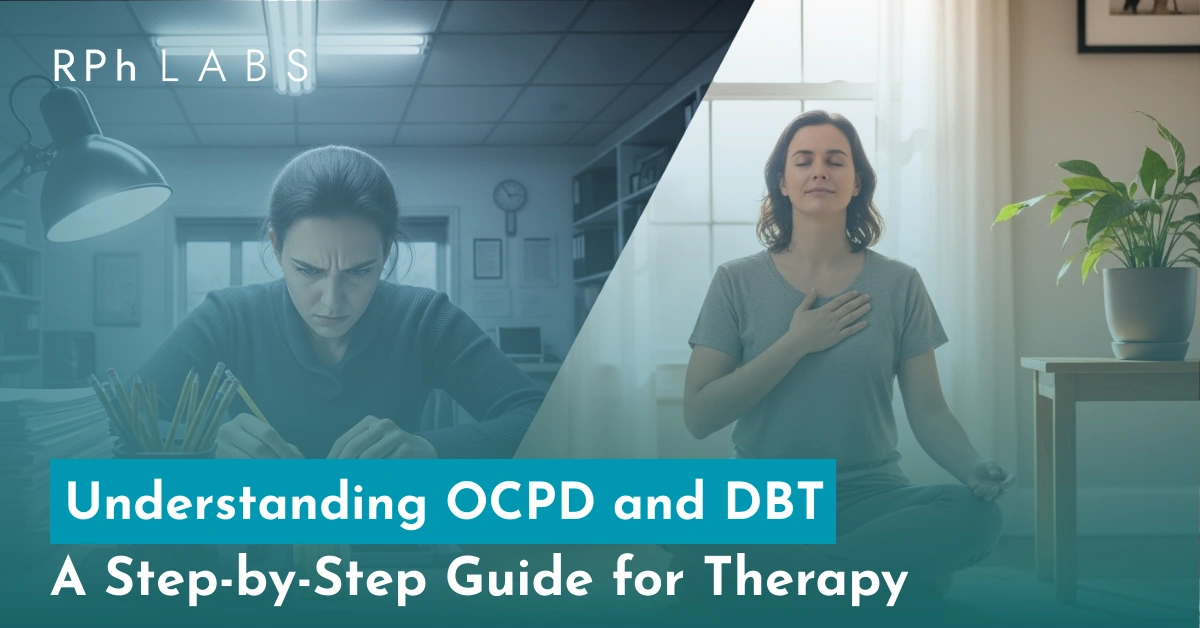
OCPD and DBT are paired so often because the skills in dialectical behavior therapy target exactly what makes obsessive-compulsive personality disorder hard to live with: rigidity, perfectionism and difficulty tolerating things being imperfect. Here is what that looks like in practice.
On this page
Mental health awareness has grown significantly in recent years, and with that, we now have better tools to understand and treat complex conditions like Obsessive-Compulsive Personality Disorder (OCPD). OCPD is often misunderstood, but with proper therapy like Dialectical Behavior Therapy (DBT) and advancements in pharmacogenomic (PGx) testing, individuals can achieve improved mental health and quality of life.
This blog will delve in-depth into OCPD and DBT, the treatment process with DBT, and the role of PGx testing in personalizing medication strategy.
What is OCPD?
Obsessive-Compulsive Personality Disorder, or OCPD, is a condition where people have an overwhelming need for control, perfectionism, and orderliness in their personal and professional lives. This usually comes at the expense of being flexible, open, and efficient. Individuals with OCPD often:
- Set high standards for themselves and others.
- They have difficulty delegating assignments because only they know how to do things the “right” way.
- They have difficulty expressing feelings and may appear critical or excessively serious.
- Become resistant to new or unexpected change.
Unlike Obsessive-Compulsive Disorder (OCD), where individuals realize that their behaviours are intrusive or irrational, people with OCPD typically see their behaviours as fair and by their values. This difference makes treating OCPD much more difficult because people might not go for treatment as a matter of choice.
Understanding DBT: A Journey to Recovery
Dialectical Behavior Therapy (DBT) is an intensive form of therapy that was originally developed to treat borderline personality disorder. However, its principles are widely applied to patients with numerous mental disorders, like OCPD. DBT combines cognitive-behavioural techniques with mindfulness to address underlying thought patterns and behaviour.
Core components of DBT
DBT (Dialectical Behavior Therapy) is a structured therapy designed to help people manage intense emotions, improve relationships, and develop healthy coping skills. Its core components include:
Core Mindfulness
- Helps individuals stay present and focused in the moment.
- Develops awareness of thoughts, emotions, and surroundings.
- Encourages non-judgmental acceptance of experiences.
Distress Tolerance
- Teaches strategies to handle crises without making the situation worse.
- Focuses on tolerating pain in tough situations rather than avoiding it.
- Techniques include self-soothing, distraction, and radical acceptance.
Emotional Regulation
- Aims to reduce emotional vulnerability and improve emotional control.
- Teaches skills to understand and label emotions accurately.
- Helps in reducing emotional intensity and frequency.
Interpersonal Effectiveness
- Focuses on improving communication and relationship skills.
- Balances self-respect with maintaining relationships.
- Teaches how to ask for what you need and say no respectfully.
Behavioural Skills Training
- Combines practical exercises to practice new skills.
- It helps in breaking unhealthy behavioural patterns.
Structure of DBT:
- Individual Therapy: Weekly one-on-one sessions for personalized guidance.
- Skills Training Group: Group sessions focusing on learning and practising DBT skills.
- Phone Coaching: On-the-spot coaching to apply skills during real-life situations.
- Therapist Consultation Team: Support for therapists to stay effective and motivated.
How Does DBT Therapy Helpful in OCPD
Dialectical Behavior Therapy (DBT) can help people with Obsessive-Compulsive Personality Disorder (OCPD) by teaching skills to manage the rigid thinking, perfectionism, and emotional challenges often seen in OCPD. Here’s how it works:
Improves Emotional Regulation
DBT helps individuals recognize and manage their emotions. OCPD often involves suppressing or over-controlling emotions, leading to stress and frustration. DBT skills like mindfulness and distress tolerance help address this.
Increases Flexibility
DBT challenges the black-and-white thinking common in OCPD. It promotes acceptance and helps individuals adapt to situations without the need for rigid control or perfection.
Reduces Interpersonal Issues
OCPD can strain relationships due to high expectations or difficulty delegating. DBT focuses on interpersonal effectiveness, teaching skills to improve communication, handle conflicts, and set realistic expectations.
Builds Distress Tolerance
OCPD individuals often struggle with distress when things don’t go as planned. DBT equips them with tools to cope without resorting to controlling or perfectionistic behaviours.
Fosters Self-Acceptance
DBT integrates acceptance strategies, helping individuals recognize their worth beyond achievements or orderliness. This can reduce self-criticism and enhance quality of life.
Steps to Seek Help for OCPD
- Recognize the Signs: Perfectionism, rigid thinking, and a need for control that negatively impact relationships or daily functioning may indicate OCPD.
- Consult a Professional: A board-certified therapist or psychiatrist can make an official diagnosis and offer treatment options.
- Consider DBT and PGx Testing: Seek out DBT-trained therapists and request that your healthcare provider assess whether the PGx Gene test is appropriate to help maximize medication.
- Make a Commitment to Change: You must actively participate in treatment and become willing to alter these old patterns. Be consistent and willing to adopt new approaches.
The Role of PGx Testing in Treatment
Pharmacogenomic, or PGx testing, is one tool used in personalized medicine. It looks at how your body metabolizes certain drugs. It does not diagnose OCPD, and no medication is approved to treat OCPD itself, so PGx only becomes relevant when a medicine is being prescribed for something occurring alongside it, such as depression or anxiety.
How PGx Testing Helps Patients with OCPD
- Better informed medication choices: OCPD may be accompanied by co-occurring conditions such as anxiety or depression. Where a medicine is prescribed for those, PGx results tell a doctor how you may process it, since genes such as CYP2C19 and CYP2D6 handle several antidepressants.
- Less trial and error: Some people stop treatment because of unpleasant side effects, or because a medicine does not help them. PGx results can narrow the choice and the starting dose, which may cut down on some of that trial and error.
- Improved Compliance: When medication does the job with minimal side effects, the patient is likelier to adhere to the treatment program.
Used alongside DBT, PGx results are one small piece of the picture. DBT does the work on OCPD itself, and PGx only informs medicines prescribed for conditions occurring alongside it.
How DBT and PGx Test Work Together
Whereas DBT seeks to change specific patterns of thoughts and behaviours, the PGx test adds information about how you may process a medicine that has been prescribed. Used together, they can support each other:
- Early progress with medication: Where anxiety or depression is being treated as well, PGx results can help a prescriber choose a starting medicine and dose with fewer surprises, so those symptoms interfere less with therapy.
- Behavioural Change with DBT: As medications stabilise mood or reduce intrusive thoughts, individuals can fully engage in DBT sessions to learn and implement new coping strategies.
- Longer term progress: Working on immediate symptoms and the patterns underneath them at the same time gives the best chance of steady improvement, although how much changes, and how quickly, varies from person to person.
OCPD symptoms and where the line sits
Being organized is not a disorder. OCPD symptoms are diagnosed when a lasting pattern of perfectionism and control gets in the way of flexibility, openness and efficiency, and shows up across many areas of life.
The pattern clinicians look for includes the following features. A diagnosis requires several of them, not one, and only a qualified professional can decide whether OCPD symptoms are present.
- Preoccupation with details, rules, lists and order to the point that the purpose of the activity gets lost.
- Perfectionism that interferes with finishing things, because the standard is never quite met.
- Devotion to work and productivity that crowds out friendships and leisure.
- Rigidity about morals, ethics or values beyond what culture or religion requires.
- Difficulty discarding worn-out or worthless objects.
- Reluctance to delegate unless others agree to do it exactly your way.
- Holding tightly to money for fear of future catastrophe.
- General rigidity and stubbornness.
What makes OCPD symptoms hard to bring to treatment is that they usually feel right from the inside. The distress often arrives secondhand, through a partner’s frustration, missed deadlines, burnout, or the loneliness that follows years of work over everything else.
That is why many people start therapy for something else entirely, such as depression, anxiety or a relationship crisis, and only later recognize the longer pattern of OCPD symptoms behind it.
OCPD vs OCD: the difference that changes treatment
The OCPD vs OCD comparison matters because the two conditions are named similarly, sit in different chapters of the diagnostic manual, and respond to different first-line care.
- OCD involves specific unwanted obsessions and compulsions aimed at preventing a feared outcome. It is a condition, not a personality style.
- OCPD is a personality disorder: a pervasive pattern of perfectionism and control that shapes work, relationships and values.
- In OCD the symptoms are usually experienced as intrusive and unwanted, although insight varies. In OCPD the traits typically feel like values worth defending.
- First-line treatment for OCD is exposure and response prevention, often with an SSRI. For OCPD, psychotherapy is the mainstay and no medication is approved for the disorder itself.
- They can occur in the same person, which is another reason the OCPD vs OCD question is worth careful assessment.
The practical upshot of OCPD vs OCD is what you should ask a clinician for. Someone treating OCPD as if it were OCD may spend months chasing compulsions that are not really there, while missing rigidity, emotional restriction and interpersonal cost.
If your experience is closer to unwanted intrusive thoughts and rituals, our comparison of OCD and anxiety disorders is the better starting point.
DBT skills training: what a program actually involves
DBT skills training is the part of dialectical behavior therapy most relevant here. It was developed by Marsha Linehan for people with intense emotional pain and chronic suicidality, and the skills modules have since been adapted far more widely.
A full program is more structured than ordinary weekly therapy, and it helps to know the shape of DBT skills training before you commit.
- Weekly individual therapy, where skills get applied to your own situation.
- A weekly skills group that works through the modules like a class, with homework.
- Between-session coaching by phone or message for moments when a skill is needed in real time.
- A consultation team supporting the therapists, which is part of the model rather than an extra.
The four modules are mindfulness, distress tolerance, emotion regulation and interpersonal effectiveness. Working through all of them usually takes several months to about a year, and some programs run the cycle twice.
Skills-only groups exist and are cheaper and easier to find than full programs. They are a reasonable option for OCPD, where the crisis-focused parts of full DBT matter less. Ask any provider whether they offer comprehensive DBT or DBT skills training alone, since the two are often advertised with the same words.
Distress tolerance skills that loosen the need for control
Distress tolerance skills exist for moments when a situation cannot be fixed right now and the urge to fix it is overwhelming. For perfectionism, that is most moments, which is why distress tolerance skills come up early.
The point is not to feel fine about an unfinished report. It is to be able to leave it unfinished without the day collapsing, and these are the moves taught early.
- Paced breathing and cold water on the face, which lower physical arousal quickly when frustration spikes.
- Deliberate distraction for a set time, with a plan to return, rather than powering through.
- Self-soothing through the senses, which many people with OCPD have quietly ruled out as unproductive.
- Radical acceptance: acknowledging that something already is the way it is, which is different from approving of it.
- Pros and cons of acting on the urge, written down, which works well for people who trust analysis.
Used well, distress tolerance skills buy you the few minutes in which a different choice becomes possible. Used badly they become one more performance to perfect, so it is worth telling your therapist if you notice yourself grading your own skill practice.
OCPD and DBT: 5 ways the skills fit the traits
Pairing OCPD and DBT is not arbitrary or new. Each module maps onto a specific trait that causes trouble.
- Mindfulness interrupts the reflex to correct, notice a flaw and act on it. It builds a gap between noticing and reacting.
- Distress tolerance makes good enough survivable, which is the doorway to finishing things.
- Emotion regulation gives names and limits to feelings that OCPD tends to suppress until they arrive as irritation.
- Interpersonal effectiveness supplies scripts for delegating, saying no and asking for something without turning it into an argument about standards.
- Dialectical thinking, the idea running through all of it, replaces either-or judgments with both-and, which is the direct opposite of black-and-white perfectionism.
There is an honest caveat to state. DBT was not designed for OCPD, and the evidence base for OCPD and DBT specifically is thinner than for cognitive behavioral or psychodynamic approaches. Clinicians use it because the skills map well onto the problems, not because large trials have settled the question.
Ask a prospective therapist what they expect to change, over what period, and how you will both know. For someone who values measurement, agreeing concrete review points is often the thing that keeps therapy going through the uncomfortable middle.
Other treatments and how to talk to a prescriber
Psychotherapy is the main treatment for personality disorders, and OCPD and DBT together are one option among several.
- Cognitive behavioral therapy targets perfectionistic beliefs and the all-or-nothing rules underneath them.
- Psychodynamic and schema-focused therapies work on where the standards came from and what they protect against.
- Couples and family therapy addresses the friction that often brings someone to treatment in the first place.
- Group therapy can be uncomfortable and useful, because other people notice rigidity faster than you will, and group is where DBT skills training usually happens.
On medication, be precise: no medicine is FDA approved to treat OCPD itself. Prescriptions are aimed at co-occurring conditions such as depression or an anxiety disorder, which are common. Any change to a psychiatric medicine belongs with your prescriber, and stopping some medicines abruptly, especially certain antidepressants, can be genuinely unpleasant or unsafe.
If you are having thoughts of harming yourself, call or text 988 in the US to reach the Suicide and Crisis Lifeline, at any hour, or call 911 in an emergency. Perfectionism and hopelessness can be a hard combination, and asking for help early is the right call.
What a PGx test can and cannot add
Pharmacogenomic testing does not diagnose OCPD, does not measure personality traits, and cannot tell you whether therapy will work. It has nothing to say about OCPD and DBT as a treatment plan. It answers one narrow question: how your body is likely to process certain medicines.
That is relevant only if medication is part of your plan for a co-occurring condition, and it is still one input among several.
- CYP2C19 affects sertraline, escitalopram and citalopram. CYP2D6 affects paroxetine, fluvoxamine, fluoxetine and others.
- Fluoxetine, paroxetine and bupropion inhibit CYP2D6, so a normal metabolizer can behave like a poor one while taking them.
- Most benzodiazepines other than diazepam are handled by routes the panel does not cover, so genetics has little to say about them.
- Results do not change over a lifetime, so a single test stays useful as prescriptions change.
Your prescriber weighs results alongside diagnosis, other medicines, kidney and liver function and your own history. The CPIC guidelines are the clinical source, and the RPh Labs at-home cheek swab kit reports 20 genes against more than 240 medications with a pharmacist review included. Our medication list shows which drugs are reported by gene.
Conclusion
OCPD can be overwhelming to deal with, but the right tools and support can help individuals lead a balanced and fulfilling life. DBT provides practical skills for dealing with rigid thought patterns and perfectionism. PGx testing does something much narrower: where a medicine is prescribed alongside therapy, it tells your prescriber how you may process it.
When these two methods are combined, individuals with OCPD can become emotionally liberated, make better relationships, and be more flexible about life. Exploring the new treatments for OCPD and DBT will help to cope with this mental health. If you or a loved one may have OCPD, start with a mental health professional, and ask them whether PGx testing would add anything useful to any medicine you are prescribed.
Pharmacogenomics testing at home reports how your body may process certain medicines, which your prescriber can use if a medicine is prescribed alongside therapy.
Reference
https://avisarecovery.com/blog/ocpd-therapy/ https://www.stuffthatworks.health/obsessive-compulsive-personality-disorder-ocpd/treatments/dbt
OCPD and DBT: frequently asked questions
What is OCPD, and how is it different from OCD?
OCPD is a personality disorder characterized by perfectionism, rigidity, and excessive concern with order and control. Unlike OCD (Obsessive-Compulsive Disorder), which involves intrusive thoughts and compulsive behaviors, OCPD is more about deeply ingrained personality traits that affect daily functioning and relationships.
Can DBT be used to treat OCPD?
Yes, DBT can be helpful for individuals with OCPD, especially in managing emotional dysregulation and improving interpersonal relationships. While not the primary treatment, DBT’s skills in mindfulness, emotional regulation, and distress tolerance can complement other therapeutic approaches.
What are the core symptoms of OCPD?
The key symptoms include a preoccupation with rules, excessive perfectionism, an overwhelming need for control, difficulty delegating tasks, and inflexibility in thinking. These traits often interfere with personal and professional relationships.
How does DBT help with rigid thinking in OCPD?
DBT addresses rigid thinking by teaching mindfulness and dialectical thinking skills. These techniques help individuals recognize and challenge their fixed beliefs and become more flexible in their thought patterns and behaviors.
Is medication effective for OCPD, or is therapy like DBT better?
No medication is approved to treat OCPD itself, so therapy such as DBT is the mainstay. Medicines like SSRIs are sometimes prescribed when depression or anxiety occurs alongside OCPD, and that decision belongs to your prescriber. If a medicine is started, do not stop it abruptly; any change is tapered with the prescriber who started it.
How do I know whether my traits are OCPD symptoms or just high standards?
The usual test is cost rather than intensity. High standards that still let you finish work, delegate and enjoy time off are a style. OCPD symptoms interfere: projects stall, relationships strain, leisure disappears. A clinician assesses the pattern across settings and over years rather than judging one busy season.
Is DBT skills training available without a full DBT program?
Often yes. Many clinics run skills-only groups, and they are usually cheaper and easier to join than comprehensive programs with individual therapy and phone coaching. For OCPD that is frequently a reasonable fit. Ask exactly which components are included before enrolling, since advertising uses the same terms for both.
Can distress tolerance skills be practiced alone?
You can practice them between sessions, and that is expected. Learning them entirely alone from a workbook is harder, because the common trap is turning practice into another performance to perfect. A therapist or group gives feedback on that, which is the part self-study tends to miss.
Does OCPD ever turn into OCD?
They are separate diagnoses rather than stages of one another, so one does not become the other. The ocpd vs ocd distinction can be blurry at first assessment, and a person can meet criteria for both. If unwanted intrusive thoughts and rituals appear, mention them, since that changes the treatment plan.
Will medication fix perfectionism?
No medicine is approved to treat OCPD itself, and none targets perfectionism directly. Prescriptions address co-occurring depression or anxiety, which can make therapy easier to engage with. Discuss any change with your prescriber, and never stop a psychiatric medicine abruptly on your own.
Can a genetic test tell me which therapy to choose?
No. Pharmacogenomic reports cover medication processing only, and say nothing about psychotherapy, personality or diagnosis. Their value is helping a prescriber anticipate dose and tolerability issues if medicine is part of the plan. See what PGx testing is for what the report contains.

Leave a Reply