
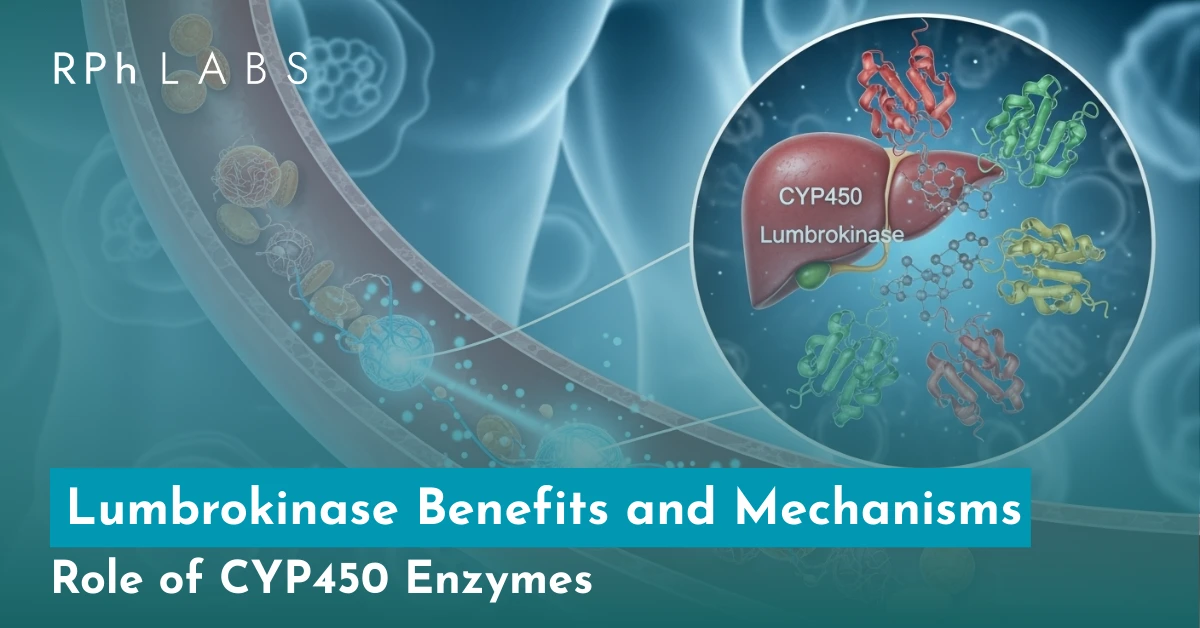
Lumbrokinase benefits are marketed confidently for circulation, clots and inflammation. The enzyme is real and studied, the evidence is thinner than the marketing, and the bleeding risk is the part that deserves the most attention. This guide covers all three.
On this page
Derived from earthworms, particularly Lumbricus rubellus and Lumbricus bimastus, Lumbrokinase is a fibrinolytic enzyme. It can break down fibrinogen (a soluble plasma protein synthesised in the liver and becomes fibrin) and fibrin (an insoluble protein that stops bleeding and wound healing). Identified in 1991, this enzyme derived from earthworms has gained attention for its potential therapeutic applications. Lumbrokinase benefits include, but are not limited to, blood clot management, heart health, and inflammation management.
Key Benefits of Lumbrokinase
Out of several lumbrokinase uses or benefits, the breakdown of fibrin, a protein involved in blood clot formation, is among the best benefits of lumbrokinase. This fibrinolytic activity underpins its diverse health benefits:
1. Cardiovascular Support
Blood Clot Reduction: Lumbrokinase helps in dissolving blood clots, potentially reducing the risk of conditions like deep vein thrombosis and pulmonary embolism.
Vascular Health: By improving blood flow, it may support overall vascular function.
2. Anti-Inflammatory Effects
Chronic Inflammation: Lumbrokinase has shown promise in reducing inflammation, which is a root cause of many chronic diseases.
3. Detox benefits of Lumbrokinase
Enhanced Circulation: Improved blood flow may facilitate the removal of metabolic waste products, supporting the body’s natural detoxification processes.
4. Therapeutic Applications
Post-Ischemic Injury: Lumbrokinase may attenuate myocardial injury through the activation of Sirt1 signalling, inhibition of NF-κB expression, and activation of FoxO1 and LC3, thereby reducing inflammation, oxidative stress, and apoptosis, and enhancing autophagy after myocardial injury.
Lumbrokinase Absorption and CYP450 Enzyme Interaction
The metabolism of substances like lumbrokinase involves the cytochrome P450 (CYP450) enzyme system, primarily located in the liver and intestines. These enzymes play a crucial role in the oxidative metabolism of various compounds, including drugs and endogenous substances.
CYP450 Enzyme Families
- CYP1, CYP2, CYP3: Responsible for the metabolism of approximately 75% of clinical drugs.
- CYP4: Involved in the metabolism of eicosanoids and fatty acids.
Genetic variations in CYP450 enzymes can lead to differences in drug metabolism, affecting drug efficacy and safety.
Pharmacogenomics and Lumbrokinase
Pharmacogenomics and enzyme therapy are related in a manner that pharmacogenomic testing, commonly known as PGx testing, can assess individual variations in CYP450 enzyme activity. Thus, providing insights into how your body may metabolise lumbrokinase. This information can guide personalized dosing and reduce the risk of adverse effects.
Book an at-home PGx test from RPh LABS and know how your body may respond to 240+ medications, especially the mental health ones.
Gender-Specific Effects of Lumbrokinase
Effects on Men
Cardiovascular Health: May support heart health by improving blood flow and reducing clot formation.
Inflammation Reduction: Potential to decrease systemic inflammation, benefiting conditions like arthritis.
Effects on Women
- Post-Ischemic Injury: It may help protect the heart after injury by turning on helpful cell signals (like Sirtuin 1 which is a key player in body’s response to stress, energy levels and potentially even aging), blocking harmful ones (like nuclear factor-kappa B which is a crucial protein group playing role in cell growth, survival, immune responses, and inflammation), and activating protective proteins (like FoxO1 and LC3). This can lower inflammation, reduce cell damage and death, and boost the heart’s ability to clean up and repair itself.
- Hormonal Considerations: Women may experience different metabolic responses due to hormonal variations affecting CYP450 enzyme activity.
Lumbrokinase in Diabetic Kidney Health
As shared by Sciencedirect, studies have demonstrated that lumbrokinase can reduce diabetic kidney disease (in rat models). This effect is believed to be facilitated through the regulation of MMPs (matrix metalloproteinases), enzymes that degrade ECMs (extracellular matrix). By modulating MMP activity, lumbrokinase may help in the degradation of excess ECMs (macromolecules that surround cells).
Considerations and Side Effects
Generally, Lumbrokinase is well-tolerated, however, some people may experience:
- Gastrointestinal Discomfort: Symptoms such as nausea, vomiting, diarrhoea, or stomach cramps.
- Allergic Reactions: Rare occurrences of rash, itching, swelling, dizziness, or difficulty breathing.
- Bleeding Risks: Due to its fibrinolytic activity, there may be an increased risk of bleeding, especially in individuals on anticoagulant therapy.
- Headaches or Dizziness: Some users have reported mild headaches or dizziness.
Individuals with liver or kidney conditions should exercise caution and consult a healthcare professional before using lumbrokinase.
Summary Table
| Benefit Category | Description |
| Cardiovascular Support | Major therapeutic effects of lumbrokinase include reduced clot formation and enhanced blood flow |
| Anti-Inflammatory | Mitigates chronic inflammation |
| Detoxification | Facilitates metabolic waste removal through improved circulation |
| Therapeutic Applications | Supports recovery from ischemic injuries and chronic conditions |
| Short-Term Benefits | Provides rapid relief from acute symptoms |
| Long-Term Benefits | Contributes to sustained health improvements over time |
Lumbrokinase benefits: what this fibrinolytic enzyme is and what the evidence supports
Lumbrokinase is a group of enzymes extracted from earthworms, principally Lumbricus rubellus. In the laboratory it acts as a fibrinolytic enzyme, meaning it can break down fibrin, the protein mesh that holds a clot together.
Fibrinolytic enzyme activity of that kind is genuine in a test tube. The gap between test tube activity and a clinical effect after swallowing a capsule is where the honest discussion belongs.
- In the United States it is sold as a dietary supplement. It is not an approved drug for any condition, and the manufacturing is not regulated to pharmaceutical standards.
- Most published research is laboratory work, animal studies, or small clinical studies, much of it from a small number of centers.
- Claims about stroke, heart attack, deep vein thrombosis and pulmonary embolism prevention are not supported by large randomized trials.
- It is an oral protein, and proteins are broken down by digestive enzymes, so how much reaches the bloodstream intact is a genuine open question.
- Enteric coating is used to address that, and it does not settle the question of systemic effect.
So the fair summary of lumbrokinase benefits is this: a plausible mechanism, some early studies, and no high-quality evidence that it prevents or treats a clotting condition in people.
Blood thinner interactions and who should avoid it
Blood thinner interactions are the part that matters most, and it is usually the shortest one in supplement marketing. Anything that reduces clotting adds to anything else that reduces clotting.
- Warfarin, apixaban, rivaroxaban, edoxaban, dabigatran and heparins: do not add a fibrinolytic supplement without your prescriber’s knowledge.
- Antiplatelet drugs including aspirin, clopidogrel, prasugrel and ticagrelor carry the same concern.
- Nonsteroidal anti-inflammatories such as ibuprofen and naproxen add bleeding risk of their own.
- Other supplements stack up too: fish oil, ginkgo, garlic, high-dose vitamin E, nattokinase and turmeric extracts.
- Stop well before any surgery or dental procedure, on a timeline your surgeon or dentist specifies.
- Avoid entirely with an active bleeding disorder, a recent hemorrhagic stroke, a peptic ulcer, or during pregnancy and breastfeeding, where safety is unknown.
Blood thinner interactions here are not theoretical caution. People take anticoagulants because a clot would be dangerous, and they are monitored for a reason. Adding an unmeasured fibrinolytic effect on top of a carefully titrated medicine is exactly the situation that produces preventable bleeding.
Warning signs to act on: unusual bruising, bleeding gums, blood in urine or stool, black tarry stools, coughing or vomiting blood, a severe headache, or bleeding that will not stop with pressure. In the United States, call 911 for severe bleeding.
Nattokinase vs lumbrokinase
Nattokinase vs lumbrokinase is a comparison people make constantly, since the two are sold side by side, so the comparison is worth making plainly.
- Nattokinase comes from natto, a fermented soybean food, and has a longer history of study, including small trials on blood pressure and markers of clotting.
- Lumbrokinase is earthworm-derived and has a smaller and more geographically concentrated literature.
- Both act on fibrin in laboratory conditions, and both face the same question about oral absorption of an active protein.
- Neither is an approved treatment, and neither should replace a prescribed anticoagulant.
- Both carry the same bleeding precautions and the same interaction list.
In the nattokinase vs lumbrokinase comparison, neither wins on evidence strong enough to justify using it in place of established treatment. If you have a genuine clotting condition, the medicines with trial evidence behind them are the answer, and the supplement question is about whether adding anything is safe at all.
Correcting a common CYP450 claim about this fibrinolytic enzyme
You will see it written that lumbrokinase is metabolized by the cytochrome P450 system, and that pharmacogenomic testing can therefore predict how you will respond to it. That is not correct, and it is worth explaining why.
Cytochrome P450 enzymes metabolize small molecules: most conventional drugs, many toxins and various natural compounds. Lumbrokinase is a protein. Proteins are broken down by proteases in the gut and elsewhere into peptides and amino acids, not oxidized by CYP450 enzymes.
The same logic applies to other protein or peptide products. Insulin, monoclonal antibodies and enzyme therapies are not CYP450 substrates, and no pharmacogenomic panel predicts their handling.
So no pharmacogenomic test, ours included, can tell you how you will respond to lumbrokinase or guide a dose of it. Anyone selling testing on that basis has the biochemistry wrong.
Supplement safety: how to evaluate any product like this
Supplement safety in the United States rests on a different regulatory model from medicines. Products do not need to demonstrate efficacy or safety before sale, and enforcement is largely after the fact.
- Check for third-party testing, such as USP, NSF or ConsumerLab verification, which addresses identity and contamination rather than effectiveness.
- Look for the actual dose and the enzyme activity units on the label, and be wary when a proprietary blend hides them.
- Search for published human trials of the specific product, not just the ingredient class.
- Treat disease claims as a red flag, because they are not permitted for supplements and signal a seller who ignores the rules.
- Tell every prescriber and your pharmacist what you take. Supplements are routinely omitted from medication lists, and that omission is where interactions hide.
- Report suspected harms, which in the United States can be done through the FDA’s MedWatch program.
None of this means supplement safety is a lost cause, or that supplements are useless. It means the burden of checking falls on you, and that fibrinolytic products deserve more caution than most because the plausible mechanism is also the risk.
Conditions people take it for, and what actually treats them
Most people arrive at lumbrokinase benefits with a specific worry. Each of those worries has an established pathway.
- Previous clot or high clot risk: anticoagulants with trial evidence, prescribed and monitored, are the treatment. Supplements do not substitute.
- Cardiovascular risk reduction: blood pressure control, lipid management, not smoking, activity and diabetes control carry the evidence.
- Persistent symptoms after a viral illness, where fibrinolytic supplements are marketed heavily: this is an active research area and treatment should come through a clinician rather than a supplement protocol.
- Chronic inflammation as a general concern: worth investigating rather than treating blindly, since it usually has a specific cause.
- Circulation symptoms such as leg pain on walking: peripheral arterial disease has specific assessment and treatment, including supervised exercise therapy.
If you are drawn to lumbrokinase benefits because conventional treatment has not helped, that is a reason to go back to your clinician with the specific problem rather than to add an unregulated product on top.
What to ask before adding any fibrinolytic supplement
If you still want to try it after reading the cautions, the conversation to have first is short and specific. These are the questions that actually change the answer.
- Am I taking anything that affects clotting, including aspirin, prescription anticoagulants, anti-inflammatories or other supplements?
- Do I have any condition that raises bleeding risk, such as a peptic ulcer, liver disease, low platelets or a previous bleed?
- Do I have a procedure, operation or dental appointment coming up in the next few months?
- What symptoms should make me stop immediately and seek help?
- Is there anything with actual trial evidence that addresses what I am hoping this will fix?
Take the bottle to a pharmacist. Pharmacists are the professionals trained specifically in interactions, the appointment is usually easy to get, and they will check the product against your full medicine list rather than against a general list of ingredients.
If your prescriber says no, ask why rather than dropping the subject. Usually the reason is a specific interaction you can then plan around, and sometimes it points to a better answer for the underlying problem.
Where pharmacogenomic testing genuinely helps
Since this article has ruled out one supplement safety use of testing, it is worth saying where it does apply, particularly for people taking anticoagulants.
Warfarin dosing is informed by CYP2C9, VKORC1 and CYP4F2, which affect both clearance and sensitivity. That pairing appears on the label and in guidelines, and Medicare has a national coverage determination for warfarin-related pharmacogenomic testing.
Clopidogrel requires CYP2C19 to become active, so poor metabolizers get less antiplatelet effect, which matters after coronary stenting. Statins are informed by SLCO1B1 and ABCG2 for muscle side effect risk.
The RPh Labs panel covers all of those among its 20 genes, reported against more than 240 medications from an at-home cheek swab, with each report reviewed by a PharmD pharmacist. See the testing kit page and the medication list by gene, and check the CPIC guidelines for the recommendations themselves. What it cannot do is tell you anything about an enzyme supplement.
Conclusion:
Lumbrokinase is a complex enzyme derived from earthworms. As shared by the synapse, it has been found to break fibrin, reduce blood clotting and thus help in maintaining cardiovascular health. In a test on rats, this has even been shown to reduce the kidney damage caused by diabetes. Lumbrokinase is metabolized in the liver, and CYP450 enzymes play a crucial role in its metabolism. Thus, this may affect individuals differently based on CYP450 enzyme activity in their body.
Due to the variation in response, there are chances of trial and error. A pharmacogenomics test gives you insights into your genetic makeup, allowing you to know how your body may respond to medications. A PGx test from RPh LABS (a CLIA-certified lab) shows how your body may respond to 240+ medications.
Lumbrokinase benefits FAQ
Can anyone use Lumbrokinase?
Lumbrokinase (derived from earthworms) helps prevent blood clots by dissolving fibrin, a protein that helps in stopping bleeding and healing wounds. Consumption by people with earthworm allergies or who don’t require it may cause side effects.
Why take lumbrokinase?
Lumbrokinase helps prevent blood clotting. It helps maintain healthy heart by dissolving fibrin.
What metabolizes Lumbrokinase?
CYP450 enzymes are involved in metabolizing lumbrokinase and variation in this enzyme may result in varied results.
Can Lumbrokinase reduce diabetic kidney damage?
In studies on rats, lumbrokinase has been shown to reduce diabetic kidney damage. However, there is currently a lack of evidence that it has the same effect in humans.
Is there good evidence for lumbrokinase benefits?
Not at present. The mechanism as a fibrinolytic enzyme is real in the laboratory, but most research is preclinical or small, and there are no large randomized trials showing it prevents or treats clotting conditions in people.
Can I take it with a blood thinner?
Not without your prescriber’s knowledge. Blood thinner interactions are the main safety concern, and the same applies to antiplatelet drugs, anti-inflammatories and other supplements such as fish oil, ginkgo and nattokinase.
How does nattokinase vs lumbrokinase compare?
Nattokinase has a longer and slightly broader research record; lumbrokinase’s literature is smaller. Both act on fibrin in the laboratory, both face the same oral absorption question, and neither is an approved treatment or a substitute for prescribed anticoagulation.
Is lumbrokinase metabolized by CYP450 enzymes?
No. It is a protein, and proteins are broken down by proteases rather than oxidized by cytochrome P450 enzymes. No pharmacogenomic test can predict your response to it, and claims otherwise misstate the biochemistry.
Should I stop it before surgery?
Yes, on a timeline your surgeon or dentist specifies, and tell them you take it. Anything with fibrinolytic or antiplatelet activity raises bleeding risk during procedures, including dental work.
How do I judge supplement safety generally?
Look for third-party testing, a clearly stated dose and activity units, published human trials of that product, and no disease claims. Tell every prescriber and your pharmacist what you take, since omitted supplements are where interactions hide.



Leave a Reply