
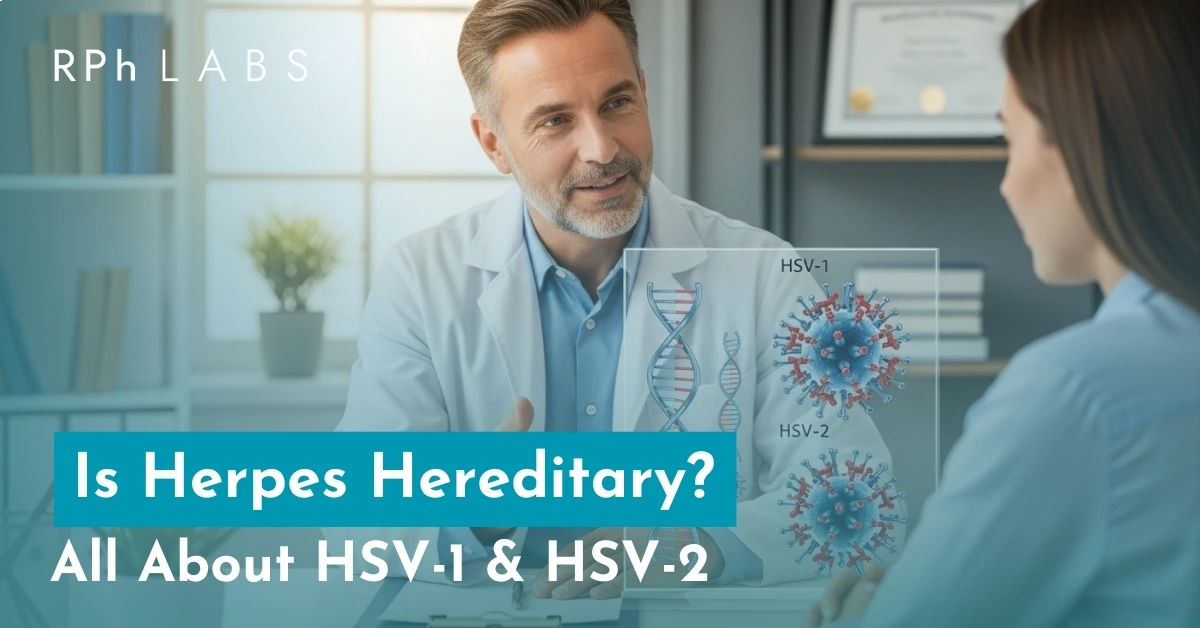
Is herpes hereditary, or does it only look that way when several people in one family get cold sores? This guide separates what you inherit from your parents from what you catch through everyday contact, and covers testing, pregnancy and honest talk about risk.
On this page
So, you’ve probably heard of herpes, and maybe even have it, or know someone who does. But is Herpes hereditary? Can your parents pass this on to you? Is there a risk if you’re pregnant? Let’s break down the key info you need to know, including the major types, causes, symptoms, and treatments. Plus, we’ll talk about the best ways to manage this common condition.
What is Herpes?
Herpes is a viral infection caused by the Herpes Simplex Virus (HSV). There are two main types: HSV-1 and HSV-2. HSV-1 primarily causes oral herpes, while HSV-2 is known for causing genital herpes. They both love to hide in your body and can “flare up” during times of stress or illness.
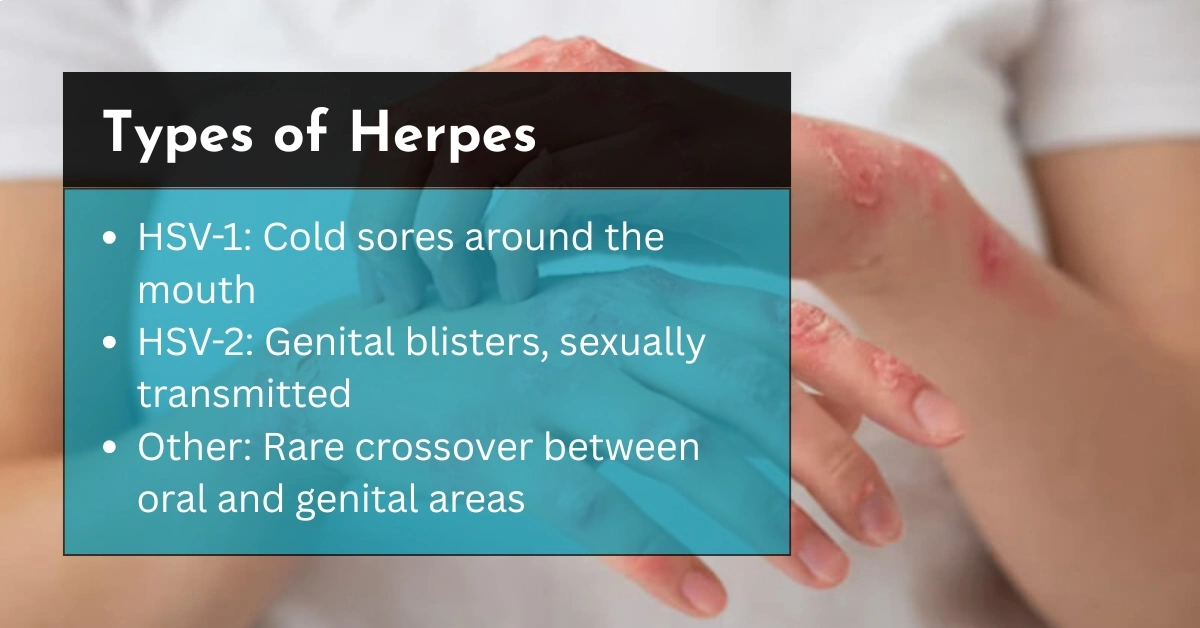
Types of Herpes
- HSV-1 (Oral Herpes) – The infamous cold sore virus! This type typically causes fever blisters or cold sores around your mouth.
- HSV-2 (Genital Herpes) – This one causes painful blisters in the genital area and is more commonly transmitted through sexual contact.
- Other Types – Although rare, HSV-1 can also cause genital herpes, and HSV-2 can cause oral herpes.
Is Herpes Hereditary?
The common question that is asked by everyone: is herpes a genetic disease? The short answer is no. Herpes is an infection you catch, not a trait you inherit, and it is not carried in your DNA. Cold sores do often appear in several members of one family, but the usual reason is shared exposure.
Most people pick up HSV-1 in childhood from ordinary contact at home, such as a kiss or a shared cup. Some researchers are studying whether immune response genes affect how often outbreaks come back once a person is infected, but that is about outbreak frequency, not about inheriting the virus.
How Does Herpes Spread?
Yes, herpes is contagious, and it’s easy to pass it along without even knowing it! The virus spreads through skin-to-skin contact. Here’s how it usually works:
- Kissing – Chances of getting herpes from kissing are high if someone has a cold sore or is shedding the virus.
- Sharing drinks – You can get cold sores from sharing drinks if someone has an active outbreak.
- Sexual contact – You can get HSV-2 from unprotected sex, even when the person shows no symptoms. Yep, it can spread without visible outbreaks. But, don’t stress, we’ll talk prevention in a sec!
Can People with Herpes Have Kids?
Yes, people with herpes can have kids. There is a small chance of passing the virus to the baby around delivery, so tell your doctor if you are planning a pregnancy or are pregnant. Herpes in newborns can be serious, so if there are active genital sores when labor starts, doctors often recommend a C-section to reduce the risk.
Did you know?
Pharmacogenomic testing, commonly known as PGx testing, gives insights into your genetic makeup, allowing your doctor to tailor your drug (especially mental health) and dosage.
Symptoms of Herpes
Symptoms can vary. For some, herpes is a quiet guest—no symptoms at all. For others, it can be a painful flare-up. Here’s what to look out for:
- Oral herpes: Cold sores, fever blisters, or pain around your mouth, just like the oral STD infection.
- Genital herpes: Painful blisters or sores around the genital area, itching, and flu-like symptoms.
- Initial infection: Can be worse and last longer (up to a few weeks), but recurring outbreaks are often shorter and milder.
Causes & Risk Factors
- HSV-1: Typically transmitted during childhood via non-sexual contact like kissing.
- HSV-2: Primarily spread through sexual activity (though HSV-1 can also be transmitted this way).
- Family history?: Growing up around someone who gets cold sores raises your chance of being exposed to HSV-1 early. That is exposure in a shared household, not an inherited gene.
Prevention of Herpes
Please note that using dental dams or condoms does not give you complete protection; they only minimize the chances of you getting the disease. Here’s how to reduce your risk:
- Avoid direct contact with cold sores or genital herpes lesions.
- Use condoms or dental dams during sex, even if your partner doesn’t have visible sores.
- Don’t share personal items like lip balm, towels, or razors.
- Avoid kissing someone with an active cold sore.
Pharmacogenomic testing is not relevant to herpes antivirals, which are cleared by the kidneys and have no gene-based dosing. For other medicines it reports how you may respond to 240+ medications. Check if yours is on the medication list.
Can You Have a Healthy Pregnancy with Herpes?
If you have genital herpes and you’re planning to get pregnant, don’t worry. Talk to your doctor about antiviral treatment, and if you’re in the clear by the time you deliver, you can have a safe, healthy pregnancy. But if you have active sores, be prepared for extra monitoring to ensure a safe delivery for both you and the baby.
Best Medications for Herpes
While there’s no cure for herpes (yet!), as confirmed by the Cleveland Clinic, there are medications that can help keep outbreaks under control:
- Acyclovir (Zovirax) – Can be taken orally or applied topically. It helps shorten the duration of outbreaks.
- Valacyclovir (Valtrex) – This one is super popular for managing HSV-2 and can also help prevent transmission.
- Famciclovir (Famvir) – Another option for managing outbreaks and reducing the risk of transmission.
Foods to Avoid with Herpes
The idea that high-arginine foods bring on outbreaks is popular but not well supported, so treat this as personal observation rather than established science:
- Chocolate and nuts are high in arginine. Some people believe this triggers outbreaks, but the evidence is weak.
- Acidic foods like citrus fruits or tomatoes can sting an existing cold sore, which is about comfort rather than triggering one.
- If you think a specific food matters for you, keep a simple note of outbreaks and check the pattern before cutting foods out.
Diet and Cold Sores: What the Evidence Actually Says
No food prevents herpes or stops the virus reactivating, and no diet clears it. Studies on lysine supplements for cold sores are small and inconsistent. General good habits are still worth having, just for honest reasons:
- A balanced diet and enough sleep support your immune system in general.
- Lysine-rich foods such as yoghurt, eggs and fish are sometimes suggested for cold sores, but the evidence is limited. Ask your clinician before taking supplements.
- Managing stress is the trigger most people recognise in themselves, and it is more actionable than changing your diet.
Is herpes hereditary, or simply easy to catch?
Is herpes hereditary in the way eye color or blood type is hereditary? No. A gene is a stretch of your own DNA, copied from your parents at conception. Herpes simplex virus (HSV) is a separate organism that has to reach you from another person, usually through skin-to-skin or mouth-to-mouth contact.
The confusion is understandable. An inherited trait and an infection picked up in early childhood can look identical from the outside: both show up in several relatives, across generations, with no obvious outside source.
So the honest answer to is herpes hereditary is that families share far more than DNA. They share cups, towels, lip balm, bedtime kisses and years of close contact. That is enough to explain most family clusters with no inheritance involved.
- What is inherited: the immune system genes that shape how firmly your body keeps a virus quiet.
- What is not inherited: the virus itself, which always has to be transmitted from one person to another.
- What is shared: the household, the habits and the early exposure that make childhood infection likely.
That is also why asking is herpes hereditary is less useful than asking when and how someone in the family was first exposed.
What you inherit is your response, not the virus
Researchers have spent years looking for genes that explain why one person gets cold sores several times a year while another carries the same virus and never notices it. Immune response genes are the main suspects, and the work is genuine, but it is still early.
Nothing from that research is used in routine care today. There is no DNA test that reads your genes and tells you how many outbreaks you will have, and no clinician uses one to plan antiviral treatment. That is worth repeating whenever someone asks is herpes genetic and expects a yes or no from a lab report.
So when people ask is herpes genetic, the useful answer comes in two parts. The virus is not genetic. How loudly your body reacts to it may be partly genetic, and that part is not yet something a lab can measure for you.
- Genes probably shade how often the virus reactivates and how rough each episode feels.
- Sleep, stress, other illnesses, sun exposure and anything that suppresses immunity clearly matter too.
- None of this changes contagiousness. All HSV can be passed on, whatever your genes look like.
If you want plain-language background on how genes and medicines interact in general, the MedlinePlus introduction to pharmacogenomics is a good place to start.
Herpes transmission: how the virus actually moves
Herpes transmission happens through direct contact with skin, saliva or mucous membranes that carry active virus. There is no airborne spread, no spread through blood relations, and no spread through toilet seats or swimming pools.
Most oral HSV-1 is picked up in childhood from an adult who kisses a child, shares a spoon or hands over a half-finished drink. Genital herpes is usually passed during sexual contact, including oral sex, which is why HSV-1 now causes a large share of first-episode genital infections. Those everyday routes are the whole story of herpes transmission in most families.
- Contact with an active sore carries the highest risk of herpes transmission.
- The virus can also be shed from skin that looks completely normal, which is why many people have no idea when they passed it on or received it.
- Condoms and dental dams lower risk but cannot cover every area of skin that may shed virus.
- Not sharing lip balm, razors, towels or drinks during an outbreak is a simple, effective habit.
Nobody is careless for catching a virus that most of the world carries. Understanding herpes transmission is about lowering risk for the people around you, especially newborns and anyone with a weakened immune system, not about assigning blame.
Is herpes genetic testing a real thing, and where does PGx fit?
People sometimes order a DNA kit hoping it will answer the question is herpes genetic for them personally. It will not. Ancestry and health DNA tests read your own genome. They do not look for viruses, so they cannot tell you whether you carry HSV.
Herpes is confirmed by testing for the virus itself, either from a swab of a sore or from a blood test that looks for antibodies your immune system has made.
Where pharmacogenomic testing honestly stands
Pharmacogenomic (PGx) testing is a different kind of genetic test: it reads genes that affect how your body processes medicines. It is worth being straight about the limits here. The standard herpes antivirals, acyclovir, valacyclovir and famciclovir, are cleared mainly by the kidneys and have no established gene-based dosing guidance, and the published CPIC prescribing guidelines do not cover them.
The RPh Labs 20-gene panel does not test for herpes, does not diagnose any infection and does not predict outbreaks. Where it can help is the rest of your medicine list, such as certain antidepressants, statins or blood thinners. You can see which medicines are covered on the medication list.
Are cold sores hereditary? What the family pattern really shows
Are cold sores hereditary? The sores are not, because they are the visible result of a virus reactivating in a nerve close to the lip. What can run in a family is the tendency to react strongly once the virus is there.
There is a second, simpler reason relatives often share the pattern. A parent who gets cold sores has been carrying HSV-1 for decades and has shed it around the house, often before anyone in the family knew what a cold sore was.
So if you are wondering are cold sores hereditary because your mother and grandmother both got them, the likely story is shared exposure plus shared biology, not a gene that was handed to you.
- The virus reaches nerve cells and stays there for life, quiet most of the time.
- Reactivation is often triggered by sunburn on the lip, illness, fever, fatigue, stress, dental work or hormonal changes.
- Frequency usually settles down over the years for many people, though it varies widely.
- Asking are cold sores hereditary usually leads back to one adult in the household who had the virus first.
If outbreaks are frequent, painful or spreading to the eye, that is a conversation to have with a clinician rather than something to wait out. Daily suppressive antiviral treatment exists, and the decision to start it is made with your prescriber.
How herpes is diagnosed and what a result means
Testing answers a different question from the one families usually start with. It cannot tell you who gave you the virus or when, and it is not a way of settling the question is herpes hereditary.
- If you have a sore now, a swab of the sore sent for PCR is the most reliable test, and it identifies whether the virus is HSV-1 or HSV-2.
- If the sore has healed, a type-specific IgG blood test is the usual option, because antibodies stay detectable for life.
- Antibodies take weeks to develop, so a blood test taken very soon after exposure can be negative even when infection has occurred.
- Low positive results on HSV-2 antibody tests are not always correct, so repeat or confirmatory testing is sometimes needed before anyone draws conclusions.
US preventive guidance does not recommend routine herpes blood testing for adults and adolescents with no symptoms, largely because of those false positives and the distress they cause. Testing makes most sense when you have symptoms, when a partner has been diagnosed, or when a clinician has a specific reason to check. It also will not tell you anything about herpes transmission dates, whatever a timeline app might claim.
Whatever the result, take it to a clinician who can put it in context. If you want to know what RPh Labs does and does not test for, the frequently asked questions page is the short version.
Herpes during pregnancy: what actually matters
Herpes during pregnancy worries people far more than the numbers justify, and the reassuring part is worth saying first. Most people with a long-standing genital HSV infection deliver healthy babies, and neonatal herpes is uncommon.
The situation that calls for real care is a brand new infection late in pregnancy. Someone who catches HSV for the first time near delivery has not yet made antibodies to pass to the baby, and that is when the risk to a newborn is highest. Everything else about herpes during pregnancy is routine monitoring rather than crisis management.
- Tell your obstetric team early if you or your partner has ever had genital herpes or cold sores, even if outbreaks are rare.
- Suppressive antiviral medicine in late pregnancy is often offered to reduce outbreaks around delivery. That is a prescriber decision, not a self-start one.
- If there are active sores or warning symptoms when labor begins, a cesarean birth is usually recommended to protect the baby.
- Avoiding new sexual exposure in the third trimester matters more than anything else if you are not already carrying the virus.
After birth, the biggest avoidable risk is an adult with an active cold sore kissing a newborn. Ask visitors to skip kisses and wash their hands. That single rule prevents most non-birth-related infections in infants, and it is the practical side of managing herpes during pregnancy and the weeks after. Ask your team what their plan is, and where cold sores fit as well as genital sores.
Living with herpes without the shame
Herpes carries a social weight that does not match its medical weight. Most of the world’s adults carry HSV-1, large numbers carry HSV-2, and the majority have no idea because they have never had a noticeable symptom. Knowing that is often more useful than a long search for whether is herpes genetic or inherited at all.
A diagnosis does not say anything about your character, your hygiene or how many partners you have had. It says a very common virus found you, probably years before you noticed.
- Tell partners before sex, plainly and without apology, and expect the conversation to go better than you fear.
- Learn your own early warning signs, the tingling or itching that often comes before a sore, and avoid contact during that window.
- Ask about episodic versus daily suppressive treatment, and about what each one does for symptoms and for onward spread.
- Treat sleep, stress and sun protection as part of management rather than an afterthought.
If the emotional side is the hard part, say so at your appointment. Support and, where appropriate, treatment for anxiety or low mood are part of care. Where medicines are involved, PGx testing can help a prescriber choose among some mental health medicines, which is a separate question from the virus itself.
Final Thoughts
While herpes simplex 1 genetic factors may influence how often outbreaks come back, the virus itself is not passed down like an inherited condition. Cold sores are not genetic. When they show up across a family, the usual explanation is that the virus was passed around the household through everyday contact, most often in childhood.
Disclaimer: This blog is for informational purposes only and does not constitute medical, legal, or professional advice. While we strive for accuracy, errors or omissions may occur.
Is herpes hereditary: frequently asked questions
Is herpes genetic?
No. Herpes simplex virus is an infection you catch, not a gene you inherit. If people in your household get cold sores, your chance of being exposed to HSV-1 is higher, which is why it can look like it runs in families. There is no “family cold sore gene” you can be tested for.
Can I get herpes from kissing?
Yes! Chances of getting herpes from kissing are high if the other person has a cold sore. It’s like a secret handshake the virus shares. Be cautious around those active outbreaks!
Can you get cold sores from sharing drinks?
You sure can! If someone’s got a cold sore, and you share a drink, the virus can hop over from their lips to yours. So, let’s keep the cup-sharing to a minimum, especially if there are cold sores involved.
Are cold sores hereditary?
No. Cold sores are caused by a virus, and the virus is not passed down genetically. A family history usually means the virus circulated in the household, so exposure happened early. What may differ between people is how often outbreaks return after infection.
Can I pass herpes to my baby during birth?
Yes, but don’t panic! Doctors keep a close eye on things. C-sections are often recommended to reduce the risk; however, the chances remain. Always check with your doctor if you’re pregnant and dealing with herpes.
Can herpes be passed down through DNA from a parent?
No. Herpes simplex virus is not part of your own DNA, so it is not copied into eggs or sperm and it is not inherited. It reaches a person through direct contact with skin, saliva or mucous membranes. The only parent-to-child route is exposure around the time of birth or shortly afterward, which is an infection, not inheritance.
If my mother gets cold sores, am I certain to get them?
No. Are cold sores hereditary? Not in the genetic sense. You may have been exposed to HSV-1 as a child in the same household, and you may share immune traits that affect how strongly you react. Plenty of people carry the virus and never develop a visible sore, so a family history is not a guarantee of anything.
Will an ancestry or health DNA kit tell me if I have herpes?
No. Consumer DNA kits read your own genome and look for human genetic variants. Is herpes genetic? The virus is not, so no DNA panel can detect it. Diagnosis needs a test aimed at the virus: a PCR swab of a sore, or a type-specific antibody blood test ordered and interpreted with a clinician.
What lowers the risk of herpes transmission to a partner?
Avoid sexual or skin contact from the first tingling or itching through to fully healed skin, use condoms or dental dams at other times, and talk with a prescriber about daily suppressive antiviral treatment, which lowers both outbreaks and shedding. No single step removes risk, but combining them reduces herpes transmission substantially.
Is herpes during pregnancy dangerous for the baby?
Usually not, when the infection is long-standing and the obstetric team knows about it. The higher-risk situation is a first infection late in pregnancy. Care for herpes during pregnancy typically includes antiviral medicine in the final weeks when appropriate, and a cesarean birth if sores or warning symptoms are present at labor.
Does pharmacogenomic testing say anything about herpes?
No. A PGx panel reports how you may process certain medicines. It does not detect infections, does not predict outbreaks and does not guide acyclovir or valacyclovir dosing, since those are cleared largely by the kidneys. It can be useful for other medicines you take, which is a separate matter from your HSV status.

Leave a Reply