
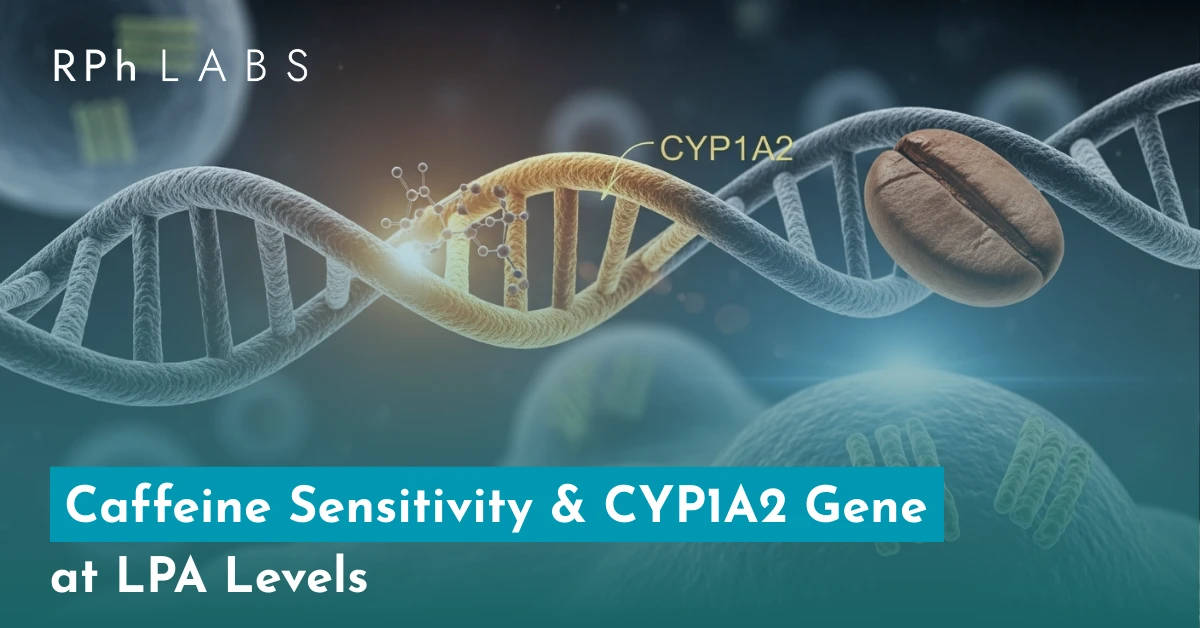
The CYP1A2 gene is best known for controlling how quickly your liver clears caffeine, and it often comes up in the same conversation as a lipoprotein(a) blood result. This guide separates what the science supports from what it does not, and shows where genetic testing genuinely helps and where it does not.
On this page
The CYP1A2 gene plays a crucial role in how our bodies metabolize caffeine. Located on chromosome 15, this gene codes for an enzyme that helps break down caffeine in the liver. Understanding your CYP1A2 gene can provide insights into your caffeine sensitivity and how it affects your overall health.
CYP1A2 Gene and LPA Levels
People often search for the CYP1A2 gene at LPA levels, so it helps to take the two apart. Lipoprotein(a), usually written Lp(a) or LPA, is measured with a blood test your clinician orders, and laboratories group the results into broad ranges:
Normal Range: Generally considered to be below 30 mg/dL.
Borderline Range: Between 30 and 50 mg/dL.
High Risk Range: Above 50 mg/dL.
These levels matter for cardiovascular health, and they are set mainly by inherited variation in the LPA gene itself. The CYP1A2 gene is not one of the genes that sets your Lp(a), and there is no established finding that CYP1A2 changes how caffeine affects LPA levels. The two topics are best understood separately: Lp(a) is a blood measurement, while CYP1A2 is the main enzyme that clears caffeine.
Understanding Caffeine Sensitivity
Caffeine sensitivity refers to how your body reacts to caffeine. Some people can drink several cups of coffee without any issues, while others may feel jittery or anxious after just a small amount. Signs of caffeine sensitivity include:
- Increased heart rate
- Anxiety or restlessness
- Insomnia
- Digestive issues
These reactions can vary widely among individuals, often due to genetic differences.
Individual Responses to Caffeine
Caffeine affects everyone differently, and this variation can be largely attributed to genetics. For example, some people metabolize caffeine quickly, while others do so slowly. This difference is primarily linked to variations in the CYP1A2 gene. People with certain variants of this gene may experience stronger effects from caffeine, leading to heightened sensitivity.
RPh Labs reports show how your genetic makeup is likely to affect your response to medicines covered by the 20 genes on the panel, and our PGx tests report a metabolizer status for those genes. CYP1A2 is not one of them, so the report does not give you a caffeine metabolizer status and it does not measure Lp(a).
Knowing Your CYP1A2 Status
Understanding your CYP1A2 gene can help you determine how much caffeine you can safely consume. For most healthy adults, up to about 400 mg of caffeine a day, roughly four small cups of coffee, is generally treated as a moderate intake. People who clear caffeine slowly often feel better well below that. The practical test is how you actually react, since jitteriness, a racing heart or broken sleep are the signals to cut back, and those are observations about your own response rather than a number a genetic report hands you.
Substitutes for coffee lovers who experience adverse caffeine reactions:
Herbal Teas: Naturally caffeine-free options like chamomile or peppermint.
Decaffeinated Coffee: Retains the flavor of coffee without the jitters.
Chicory Root Coffee: A caffeine-free herbal drink that mimics the taste of coffee.
Matcha: Contains caffeine but may be gentler on the system due to its antioxidants.
These alternatives allow you to enjoy a warm beverage without the potential side effects of caffeine.
What the CYP1A2 gene actually does
The CYP1A2 gene sits on chromosome 15 and codes for one enzyme in the cytochrome P450 family. That enzyme works mostly in the liver, where it chemically alters caffeine, a small group of medicines, and some compounds you take in from tobacco smoke and char-grilled food.
CYP1A2 handles most caffeine clearance in the body, which is why caffeine metabolism is the trait people connect to this gene. It is also unusual among the P450 enzymes because it is strongly inducible: the amount of enzyme you make can rise or fall with what you smoke, eat and take.
That matters for interpretation. A genotype describes a baseline. Real-world caffeine metabolism is that baseline plus everything currently pushing the enzyme up or down. Two people with the same CYP1A2 result can clear caffeine at noticeably different speeds.
- Where it works: mainly the liver
- The substrate people notice most: caffeine
- Strongly influenced by tobacco smoke, diet and certain medicines
- Not a disease gene, and not a diagnosis of anything
The CYP1A2 gene and lipoprotein a levels: what the evidence supports
Lipoprotein(a), usually written Lp(a), is a cholesterol-carrying particle measured with an ordinary blood test. Your lipoprotein a levels are largely inherited, and they are set mainly by the LPA gene, which is a completely different gene from CYP1A2.
The two are easy to confuse because the letters look similar. CYP1A2 is a drug and caffeine metabolizing enzyme. LPA codes for apolipoprotein(a), the protein that makes an Lp(a) particle what it is. Research has not established that CYP1A2 variants raise or lower lipoprotein a levels, and no prescribing guideline uses a CYP1A2 result to interpret an Lp(a) number.
So if a clinician has flagged your lipoprotein a levels, the useful next steps are cardiovascular rather than caffeine related. Confirm the value, look at family history of early heart disease, and work through your overall risk with the clinician who ordered the test.
Coffee and blood lipids have been studied for decades, and brewing method is the part most often discussed, since unfiltered coffee carries compounds that filtered coffee largely removes. None of that is a reason to order a CYP1A2 test.
Caffeine metabolism: the enzyme, not just the cup
People usually judge caffeine by the drink. Your body judges it by how fast the enzyme works. Caffeine metabolism is the reason one person sleeps fine after an evening espresso while another is awake at 2 a.m. after a single afternoon cup.
Caffeine hides in more places than coffee: tea, cola, energy drinks, chocolate, pre-workout powders, and several over-the-counter headache and cold products. If you are tracking your reaction, count all of them for a week before you draw conclusions.
Why timing tells you more than dose
Slower caffeine metabolism mostly shows up as duration, not intensity. The alertness lasts longer, the sleep window shrinks, and the late-day cup starts to matter more than the early one. Shifting your last caffeine earlier is a low-risk experiment that needs no test at all.
If caffeine is affecting your sleep or your heart rate in a way that worries you, that is worth raising with a clinician rather than self-managing with supplements.
Are you a CYP1A2 fast metabolizer or a slow one?
Laboratories describe CYP1A2 variation in terms of enzyme activity and inducibility rather than a neat set of drug dosing categories. A CYP1A2 fast metabolizer clears caffeine quickly, especially when something is also inducing the enzyme. A slower phenotype clears it more gradually.
Two honest limits apply. First, the category is not a clinical instruction: there is no published gene-drug guideline telling a prescriber to change a caffeine intake or a medication dose because someone is a CYP1A2 fast metabolizer. Second, the same person can behave like a faster metabolizer during a period of heavy smoking and a slower one after quitting.
You can read the reference nomenclature for CYP1A2 and other P450 genes at PharmVar, which curates the star allele definitions labs use. It is a good way to see how much of this is descriptive science rather than prescribing advice.
- Faster activity: shorter caffeine effect, more day-to-day variation with smoking and diet
- Slower activity: longer caffeine effect, sleep more easily disturbed
- Either way: no guideline-backed medication change follows from the result
Caffeine sensitivity symptoms and what else can cause them
The caffeine sensitivity symptoms people describe most often are a racing or pounding heartbeat, jitteriness, anxiety, stomach upset, headache and trouble falling asleep. They usually appear within an hour or two and fade as the caffeine clears.
The catch is that almost nothing on that list is specific to caffeine. Thyroid problems, anemia, dehydration, anxiety disorders, alcohol, nicotine, decongestants, some asthma inhalers and several antidepressants can all produce similar caffeine sensitivity symptoms. So can simply being short on sleep.
Because of that overlap, a gene result is a weak diagnostic tool here and an honest conversation with a clinician is a strong one. If you have palpitations, chest pain, fainting or a resting heart rate that stays high, treat that as a medical question and not a caffeine question.
Cutting caffeine abruptly can also cause a few days of headache and fatigue. Tapering over a week or two is usually more comfortable.
What changes your caffeine metabolism from week to week
CYP1A2 is the classic inducible enzyme, which is why caffeine metabolism is not a fixed personal trait the way an eye color is. Several everyday exposures move it, and they can easily outweigh the genotype.
- Tobacco smoke is a strong inducer, so smokers often clear caffeine faster and notice caffeine more after quitting
- Cruciferous vegetables and char-grilled meat contain mild inducers
- Fluvoxamine and ciprofloxacin are well-described inhibitors that slow the enzyme
- Estrogen-containing oral contraceptives and pregnancy both slow caffeine clearance
- Liver disease reduces the capacity of this and most other P450 enzymes
Pregnancy is the clearest practical example: caffeine clearance slows a great deal over the course of a pregnancy, which is part of why prenatal guidance limits caffeine. Ask your obstetric clinician for the number that applies to you rather than relying on a genetic result.
If you quit smoking while taking a medicine handled by this enzyme, tell your prescriber. That single change can alter drug levels enough to matter, and it has nothing to do with which CYP1A2 variants you carry.
How lipoprotein a levels are measured, and what to do with the number
An Lp(a) test is a blood draw, usually a one-time measurement because the value is mostly genetic and fairly stable through adult life. Labs report it either in mg/dL or in nmol/L, and the two units are not interchangeable, so compare like with like.
Cut-points and risk bands differ between laboratories and guidelines, which is why your own report and the clinician who ordered it are the right reference rather than a number you read online. Ask specifically which units were used and what threshold that lab applies.
Elevated lipoprotein a levels are treated as one independent cardiovascular risk factor among several. The usual response is to manage everything else more firmly: blood pressure, LDL cholesterol, smoking, diabetes and family screening. Standard statin therapy lowers LDL well but has little effect on Lp(a) itself.
Statin therapy is one place where pharmacogenomics really does have prescribing guidance, through SLCO1B1 and muscle side effect risk. You can read more about that in our guide to SLCO1B1 decreased function.
Medicines that involve the CYP1A2 gene
A handful of drugs genuinely depend on this enzyme. Clozapine and olanzapine are the best known, along with theophylline, tizanidine, some melatonin products and caffeine itself when it is used as a medicine.
Even for those drugs, dosing is generally guided by blood levels, clinical response and known interactions rather than by CYP1A2 genotype. Clozapine in particular is monitored closely for other reasons, and smoking status often matters more to its levels than any variant does.
That is the honest state of the field: CYP1A2 is real pharmacology with thin genotype-based prescribing guidance. You can check which gene-drug pairs do have actionable guidance at the CPIC guidelines library, and see the drugs a PGx report can speak to on our medication list.
Never change a dose of clozapine, olanzapine or theophylline on your own. Those are prescriber decisions, and abrupt changes can be harmful.
What RPh Labs tests instead of the CYP1A2 gene
To be direct: the RPh Labs 20-gene panel does not include the CYP1A2 gene, and it does not include LPA either. Our report cannot tell you your caffeine tolerance, your lipoprotein a levels, or your risk of any disease.
What it does cover is the set of enzymes and transporters that have published, actionable prescribing guidance: CYP2D6, CYP2C19, CYP2C9, CYP3A5, CYP2B6, DPYD, TPMT, NUDT15, SLCO1B1, VKORC1, UGT1A1, G6PD and others, reported against more than 240 medications.
That is a narrower promise than a caffeine or wellness report, and deliberately so. It is the part of pharmacogenomics where a pharmacist and a prescriber can actually act on the result. Our introduction to PGx testing explains the difference, and the at-home cheek swab kit shows exactly which genes are included before you order.
Results are read by a PharmD pharmacist and come with a free consultation, so you can ask what the report does and does not answer. Your DNA sequence does not change, so a panel like this is generally a one-time test, with the interpretation refreshed when guidelines change.
Conclusion
Searching for the CYP1A2 gene at LPA level really turns up two separate subjects: how quickly you clear caffeine, and a lipoprotein(a) blood test that is driven by the LPA gene rather than by CYP1A2. Keeping them apart makes both easier to act on, because how much caffeine suits you comes from how you feel, while an Lp(a) result is something to review with your clinician. By recognizing how your body reacts to caffeine and considering alternatives, you can enjoy your beverages while prioritizing your health.
CYP1A2 gene, caffeine and Lp(a) FAQ
If there a specific caffeine sensitivity test?
There is no clinical caffeine sensitivity test. Some consumer genetics services report CYP1A2, the main caffeine enzyme, but that is not a prescribing test, and CYP1A2 is not on the RPh Labs 20-gene panel. Tracking how you feel after a set amount of coffee usually tells you more.
Are PGx tests for a specific time period?
No. Your DNA does not change, so the genotype does not need repeating and there is no ten year expiry. What does change is the guidance, and RPh Labs updates your report when guidelines change, so you do not need a new sample to get the current interpretation.
How to interpret a PGx test report?
Every RPh Labs report is reviewed by a PharmD pharmacist, and a free pharmacist consultation is included, so you can have your results walked through with you before you discuss them with your prescriber.
Is there a specific age requirement for PGx testing?
There is no fixed age limit. For a child or teenager the decision is made by the parent or guardian together with the prescriber, and testing is most useful when a specific medicine covered by the panel is being considered.
Does a PGx test tell me my safe caffeine limit?
No. No pharmacogenomic report sets a personal caffeine limit, and the RPh Labs panel does not include this gene at all. Caffeine tolerance depends on genotype plus smoking, medicines, pregnancy, liver function and sleep. Tracking your own intake and timing for a couple of weeks gives you more usable information than a genotype would.
Can my caffeine metabolism change over time?
Yes, and that is unusual for a genetic trait. The enzyme is inducible, so caffeine metabolism speeds up with tobacco smoke and slows with pregnancy, estrogen-containing contraceptives, liver disease and inhibitors such as fluvoxamine or ciprofloxacin. Your DNA stays the same while your actual clearance moves, which is why context matters more than category here.
Should I cut caffeine if my lipoprotein a levels are high?
Discuss it with the clinician who ordered the test. High lipoprotein a levels are a cardiovascular risk factor driven mainly by the LPA gene, and the evidence-based response focuses on blood pressure, LDL cholesterol, smoking and family screening. There is no established link between CYP1A2 variants and Lp(a) that would justify a caffeine rule.
Is being a CYP1A2 fast metabolizer better?
Neither phenotype is better. A CYP1A2 fast metabolizer clears caffeine sooner, which can mean less sleep disruption but also a shorter effect. There is no published gene-drug guideline that changes a prescription based on this category, so treat it as a description of biology rather than a health advantage.
Do decaf drinks still cause caffeine sensitivity symptoms?
Sometimes. Decaffeinated coffee and tea contain small residual amounts, and a cup or two can add up for someone who reacts strongly. If caffeine sensitivity symptoms persist on decaf, look at other causes such as thyroid function, anxiety, poor sleep or medicines like decongestants, and raise it with a clinician.
Which genes does the RPh Labs panel include?
Twenty genes with actionable prescribing guidance: ABCG2, APOE, BCHE, CYP2B6, CYP2C19, CYP2C9, CYP2C, CYP3A4, CYP3A5, CYP2D6, CYP4F2, DPYD, G6PD, MT-RNR1, NAT2, NUDT15, SLCO1B1, TPMT, UGT1A1 and VKORC1, reported against 240 or more medications. CYP1A2, COMT, MTHFR and disease-risk genes are not part of it.



Leave a Reply