
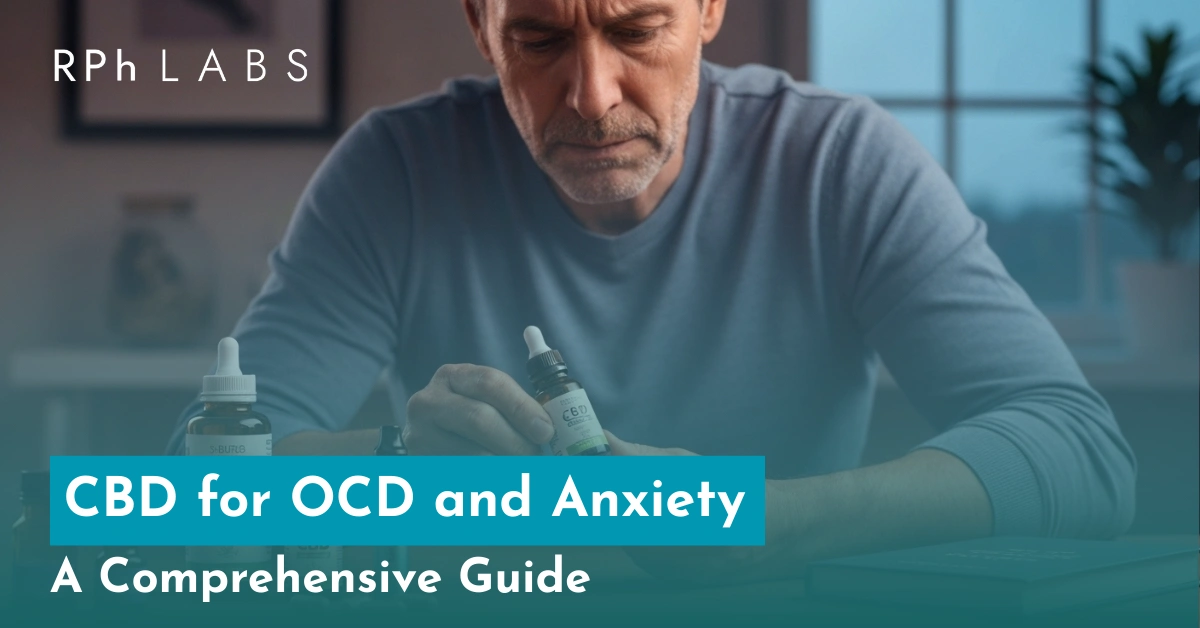
People ask about cbd for anxiety and ocd because the marketing is everywhere and the waiting list for therapy is long. This guide gives you the honest version: what the research does and does not show, the interactions that matter with your other medicines, and the treatments with far stronger evidence.
On this page
CBD, short for cannabidiol, is a natural compound found in the Cannabis sativa plant. Unlike THC, it doesn’t cause a “high” and is non-intoxicating. CBD is available in oils, tinctures, capsules, edibles, and creams, and it’s commonly used for pain relief, anxiety, depression, and even conditions like epilepsy. Many people turn to CBD for anxiety and OCD, as studies suggest it may help calm the mind and reduce stress.
It’s also FDA-approved for treating seizures in rare epilepsy cases. While generally safe, CBD can cause side effects like fatigue or appetite changes and may interact with medications. Always choose reputable brands with third-party lab testing to ensure quality and safety.
What is Anxiety?
Anxiety is the feeling of worry, nervousness, or fear, often about a real or imagined threat or situation. It can cause physical symptoms like a racing heartbeat, muscle tension, sweating, or restlessness. While occasional anxiety or stress is normal, constant or excessive worry, especially when it happens daily, can be a sign of an anxiety disorder. Anxiety disorders are a group of conditions that cause persistent and overwhelming feelings of anxiety, which can interfere with daily life and require attention or treatment to manage.
What is OCD?
Obsessive-Compulsive Disorder (OCD) is a condition where a person has unwanted, repetitive thoughts (obsessions) and/or feels the need to do certain actions (compulsions). These thoughts and actions can take up a lot of time, cause distress, and make everyday activities difficult. Treatment can help manage symptoms and improve life quality.
How CBD Works for Anxiety
CBD interacts with the endocannabinoid system (ECS), a network in the body responsible for maintaining balance in various functions like mood, stress, and sleep. By binding with ECS receptors, CBD may influence serotonin levels, a neurotransmitter crucial for regulating anxiety.
What Research Says
Research on CBD for anxiety is still emerging but shows promise:
A 2015 review of studies published in Neurotherapeutics concluded that CBD has potential for reducing anxiety disorders, including generalized anxiety disorder (GAD), social anxiety disorder (SAD), and post-traumatic stress disorder (PTSD).
A 2019 report in The Permanente Journal described reduced anxiety scores in most participants over the first month, although it was a retrospective case series at a single clinic with no control group, so it cannot separate the drug from expectation or natural fluctuation.
Preclinical studies have suggested that CBD might reduce the fear response, making it a potential tool for anxiety management.
Benefits of CBD for Anxiety
- Calming Effect: CBD may help reduce overactivity in brain areas linked to fear and stress.
- Non-Psychoactive: Unlike THC, CBD does not produce a “high,” making it appealing for those seeking relief without mind-altering effects.
- Improved Sleep: Anxiety often interferes with sleep, and CBD has been shown to enhance sleep quality in some users.
CBD for OCD
The Emergence of Interest in CBD for Anxiety
Obsessive-Compulsive Disorder (OCD) is a chronic condition characterized by unwanted, recurring thoughts (obsessions) and repetitive behaviors (compulsions). Research suggests that CBD may help reduce the severity of OCD symptoms by modulating anxiety levels and dampening compulsive behaviors.
What Research Shows
- Animal Studies: A 2017 study in Frontiers in Pharmacology demonstrated that CBD reduced compulsive behaviors in mice, suggesting potential for OCD treatment.
- Human Evidence: Limited human studies suggest that CBD’s anxiolytic effects may indirectly benefit individuals with OCD by lowering overall anxiety, a key driver of OCD symptoms.
Potential Benefits for OCD
- Reduced Compulsions: CBD may help regulate abnormal activity in brain areas linked to OCD, such as the orbitofrontal cortex.
- Stress Relief: By lowering stress levels, CBD can reduce the triggers that exacerbate OCD symptoms.
- Support for Co-occurring Anxiety: OCD often coexists with anxiety disorders, making CBD’s dual effects particularly valuable.
Dosage and Use
As with anxiety, there is no standardized dosage for OCD. Starting with a low dose and gradually increasing under medical supervision is recommended. CBD tinctures or oils may offer the most precise dosing.
Dosage and Administration
- Forms of CBD: Oils, capsules, edibles, and vapes are common. Sublingual tinctures are favored for quick absorption.
- Dosage: There is no standard dosage for anxiety. Experts recommend starting with a low dose (e.g., 10-20 mg per day) and adjusting gradually. Always consult a healthcare provider before beginning.
Potential Side Effects
While generally well-tolerated, CBD can cause side effects such as:
- Dry mouth
- Drowsiness
- Diarrhea
- Interaction with medications (e.g., blood thinners)
- Limitations and Considerations
- Legal Status: CBD derived from hemp with less than 0.3% THC is federally legal in the U.S., but state laws vary.
- Not a Cure-All: CBD can help manage symptoms but is not a replacement for therapy or prescribed medication.
- Product Quality: Choose high-quality products from reputable companies. Look for third-party lab testing to ensure purity and potency.
What the evidence on cbd for anxiety and ocd actually shows
Start with what is approved. In the United States, one purified prescription cannabidiol product is approved for rare seizure disorders. Nothing containing CBD is approved for anxiety, and nothing is approved for OCD.
For anxiety, the human research is early and thin. Small experimental studies have looked at single doses before a stressful task, such as public speaking, and some found reduced anxiety. Those are laboratory situations, not treatment for an anxiety disorder over months.
For OCD the evidence is weaker still. Most of what gets cited is animal work on compulsive behavior plus a handful of small human studies. There is no adequately powered randomized trial showing that cbd for anxiety and ocd reduces OCD symptoms.
Why weak study designs mislead
A frequently quoted figure comes from a retrospective case series at a single clinic with no control group. Anxiety scores fluctuate on their own, expectation effects are powerful, and people who feel better are more likely to be followed up. A design like that cannot separate the drug from those forces, so the percentage that gets repeated online means much less than it appears to.
Cbd drug interactions worth taking seriously
This is the part most articles skip, and it is the part that can actually hurt you. Cannabidiol inhibits several liver enzymes, which means it changes the levels of other medicines in your body.
- CYP3A4 and CYP2C19 inhibition can raise levels of many drugs, including clobazam, where the interaction is well documented.
- CYP2C9 inhibition matters for warfarin. Case reports describe rising INR values and bleeding risk when CBD was added.
- CBD itself is broken down mainly by CYP2C19 and CYP3A4, so your own metabolizer status and other medicines change how much CBD you are exposed to.
- Sedation adds up. Combining CBD with benzodiazepines, opioids, sleep medicines or alcohol increases drowsiness.
- Liver enzyme elevations have been seen, particularly at higher doses and alongside valproate.
Cbd drug interactions are not theoretical footnotes. If you take any prescription medicine, tell your prescriber and your pharmacist before you start CBD, not after something changes. Our medication list by gene shows which of your prescriptions run through the same enzymes.
There is one more wrinkle for anyone considering cbd for anxiety and ocd. SSRIs used for these conditions, such as sertraline, citalopram and escitalopram, are themselves processed by CYP2C19, so adding an enzyme inhibitor on top is a genuine interaction question rather than a harmless supplement decision.
Cbd side effects and product quality
CBD is often described as well tolerated, which is true up to a point. The commonly reported cbd side effects are drowsiness, diarrhea, reduced appetite, dry mouth and fatigue, and they are more likely at higher doses.
Liver enzyme changes are the more serious concern from trial data, especially in combination with other medicines. That is one reason prescription cannabidiol is monitored with blood tests and unregulated products are not.
- Content often does not match the label. Independent testing repeatedly finds products with less CBD than claimed, more, or detectable THC.
- Detectable THC matters if you are drug tested at work, and it is a real reason people have failed screens.
- Look for a current certificate of analysis from an independent laboratory, matched to the batch number on your bottle.
- Avoid products making disease claims. Claiming to treat OCD or anxiety is a regulatory violation and a sign of a seller who does not follow the rules.
- Vaping products carry their own respiratory risks and are not a safer delivery method by default.
Pregnancy and breastfeeding are a clear no. Regulators advise against CBD in pregnancy because safety has not been established, and that advice is worth following rather than debating.
Is cbd legal, and what that actually means
The question is cbd legal has a federal answer and a state answer, and they are not the same.
Federally, hemp-derived products containing no more than 0.3 percent THC were removed from the controlled substances definition of marijuana. That is a narrow legal change about hemp, not an approval of CBD as a treatment or a food additive.
State law varies widely, covering what may be sold, where, and to whom. Some states restrict CBD in food and drink. When people ask is cbd legal for their own situation, the answer depends on their state and sometimes on their employer or licensing body.
Two practical points. Federal legality does not mean a product is tested, accurately labeled or safe with your medicines. And a legal product can still cost you a job if it contains enough THC to show on a workplace screen, so if you are tested, treat that risk as real.
Exposure and response prevention: the treatment with the strongest evidence for OCD
If OCD is the actual problem, the most useful thing this article can tell you is a name: exposure and response prevention, usually shortened to ERP. It is a specific form of cognitive behavioral therapy and it is the first-line psychological treatment for OCD.
The method sounds simple and is not easy. You approach the trigger deliberately, in a planned and graded way, and you do not perform the compulsion or the mental ritual afterward. Over repeated practice the anxiety falls on its own, and the belief that the ritual was necessary weakens.
- Map the obsessions, the compulsions and the avoidance, including mental rituals and reassurance seeking.
- Build a graded list from mildly uncomfortable to very difficult.
- Start with a manageable step, with the therapist’s support, and stay with the discomfort without ritualizing.
- Repeat between sessions. Homework is where most of the progress happens.
- Move up the list as each step becomes routine, and plan for lapses rather than treating them as failure.
Medication also has a real evidence base for OCD, usually SSRIs, often at higher doses and for longer before judging response than in depression. Exposure and response prevention and medication are frequently combined, and that decision belongs with your clinician.
Anything you read about cbd for anxiety and ocd should be measured against that standard. A treatment with decades of trial evidence sits in a different category from a supplement with a handful of small studies.
What works for anxiety disorders
Anxiety disorders are treatable, and the effective options are well established.
- Cognitive behavioral therapy, including exposure-based work, has strong evidence across generalized anxiety, social anxiety and panic disorder.
- SSRIs and SNRIs are the usual first-line medicines, and they take several weeks to show their full effect.
- Buspirone is an option for generalized anxiety, and propranolol is sometimes used for performance situations.
- Benzodiazepines work quickly but carry tolerance and dependence risks, so they are generally short-term and closely supervised.
- Sleep, alcohol reduction, regular activity and caffeine awareness are genuinely part of treatment rather than filler advice.
The NIMH overview of anxiety disorders is a good neutral starting point. If you are having thoughts of harming yourself, call or text the 988 Suicide and Crisis Lifeline in the United States, or call 911 in an emergency.
Where genetics fits, honestly
No genetic test diagnoses OCD or an anxiety disorder, and none predicts whether CBD will help you. Anyone selling that is overstating what the science supports.
Pharmacogenomic testing does something narrower and real. It reports how your body is likely to process certain medicines, and CYP2C19 and CYP2D6 both matter for the SSRIs commonly used in these conditions.
That has a bearing on cbd drug interactions too, because CBD is itself a CYP2C19 and CYP3A4 substrate and an inhibitor of several enzymes. Knowing your metabolizer status does not make a supplement safe, but it does give your prescriber more context when several things are being taken together.
The RPh Labs panel covers 20 genes reported against more than 240 medications, using an at-home cheek swab reviewed by a PharmD pharmacist. You can see what it covers on the testing kit page or read what is PGx testing first. It does not test cannabinoid response, and it is not a substitute for talking to a clinician about cbd for anxiety and ocd.
Final Thoughts
CBD shows significant potential for managing anxiety and OCD, offering a natural alternative with minimal side effects. However, further research is needed to fully understand its mechanisms and long-term effects. For those considering CBD, consulting with a healthcare professional ensures safe and effective use.
Reference
Cbd for anxiety and ocd: honest answers
Is CBD for OCD and Anxiety?
Yes, CBD has shown potential for managing both anxiety and OCD. It interacts with the endocannabinoid system to regulate stress and compulsive behaviors. Research, such as a 2015 review in Neurotherapeutics and studies on compulsive behavior in Frontiers in Pharmacology, supports its benefits. However, more clinical trials are needed to confirm its efficacy.
What are CBD Gummies?
CBD gummies are edible candies infused with cannabidiol. They offer a convenient and discreet way to consume CBD for potential benefits like anxiety and stress relief. Gummies are available in various dosages and flavors, making them appealing for beginners or those avoiding oils or capsules.
What is the Main Difference Between CBD and THC?
The primary difference is psychoactivity. CBD is non-psychoactive, meaning it doesn’t cause a “high,” whereas THC (tetrahydrocannabinol) is psychoactive and produces euphoria or intoxication. Both compounds interact with the endocannabinoid system but have distinct effects.
Can CBD Provide Permanent Treatment of Anxiety?
No, CBD is not a permanent cure for anxiety. While it may help manage symptoms, long-term effectiveness and mechanisms are still under research. It works best when used alongside therapy or prescribed treatments as part of a comprehensive care plan.
Which Forms of CBD are Legal in the USA?
CBD derived from hemp with less than 0.3% THC is federally legal in the U.S. under the 2018 Farm Bill. Legal forms include oils, tinctures, gummies, capsules, and topicals. However, state laws vary, so it’s essential to check local regulations.
Does CBD treat OCD?
There is no adequately powered randomized trial showing that cbd for anxiety and ocd reduces OCD symptoms. Most citations are animal studies or very small human ones. Exposure and response prevention, with or without an SSRI, has far stronger evidence.
What cbd drug interactions should I check first?
Warfarin, clobazam and other drugs cleared by CYP3A4, CYP2C19 or CYP2C9, plus anything sedating. CBD inhibits those enzymes, so levels of other medicines can rise. Tell your prescriber and pharmacist before starting, not afterward.
What is exposure and response prevention?
A structured form of cognitive behavioral therapy for OCD. You approach triggers in a planned, graded way and deliberately do not perform the compulsion or mental ritual. Repetition between sessions is where most of the progress comes from.
What are the common cbd side effects?
Drowsiness, diarrhea, reduced appetite, dry mouth and fatigue, more likely at higher doses. Liver enzyme elevations have been seen in trials, particularly with other medicines such as valproate, which is why prescription cannabidiol is monitored with blood tests.
Is cbd legal everywhere in the US?
Federally, hemp-derived products with no more than 0.3 percent THC are not treated as marijuana, but state rules vary on sale and use. Legality does not imply testing, accurate labeling or safety with your medicines, and THC content can still affect a workplace drug test.
Can I take CBD with my SSRI?
Ask your prescriber first. SSRIs such as sertraline, citalopram and escitalopram are processed by CYP2C19, which CBD inhibits, so adding it is a genuine interaction question. Never reduce or stop a prescribed antidepressant to make room for a supplement.

Leave a Reply