
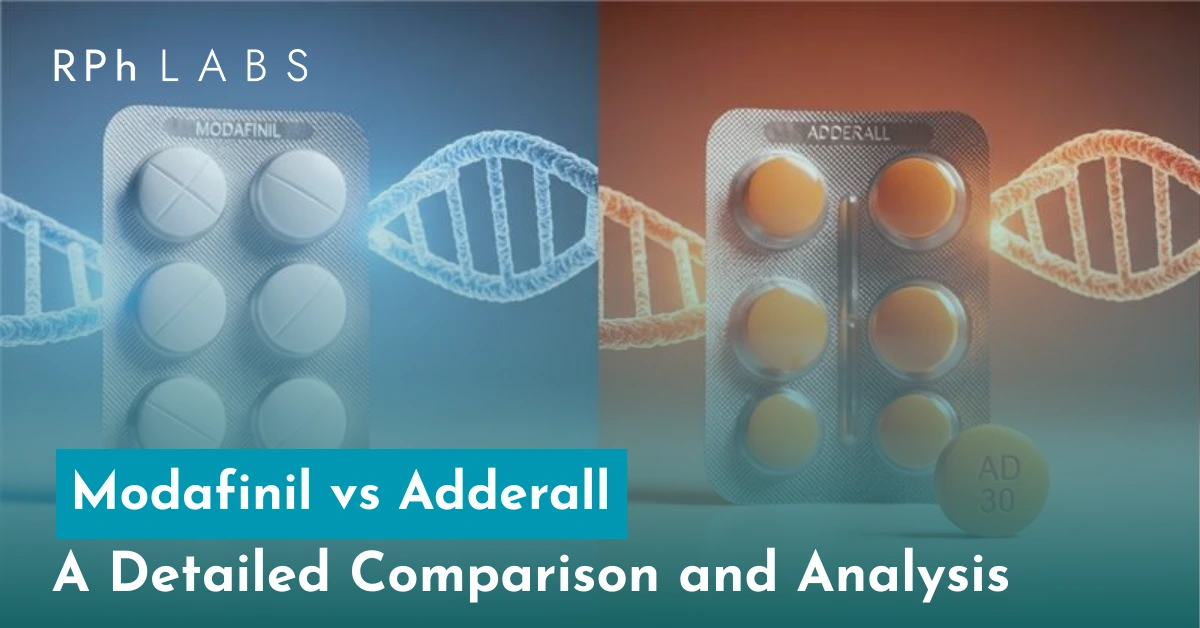
Most people searching modafinil vs adderall want one answer: which drug should I be on? That depends on what you are being treated for, since only one of them is approved for ADHD. Here is how the two compare on class, timing, side effects, interactions and legal status.
On this page
In today’s fast-paced world, the pressure to stay productive and focused is higher than ever. This has led to the increased use of cognitive-enhancing drugs, such as Modafinil and Adderall. The two are primarily taken for enhancement in concentration, clarity of thought, and generally enhanced performance. Even though they both come into play within a similar usage domain, their mode of action is very different. In this blog, we will discuss Modafinil Vs Adderall to know how these drugs rank concerning their efficacy, use, safety, and much more.
What is Modafinil?
Modafinil is a prescription medication that serves primarily to treat narcolepsy and other sleep disorders, such as obstructive sleep apnea and shift work sleep disorder. It works on the body by activating wakefulness; hence, Modafinil is sometimes described as a “eugeroic” or wakefulness-promoting agent. Traditional stimulants have been so intense that a lot of users seek out an alternative with less overwhelming highs and not-so-ouch crashes.
Common Uses of Modafinil:
- Narcolepsy
- Sleep apnea (to help stay awake during the day)
- Shift work sleep disorder
- Off-label uses include cognitive enhancement and as a treatment for ADHD
What is Adderall?
Adderall is a prescription amphetamine salt-combination drug that is primarily used to treat attention deficit hyperactivity disorder and Narcolepsy. The effect of Adderall is due to the enhancement of dopamine and norepinephrine levels in the brain, which enhances concentration, attention, and impulse control. Because it has a stimulating effect, it is often utilized by people who need a rapid shot of energy and focus to finish tasks, such as students when exams or professionals are working long hours.
Common Uses of Adderall:
- ADHD (Attention Deficit Hyperactivity Disorder)
- Narcolepsy
- Off-label uses for cognitive enhancement and energy boosts
Mechanism of Action
Modafinil:
The mechanism of action for Modafinil is not entirely known but has been known to affect several neurotransmitter systems in the brain, including dopamine, norepinephrine, and histamine. Unlike the more classical stimulants, it does not produce a massive dumping of dopamine and has much less intense effects associated with the euphoria typically experienced with other stimulants, so the tendency to be addicted tends to be lower in those classic stimulants such as Adderall.
Adderall:
It raises dopamine and norepinephrine levels in the brain and neurotransmitters for alertness, energy, and focus. Adderall is far more potent and direct than Modafinil; it enhances all cognitive functions and alertness. However, increased dopamine tends to create a euphoric feeling, and this factor may help to improve the possibility of misuse and addiction.
Effectiveness: Modafinil vs Adderall
Modafinil:
Modafinil is a kinder form of cognition enhancer. It brings out increased wakefulness, enhanced concentration, and reduced fatigue without giving that high rush or jitters that very much accompany traditional stimulants. The results of Modafinil last much longer, usually between 10 to 12 hours, and there are fewer instances of “crashing” at the close. It thus appeals to anyone with a need for long-term mental clarity.
Adderall:
Adderall tends to be stronger and is absorbed quickly. Adderall begins acting faster, usually within 30-60 minutes, and works from 4-6 hours. With ADHD, the results in attention, impulses, and activity will significantly improve when using Adderall. However, there is a “crash” from such intense energy peaks where patients will be exhausted or irritable.
Side Effects and Safety
Modafinil:
- Common side effects of Modafinil include headaches, dizziness, nausea, and anxiety.
- It can cause insomnia, especially if taken too late in the day since it promotes wakefulness.
- Serious side effects are rare but can include allergic reactions, skin rashes, and psychological symptoms such as paranoia and hallucinations in some cases.
Modafinil has a relatively low potential for addiction compared to Adderall, and most users report mild to no side effects. However, it can become habit-forming if misused for an extended period.
Adderall:
- Common side effects are anxiety, jitteriness, dry mouth, insomnia, and loss of appetite.
- More severe side effects are high blood pressure and heart palpitations, and it may increase anxiety or mood swings.
- Adderall carries more risks for addiction, given that it is a stimulant drug and induces dopamine release.
Those with a history of heart conditions or anxiety disorders ought to be careful using Adderall because the stimulation will trigger the heart condition or boost the anxiety disorder.
Risk for Abuse and Addiction
Modafinil differs from Adderall in that it is a relatively non-abusable compound. In comparison, a very potent and fast-acting drug such as Adderall more readily leads to its abuse and, consequently, addiction because the drug action can be strongly manifested in even normal individuals aiming at cognitive enhancements. To enjoy the euphoria of increased dopamine levels, the users can become tolerant and dependent over time, thus becoming addicted to it.
Compared to amphetamine, Modafinil has a reduced risk of abusing its pharmacological effects. It is less likely to get abused because when it is overdosed, there are subtle yet long-lasting results. Modafinil tends to be prescribed for people interested in cognitive-enhancing drugs without facing the risk of drug addiction.
Legality
Both Modafinil and Adderall are controlled substances available by prescription only. However, their classification varies by country. Adderall falls under Schedule II controlled substance classification in the United States, which signifies the drug’s significant potential for abuse. Modafinil falls under Schedule IV classification, which indicates a lower potential for abuse.
Which one is suitable for you?
The individual’s choice of using Modafinil or Adderall would depend on their requirements, health, and goals.
- Modafinil is suitable to be prescribed when individuals need a much milder cognitive enhancer or someone who require assistance to regulate narcolepsy or a shift work disorder. It is also ideal for individuals who do not want the intense high of conventional stimulants or the potential for addiction.
- Adderall is better suited for individuals with ADHD and requires a potent stimulant in terms of improving focus and controlling impulsivity. Others may use the medication for short-term performance enhancements but use precautions as it bears risks for misuse.
How PGx Testing Can Help Diagnose the Right Medication: Modafinil vs Adderall
Pharmacogenomic testing of RPh Labs could be helpful to a very great extent in establishing the proper medication for an individual, such as Modafinil vs Adderall, against his genetic makeup, which determines how his body metabolizes and reacts to such drugs. This would include gene variations influencing drug metabolism, such as genes that encode for cytochrome P450 enzymes determining more rapid metabolism of medicines like Modafinil or Adderall.
PGx testing might help establish whether an individual will likely experience amplified or attenuated effects from these drugs or possibly be at higher risk for adverse reactions, enabling providers to customize prescriptions to achieve the most beneficial and least hazardous outcomes.
Is modafinil a stimulant in the strict sense?
When people ask is modafinil a stimulant, the honest answer is that it depends on how narrowly you define the word. Modafinil promotes wakefulness and is regulated as a controlled substance, so in everyday language it behaves like one. Pharmacologically it is not an amphetamine, and its mechanism is still not fully described.
In the modafinil vs adderall comparison the mechanisms are not close relatives. Amphetamine salts in Adderall work by pushing dopamine and norepinephrine out of nerve terminals and blocking their reuptake. Modafinil interacts with the dopamine transporter more weakly and also touches histamine and orexin signaling, which is why the subjective experience is usually described as flatter.
Why the answer to is modafinil a stimulant matters
The distinction changes expectations, and it is the first thing to settle when you ask is modafinil a stimulant. Someone who assumes modafinil will feel like a stimulant may conclude it is not working, then take more than prescribed. That is the wrong move. Dose changes belong to the prescriber, and taking extra doses of either drug raises the risk of a fast heart rate, high blood pressure, insomnia and anxiety.
It also matters legally. Both are prescription only in the United States, and neither should be bought online or borrowed from someone else.
Modafinil side effects and the warning signs that need urgent care
The common modafinil side effects are headache, nausea, nervousness, dizziness, trouble sleeping and dry mouth. Headache is the one most people notice first, and taking the dose early in the day is the usual way prescribers reduce insomnia.
Two rarer modafinil side effects are the reason it is a prescription drug. Serious skin reactions, including Stevens Johnson syndrome and other severe rashes, have been reported, and a spreading rash with fever, blistering, mouth sores or peeling skin is an emergency, not something to wait out. Psychiatric reactions such as mania, hallucinations, agitation or new suicidal thoughts have also been reported.
If you suspect an overdose of either medicine, call 911 or your local emergency number. In the United States, Poison Control is available at 1-800-222-1222. If you are having thoughts of harming yourself, call or text the 988 Suicide and Crisis Lifeline.
How modafinil side effects compare with Adderall side effects
Adderall more often causes appetite loss, weight change, a faster heart rate, jitteriness and a noticeable drop in energy as it wears off. Both drugs can raise blood pressure, so cuff checks belong in follow up for either one.
Modafinil for adhd: what the label does and does not cover
This is the part of modafinil vs adderall that is most often blurred online. In the United States, modafinil is approved for excessive sleepiness in narcolepsy, obstructive sleep apnea and shift work sleep disorder. It is not approved for ADHD in adults or children.
Prescribers do sometimes use modafinil for adhd off label, usually when stimulants have failed or cannot be used. Off label is legal and sometimes reasonable, but it means the dosing, the safety monitoring and the expected benefit are less clearly mapped out than for an approved medicine.
Adderall, by contrast, is approved for ADHD and narcolepsy, and approved non stimulant options exist as well. If a stimulant is not a good fit, ask your prescriber about those approved alternatives before reaching for modafinil for adhd, and ask what the monitoring plan would be either way.
If your main problem is daytime sleepiness rather than inattention, say so plainly at the visit. Untreated sleep apnea can look a lot like ADHD, and treating the sleep disorder sometimes removes the reason for a stimulant altogether.
Provigil vs adderall on schedules, refills and legality
Provigil is a brand name for modafinil, so the provigil vs adderall label is the same drug pair, so provigil vs adderall is the same comparison under a different label. The legal categories are not the same, though.
- Adderall is a Schedule II controlled substance, with the tightest prescribing and refill rules.
- Modafinil is Schedule IV, reflecting a lower assessed potential for abuse and dependence.
- Both still require a prescription, and both are misused for study or work performance.
- Sharing, selling or giving away either medicine is illegal and can be dangerous for the person who takes it.
Lower scheduling does not make provigil vs adderall a question of safe versus unsafe. Modafinil can be habit forming with sustained misuse, it can disrupt sleep badly enough to worsen the problem it was prescribed for, and stopping a long course abruptly can leave you very tired for a stretch. Any plan to stop either drug should be made with the prescriber.
Travel is worth a question too. Rules on carrying controlled medicines differ between states and countries, and a stimulant prescription needs more planning than a Schedule IV one.
Drug interactions that change the modafinil vs adderall choice
Interactions are where modafinil vs adderall gets practical, and they are easy to miss because they involve drugs you may not think of as related.
Modafinil induces CYP3A4 and inhibits CYP2C19. Induction can lower the levels of drugs cleared by CYP3A4, and hormonal contraceptives are the classic example, so people using the pill, patch, ring or an implant need a backup plan discussed with their prescriber during and for a period after treatment. Inhibiting CYP2C19 can push up levels of drugs like phenytoin and diazepam, and can blunt the activation of clopidogrel, which needs that enzyme to work.
Adderall has its own hard rules. Monoamine oxidase inhibitors must not be combined with amphetamines, and a washout period is required. Adderall also stacks with other stimulants, including large amounts of caffeine, decongestants and some weight loss products.
Bring a complete list to every appointment, including supplements. Our page on medications by gene shows which drugs have gene based guidance behind them and which do not.
What genetics can and cannot say about modafinil vs adderall
Neither drug in the modafinil vs adderall pairing has a published gene based dosing guideline. Modafinil is cleared mostly by amide hydrolysis with a CYP3A4 contribution. Amphetamine is partly handled by CYP2D6, but a large share leaves the body unchanged in the urine and other routes share the work, so a gene result does not produce a milligram number for either drug.
Where a pharmacogenomic panel does earn its place is everything else on your prescription list. If you take an antidepressant, an antipsychotic, a statin, clopidogrel or codeine, CYP2D6, CYP2C19, CYP2C9 and SLCO1B1 results carry real guidance from CPIC guidelines, and those results also flag interaction risk with a CYP2C19 inhibitor like modafinil.
The RPh Labs at home PGx kit is a cheek swab that covers 20 genes and reports against more than 240 medications, with every report reviewed by a PharmD pharmacist. It is most useful when the wider medication picture is complicated, not as a way to settle a stimulant question.
Be wary of any service that claims to tell you a precise stimulant dose from your DNA. That claim outruns the evidence.
Talking with your prescriber about modafinil vs adderall
Come to the appointment with the problem rather than the product, since modafinil vs adderall is decided by your diagnosis. Describing exactly when your day falls apart tells a prescriber more than naming a drug does.
- Name the target: daytime sleepiness, inattention, impulsivity, or all three.
- Bring a week of notes on when symptoms are worst and how you sleep.
- List every medicine, supplement and contraceptive you use.
- Mention any heart condition, high blood pressure, anxiety, tics, liver problems or history of substance misuse.
- Ask what will be monitored and when you will review whether it is working.
Ask directly whether the plan is on label or off label and why. That single question clears up most of the confusion around provigil vs adderall, because it reframes the choice around your diagnosis instead of the drug’s reputation.
Never adjust, stop or double a dose on your own, and never take someone else’s prescription. If a medicine is not working, that is information for your prescriber, not a reason to self correct. Our FAQ page answers common questions about how testing and pharmacist support fit into that conversation.
Conclusion
In conclusion, both Modafinil and Adderall are effective drugs that enhance focus, but they significantly differ in their mechanisms, duration of action, and tendency to abuse.
Modafinil offers a gentler, longer-lasting alternative with less risk of addiction, making it suitable for people seeking sustained cognitive enhancement. Adderall gives a faster boost but is more intense, with a higher risk of developing side effects or the likelihood of abuse. The right drug depends on the person, lifestyle, and health conditions.
Modafinil vs Adderall FAQ
What is the difference between Modafinil and Adderall?
The difference is that modafinil acts as a wakefulness agent. It works in a more subtle way to improve focus and alertness. Adderall acts as a stimulant, with a sharper and more rapid focus and increase in energy, but at a price of increasing risk of addiction.
Can Modafinil be used as a treatment for ADHD?
Even though Modafinil is not approved for being used for ADHD, many of its users off-label use them as cognitive enhancing agents. Anyway, they act much weaker than the usual dose of Adderall to treat this condition.
Are there serious side effects of using Modafinil?
Common ones are headache, dizziness, nausea, and sometimes insomnia. Other rare, severe skin rashes can be associated with mental disorders.
Is Adderall habit-forming?
Yes, Adderall has a stronger tendency to be abused and addicting primarily because it acts like a stimulant, causes euphoria, and has a predisposition to developing addiction when abused.
Which one is a better drug to take for long-term cognitive enhancement?
Modafinil is the better drug, as opposed to Adderall, since it gives a milder effect and has a lesser tendency toward addiction.
Is modafinil safer than Adderall?
Neither is simply safer. Modafinil is Schedule IV and less likely to cause the sharp peaks and crashes of a stimulant, but it carries rare serious rash and psychiatric warnings. Adderall has clearer cardiovascular cautions and a higher misuse risk. Safety depends on your diagnosis, your heart and mental health history, and your other medicines.
Can I take modafinil for adhd if stimulants make me anxious?
That is a reasonable question for your prescriber, but it is an off label use. Approved non stimulant ADHD options exist and are usually considered first. Bring the specific problem, such as anxiety or racing heart on a stimulant, so the alternative is chosen for the right reason rather than by trial and error.
How long do modafinil side effects last after stopping?
Most common effects, such as headache or trouble sleeping, ease within a few days after the drug clears. Sleepiness may return, because the underlying sleep disorder was never cured by the medicine. Do not stop a long course on your own; ask your prescriber how to step down and what to expect.
Does modafinil interfere with birth control?
It can. Modafinil induces CYP3A4, which lowers levels of hormonal contraceptives including pills, patches, rings and implants. Discuss a backup or alternative method with your prescriber before starting, and ask how long to continue it after stopping. This is one of the most commonly missed interactions in the provigil vs adderall discussion.
Will a PGx test tell me which of these two drugs to take?
No. Neither drug has a gene based dosing guideline, so a panel will not choose between them. It can still flag how you handle antidepressants, clopidogrel, statins, codeine and other drugs you may take alongside, which is where the useful part of the report lives.
Can I drink coffee or energy drinks on either medicine?
Ask your prescriber, and be honest about how much you drink. Caffeine stacks with a stimulant and can add to a fast heart rate, jitteriness and poor sleep. With modafinil, heavy caffeine tends to worsen insomnia, which undermines the point of treating daytime sleepiness in the first place.


Leave a Reply